

Looking for another way to say feeling? Several words can help you express yourself more clearly. For example, you can use emotion, sensation, mood, sentiment, or impression. However, each word has a slightly different meaning.
Whether you are writing an essay, a message, or a personal story, the right word makes your writing stronger. In this guide, you will find useful synonyms, simple definitions, and practical examples. You will also learn which words work best in different situations.
Quick List of Synonyms for Feeling
First, explore these common alternatives to the word feeling.
- Emotion
- Sensation
- Mood
- Sentiment
- Impression
- Intuition
- Instinct
- Perception
- Affection
- Passion
- Sympathy
- Empathy
- Concern
- Reaction
- Response
- Opinion
- Attitude
- Belief
- Joy
- Sadness
- Excitement
- Anxiety
- Compassion
- Fondness
- Tenderness
- Hunch
- Sense
- Awareness
- Inclination
- Sensitivity
However, these words are not always interchangeable. The best choice depends on what you want to express.
Best Ways to Say Feeling in Different Situations

1. Emotion
An emotion is a mental response such as happiness, sadness, anger, or fear.
Example: She could not hide her emotions during the speech.
Use this word when you want to describe someone’s emotional state.
2. Sensation
A sensation is a physical experience that you notice through your body.
Example: I felt a strange sensation in my hand.
For example, pain, warmth, and tingling can all be sensations.
3. Mood
A mood describes how someone feels over a period of time.
Example: A short walk helped improve my mood.
Similarly, music, weather, and daily events can affect your mood.
4. Sentiment
A sentiment is a feeling or attitude toward someone or something.
Example: She expressed positive sentiments about the new plan.
This word often suits formal writing, speeches, and discussions.
5. Impression
An impression is an idea or opinion you form about someone or something.
Example: My first impression of the teacher was positive.
Use this alternative when describing how a person, place, or situation seems to you.
6. Intuition
Intuition is the ability to understand something without carefully reasoning it out.
Example: My intuition told me to wait before making a decision.
In everyday English, you might also call this a gut feeling.
7. Instinct
An instinct is a natural tendency to act or respond in a certain way.
Example: Her first instinct was to help the child.
Unlike a general emotion, instinct often guides an immediate action.
8. Perception
Perception describes how someone understands or interprets something.
Example: His perception of the problem changed after the discussion.
This word is especially useful in academic and professional writing.
9. Affection
Affection means warmth, care, or love for someone.
Example: She showed affection for her younger brother.
Use this word when describing close relationships and loving feelings.
10. Passion
Passion is a strong feeling of enthusiasm, love, or interest.
Example: He has a passion for teaching.
In addition to describing emotions, this word can express a strong interest in an activity.
11. Sympathy
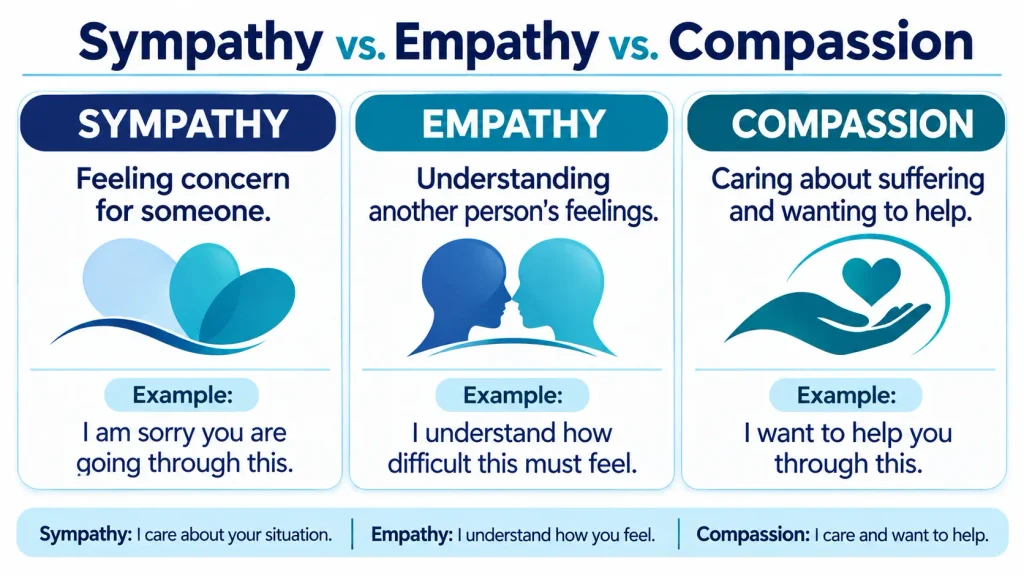
Sympathy means care or concern for someone who is facing a difficult situation.
Example: We expressed sympathy for the family.
Use this word when you want to show that you care about another person’s hardship.
12. Empathy
Empathy means understanding or sharing another person’s feelings.
Example: Her empathy helped her support her friend.
Although sympathy and empathy are related, they have slightly different meanings. Sympathy focuses on concern, while empathy involves understanding another person’s experience.
13. Concern
Concern describes worry, care, or interest about something.
Example: His parents expressed concern about his safety.
Therefore, this word works well when a feeling involves worry or care.
14. Reaction
A reaction is the way someone responds to an event or experience.
Example: Her reaction to the news was unexpected.
A reaction can be emotional, physical, or verbal.
15. Response
A response is an answer or reaction to something.
Example: His response showed genuine excitement.
However, response usually describes what someone does or says rather than the feeling itself.
16. Opinion
An opinion is a personal view or judgment about something.
Example: My opinion is that we should try another approach.
Use this word when feeling refers to what someone thinks about an issue.
17. Attitude
An attitude describes the way someone thinks about or approaches something.
Example: Her positive attitude encouraged the team.
In this context, attitude can be a better choice than feeling because it describes a general outlook.
18. Belief
A belief is something that a person accepts as true.
Example: She has a strong belief in her abilities.
Use this word when the original sentence refers to confidence in an idea or principle.
19. Joy
Joy means great happiness or delight.
Example: Seeing his family filled him with joy.
This word offers a more specific meaning than the general term feeling.
20. Sadness
Sadness is the emotion you experience when you feel unhappy or sorrowful.
Example: She felt sadness when her friend moved away.
Similarly, sorrow can work when you want to express deep sadness.
21. Excitement
Excitement describes happiness and enthusiasm about something.
Example: The children could barely contain their excitement before the trip.
Use this word when someone eagerly looks forward to an event.
22. Anxiety
Anxiety describes worry, nervousness, or uneasiness.
Example: He felt anxiety before his job interview.
This word is more specific than feeling because it describes an uncomfortable emotional state.
23. Compassion
Compassion means caring about another person’s suffering and wanting to help.
Example: Her compassion inspired her to volunteer.
Unlike simple concern, compassion often includes a desire to take helpful action.
24. Fondness
Fondness means a feeling of liking or affection.
Example: She has a fondness for classic books.
Use this word when describing a warm liking for a person, place, or activity.
25. Tenderness
Tenderness describes gentle affection, care, or warmth.
Example: He spoke about his family with tenderness.
This alternative works especially well in personal stories and emotional writing.
26. Hunch
A hunch is an idea or suspicion based on intuition rather than clear evidence.
Example: I had a hunch that they would arrive early.
In casual conversations, hunch is a natural alternative to gut feeling.
27. Sense
A sense can describe an impression, awareness, or intuitive understanding.
Example: I had a sense that something was wrong.
As a result, this word works in many everyday situations.
28. Awareness
Awareness means knowing or noticing something.
Example: She developed a better awareness of her emotions.
Use it when describing recognition rather than a specific emotion.
29. Inclination
An inclination is a tendency or preference toward something.
Example: He felt an inclination to agree with her.
This word suits formal writing and descriptions of personal preferences.
30. Sensitivity
Sensitivity describes the ability to notice or respond to emotions and experiences.
Example: Her sensitivity helped her understand other people’s needs.
It can also describe how someone reacts to physical or emotional changes.
Which Feeling Synonym Should You Choose?
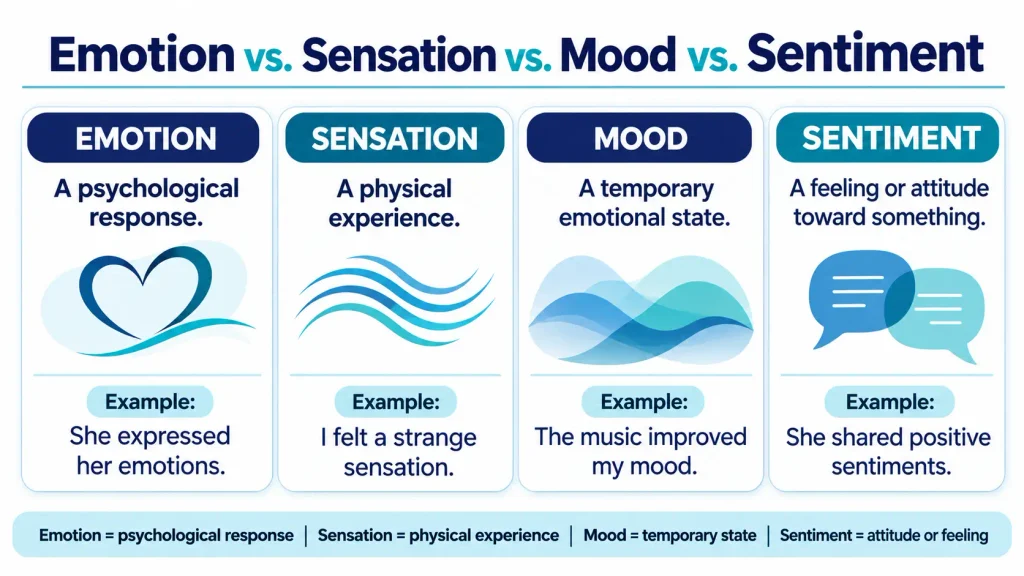
Different situations call for different words. Use the following table to find the best match.
| What You Mean | Best Alternative | Example |
|---|---|---|
| An emotional state | Emotion | She expressed her emotions. |
| A physical experience | Sensation | I noticed a strange sensation. |
| A temporary emotional state | Mood | The music improved my mood. |
| An opinion about something | Impression | My first impression was positive. |
| A gut feeling | Intuition | My intuition told me to wait. |
| A natural response | Instinct | Her instinct was to help. |
| Love or care | Affection | He showed affection for his family. |
| Strong interest | Passion | She has a passion for art. |
| Worry about something | Concern | They expressed concern. |
| Understanding others | Empathy | His empathy comforted his friend. |
| Happiness | Joy | Her face showed joy. |
| Nervousness | Anxiety | He experienced anxiety before the exam. |
How to Replace Feeling in Everyday Sentences
Choosing the right synonym can make your writing more natural. Here are some simple examples.
Instead of “I Have a Strange Feeling”
You could write:
- I have a strange intuition.
- I have an unusual hunch.
- I have a sense that something is wrong.
- Something feels unusual to me.
However, choose intuition or hunch only when you mean an unexplained suspicion.
Instead of “She Expressed Her Feelings”
You could write:
- She expressed her emotions.
- She shared her sentiments.
- She explained how she felt.
- She communicated her emotions clearly.
The first and fourth options work well when discussing emotions directly.
Instead of “I Have Strong Feelings About This”
You could write:
- I have strong opinions about this.
- I feel passionately about this issue.
- I have deep concerns about this matter.
- I care deeply about this subject.
Each alternative expresses a slightly different meaning. For example, opinions refers to views, while concerns highlights worry.
Common Mistakes When Using Feeling Synonyms
Although these alternatives share related meanings, some words cannot replace feeling in every sentence.
Confusing Emotion With Sensation
An emotion describes a psychological state. In contrast, a sensation usually describes a physical experience.
For example, “I felt sadness” describes an emotion. However, “I felt a tingling sensation” describes a physical experience.
Confusing Intuition With Opinion
Intuition is an understanding that arises without conscious reasoning. An opinion is a personal view or judgment.
For example, “My intuition told me to leave” differs from “My opinion is that we should leave.”
Confusing Sympathy With Empathy
Sympathy involves concern for another person’s difficulties. Empathy involves understanding or sharing that person’s feelings.
Therefore, use sympathy when expressing concern and empathy when emphasizing emotional understanding.
Choosing an Unnatural Replacement
Not every synonym fits every sentence. For example, “I have a sensation that it will rain” sounds unnatural if you mean an intuitive prediction.
Instead, write, “I have a feeling that it will rain” or “I have a hunch that it will rain.”
Frequently Asked Questions
What Is the Most Common Synonym for Feeling?
Common alternatives include emotion, sensation, mood, and sentiment. However, the best word depends on the context.
What Is Another Word for Feeling Emotional?
You can use moved, overwhelmed, or deeply affected. For example, “She felt emotional” can become “She was deeply moved.”
What Is a Formal Word for Feeling?
Sentiment, perception, and emotional response can work in formal writing. Choose the word that best matches your intended meaning.
What Is Another Way to Say Gut Feeling?
You can use intuition, instinct, hunch, or inner sense. For example, “I had a gut feeling” can become “I had a hunch.”
What Is Another Word for Feeling in an Essay?
Depending on the sentence, use emotion, sentiment, perception, impression, or response. These words can make your writing more precise.
What Is the Difference Between Feeling and Emotion?
Feeling is a broad term that can describe an emotion, physical sensation, or intuitive impression. Emotion refers specifically to a psychological state, such as happiness, anger, or fear.
How Can I Avoid Repeating the Word Feeling?
Replace it with a more precise word when possible. For example, use joy for happiness, concern for worry, and sensation for a physical experience.
Feeling Synonyms: Comparison Table
Use this final table as a quick reference when choosing another way to say feeling.
| Word | Best Use | Example |
|---|---|---|
| Emotion | An emotional state | Her emotion was clear. |
| Sensation | A physical experience | I felt a strange sensation. |
| Mood | A temporary state | His mood improved. |
| Sentiment | A feeling or attitude | She shared her sentiments. |
| Impression | An initial idea | My impression was positive. |
| Intuition | An unexplained understanding | My intuition told me to wait. |
| Instinct | A natural response | His instinct was to help. |
| Affection | Love or care | She showed affection. |
| Passion | Strong interest | He has a passion for music. |
| Sympathy | Concern for another person | We offered our sympathy. |
| Empathy | Understanding others’ feelings | Her empathy was helpful. |
| Concern | Worry or care | They expressed concern. |
| Opinion | A personal view | My opinion has changed. |
| Attitude | A general outlook | His attitude was positive. |
| Joy | Great happiness | The news brought joy. |
| Sadness | Unhappiness | She expressed sadness. |
| Excitement | Eager enthusiasm | Their excitement was obvious. |
| Anxiety | Worry or nervousness | He felt anxiety. |
| Compassion | Care and desire to help | Her compassion inspired us. |
| Fondness | A warm liking | He has a fondness for books. |
| Tenderness | Gentle affection | She spoke with tenderness. |
| Hunch | An intuitive suspicion | I had a hunch. |
| Sense | An impression or awareness | I had a sense of danger. |
| Awareness | Recognition or knowledge | She gained awareness. |
| Inclination | A tendency or preference | He had an inclination to agree. |
| Sensitivity | Awareness of feelings | Her sensitivity helped others. |
Conclusion
There are many ways to say feeling, but the right synonym depends on your meaning. For emotions, use words such as emotion, joy, or sadness. For physical experiences, choose sensation. Meanwhile, intuition and hunch work well when describing a gut feeling.
By choosing precise words, you can make your essays, emails, and everyday writing clearer. Above all, focus on meaning rather than replacing every use of “feeling” with a different word.

Role: English Language & Communication Writer
Daniel Carter is an English language writer specializing in workplace communication, professional vocabulary, resumes, emails, and career-focused English.