

The best alternatives to “take for granted” include fail to appreciate, undervalue, overlook, assume, treat as a given, and not recognize the value of. The right expression depends on whether you mean someone is not appreciating another person or assuming something is true or certain without questioning it.
Key Takeaways
- Use “fail to appreciate” when someone does not recognize another person’s value or efforts.
- Choose “undervalue” when someone does not recognize how important something is.
- Use “assume” or “presume” when treating something as true without checking.
- “Treat as a given” works when something is considered certain or guaranteed.
- “Overlook” describes failing to notice someone’s efforts, qualities, or contributions.
- The best alternative depends on the situation, tone, and intended meaning.
What Does “Take for Granted” Mean?
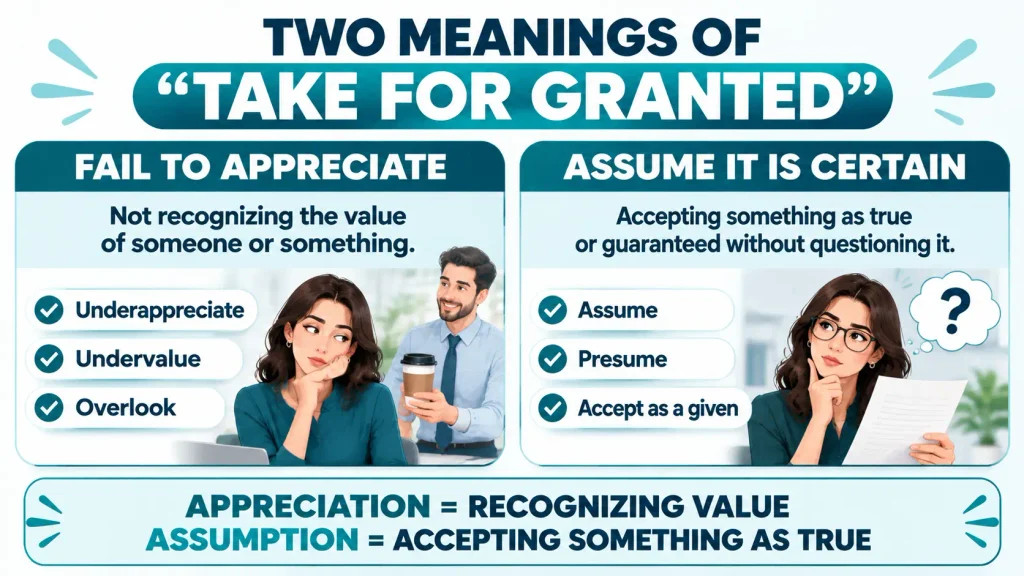
The phrase “take for granted” has two main meanings in American English.
First, it means failing to appreciate someone or something because you have become too familiar with it or expect it to remain available. For example, someone might take their parents’ support for granted without recognizing the sacrifices they make.
Second, it means accepting something as true, certain, or guaranteed without questioning it. For instance, you might take it for granted that your internet connection will always work.
These meanings are related, but they are not interchangeable in every situation. Some alternatives focus on appreciation, while others describe assumptions or expectations.
20 Other Ways to Say Take for Granted

Here are 20 natural alternatives, with explanations and examples to help you choose the right expression.
1. Fail to Appreciate
This is one of the closest alternatives when talking about relationships, support, kindness, or someone’s efforts. It means not recognizing the value of what another person does.
Best for: Personal relationships, family, friendships, and everyday conversations.
Example: She failed to appreciate how much her parents sacrificed to support her education.
2. Undervalue
To undervalue something means to consider it less important or valuable than it really is. It works well when someone does not recognize the significance of a person, opportunity, or contribution.
Best for: Professional communication, personal development, and discussions about someone’s worth.
Example: Many employees feel their contributions are undervalued by management.
3. Overlook
“Overlook” means to fail to notice or consider something important. It can describe ignoring someone’s efforts, qualities, or contributions without necessarily intending to do so.
Best for: Workplace situations, relationships, and everyday communication.
Example: Don’t overlook the small things your friends do to make your life easier.
4. Assume
When you assume something, you accept it as true without checking whether it is actually correct. This is a particularly useful alternative when “take for granted” refers to an unquestioned belief.
Best for: Everyday conversations, professional discussions, and decision-making.
Example: I assumed everyone understood the instructions, but several people needed clarification.
5. Presume
“Presume” is similar to “assume,” but it can sound slightly more formal. It describes accepting something as true based on limited information or without confirmation.
Best for: Formal conversations, professional writing, and situations involving expectations.
Example: We shouldn’t presume that customers will automatically renew their subscriptions.
6. Treat as a Given
This expression means considering something certain, established, or guaranteed rather than recognizing that it could change.
Best for: Everyday conversations, business discussions, and professional writing.
Example: Many people treat reliable internet access as a given until their connection stops working.
7. Not Recognize the Value Of
This phrase directly describes failing to understand how important or beneficial someone or something is.
Best for: Relationships, workplace communication, and personal discussions.
Example: He didn’t recognize the value of his team’s support until he started working independently.
8. Become Complacent About
To become complacent means becoming too comfortable or satisfied with a situation, sometimes resulting in less effort or appreciation.
Best for: Workplace performance, relationships, and personal development.
Example: The company became complacent about customer service after years of steady growth.
9. Expect as a Matter of Course
This expression describes expecting something to happen naturally or regularly, without considering the effort or circumstances behind it.
Best for: Family responsibilities, workplace expectations, and everyday situations.
Example: She had started expecting her sister’s help as a matter of course.
10. Regard as Guaranteed
To regard something as guaranteed means believing it will always be available or happen without considering possible changes.
Best for: Business, financial discussions, and personal expectations.
Example: Never regard a steady income as guaranteed because circumstances can change.
11. Take for Granted Without Thinking
This is a more explicit paraphrase rather than a direct synonym. It emphasizes accepting something automatically without stopping to consider its value or accuracy.
Best for: Informal explanations and conversational writing.
Example: We often take our daily comforts for granted without thinking about the effort behind them.
12. Neglect to Appreciate
This expression means failing to show or feel appreciation for someone or something. It can suggest that a person has not given enough attention to what they have.
Best for: Relationships, family, friendships, and emotional conversations.
Example: He neglected to appreciate his wife’s support during a difficult period.
13. Underestimate
To underestimate something means judging its importance, value, ability, or impact as lower than it actually is. It is useful when someone does not fully understand what they have.
Best for: Personal abilities, opportunities, contributions, and professional situations.
Example: Don’t underestimate the importance of having supportive people around you.
14. Disregard
“Disregard” means to pay little or no attention to something. It is stronger and more deliberate than simply overlooking something.
Best for: Formal writing, workplace communication, and serious situations.
Example: The manager disregarded the team’s hard work when discussing the project’s success.
15. Take Someone or Something for Granted
Sometimes the original expression is already the most natural choice. Rephrasing it is unnecessary when it communicates the intended meaning clearly.
Best for: Everyday conversations and personal relationships.
Example: Never take your closest friends for granted because genuine friendships require appreciation.
16. Expect Without Question
This phrase describes expecting something to happen or remain available without considering whether that expectation is reasonable.
Best for: Personal relationships, family responsibilities, and everyday communication.
Example: He expected his parents’ financial support without question.
17. Fail to Acknowledge
To fail to acknowledge something means not recognizing or giving credit to a person’s actions, efforts, or achievements.
Best for: Workplace communication, professional writing, and discussions about recognition.
Example: The supervisor failed to acknowledge the extra hours the employees had worked.
18. Count On
“Count on” means to depend on someone or something. It is not an exact synonym, but it can work when the original expression describes expecting someone’s continued support or availability.
Best for: Friendships, family relationships, and everyday conversations.
Example: She knew she could count on her brother whenever she needed help.
19. Exploit
“Exploit” means taking unfair advantage of someone or something for personal benefit. It is much stronger than “take for granted” and suggests unfair or selfish behavior.
Best for: Situations involving manipulation, unfair treatment, or taking advantage of someone’s kindness.
Example: He exploited his friend’s generosity by repeatedly asking for favors without offering anything in return.
20. Overlook Someone’s Contributions
This expression specifically means failing to notice or recognize the work, effort, or help someone provides.
Best for: Workplace situations, teamwork, and personal relationships.
Example: Don’t overlook your colleagues’ contributions when celebrating a successful project.
Best Alternatives to Take for Granted in Different Situations
Not every alternative works equally well in every context. Here is a quick guide to choosing the most appropriate expression.
In Relationships and Friendships
When someone does not appreciate another person’s kindness, love, or support, choose expressions that communicate a lack of appreciation.
- Fail to appreciate
- Neglect to appreciate
- Undervalue
- Overlook someone’s efforts
- Not recognize someone’s value
Example:
Original: Don’t take your friends for granted.
Alternative: Don’t fail to appreciate the people who stand by you.
In Professional and Workplace Situations
When discussing employees, teamwork, or someone’s contributions, choose expressions that sound respectful and professional.
- Undervalue
- Fail to acknowledge
- Overlook
- Not recognize the value of
- Become complacent about
Example:
Original: Managers sometimes take hardworking employees for granted.
Alternative: Managers sometimes undervalue their employees’ contributions.
When Talking About Assumptions
When you mean accepting something as true without questioning it, use expressions related to assumptions and expectations.
- Assume
- Presume
- Treat as a given
- Regard as guaranteed
- Expect without question
Example:
Original: Don’t take it for granted that everyone agrees with you.
Alternative: Don’t assume that everyone agrees with you.
In Formal Writing
For essays, reports, and professional communication, these expressions can provide a more precise tone.
- Undervalue
- Presume
- Fail to acknowledge
- Regard as guaranteed
- Fail to appreciate
Example:
Original: Organizations should not take employee loyalty for granted.
Alternative: Organizations should not undervalue employee loyalty.
Comparison Table: Which Alternative Should You Choose?
| Alternative | Main meaning | Tone |
|---|---|---|
| Fail to appreciate | Not recognizing value | Neutral |
| Undervalue | Considering something less valuable | Neutral |
| Overlook | Failing to notice | Neutral |
| Assume | Accepting something as true | Neutral |
| Presume | Accepting without confirmation | Formal |
| Treat as a given | Considering something certain | Neutral |
| Become complacent about | Becoming too comfortable | Neutral |
| Neglect to appreciate | Failing to show appreciation | Slightly formal |
| Underestimate | Judging something as less important | Neutral |
| Disregard | Paying little attention | Strong |
| Exploit | Taking unfair advantage | Strong |
Common Mistakes When Replacing “Take for Granted”
Although several expressions are related, using the wrong one can change your intended meaning.
Confusing Appreciation With Assumption
“Fail to appreciate” and “assume” describe different situations.
- Fail to appreciate: Not recognizing someone’s kindness or value.
- Assume: Believing something is true without checking.
For example, “I failed to appreciate her support” does not mean the same thing as “I assumed she would support me.”
Using “Exploit” Too Casually
“Exploit” suggests unfairly taking advantage of someone or something. It is much stronger than simply failing to appreciate someone’s efforts.
Use “undervalue” or “fail to appreciate” when you want a softer expression.
Treating “Count On” as an Exact Synonym
“Count on” describes dependence or trust. It does not automatically suggest a lack of appreciation.
For example, “I count on my family” expresses trust, while “I take my family for granted” suggests insufficient appreciation.
Choosing Formal Expressions for Casual Conversations
Phrases such as “fail to acknowledge” and “regard as guaranteed” can sound formal in everyday conversations.
For casual situations, “not appreciate,” “overlook,” and “assume” are often more natural.
FAQs About Other Ways to Say Take for Granted
1. What is the closest synonym for take for granted?
“Fail to appreciate” is one of the closest alternatives when discussing people, relationships, or support. When the phrase means accepting something as true without questioning it, “assume” is more appropriate.
2. What is another way to say someone takes you for granted?
You can say someone doesn’t appreciate you, undervalues you, overlooks your efforts, or fails to recognize your contributions.
For example: “I feel like you don’t appreciate everything I do for you.”
3. What is a polite way to say take for granted?
“Fail to fully appreciate” is a polite and natural alternative. It communicates the lack of appreciation without sounding overly critical.
Example: “Sometimes we fail to fully appreciate the people who support us.”
4. What is a professional way to say take for granted?
“Undervalue,” “fail to acknowledge,” and “overlook someone’s contributions” are useful professional alternatives.
Example: “The organization should not undervalue the contributions of its employees.”
5. Is take for granted a negative expression?
It is generally negative when describing a lack of appreciation or unreasonable expectations. However, it can also be neutral when referring to accepting something as true without questioning it.
6. Can I use assume instead of take for granted?
Yes, when you mean believing something is true without checking or questioning it.
Example: “Don’t assume that everyone knows the rules.”
However, “assume” does not replace “take for granted” when discussing a failure to appreciate someone’s kindness or support.
7. What is the difference between take for granted and take advantage of?
“Take for granted” usually means failing to appreciate someone’s value or expecting something without thinking about it. “Take advantage of” means using someone or something for personal benefit, sometimes unfairly.
For example:
- Take for granted: He never appreciates his mother’s help.
- Take advantage of: He uses his mother’s kindness to get whatever he wants.
Conclusion
Choosing another way to say “take for granted” depends on the meaning you want to communicate. “Fail to appreciate” and “undervalue” work well when discussing relationships and people’s contributions. “Assume,” “presume,” and “treat as a given” are better choices when describing unquestioned beliefs or expectations.
The key is to choose an expression that preserves your intended meaning while sounding natural in the situation.

Role: Author & Contributing Writer
Olivia Bennett is a dedicated Author at Elite’s Collective, focused on delivering clear, well-researched, and engaging articles tailored to the audience.