
Another way to say as for is “regarding,” “about,” or “when it comes to,” depending on the context. These expressions help you introduce a topic, shift a conversation, or focus on a specific issue. For example, “As for the meeting, we can reschedule it” can become “Regarding the meeting, we can reschedule it.”
Key Takeaways
- Use “regarding” for professional emails and formal writing.
- Choose “about” for simple, everyday communication.
- Use “speaking of” to connect a new topic to something already mentioned.
- Choose “in terms of” when discussing a specific factor, such as price or quality.
- Use “when it comes to” for opinions, preferences, and comparisons.
- Remember that not every alternative to “as for” fits every sentence.
What Does “As For” Mean?
The phrase “as for” introduces a person, subject, or issue that you want to discuss. It often signals a change of topic or shifts attention to a particular part of a conversation.
For example:
- As for the meeting, we can move it to Friday.
- As for Sarah, she has already submitted her report.
- I like the design. As for the price, it’s a little too high.
In American English, “as for” is common in both conversation and writing. Its meaning depends on the context. Sometimes it simply introduces a topic; other times, it creates a contrast between two things.
27 Alternatives to “As For”
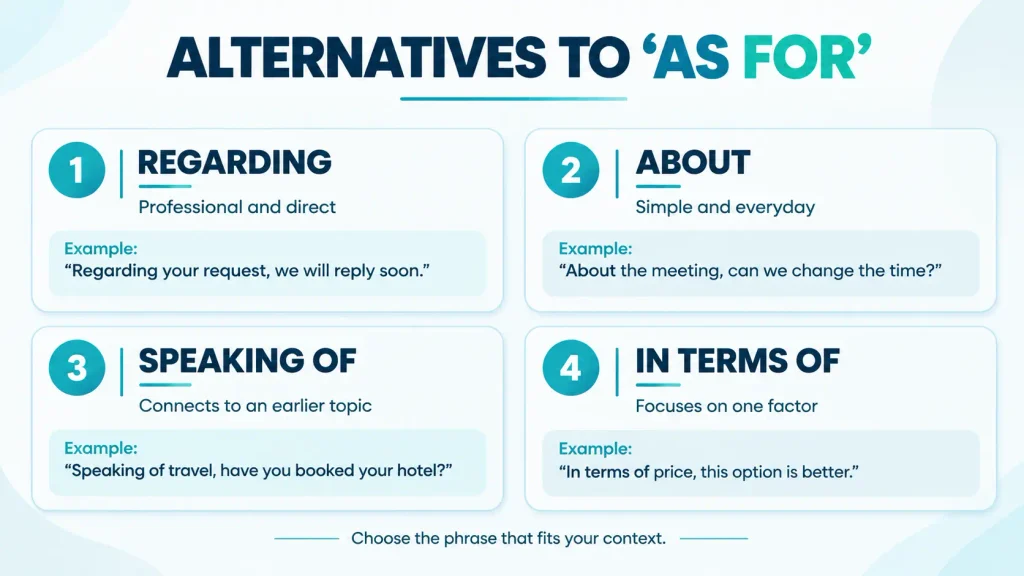
Here are natural alternatives to “as for,” along with their meanings and examples. Choose the expression that best matches your sentence and intended tone.
1. Regarding
Meaning: About or concerning a particular subject.
Best for: Professional emails, reports, and formal communication.
Example: Regarding your application, we will contact you next week.
“Regarding” is one of the most useful alternatives to “as for” when you want a clear, professional tone.
2. About
Meaning: Concerning a person, topic, or issue.
Best for: Everyday conversations and informal writing.
Example: About the dinner reservation, should we move it to Saturday?
“About” is simple and familiar. It works best when the subject is already clear to the reader or listener.
3. When It Comes To
Meaning: When discussing or considering a particular subject.
Best for: Opinions, preferences, and comparisons.
Example: When it comes to customer service, this company sets a high standard.
This expression is especially useful when discussing skills, priorities, interests, or performance.
4. Speaking Of
Meaning: Introducing a topic connected to something already mentioned.
Best for: Casual conversations and friendly writing.
Example: Speaking of vacation plans, have you booked your hotel yet?
Unlike “regarding,” this expression suggests a natural connection between the previous topic and the new one.
5. In Terms Of
Meaning: With regard to a particular aspect or factor.
Best for: Comparisons, reports, and analytical writing.
Example: In terms of cost, the second option is more practical.
Use this phrase when you want to focus on one feature, such as price, quality, speed, or performance.
6. As Far As … Is Concerned
Meaning: Referring to a particular person, subject, or point of view.
Best for: Opinions and discussions.
Example: As far as the budget is concerned, we have enough funds for the project.
Include the appropriate subject to complete the expression. “As far as I am concerned” emphasizes your personal view.
7. With Regard To
Meaning: In relation to a particular subject.
Best for: Formal correspondence and business writing.
Example: With regard to your request, we need a little more information.
This expression sounds formal and works well when introducing a specific matter in professional communication.
8. Concerning
Meaning: About a particular issue or subject.
Best for: Formal emails, official communication, and reports.
Example: Concerning the revised schedule, the team will receive an update tomorrow.
“Concerning” is a valid alternative to “as for,” although it can sound more formal in everyday conversation.
9. As Regards
Meaning: Regarding or in relation to something.
Best for: Formal writing.
Example: As regards the final payment, we are waiting for confirmation.
This expression is grammatically correct but may sound stiff in casual American English. “Regarding” is usually a simpler choice.
10. On the Subject Of
Meaning: Introducing a particular topic for discussion.
Best for: Presentations, discussions, and explanatory writing.
Example: On the subject of hiring, we should review the candidates first.
Use this phrase when you want to make a topic change clear.
11. In Relation To
Meaning: Connected with or concerning something.
Best for: Reports and formal explanations.
Example: In relation to your feedback, we have revised the proposal.
This phrase works when the subject has a clear connection to another issue, event, or decision.
12. With Respect To
Meaning: Regarding a specific matter or aspect.
Best for: Formal, technical, and business writing.
Example: With respect to delivery times, the new service is more reliable.
This is more formal than “about.” Use it when discussing a particular part of a larger issue.
13. In Regard To
Meaning: Regarding or concerning a particular matter.
Best for: Formal correspondence.
Example: In regard to your recent inquiry, the documents are ready.
Although correct, this expression is often longer than necessary. “Regarding your recent inquiry” is more concise.
14. Turning To
Meaning: Moving the discussion to another subject.
Best for: Meetings, presentations, and structured discussions.
Example: Turning to the next item on our agenda, let’s discuss the budget.
Unlike “regarding,” this phrase highlights the transition from one topic to another.
15. As To
Meaning: Regarding a specific question, issue, or matter.
Best for: Formal discussions and concise writing.
Example: As to the final decision, we will announce it tomorrow.
“As to” can sound formal, but it is a useful option when introducing a specific question or point.
16. In The Case Of
Meaning: Referring to a particular person, situation, or example.
Best for: Explanations and comparisons.
Example: In the case of remote workers, flexible hours can make scheduling easier.
This is a contextual alternative rather than a direct synonym. It focuses on a particular case or situation.
17. Speaking About
Meaning: Discussing a particular topic.
Best for: Casual conversation and general writing.
Example: Speaking about our upcoming trip, we still need to choose a hotel.
Use this phrase when you are actively discussing a subject rather than simply referring to it.
18. Where … Is Concerned
Meaning: Referring to a particular subject or area.
Best for: Neutral discussions and comparisons.
Example: Where technology is concerned, the company invests in reliable equipment.
This construction is useful when you want to emphasize one area of discussion.
19. When Discussing
Meaning: While talking or writing about a particular subject.
Best for: Explanations, educational content, and professional communication.
Example: When discussing salary expectations, be clear about your priorities.
This phrase focuses on the situation in which a subject is being discussed.
20. In Connection With
Meaning: Related to or associated with a particular matter.
Best for: Official correspondence and administrative communication.
Example: In connection with your appointment, please complete the required form.
Use it when the relationship between the subject and another event or matter is important.
21. For My Part
Meaning: Expressing your own position or contribution to a discussion.
Best for: Personal opinions and comparisons.
Example: For my part, I think we should wait until Monday.
This expression emphasizes your viewpoint rather than simply introducing a topic.
22. Personally
Meaning: Expressing your individual opinion or preference.
Best for: Everyday conversation and personal statements.
Example: Personally, I’d rather stay home this weekend.
“Personally” is often more natural than “as for me” when you want to share your own preference.
23. On The Topic Of
Meaning: Introducing a subject for discussion.
Best for: Conversations, presentations, and explanations.
Example: On the topic of healthy habits, getting enough sleep deserves attention.
This phrase is clear and direct, though “about” may sound more natural in casual conversation.
24. As Far As … Goes
Meaning: Referring to the limits or extent of a particular subject.
Best for: Informal evaluations and comparisons.
Example: As far as design goes, the new version looks much better.
Use this expression to evaluate a specific aspect of something.
25. Regarding The Matter Of
Meaning: Introducing a particular issue or concern.
Best for: Formal reports and official correspondence.
Example: Regarding the matter of refunds, our policy remains unchanged.
This expression is correct but wordy. “Regarding refunds” is usually clearer and more direct.
26. As For Me
Meaning: Introducing your own opinion or preference.
Best for: Personal opinions and contrasts.
Example: As for me, I’d rather spend the weekend at home.
In casual American English, “Personally, I’d rather spend the weekend at home” is often more natural.
27. For One Thing
Meaning: Introducing one reason or point in an explanation.
Best for: Casual arguments and explanations.
Example: I don’t want to buy that car. For one thing, it costs too much.
This is not a direct synonym for “as for.” It works when you are giving a reason or starting one point in a list of arguments.
Formal and Casual Alternatives to “As For”

The right expression depends on your audience and purpose. Some alternatives sound natural in a professional email, while others work better in everyday conversation.
Formal alternatives
For workplace communication, reports, and official messages, consider:
- Regarding
- Concerning
- With regard to
- With respect to
- In relation to
Example: As for the revised proposal, we will send the final version tomorrow.
More formal: Regarding the revised proposal, we will send the final version tomorrow.
For more guidance on professional language, see our related article on another way to say “according to the author”.
Casual alternatives
For everyday conversation, these expressions are often more natural:
- About
- Speaking of
- When it comes to
- Personally
- As for me
Example: As for the movie, I thought it was great.
Conversational alternative: Speaking of the movie, I thought it was great.
Use “speaking of” when the movie has already come up in the conversation. If you are introducing it without that connection, “about the movie” may be more appropriate.
How To Choose the Best Alternative to “As For”
Choosing an alternative becomes easier when you identify what your sentence is doing.
For professional emails
Choose “regarding” or “with regard to” to introduce a specific matter.
Original: As for your payment, it will be processed tomorrow.
Alternative: Regarding your payment, it will be processed tomorrow.
For everyday conversation
Choose “about” for a simple reference or “speaking of” when the new topic connects to an earlier one.
Original: As for the restaurant, I liked the food.
Alternative: Speaking of the restaurant, I really liked the food.
The alternative works best when the restaurant has already been mentioned.
For comparisons
Use “in terms of” when discussing one factor.
Original: As for price, this laptop is the better option.
Alternative: In terms of price, this laptop is the better option.
The second sentence makes it clear that price is the basis of the comparison.
For personal opinions
Choose “personally,” “for my part,” or “as far as I am concerned.”
Original: As for me, I would rather stay home.
Alternative: Personally, I’d rather stay home.
The second version is shorter and more conversational.
Common Mistakes When Using “As For”
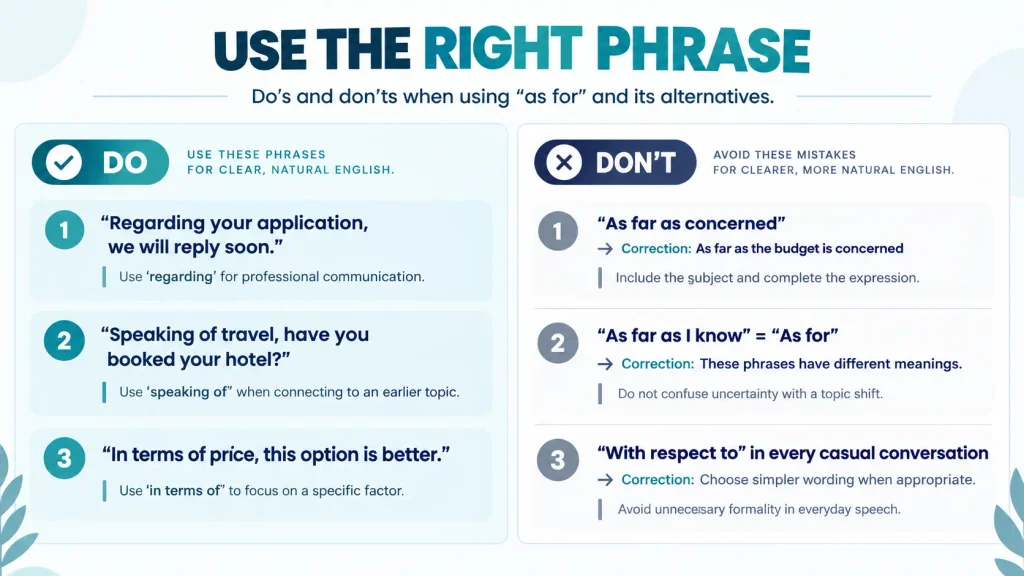
Avoid these mistakes to keep your writing clear and natural.
- Treating all alternatives as interchangeable. “Speaking of” suggests a connection to an earlier topic, while “regarding” simply introduces a subject.
- Using overly formal expressions in casual messages. “With respect to” may sound stiff in an ordinary text conversation.
- Confusing topic phrases with expressions of uncertainty. “As far as I know” means that something is true to the best of your knowledge. It is not a direct synonym for “as for.”
- Adding unnecessary words. “Regarding the matter of your application” can usually become “Regarding your application.”
- Ignoring sentence structure. Say “as far as the budget is concerned,” not “as far as concerned.”
- Using “for one thing” incorrectly. This expression introduces a reason, not simply a new topic.
Frequently Asked Questions
What is the most common alternative to “as for”?
“Regarding” is a useful general alternative, especially in writing. “About” works well in casual contexts, while “when it comes to” is useful for opinions, preferences, and comparisons.
What is a formal way to say “as for”?
Use “regarding,” “concerning,” “with regard to,” or “with respect to.” For example, “Regarding your request, we will respond by Friday” sounds professional and clear.
What is a casual way to say “as for”?
“About,” “speaking of,” and “when it comes to” are useful options. Choose “speaking of” when the topic connects to something already mentioned.
Is “as for” grammatically correct?
Yes. “As for” is a standard English expression used to introduce or shift attention to a topic. For example, “As for the schedule, we can discuss it tomorrow.”
Is “in terms of” the same as “as for”?
Not exactly. “As for” introduces or shifts attention to a topic, while “in terms of” usually focuses on a specific aspect, such as cost, quality, or performance.
Can I use “regarding” instead of “as for”?
Often, yes. “As for the meeting, we need to change the time” can become “Regarding the meeting, we need to change the time.” The best choice depends on whether you want to emphasize a topic shift or simply refer to a subject.
What is another way to say “as for me”?
You can say “personally,” “for my part,” or “as far as I am concerned.” In casual conversation, “personally” is often the simplest choice.
Final Thoughts
The best alternative to “as for” depends on what you want to communicate. Choose “regarding” for professional writing, “about” for everyday language, “speaking of” for connected topics, and “in terms of” when focusing on a specific factor. Matching the phrase to the context will make your American English sound clearer and more natural.

Role: Author & Contributing Writer
Olivia Bennett is a dedicated Author at Elite’s Collective, focused on delivering clear, well-researched, and engaging articles tailored to the audience.