

If you want another way to say “think on your feet,” natural options include “think quickly,” “think fast,” “respond quickly,” “act decisively,” “make quick decisions,” “adapt quickly,” and “handle unexpected situations well.” The best choice depends on whether you mean quick thinking, adaptability, confident decision-making, or staying calm under pressure.
Key Takeaways
- “Think on your feet” means responding quickly and effectively to an unexpected situation.
- “Think quickly” and “think fast” are the closest simple alternatives.
- “Adapt quickly” emphasizes flexibility rather than speed alone.
- “Make quick decisions” focuses on judgment and decision-making.
- “Stay calm under pressure” highlights composure, not necessarily quick thinking.
- In professional writing, a specific phrase often sounds more polished than the idiom.
What Does “Think on Your Feet” Mean?

“To think on your feet” is an idiom that means being able to respond intelligently and effectively without having much time to prepare.
It is often used when someone faces an unexpected question, problem, change, or challenge and needs to come up with a good response immediately.
For example:
“The interviewer asked an unexpected question, but Maria thought on her feet and gave a clear answer.”
The phrase usually combines several qualities: quick thinking, adaptability, confidence, and good judgment.
Because it is an idiom, you may want a different expression when writing a resume, professional email, academic assignment, or formal document.
15 Natural Alternatives to “Think on Your Feet”

1. Think Quickly
“Think quickly” is one of the closest and simplest alternatives. It focuses directly on the ability to process a situation and respond without much delay.
Best for: Professional, neutral, and everyday English
Example:
“Customer service representatives need to think quickly when unexpected problems arise.”
2. Think Fast
“Think fast” has almost the same meaning, but it sounds more conversational than “think quickly.”
Best for: Casual and conversational situations
Example:
“You have to think fast when a client suddenly changes the project requirements.”
It can also be used as a direct warning:
“Think fast! The deadline was moved up.”
3. Respond Quickly
“Respond quickly” emphasizes the speed of the response rather than the thinking process itself.
Best for: Workplace and professional communication
Example:
“Successful managers need to respond quickly when priorities change.”
This is especially useful when describing how someone handles questions, requests, or unexpected developments.
4. Adapt Quickly
“Adapt quickly” is a good choice when the original idea involves adjusting to changing circumstances.
Best for: Workplace, career, and professional writing
Example:
“She adapts quickly when project requirements change.”
This is not an exact synonym because adaptability is broader than quick thinking, but it works well when flexibility is the main idea.
5. Make Quick Decisions
Use this phrase when “thinking on your feet” specifically means making decisions under time pressure.
Best for: Professional, business, and leadership contexts
Example:
“Team leaders often need to make quick decisions when unexpected issues arise.”
The focus here is on decision-making rather than generating an answer.
6. Respond on the Spot
“Respond on the spot” means giving an answer or reaction immediately, often without preparation.
Best for: Conversational and professional English
Example:
“The manager asked me to respond on the spot, so I explained the situation as clearly as I could.”
This is particularly useful for interviews, meetings, presentations, and unexpected questions.
7. Handle Unexpected Situations Well
This longer phrase is useful when you want to explain what “thinking on your feet” actually looks like.
Best for: Resumes, performance reviews, and professional writing
Example:
“She handles unexpected situations well and keeps projects moving forward.”
It is less concise than the original idiom but often clearer in formal writing.
8. Stay Calm Under Pressure
This alternative focuses on composure. Someone who thinks on their feet often needs to remain calm, but the two expressions are not identical.
Best for: Workplace, leadership, interviews, and performance descriptions
Example:
“Good emergency coordinators stay calm under pressure.”
Choose this phrase when remaining composed is more important than making a quick decision.
9. Use Good Judgment in the Moment
This phrase emphasizes making a sensible decision without having much time to consider all the options.
Best for: Formal and professional contexts
Example:
“Experienced supervisors know how to use good judgment in the moment.”
It is a strong choice when accuracy and judgment matter more than speed alone.
10. Act Decisively
“Act decisively” focuses on taking action confidently and without unnecessary hesitation.
Best for: Professional, leadership, and formal writing
Example:
“Effective leaders must act decisively when unexpected problems occur.”
This is a near-synonym rather than an exact replacement because it emphasizes action more than mental flexibility.
11. Improvise
“Improvise” means creating a response, solution, or approach without having planned it in advance.
Best for: Creative, practical, and problem-solving situations
Example:
“When the presentation equipment stopped working, she improvised and continued the presentation without slides.”
This can be a good alternative, but it does not always imply that the response was quick or especially well considered.
12. Handle Things in Real Time
This phrase describes dealing with events as they happen instead of relying entirely on advance preparation.
Best for: Workplace and conversational English
Example:
“Live event coordinators need to handle problems in real time.”
It works particularly well for situations involving changing circumstances or unexpected problems.
13. Come Up With a Solution Quickly
Use this phrase when “thinking on your feet” specifically refers to solving a problem.
Best for: Professional and practical contexts
Example:
“Our support team can come up with a solution quickly when technical issues occur.”
It is more specific than the original idiom because it focuses on problem-solving.
14. Handle Pressure Well
“Handle pressure well” emphasizes performance when someone is under stress or facing demanding circumstances.
Best for: Resumes, interviews, and workplace communication
Example:
“She handles pressure well and remains focused during tight deadlines.”
Like “stay calm under pressure,” this describes an important part of thinking on your feet rather than the entire meaning.
15. Be Quick on Your Feet
“Quick on your feet” is closely related to “think on your feet” and can describe someone who reacts quickly and intelligently.
Best for: Conversational and descriptive English
Example:
“You need to be quick on your feet when answering questions from a large audience.”
This expression can also have a physical meaning, so context matters.
Quick Comparison
| Alternative | Main Meaning | Tone | Best Context |
| Think quickly | Process information fast | Neutral | General |
| Think fast | React mentally fast | Casual | Conversation |
| Respond quickly | Give a fast response | Neutral | Work |
| Adapt quickly | Adjust to change | Professional | Workplace |
| Make quick decisions | Decide under time pressure | Professional | Leadership |
| Respond on the spot | Answer immediately | Neutral | Meetings/interviews |
| Handle unexpected situations well | Manage surprises effectively | Professional | Resume/work |
| Stay calm under pressure | Remain composed | Professional | Work/interviews |
| Use good judgment in the moment | Make sound decisions quickly | Formal | Professional |
| Act decisively | Take confident action | Formal | Leadership |
| Improvise | Create a solution without preparation | Neutral | Problem-solving |
| Handle things in real time | Manage events as they happen | Neutral | Work/events |
| Come up with a solution quickly | Solve a problem fast | Professional | Work |
| Handle pressure well | Perform effectively under stress | Professional | Resume/interview |
| Be quick on your feet | React quickly and intelligently | Conversational | General |
Which Alternative Should You Use?
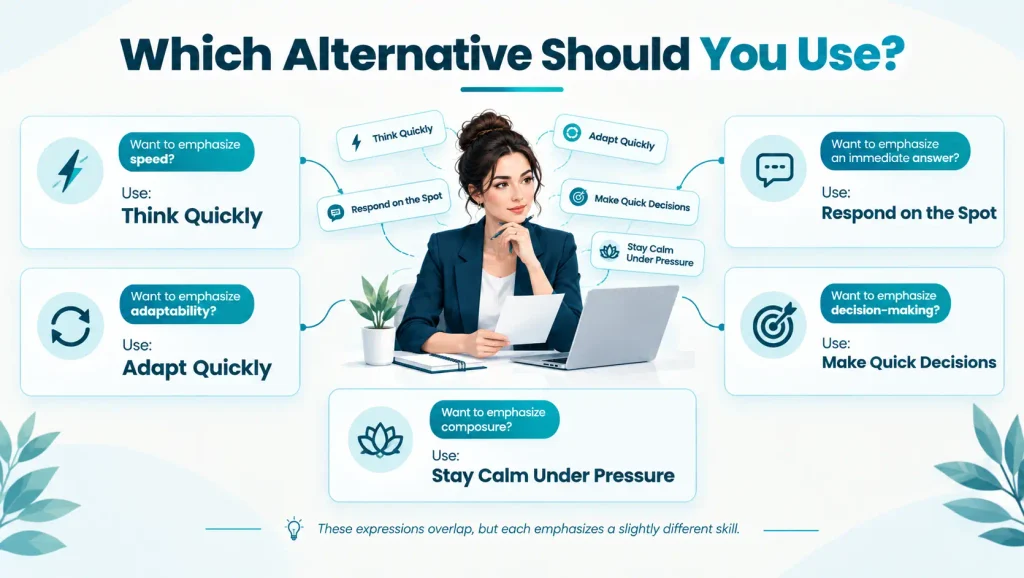
The right replacement depends on what you are trying to emphasize.
If you mean “respond quickly”
Use:
- Think quickly
- Think fast
- Respond quickly
- Respond on the spot
Example:
“Good interview candidates can think quickly when faced with unexpected questions.”
If you mean “adapt to change”
Use:
- Adapt quickly
- Handle things in real time
- Handle unexpected situations well
Example:
“Our team adapts quickly when client requirements change.”
If you mean “make good decisions under pressure”
Use:
- Make quick decisions
- Use good judgment in the moment
- Act decisively
Example:
“Managers must use good judgment in the moment when unexpected problems arise.”
If you mean “stay calm”
Use:
- Stay calm under pressure
- Handle pressure well
Example:
“She stays calm under pressure during demanding client meetings.”
If you mean “solve problems without preparation”
Use:
- Improvise
- Come up with a solution quickly
- Handle things in real time
Example:
“When the original plan failed, the team improvised and found another solution.”
“Think on Your Feet” in Professional Writing
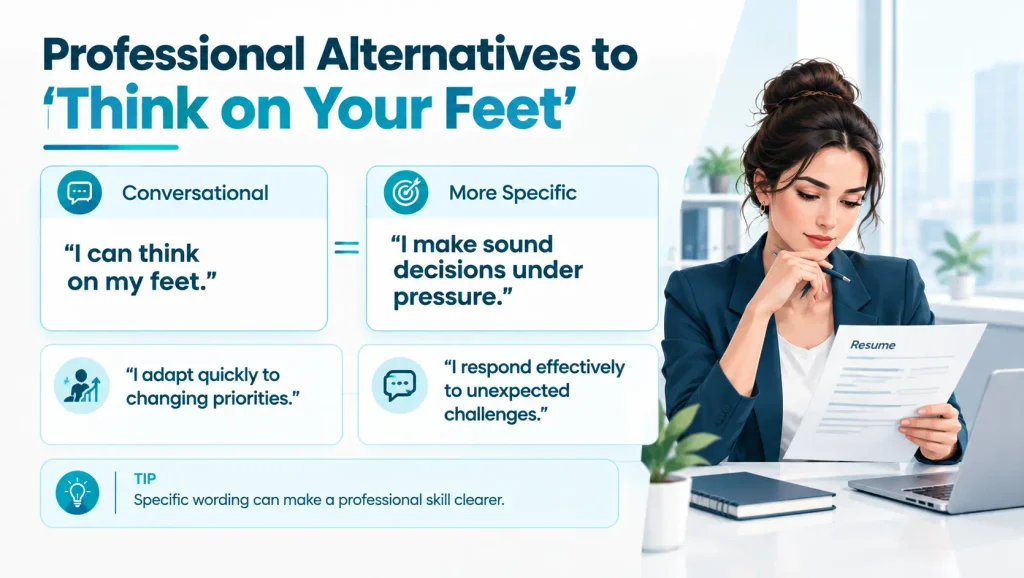
“Think on your feet” is perfectly natural in workplace English, but it can sometimes sound conversational. On a resume or cover letter, a more specific description can communicate the skill more clearly.
Instead of:
“I can think on my feet.”
You could write:
“I make sound decisions under pressure.”
Or:
“I adapt quickly to changing priorities and unexpected challenges.”
Or:
“I respond effectively to unexpected problems and changing requirements.”
These versions tell the reader exactly what you can do rather than relying on the idiom.
Common Mistakes
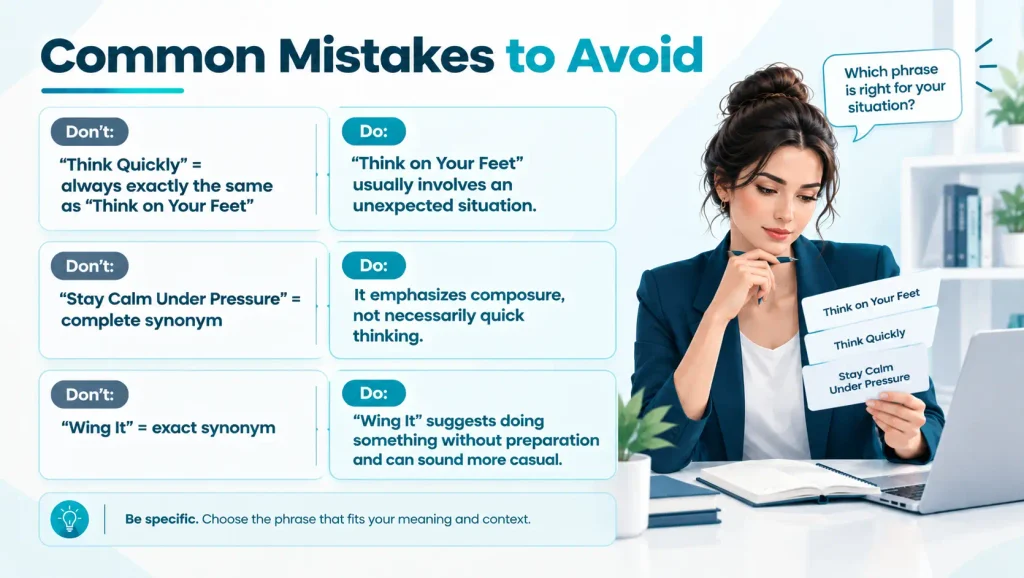
Treating “think quickly” and “think on your feet” as completely identical
They are very close, but “think on your feet” usually involves an unexpected situation. Someone can think quickly while working on a routine task, while thinking on their feet usually involves responding without much preparation.
Using “wing it” as a direct synonym
“Wing it” means doing something without preparation and relying on improvisation. It can sometimes overlap with thinking on your feet, but it often suggests a lack of preparation.
For example:
“I had to think on my feet during the interview.”
sounds more positive and professional than:
“I had to wing it during the interview.”
Using “stay calm under pressure” when speed is the main point
Someone can remain calm under pressure without making a particularly quick decision. Use this phrase when composure is the quality you want to highlight.
Using “act decisively” when you mean generating ideas
“Act decisively” focuses on taking action. “Think on your feet” can involve coming up with an answer, idea, or solution before taking action.
Frequently Asked Questions
What is the closest synonym for “think on your feet”?
“Think quickly” is probably the simplest close alternative. “Think fast” is also very close but more conversational.
Is “think on your feet” formal?
It is a standard English idiom and is appropriate in many professional conversations. For formal documents, a more specific phrase such as “make sound decisions under pressure” may be clearer.
What is another way to say “think on your feet” on a resume?
Good options include “adapt quickly to changing situations,” “make sound decisions under pressure,” “respond effectively to unexpected challenges,” and “solve problems quickly.”
Is “improvise” the same as “think on your feet”?
Not exactly. “Improvise” means creating or doing something without a prepared plan. “Think on your feet” emphasizes quick and effective mental responses to unexpected circumstances.
Can I say “think fast” instead of “think on your feet”?
Yes. “Think fast” is natural American English, especially in conversation. It is more direct and casual than “think on your feet.”
What is a professional way to say “think on your feet”?
Depending on the context, you can say “make quick decisions,” “adapt quickly,” “respond effectively to unexpected challenges,” or “use good judgment under pressure.”
What does “quick on your feet” mean?
“Quick on your feet” generally describes someone who reacts quickly and intelligently. It is closely related to “think on your feet,” although the wording can also have a literal physical meaning.
Final Thoughts
“Think on your feet” is a useful idiom for describing quick, effective responses to unexpected situations. The closest everyday alternatives are “think quickly,” “think fast,” and “respond on the spot.” For professional writing, more specific choices such as “adapt quickly,” “make sound decisions under pressure,” or “handle unexpected situations well” can communicate the intended skill more clearly.
The best replacement depends on what you actually want to emphasize: speed, adaptability, decision-making, composure, or problem-solving

Role: Author & Editorial Specialist
Sophia Williams serves as an Author at Elite’s Collective, bringing strong communication skills and fresh perspectives to the team through high-quality written content.