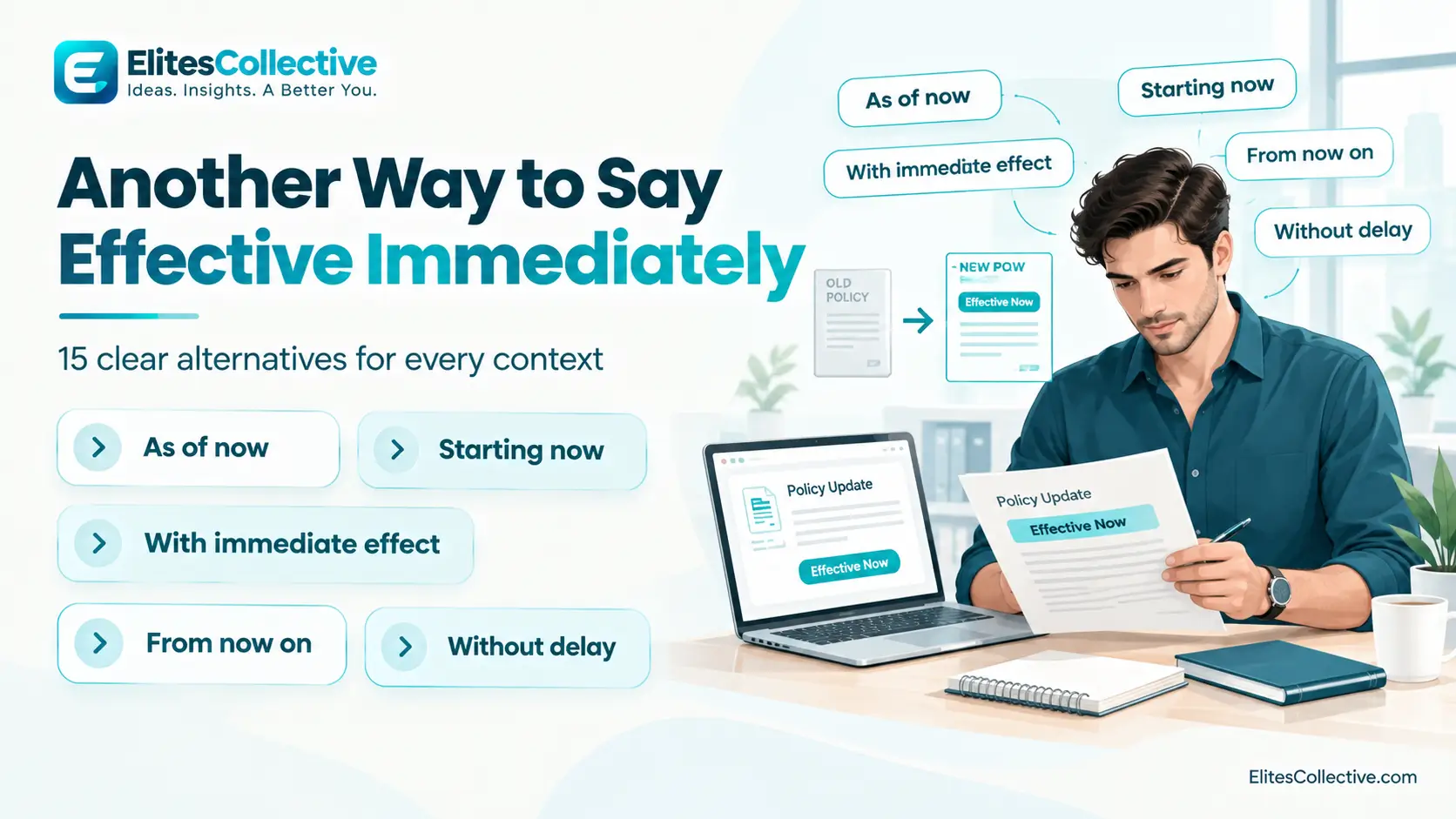
“Effective immediately” means that a rule, decision, change, or action starts right away, with no waiting period. Depending on the situation, you can replace it with phrases such as “as of now,” “starting now,” “with immediate effect,” “from this point forward,” or “without delay.” The best choice depends on whether you are writing a formal notice, business email, policy update, or casual message.
Key Takeaways
- “Effective immediately” is mainly used for changes, rules, decisions, and instructions that begin right away.
- “As of now” is a natural, less formal alternative.
- “With immediate effect” sounds formal and is common in official or business communication.
- “Starting now” works well in everyday and conversational English.
- “Without delay” focuses more on urgency than on when a rule officially takes effect.
- Not every phrase that means “immediately” is a direct replacement for “effective immediately.”
What Does “Effective Immediately” Mean?
“Effective immediately” tells the reader that something becomes valid, active, or applicable at once. It is especially common in workplace announcements, policies, official notices, contracts, and other formal communication.
For example:
Effective immediately, employees must use the new time-tracking system.
This means employees must begin using the system now rather than at a later date.
The phrase can describe many kinds of changes:
- A new company policy
- A change in responsibilities
- A cancellation or suspension
- A new rule
- A resignation
- A change in operating hours
- A new procedure
- An updated agreement
The important idea is that there is no delay between the announcement and the change taking effect.
15 Other Ways to Say “Effective Immediately”
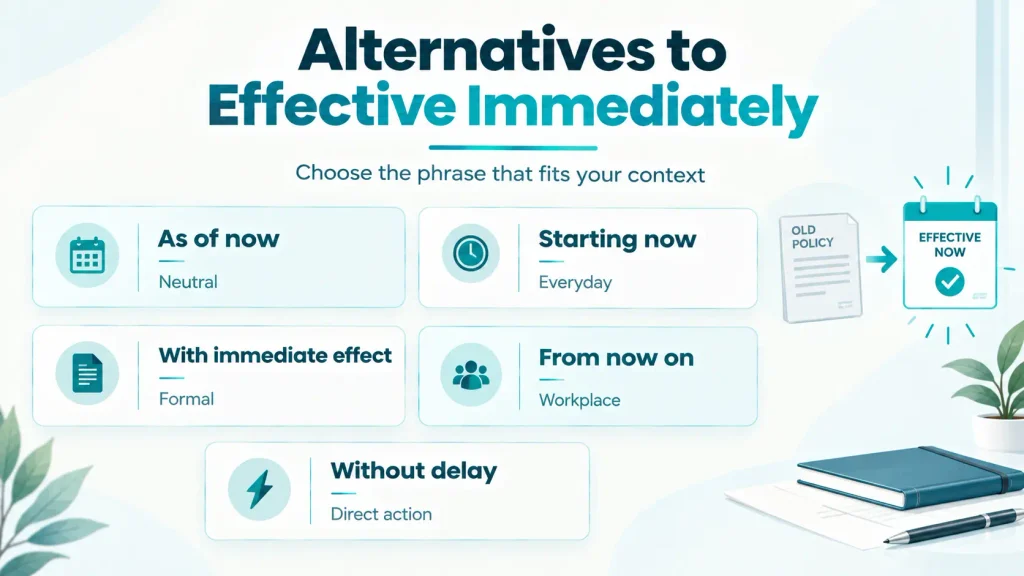
Here are natural alternatives, with the context where each one works best.
1. As of Now
“As of now” means starting at the present time. It is more conversational than “effective immediately” and works well in everyday and workplace communication.
Example:
As of now, all customer requests should be sent to the support team.
Best for: Workplace, neutral, conversational
2. Starting Now
“Starting now” is a straightforward way to say that something begins at the present moment. It sounds less formal and more direct.
Example:
Starting now, we’ll use the updated meeting format.
Best for: Casual, conversational, workplace
3. With Immediate Effect
“With immediate effect” communicates essentially the same idea as “effective immediately.” It has a formal tone and is particularly suitable for official announcements and business writing.
Example:
The revised policy will take effect with immediate effect.
A more natural version is often:
The revised policy takes effect with immediate effect.
Best for: Formal, official, professional
4. From This Moment On
“From this moment on” means beginning at this exact point and continuing into the future.
Example:
From this moment on, all project updates must be documented.
Best for: Direct, conversational, dramatic
This phrase can sound stronger or more personal than “effective immediately,” so it may not be ideal for every business document.
5. From This Point Forward
“From this point forward” emphasizes that a new situation or practice will continue into the future.
Example:
From this point forward, invoices will be processed electronically.
Best for: Professional, neutral, policy-related
Unlike “effective immediately,” it can place more emphasis on future practice than on the exact moment a change becomes legally or officially effective.
6. From Now On
“From now on” is a common everyday alternative. It clearly tells someone that a different action or rule applies beginning now.
Example:
From now on, please save all project files in the shared folder.
Best for: Everyday, conversational, workplace
It is usually less formal than “effective immediately.”
7. As of Today
“As of today” means that something applies beginning today.
Example:
As of today, the new office hours are 9 a.m. to 5 p.m.
Best for: Workplace, announcements, neutral
Use this when the date matters. It is not always identical to “effective immediately,” because “today” can refer to the current calendar day rather than the exact moment of the announcement.
8. As of This Moment
“As of this moment” emphasizes the present point in time.
Example:
As of this moment, the service is no longer available.
Best for: Formal, direct, urgent
It can sound more emphatic than the standard “effective immediately.”
9. Right Away
“Right away” means immediately or without waiting. It is much more conversational than “effective immediately.”
Example:
Please stop using the old form and switch to the new one right away.
Best for: Casual, conversational
It is generally better for instructions than for formal policy language.
10. At Once
“At once” means immediately. It can sound direct and somewhat formal depending on the sentence.
Example:
All staff members must leave the building at once.
Best for: Direct instructions, formal, urgent
“At once” often emphasizes immediate action rather than the official start of a policy.
11. Without Delay
“Without delay” tells someone that an action should happen promptly, with no unnecessary waiting.
Example:
The issue must be reported to management without delay.
Best for: Formal, professional, official
This is a useful alternative when you are telling someone to act immediately, but it is not always a perfect substitute when you are announcing that a rule has officially taken effect.
12. Immediately
Sometimes the simplest alternative is simply “immediately.”
Example:
The new procedure applies immediately.
Best for: Neutral, professional, direct
It is shorter and can be more natural when the surrounding sentence already makes the context clear.
13. Straightaway
“Straightaway” means immediately or without delay. It is a natural English expression, although it can sound more conversational than “effective immediately.”
Example:
Please contact the manager straightaway if you notice an error.
Best for: Conversational, direct
It is generally better for instructions than for formal policy announcements.
14. From Today Forward
“From today forward” indicates that a new situation begins today and continues into the future.
Example:
From today forward, all appointments must be confirmed by email.
Best for: Neutral, professional
For highly formal writing, “effective today” or “effective as of today” may sound more natural.
15. Effective as of Now
“Effective as of now” combines the formal idea of something taking effect with a direct reference to the present.
Example:
The revised schedule is effective as of now.
Best for: Professional, formal, administrative
It can be useful when you want to retain the formal tone of “effective” while making the timing explicit.
Quick Comparison of Alternatives
| Alternative | Tone | Best Context | Exact Meaning Match? |
| As of now | Neutral | Workplace, everyday | Very close |
| Starting now | Casual/neutral | Conversations, instructions | Close |
| With immediate effect | Formal | Official notices | Very close |
| From this moment on | Direct | Personal or formal statements | Close |
| From this point forward | Neutral/formal | Policies, procedures | Close |
| From now on | Conversational | Everyday, workplace | Close |
| As of today | Neutral | Announcements | Depends on timing |
| As of this moment | Formal/direct | Urgent announcements | Close |
| Right away | Casual | Instructions | Related, not exact |
| At once | Direct | Urgent instructions | Related |
| Without delay | Formal | Instructions, official writing | Related |
| Immediately | Neutral | General communication | Very close |
| Straightaway | Conversational | Instructions | Related |
| From today forward | Neutral | Policies, announcements | Close |
| Effective as of now | Formal | Business/administrative | Very close |
Which Alternative Should You Use?
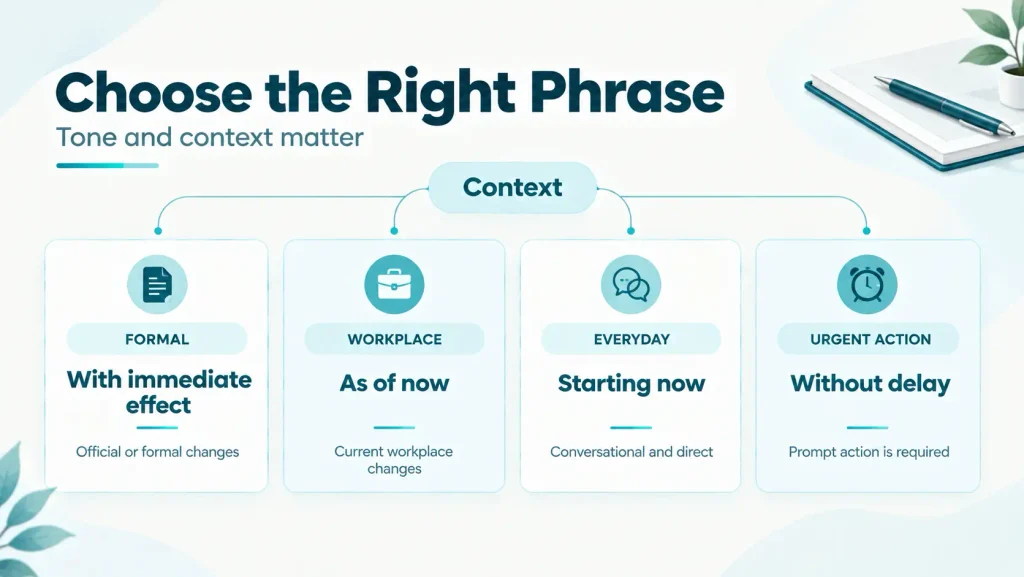
The best replacement depends on what you are trying to communicate.
For a formal business announcement
Use:
- With immediate effect
- Effective as of now
- As of this moment
- Immediately
Example:
The updated attendance policy is effective as of now.
For a workplace email
Use:
- As of now
- Starting now
- From this point forward
- From now on
Example:
As of now, please send all invoices to the finance department.
For an everyday conversation
Use:
- Starting now
- From now on
- Right away
- Immediately
Example:
Starting now, let’s keep all our receipts in one folder.
For an urgent instruction
Use:
- Immediately
- At once
- Right away
- Without delay
- Straightaway
Example:
Please contact the emergency coordinator immediately.
“Effective Immediately” vs. “As of Now”
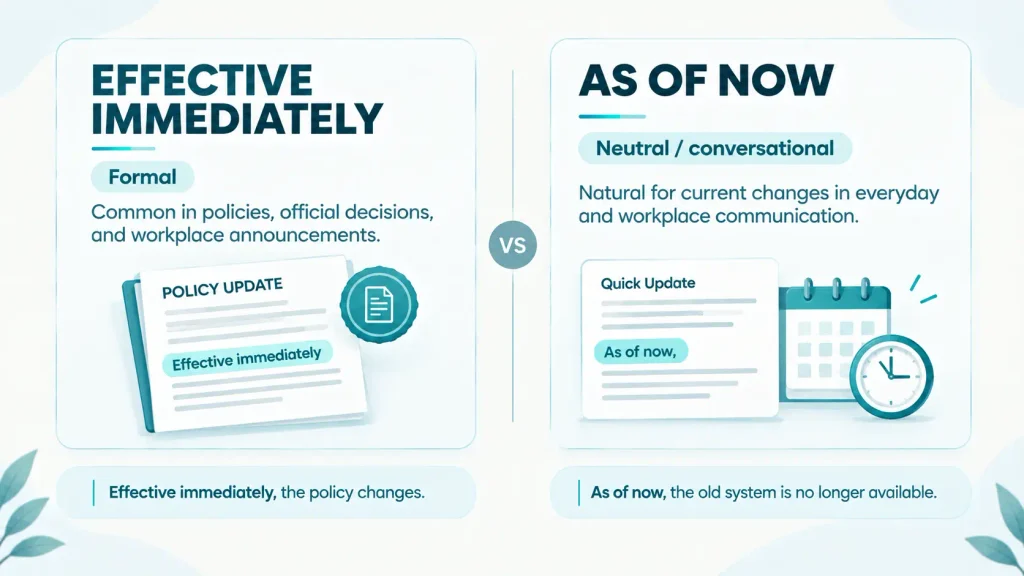
These phrases are very similar, but their tone is different.
“Effective immediately” sounds more formal and is commonly associated with policies, official decisions, workplace announcements, and other situations where a change officially takes effect.
“As of now” is more flexible and conversational.
Compare:
Effective immediately, employees may no longer access the old system.
As of now, employees may no longer access the old system.
Both communicate an immediate change, but the first sounds more like formal policy language.
“Effective Immediately” vs. “Without Delay”
These expressions should not always be treated as exact synonyms.
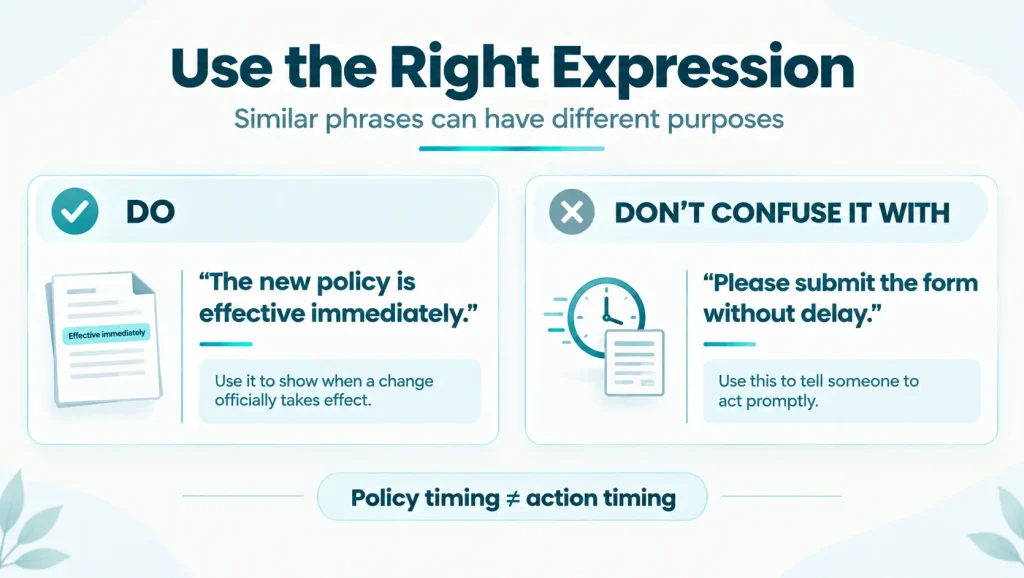
“Effective immediately” describes when a rule, decision, or change takes effect.
“Without delay” usually tells someone to perform an action promptly.
Compare:
The new policy is effective immediately.
This means the policy is now in force.
Please submit the required documents without delay.
This tells someone to submit the documents promptly.
The difference is small but important when precision matters.
Common Mistakes to Avoid
Using “right away” in every formal document
“Right away” is perfectly natural English, but it can sound too conversational for contracts, formal notices, or official policy documents.
Treating “from now on” as exactly the same in every context
“From now on” emphasizes future behavior. “Effective immediately” can emphasize the official moment a rule or decision takes effect.
Using “without delay” when announcing a policy
“Without delay” usually describes how quickly something should be done. If you are announcing that a policy has officially started, “effective immediately” or “effective as of now” may be more precise.
Confusing “as of today” with “effective immediately”
“As of today” identifies a calendar date. “Effective immediately” identifies an immediate point of effect. If an announcement is made late in the day, those two expressions can carry slightly different timing implications.
Examples of “Effective Immediately” Alternatives
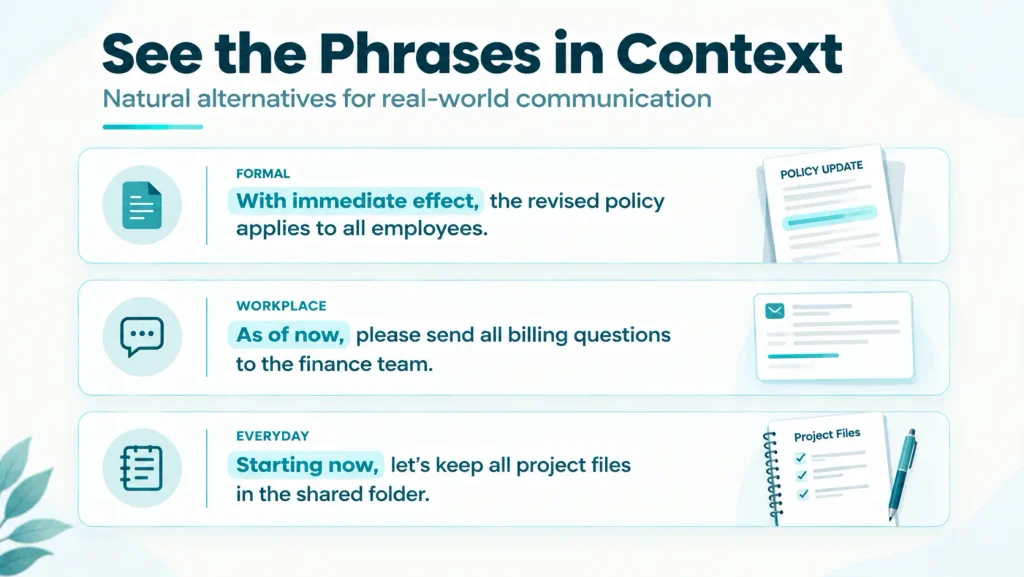
Here are some practical examples for different situations:
Company policy:
Effective immediately, all employees must use the new expense-reporting system.
More conversational:
Starting now, all employees must use the new expense-reporting system.
Formal announcement:
The revised policy will take effect with immediate effect.
Workplace email:
As of now, please direct all billing questions to the finance team.
Urgent instruction:
Please stop using the previous form immediately.
Future-facing policy:
From this point forward, all requests must be submitted through the online portal.
Everyday conversation:
From now on, I’ll keep my calendar updated.
These examples show why choosing an alternative based on context is more useful than simply replacing “effective immediately” with any phrase that means “now.”
Frequently Asked Questions
What is another professional way to say “effective immediately”?
“As of now,” “effective as of now,” “with immediate effect,” and “as of this moment” can work in professional contexts. The best option depends on how formal the communication needs to be.
What is a simple way to say “effective immediately”?
“Starting now” is one of the simplest natural alternatives. “As of now” is another concise option.
What is a formal synonym for “effective immediately”?
“With immediate effect” is a formal alternative. “Effective as of now” can also work in administrative or professional writing.
Can I say “effective as of today”?
Yes. “Effective as of today” means the change takes effect today. It is useful when the calendar date is relevant.
Is “from now on” the same as “effective immediately”?
They are closely related but not identical. “From now on” usually emphasizes how things will be handled going forward, while “effective immediately” emphasizes that a change takes effect right away.
Is “without delay” the same as “effective immediately”?
Not always. “Without delay” generally tells someone to act promptly, while “effective immediately” usually indicates when a rule, decision, or change becomes active.
What is the best alternative for an email?
For a professional email, “as of now,” “starting now,” or “effective as of now” can sound natural. For a formal announcement, “with immediate effect” may be more appropriate.
Final Thoughts
“Effective immediately” is a clear and useful phrase when you need to communicate that a change begins right away. The closest alternatives include “as of now,” “with immediate effect,” “starting now,” “immediately,” and “effective as of now.”
The key is to match the phrase to the situation. Use formal wording for policies and official announcements, simpler language for workplace messages, and conversational alternatives such as “starting now” or “from now on” in everyday communication.

Role: Author & Contributing Writer
Olivia Bennett is a dedicated Author at Elite’s Collective, focused on delivering clear, well-researched, and engaging articles tailored to the audience.