

Direct Answer:
Depending on the context, another way to say “part of” can be “a component of,” “an element of,” “a portion of,” “a section of,” “included in,” “a member of,” “involved in,” or “a segment of.” The best choice depends on whether you mean physical division, membership, inclusion, participation, or a role within something larger.
Key Takeaways
- “Part of” is broad and can describe inclusion, membership, division, or involvement.
- “Component of” and “element of” work well when describing something that contributes to a larger whole.
- “Included in” emphasizes that something belongs within a larger group, list, or system.
- “Member of” is more precise when talking about people and organizations.
- “Involved in” or “participating in” works better when “part of” means active participation.
- Some alternatives are only near-synonyms, so the context matters.
What Does “Part Of” Mean?

The phrase “part of” generally means that something belongs to, makes up, or is included within something larger.
For example:
- “This chapter is part of the book.”
- “She is part of the marketing team.”
- “Exercise is part of my daily routine.”
- “A large part of the budget goes toward research.”
The meaning changes slightly depending on what follows. A chapter is a physical or structural section of a book, while a person can be a member of a team. A task can also be part of a larger process.
That is why there is no single replacement for “part of” that works in every sentence. The most natural alternative depends on the relationship between the smaller thing and the larger whole.
15 Natural Alternatives to “Part Of”
1. A Component Of
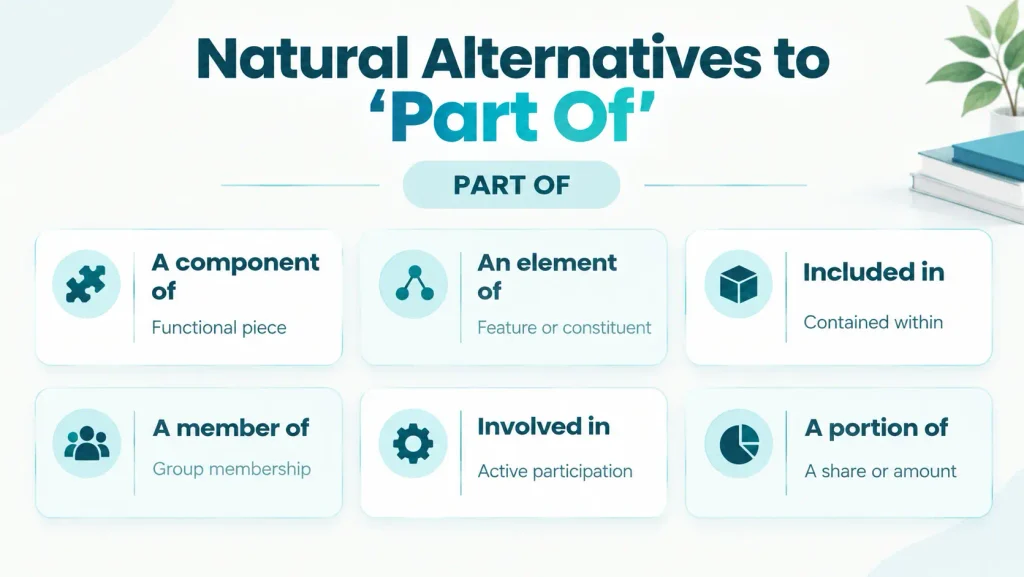
“Component of” is useful when something is one functional piece of a larger system, product, process, or structure.
Example:
“Customer support is an essential component of our service.”
Best for: Professional, technical, and formal writing.
It usually suggests that the smaller element contributes to how the larger system works.
2. An Element Of
“Element of” is a flexible alternative that describes one feature, factor, or constituent within a larger whole.
Example:
“Trust is an important element of a successful relationship.”
Best for: Academic, professional, and general writing.
Compared with “component,” “element” can sound less technical and can work for abstract ideas such as trust, communication, or creativity.
3. A Portion Of
Use “portion of” when you mean a specific amount or share of something larger.
Example:
“Only a small portion of the budget was allocated to advertising.”
Best for: Money, food, quantities, resources, and measurable amounts.
“Portion of” is not usually the right replacement when you’re talking about someone’s membership in a group.
4. A Section Of
“Section of” works when something is a distinct division within a larger document, organization, physical space, or structure.
Example:
“Please read the final section of the report.”
Best for: Reports, books, websites, buildings, departments, and other clearly divided structures.
5. A Segment Of
“Segment of” refers to a distinct part of a larger group, market, population, or whole.
Example:
“This campaign targets a younger segment of the market.”
Best for: Business, marketing, statistics, demographics, and structured groups.
It often implies that the larger whole has been divided into identifiable sections.
6. Included In
“Included in” emphasizes that something is contained within a larger group, collection, list, package, or system.
Example:
“Breakfast is included in the hotel package.”
Best for: Lists, packages, collections, plans, documents, and services.
This is especially useful when “part of” means simply “contained within” rather than “actively contributes to.”
7. A Member Of
When referring to a person or organization that belongs to a group, “a member of” is often more precise than “part of.”
Example:
“She is a member of the university debate team.”
Best for: Teams, clubs, organizations, committees, associations, and communities.
Instead of:
“He is part of the committee.”
you can say:
“He is a member of the committee.”
The second sentence clearly emphasizes membership.
8. Belonging To
“Belonging to” can express membership, ownership, or association depending on the sentence.
Example:
“She is proud of belonging to the local community.”
Best for: Communities, groups, organizations, and personal connections.
It can also refer to ownership:
“The documents belonging to the company were stored securely.”
So, the surrounding context is important.
9. Involved In
“Involved in” is a good choice when “part of” means actively participating in something.
Example:
“He is involved in several community projects.”
Best for: Projects, activities, work, events, and causes.
Notice the difference:
- “She is part of the project.” → She belongs to or is included in it.
- “She is involved in the project.” → She actively participates in it.
“Involved in” therefore adds an element of participation that “part of” does not necessarily express.
10. Participating In
“Participating in” specifically emphasizes taking part in an activity, event, or process.
Example:
“More than 100 students are participating in the competition.”
Best for: Events, competitions, discussions, programs, studies, and activities.
It is not a universal synonym for “part of.” For example, “This chapter is participating in the book” would be incorrect.
11. Taking Part In
“Taking part in” is a natural, conversational alternative when someone actively participates in something.
Example:
“Everyone is encouraged to take part in the discussion.”
Best for: Everyday English and conversational writing.
It is especially natural when discussing activities rather than permanent membership.
12. A Piece Of
“Piece of” can describe one portion or individual part of something larger.
Example:
“This puzzle is one piece of a much larger problem.”
Best for: Everyday language and informal explanations.
It can be literal:
“She ate a piece of cake.”
or figurative:
“This project is one piece of our overall strategy.”
It is generally more casual than “component” or “element.”
13. An Aspect Of
“Aspect of” works when you’re talking about one side, feature, or dimension of a broader subject.
Example:
“Communication is an important aspect of leadership.”
Best for: Abstract subjects, ideas, situations, and professional or academic writing.
It does not necessarily mean a physical or structural part. Instead, it usually refers to one characteristic or dimension.
14. A Constituent Of
“Constituent of” is a formal expression meaning something that forms or makes up part of a larger whole.
Example:
“Water is a major constituent of the human body.”
Best for: Scientific, technical, and formal writing.
This phrase is more specialized than everyday “part of,” so it should not be used simply to sound sophisticated.
15. A Role In
When “part of” describes someone’s contribution or function, “a role in” may be more precise.
Example:
“She played an important role in the development of the project.”
Best for: Work, projects, achievements, decisions, and contributions.
Compare:
“He was part of the project.”
with:
“He played a key role in the project.”
The second sentence tells the reader more about his contribution.
Quick Comparison: Which Alternative Should You Use?
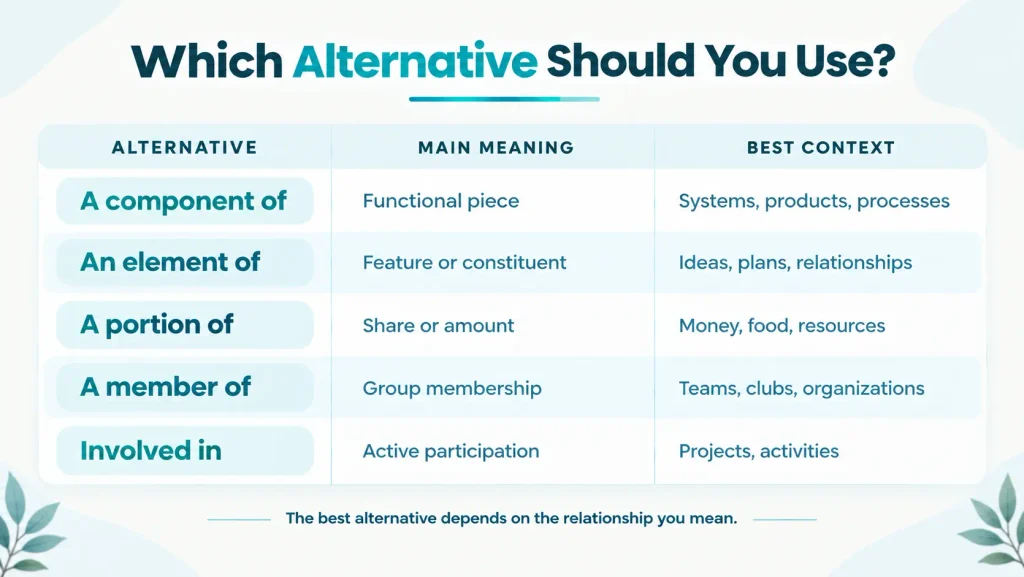
| Alternative | Main Meaning | Tone | Best Context |
| A component of | Functional piece | Professional | Systems, products, processes |
| An element of | Feature or constituent | Neutral/Formal | Ideas, plans, relationships |
| A portion of | Share or amount | Neutral | Money, food, resources |
| A section of | Distinct division | Neutral | Books, reports, buildings |
| A segment of | Defined division | Professional | Markets, groups, populations |
| Included in | Contained within | Neutral | Lists, packages, systems |
| A member of | Group membership | Neutral | Teams, clubs, organizations |
| Belonging to | Membership or connection | Neutral | Groups, communities |
| Involved in | Active participation | Neutral | Projects, activities |
| Participating in | Taking active part | Neutral | Events, programs, activities |
| Taking part in | Active participation | Casual/Neutral | Everyday conversation |
| A piece of | Individual part | Casual | Objects, problems, plans |
| An aspect of | One dimension or feature | Neutral/Formal | Ideas and subjects |
| A constituent of | Forming part of a whole | Formal | Scientific/technical writing |
| A role in | Function or contribution | Neutral/Professional | Projects and responsibilities |
How to Choose the Right Alternative

The easiest way to replace “part of” is to ask what relationship you actually want to describe.
If you mean membership
Use:
- “a member of”
- “belonging to”
Original:
“Maria is part of the tennis club.”
More precise:
“Maria is a member of the tennis club.”
If you mean active participation
Use:
- “involved in”
- “participating in”
- “taking part in”
Original:
“Several employees are part of the training program.”
More precise:
“Several employees are participating in the training program.”
If you mean a structural piece
Use:
- “a component of”
- “an element of”
- “a section of”
Original:
“This module is part of the software.”
More precise:
“This module is a component of the software.”
If you mean a quantity or share
Use:
- “a portion of”
- “a fraction of”
Original:
“A part of the budget was spent on equipment.”
More precise:
“A portion of the budget was spent on equipment.”
If you mean someone’s contribution
Use:
- “a role in”
- “contributing to”
- “involved in”
Original:
“She was part of the team’s success.”
Depending on the intended meaning:
“She played a role in the team’s success.”
or:
“She contributed to the team’s success.”
These are more specific because they focus on contribution rather than simple membership.
“Part Of” vs. “A Part Of”
Both forms are grammatical, but they can behave slightly differently depending on the sentence.
For example:
- “She is part of the team.”
- “She is a part of the team.”
Both can be understood, but “part of” is often the more natural choice when describing membership or inclusion.
With abstract nouns, “a part of” can also emphasize an individual element:
“Failure is a part of learning.”
However, you do not need to add “a” simply because you are trying to make the phrase sound more formal.
Common Mistakes When Replacing “Part Of”
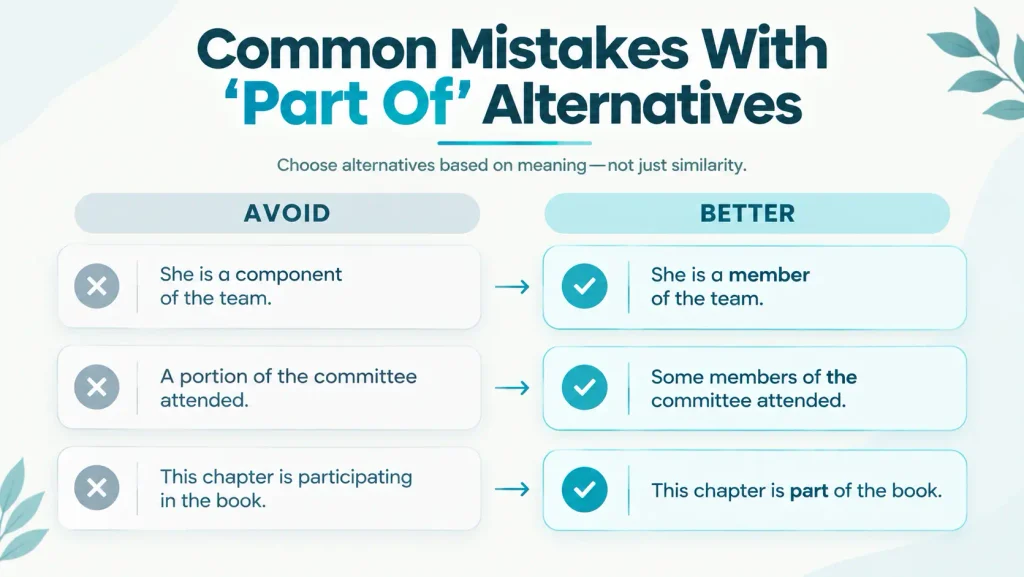
Using “component” for people
“Component” usually describes a functional element of a system, not a person’s membership.
Awkward:
“She is a component of the team.”
Better:
“She is a member of the team.”
Using “participating in” for simple membership
“Participating in” implies activity.
If someone belongs to an organization but is not necessarily active, “member of” is more accurate.
Using “portion of” for groups
“Portion” normally refers to an amount or share.
Instead of:
“A portion of the committee attended.”
you would usually say:
“Some members of the committee attended.”
Choosing a formal word just to sound sophisticated
Words such as “constituent” and “component” are useful in the right context, but everyday English often sounds better with the simple “part of.”
There is nothing wrong with the original phrase when it communicates the meaning clearly.
Frequently Asked Questions
What is the most common synonym for “part of”?
There is no single synonym that works in every context. “A component of,” “an element of,” “included in,” “a member of,” and “involved in” are useful alternatives, depending on whether you mean structure, inclusion, membership, or participation.
What is another way to say “part of” professionally?
For professional writing, consider “a component of,” “an element of,” “a member of,” “included in,” or “involved in.” The best option depends on the exact meaning.
For example:
“She is part of the marketing team.”
can become:
“She is a member of the marketing team.”
What is another way to say “part of a team”?
The most natural alternatives include “a member of the team,” “on the team,” “involved with the team,” or “contributing to the team.” Use “a member of the team” when you mean formal membership.
What is another way to say “part of a project”?
Depending on the meaning, you can say “involved in the project,” “working on the project,” “participating in the project,” or “a contributor to the project.”
Is “component of” the same as “part of”?
They are closely related, but not identical in every context. “Component of” usually emphasizes a functional or structural element of a larger system, while “part of” is much broader.
Is “portion of” a synonym for “part of”?
Sometimes. “Portion of” usually refers to a specific amount or share of something, such as a portion of a budget or a portion of a meal. It is not a general replacement for “part of.”
What is a casual way to say “part of”?
In everyday English, “part of,” “on,” “in,” “with,” or “taking part in” may be more natural depending on the sentence.
For example:
“She’s part of the team.”
can simply become:
“She’s on the team.”
Final Thoughts
“Part of” is already a natural and useful phrase, so you do not always need to replace it. The best alternative is the one that makes the relationship clearer.
Use “a member of” for membership, “involved in” or “participating in” for active involvement, “a component of” for functional parts, “a portion of” for amounts, and “an aspect of” for broader ideas or characteristics. Choosing the phrase based on meaning will make your American English sound more precise and natural than simply replacing “part of” with a random synonym.

Role: Author & Contributing Writer
Olivia Bennett is a dedicated Author at Elite’s Collective, focused on delivering clear, well-researched, and engaging articles tailored to the audience.