

If you need another way to say “results in,” the best choices include leads to, causes, brings about, produces, creates, gives rise to, triggers, contributes to, ends in, culminates in, and brings on. The right alternative depends on whether you want to emphasize a direct cause, a possible consequence, a gradual effect, or a final outcome.
Key Takeaways
- Leads to is the most flexible everyday alternative to “results in.”
- Causes is more direct and clearly shows a cause-and-effect relationship.
- Brings about works well in formal and professional writing.
- Contributes to is better when something is only one factor among several.
- Triggers suggests that an event starts or activates a response.
- Ends in and culminates in focus more on the final outcome than the cause.
What Does “Results In” Mean?
“Results in” means causes something to happen or produces a particular outcome. It connects a cause, action, event, or condition with its effect.
For example:
Poor planning results in unnecessary delays.
Here, poor planning is the cause, while unnecessary delays are the result.
The basic pattern is:
Cause + results in + outcome
For example:
- Heavy rain results in flooding.
- Regular practice results in better performance.
- Poor communication results in misunderstandings.
“Result in” is a standard way to express cause and effect in both everyday and formal English.
15 Alternatives to “Results In”
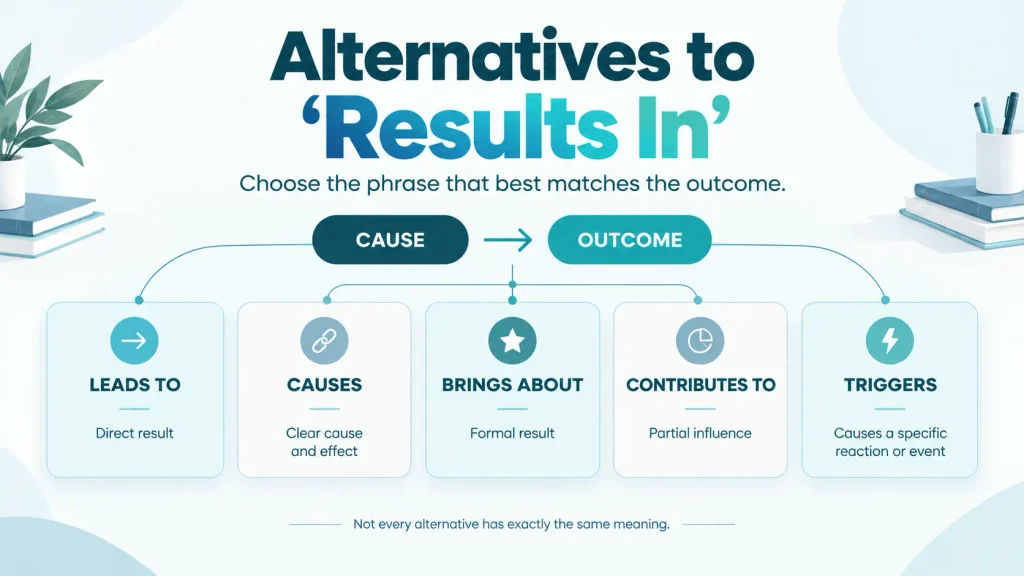
Not every alternative has exactly the same meaning or tone. Some are close substitutes, while others work better in specific situations.
1. Leads To
Leads to is probably the most natural general-purpose alternative to “results in.” It clearly shows that one thing produces or contributes to another outcome.
Example:
Poor communication can lead to misunderstandings between team members.
Best for: Everyday, professional, academic, and business writing.
Usage tip: If you want a simple replacement that sounds natural in most situations, “leads to” is usually a strong choice.
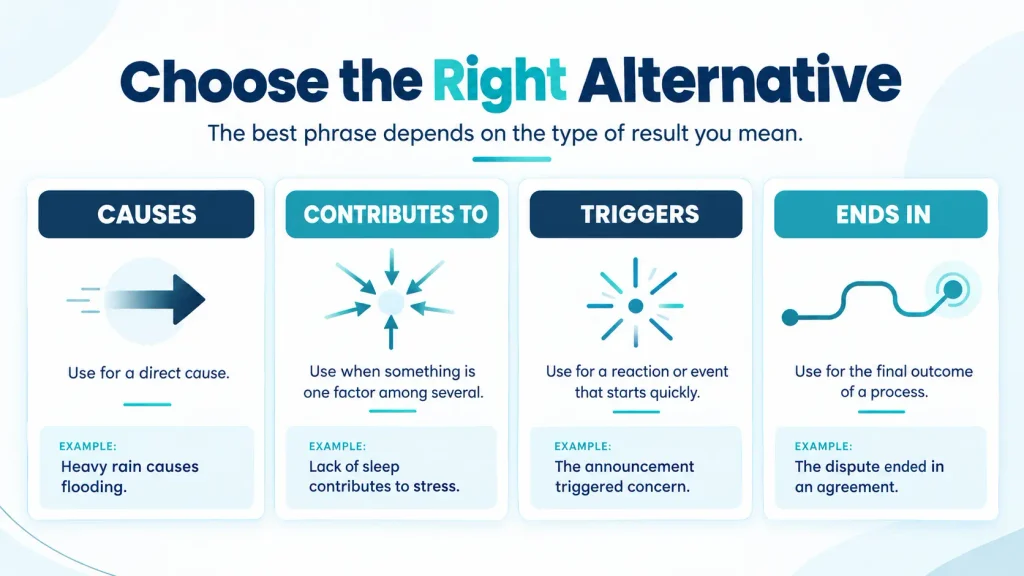
2. Causes
Causes is a direct and strong alternative. It emphasizes that one thing is responsible for producing another.
Example:
Lack of sleep can cause difficulty concentrating.
Best for: Scientific, medical, academic, professional, and everyday contexts.
Usage tip: Use “causes” when the relationship between the cause and effect is clear. It can sound stronger than “contributes to,” which suggests only partial influence.
3. Brings About
Brings about means causes something to happen or creates a particular change.
Example:
The new policy brought about significant improvements in workplace safety.
Best for: Formal, professional, and academic writing.
Usage tip: This phrase can sound slightly more formal than “leads to,” so it works especially well in reports and essays.
4. Produces
Produces emphasizes the outcome created by an action, process, or condition.
Example:
The new manufacturing process produces better-quality products.
Best for: Business, technical, scientific, and professional contexts.
Usage tip: “Produces” works especially well when the result is something tangible, measurable, or clearly generated.
5. Creates
Creates emphasizes that something brings a new situation, condition, or outcome into existence.
Example:
The sudden change in schedule created confusion among employees.
Best for: Everyday and professional English.
Usage tip: “Creates” is natural when the outcome is a situation, problem, opportunity, or condition.
6. Gives Rise To
Gives rise to means causes or creates a particular situation or consequence.
Example:
The disagreement gave rise to several concerns among investors.
Best for: Formal, academic, legal, and professional writing.
Usage tip: This phrase is more formal than “leads to.” It can be useful when you want your writing to sound precise without using overly technical vocabulary.
7. Triggers
Triggers means causes a reaction, event, or process to begin.
Example:
The announcement triggered a strong response from customers.
Best for: News, business, technology, psychology, and everyday contexts.
Usage tip: “Triggers” suggests a relatively immediate reaction. It is not always a perfect substitute for “results in.”
For example, “Years of planning resulted in a successful launch” sounds natural, but “years of planning triggered a successful launch” changes the meaning.
8. Contributes To
Contributes to means helps cause an outcome but is not necessarily the only cause.
Example:
Regular exercise contributes to better overall health.
Best for: Academic, professional, scientific, and health-related writing.
Usage tip: Choose this phrase when several factors may be responsible for the final result.
Compare:
- Poor planning causes delays.
- Poor planning contributes to delays.
The first suggests a stronger causal relationship. The second suggests that poor planning is one factor among others.
9. Brings On
Brings on can mean causes a particular condition or situation to happen.
Example:
Working long hours without enough rest can bring on exhaustion.
Best for: Everyday and conversational English.
Usage tip: This phrase often works well with unpleasant conditions or problems, such as stress, fatigue, illness, or trouble.
10. Ends In
Ends in focuses on the final outcome of an event, process, or situation.
Example:
The long negotiation ended in an agreement.
Best for: Everyday, narrative, and formal writing.
Usage tip: “Ends in” emphasizes where something finishes rather than directly emphasizing the cause.
For that reason, it isn’t always interchangeable with “results in.”
11. Culminates In
Culminates in describes something reaching a final or important stage that produces a particular outcome.
Example:
Months of preparation culminated in a successful product launch.
Best for: Formal, academic, professional, and narrative writing.
Usage tip: This phrase often suggests a process that develops over time before reaching an important final point.
12. Brings About
“Brings about” is worth highlighting because it can be especially useful when describing a meaningful change rather than a simple consequence.
Example:
The new training program brought about major improvements in employee performance.
Best for: Formal and professional writing.
Usage tip: Because “brings about” and “causes” can overlap, choose “brings about” when you want to emphasize the change that was produced.
13. Generates
Generates means produces or creates a particular result, response, amount, or effect.
Example:
The advertising campaign generated considerable interest in the new product.
Best for: Business, marketing, technology, academic, and professional writing.
Usage tip: “Generates” is particularly natural with nouns such as interest, revenue, discussion, demand, data, or results.
14. Brings
In some sentences, the shorter verb brings can naturally replace “results in.”
Example:
The new strategy brought significant improvements to the team’s workflow.
Best for: General and professional writing.
Usage tip: The exact sentence structure may need to change. “Brings” is not a universal word-for-word replacement for “results in.”
15. Is Responsible For
Is responsible for emphasizes responsibility for an outcome rather than simply describing a sequence of events.
Example:
Poor maintenance was responsible for the equipment failure.
Best for: Professional, technical, investigative, and formal contexts.
Usage tip: This phrase can sound stronger because it directly assigns responsibility. Use it when the evidence supports that relationship.
Quick Comparison: Which Alternative Should You Use?
| Alternative | Main Meaning | Tone | Best Context |
|---|---|---|---|
| Leads to | Produces an outcome | Neutral | Almost any context |
| Causes | Directly makes something happen | Direct | Academic, professional, everyday |
| Brings about | Produces a change | Formal | Business, academic |
| Produces | Creates an outcome | Neutral | Technical, business |
| Creates | Makes a situation happen | Neutral | Everyday, professional |
| Gives rise to | Causes a situation | Formal | Academic, professional |
| Triggers | Starts a reaction or event | Neutral | News, business, technology |
| Contributes to | Helps cause an outcome | Neutral | Academic, scientific |
| Brings on | Causes a condition | Conversational | Everyday English |
| Ends in | Finishes with an outcome | Neutral | Events and processes |
| Culminates in | Reaches an important final outcome | Formal | Academic, professional |
| Generates | Produces something | Neutral/Formal | Business, marketing |
| Is responsible for | Has responsibility for an outcome | Direct/Formal | Professional, investigative |
“Results In” vs. “Leads To”
“Results in” and “leads to” are often interchangeable because both can describe a cause-and-effect relationship.
Compare:
Poor planning results in delays.
Poor planning leads to delays.
Both sentences communicate essentially the same idea.
“Leads to” often feels slightly more natural in general conversation, while “results in” is common in formal, academic, technical, and professional writing. Both are standard expressions for describing cause and effect.
“Results In” vs. “Causes”
These phrases are close, but “causes” can sound more direct.
Excessive noise results in sleep problems.
Excessive noise causes sleep problems.
The second sentence makes the causal relationship more direct.
Use causes when you want to clearly identify something as the source of an effect. Use results in when you want to describe the connection between an event and its outcome without necessarily making the wording quite as direct.
“Results In” vs. “Contributes To”
These expressions should not always be treated as exact synonyms.
Results in can present something as producing an outcome:
Poor planning resulted in project delays.
Contributes to suggests that the factor is only part of the reason:
Poor planning contributed to project delays.
The second sentence leaves room for other causes, such as staffing problems, technical issues, or changing requirements.
“Results In” vs. “Triggers”
“Triggers” usually suggests that something starts a reaction or event.
The announcement triggered a public debate.
“Results in” simply identifies the outcome:
The announcement resulted in a public debate.
The two can overlap, but “trigger” places more emphasis on the beginning of the reaction.
Common Mistakes When Replacing “Results In”
Using “Result To”
A common mistake is using result to when the intended meaning is cause and effect.
For example:
❌ The mistake resulted to serious problems.
✅ The mistake resulted in serious problems.
Standard English uses result in for this meaning.
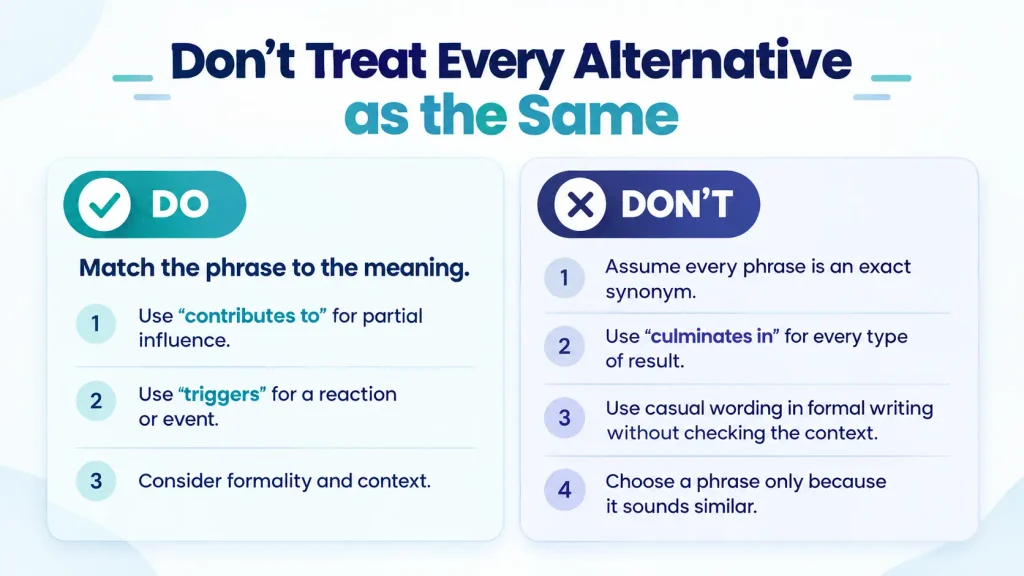
Treating Every Alternative as an Exact Synonym
Words such as “trigger,” “contribute to,” “end in,” and “culminate in” can overlap with “result in,” but their meanings are not identical.
Choose the word that expresses the relationship you actually mean.
Using “Causes” When the Relationship Is Uncertain
If something is only one possible factor, “contributes to” may be more accurate.
For example:
Regular exercise contributes to better health.
This does not claim that exercise is the only factor affecting health.
Using Formal Phrases in Casual Conversation
Expressions such as gives rise to and culminates in are perfectly valid, but they may sound formal in a casual conversation.
For everyday speech, leads to or causes will often sound more natural.
Which Alternative Is Best for Formal Writing?
For formal or academic writing, some of the strongest choices are:
- leads to
- causes
- brings about
- gives rise to
- contributes to
- culminates in
The best choice depends on the relationship you want to describe. “Contributes to,” for example, is useful when the outcome has multiple causes, while “culminates in” suggests the final stage of a longer process.
Which Alternative Is Best for Everyday English?
For everyday communication, the most natural options are usually:
- Leads to
- Causes
- Creates
- Brings on
- Ends in
For example:
- Too much screen time can lead to poor sleep.
- Lack of preparation can cause problems.
- A misunderstanding can create unnecessary tension.
- Stress can bring on headaches.
- The argument ended in an apology.
Frequently Asked Questions
What is the best synonym for “results in”?
Leads to is one of the best general alternatives because it clearly expresses a cause-and-effect relationship and works in everyday, professional, and academic writing.
What is a formal way to say “results in”?
Formal alternatives include brings about, gives rise to, contributes to, and culminates in. The appropriate choice depends on the exact relationship between the cause and outcome.
Is “leads to” the same as “results in”?
In many sentences, yes. Both can describe something causing or producing an outcome. However, “leads to” can sometimes suggest a pathway toward an outcome, while “results in” places stronger emphasis on the resulting effect.
Is “causes” stronger than “results in”?
Often, yes. “Causes” directly identifies something as producing an effect. “Results in” describes the cause-and-effect relationship but can sound slightly less direct.
Can I use “results to” instead of “results in”?
No, not when you mean that something causes a particular outcome. The standard expression is result in. For example, “Poor planning resulted in delays” is correct.
What is another way to say “results in” in an essay?
For an essay, leads to, causes, contributes to, brings about, and gives rise to are useful choices. Select the phrase according to the strength and type of causal relationship.
What is a casual way to say “results in”?
Depending on the sentence, leads to, causes, creates, or brings on can sound more conversational. “Ends up” may also work in some contexts, but it changes the focus toward the eventual outcome rather than a direct cause-and-effect relationship.
Final Thoughts
The best alternative to “results in” depends on what you want to emphasize. Leads to is the safest all-purpose option, while causes gives a stronger sense of direct responsibility. Contributes to works when several factors are involved, triggers emphasizes the start of a reaction, and culminates in highlights the final stage of a longer process.
Instead of replacing “results in” with the same synonym every time, consider the exact relationship between the cause and the outcome. That small distinction will make your English more precise, natural, and effective.

Role: English Language & Communication Writer
Daniel Carter is an English language writer specializing in workplace communication, professional vocabulary, resumes, emails, and career-focused English.