
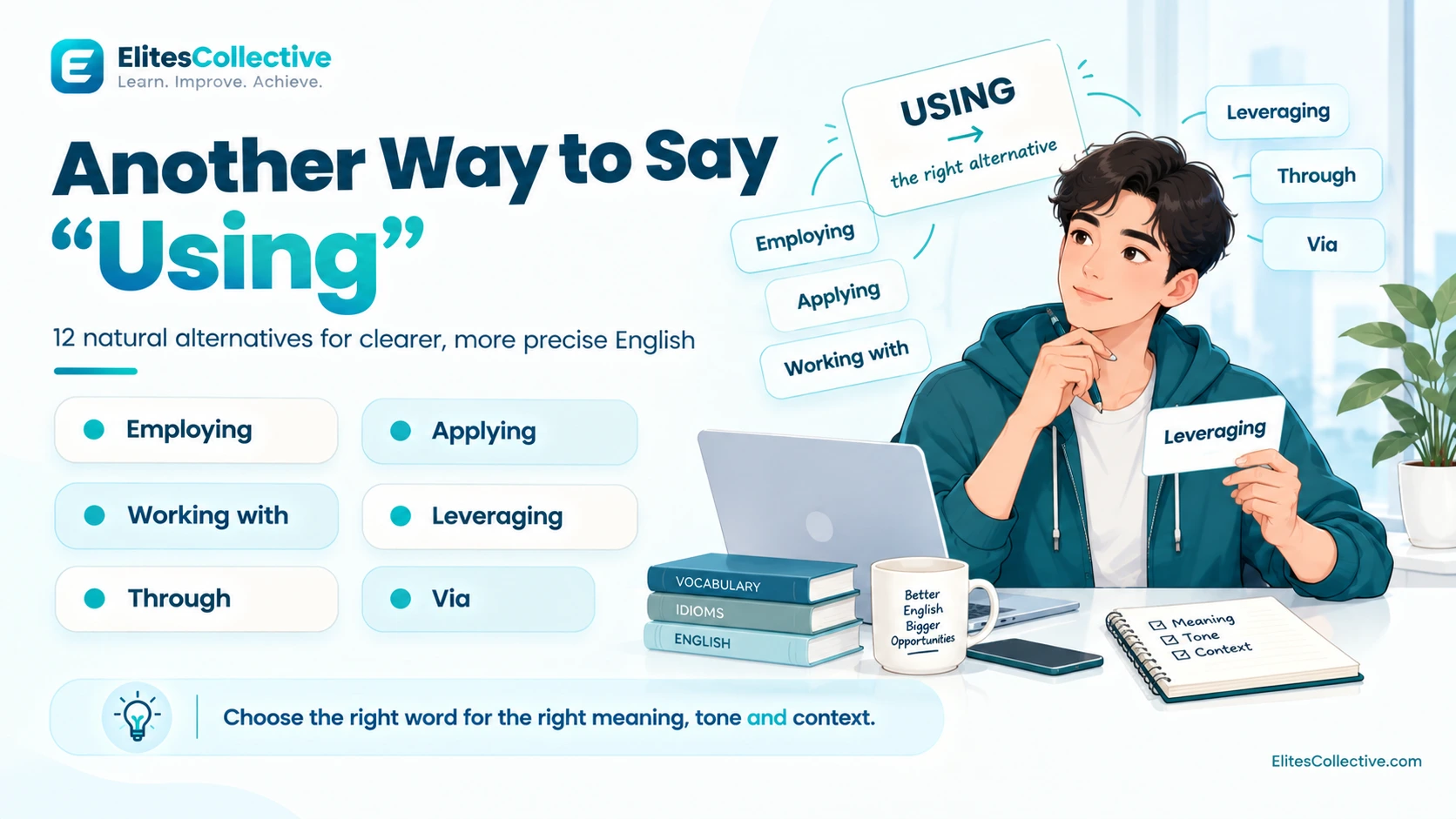
If you’re looking for another way to say “using,” the best replacement depends on your sentence and intended tone. Common alternatives include employing, utilizing, applying, operating, working with, through, via, by means of, and leveraging. Some are more formal than others, so context matters.
Key Takeaways
- Using is the most natural and flexible choice in everyday American English.
- Employing works well when describing a method, tool, or strategy.
- Utilizing is more formal and can sound unnecessarily technical in casual writing.
- Applying fits skills, knowledge, methods, and principles.
- Working with sounds natural when referring to people, software, tools, or materials.
- Through, via, and by means of can replace “using” when you want to emphasize the method.
What Does “Using” Mean?
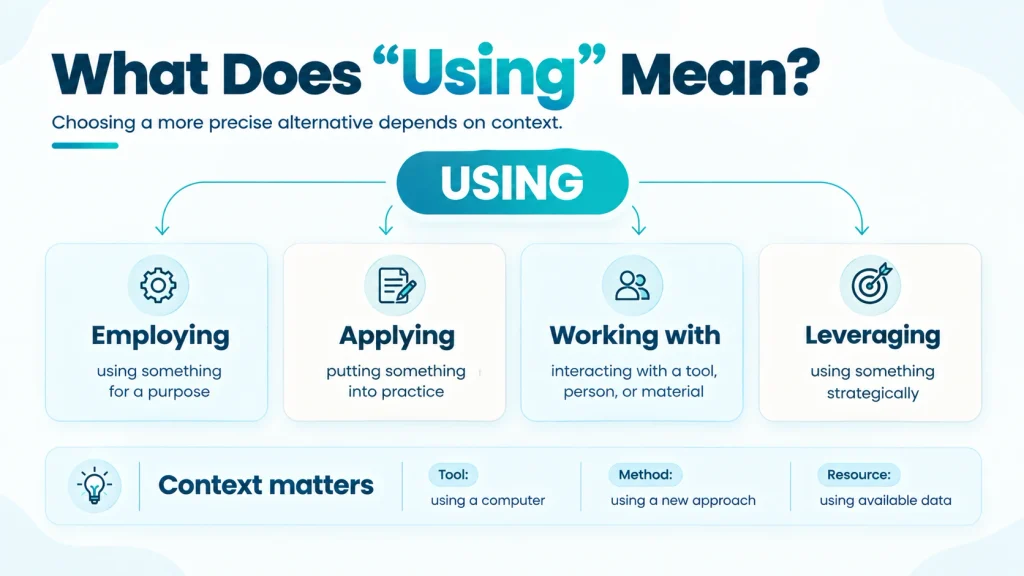
Using generally means employing something for a particular purpose. It can refer to tools, objects, methods, skills, technology, resources, or even people.
For example:
She is using a new software program to organize the data.
The best alternative depends on what follows “using.” You would not always replace it with the same word.
For example:
- using a tool → employing a tool
- using a method → applying a method
- using software → working with software
- using technology → leveraging technology
- using a website → accessing a website
- using a method to solve a problem → solving it through a method
That is why context is more important than simply finding a synonym.
12 Natural Alternatives to “Using”
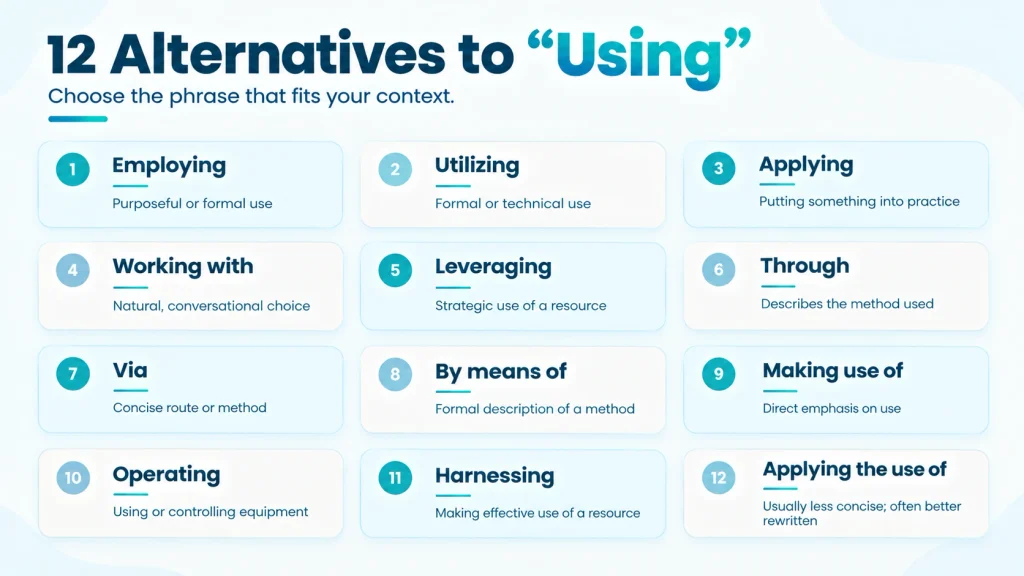
1. Employing
Employing means using something for a particular purpose. It is a natural choice in formal, academic, and professional writing.
Example:
The researchers are employing a new method to analyze the results.
Best for: Formal, academic, and professional writing.
Tip: “Employing” is usually a closer replacement for “using” than more specialized alternatives such as “leveraging.”
2. Utilizing
Utilizing means making use of something. It is common in formal or technical writing, although using is often simpler and more natural.
Example:
The team is utilizing advanced software to improve its workflow.
Best for: Technical, formal, or professional contexts.
Tip: Don’t automatically choose “utilizing” just because it sounds more sophisticated. In many sentences, using reads better.
3. Applying
Applying works particularly well when you use knowledge, skills, principles, techniques, or methods.
Example:
She is applying her design skills to the new project.
Best for: Skills, knowledge, methods, rules, and principles.
Tip: “Applying” does not replace “using” in every situation. You can apply a method or skill, but you would normally use a chair rather than “apply” one.
4. Working With
Working with is a natural, conversational alternative when talking about tools, materials, software, systems, or people.
Example:
I enjoy working with WordPress and WooCommerce.
Best for: Everyday, professional, and conversational English.
Tip: This phrase often sounds more natural than a formal synonym when describing practical experience.
5. Leveraging
Leveraging means making effective use of something, especially an existing resource, advantage, skill, technology, or opportunity.
Example:
The company is leveraging social media to reach new customers.
Best for: Business, marketing, technology, and professional writing.
Tip: “Leveraging” often suggests using something strategically rather than simply using it.
6. Applying the Use of
This construction can sometimes replace “using,” but it is generally less concise.
Example:
The study examines the benefits of applying the use of renewable energy technologies.
However, this sentence would usually be cleaner as:
The study examines the benefits of using renewable energy technologies.
Best for: Limited contexts where the wording requires emphasis on application.
Tip: In most cases, avoid this phrase. Using or applying is usually clearer.
7. By Means of
By means of emphasizes the method or instrument used to accomplish something.
Example:
The device communicates by means of a wireless connection.
Best for: Formal and explanatory writing.
Tip: It can sound more formal than everyday “using,” so it is usually unnecessary in casual conversation.
8. Through
Through can replace “using” when you want to explain the method, process, or channel by which something happens.
Example:
Customers can contact the company through its online support system.
Best for: Methods, processes, channels, and communication.
Tip: “Through” often focuses more on how something happens than on the object being used.
9. Via
Via means by way of or through a particular route, method, or medium.
Example:
Please send the documents via email.
Best for: Professional, technical, digital, and concise writing.
Tip: “Via” is especially useful when describing communication methods or routes.
10. Making Use of
Making use of is a direct alternative to “using.” It emphasizes putting something to practical use.
Example:
We can make use of the available resources.
Best for: Neutral and moderately formal writing.
Tip: It is grammatically natural, but often longer than simply saying use.
11. Operating
Operating can replace “using” when the object is a machine, device, system, or piece of equipment that someone controls.
Example:
Employees must receive training before operating the equipment.
Best for: Machines, equipment, vehicles, and technical systems.
Tip: “Operating” is more specific than “using.” Someone can use a machine without necessarily emphasizing the act of operating it.
12. Harnessing
Harnessing means making effective use of a resource, force, technology, or opportunity.
Example:
The company is harnessing artificial intelligence to improve customer service.
Best for: Technology, energy, resources, skills, and opportunities.
Tip: It often suggests purposeful or effective use rather than ordinary use.
“Using” Alternatives at a Glance
| Alternative | Tone | Best Context |
|---|---|---|
| Employing | Formal | Methods, tools, strategies |
| Utilizing | Formal | Technical and professional writing |
| Applying | Neutral/Formal | Skills, methods, knowledge |
| Working with | Natural | Tools, software, people, materials |
| Leveraging | Professional | Technology, resources, advantages |
| By means of | Formal | Methods and processes |
| Through | Neutral | Methods and channels |
| Via | Neutral/Formal | Communication and routes |
| Making use of | Neutral | Resources and objects |
| Operating | Neutral | Machines and systems |
| Harnessing | Formal/Professional | Technology, resources, opportunities |
How to Choose the Right Alternative
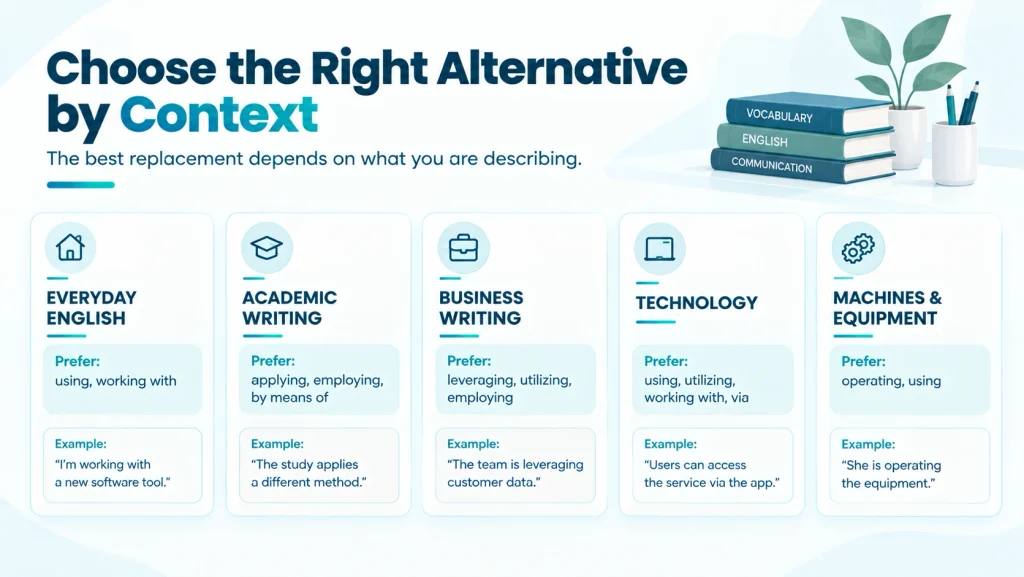
The easiest way to choose an alternative is to look at what you are using and why you are using it.
For everyday English
Stick with using, working with, or through.
I’m using a new laptop.
I’m working with a new software system.
For academic writing
Consider employing, applying, or by means of.
The researchers are employing a different analytical method.
For business writing
Employing, leveraging, and utilizing can work, depending on the sentence.
The company is leveraging customer data to improve its services.
For technology
Using, working with, leveraging, and harnessing are common choices.
The developer is working with a new JavaScript framework.
For machines and equipment
Operating may be more precise than “using.”
Employees must be trained before operating the machine.
Common Mistakes When Replacing “Using”
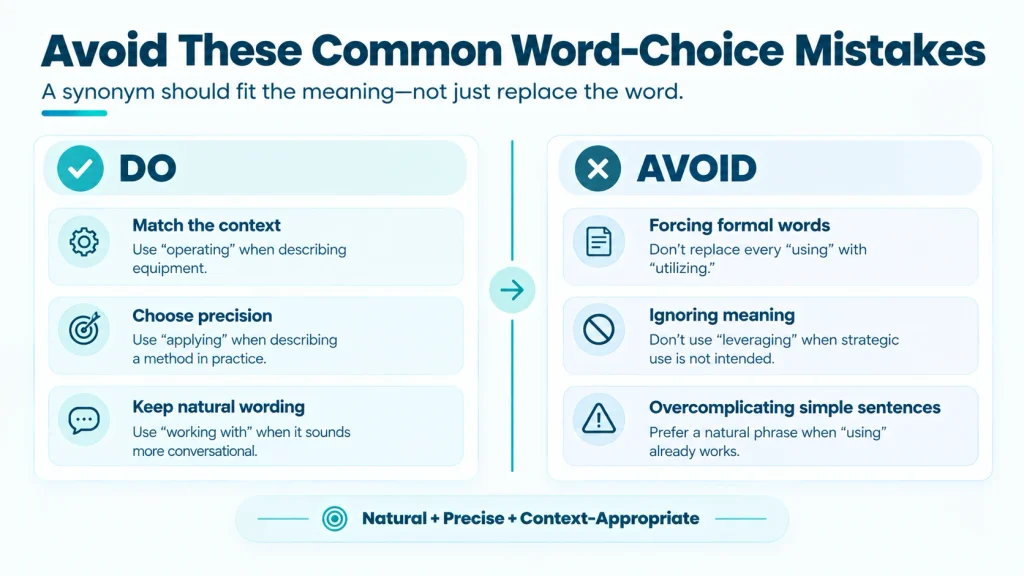
Choosing a synonym that changes the meaning
Not every alternative means exactly the same thing.
For example:
She is using her knowledge.
“Applying her knowledge” works well because knowledge can be applied. But:
She is operating her knowledge.
does not work because operating is normally associated with machines, equipment, or systems.
Using “utilizing” when “using” is clearer
“Utilizing” is grammatically valid, but it can make simple sentences unnecessarily formal.
Less natural:
We are utilizing a new calendar.
More natural:
We are using a new calendar.
Using “leveraging” for ordinary actions
“Leveraging” often implies strategic or effective use.
The company is leveraging its existing customer base.
This makes sense because the company is using an existing advantage strategically. For a simple physical object, using is usually better.
Confusing “through” with “using”
These words can overlap, but they emphasize different things.
She solved the problem using a calculator.
Here, the calculator is the tool.
She solved the problem through careful analysis.
Here, careful analysis is the method or process.
Is “Utilizing” Better Than “Using”?
Not necessarily. Using is shorter, simpler, and more common in everyday American English. Utilizing can be appropriate in technical or formal contexts, but it should not be used simply to make writing sound more sophisticated.
Compare:
We are using the available data.
We are utilizing the available data.
Both are grammatical, but the first is generally more direct.
Is “Employing” the Same as “Using”?
Usually, but not in every context. Employing often sounds more formal and works particularly well with methods, techniques, strategies, tools, and resources.
For example:
The researchers are employing a new technique.
This is natural.
But in everyday speech:
I’m employing my phone to call my friend.
sounds unnecessarily formal. I’m using my phone is much more natural.
Frequently Asked Questions
What is a formal word for “using”?
Employing and utilizing are common formal alternatives. Applying is also appropriate when referring to knowledge, skills, methods, or principles.
What is a professional way to say “using”?
Depending on the context, you can use employing, utilizing, applying, leveraging, or working with. The best choice depends on what is being used.
What is another way to say “using a method”?
Good alternatives include employing a method, applying a method, or using a method. “Employing” is particularly natural in formal writing.
What is another way to say “using technology”?
Depending on the meaning, you can say leveraging technology, harnessing technology, working with technology, or simply using technology.
What is another way to say “using a tool”?
You can say employing a tool, working with a tool, or making use of a tool. In most everyday situations, using a tool remains the most natural option.
Is “making use of” the same as “using”?
Yes, in many contexts. “Making use of” generally means putting something to practical use, but it is longer than the simple word using.
What is a casual alternative to “using”?
Working with can sound natural and conversational in many contexts. However, using itself is already a very casual and widely accepted choice.
Final Thoughts
There is no single replacement for “using” that works in every sentence. Employing suits formal writing, applying works well with skills and methods, working with sounds natural in everyday and professional contexts, and leveraging or harnessing can emphasize strategic use. When no special nuance is needed, using is often still the clearest choice.

Role: Lead Author & Content Specialist
James Mitchell is an experienced Lead Author at Elite’s Collective. He specializes in creating high-impact editorial content and driving core written projects designed to inform and engage readers.