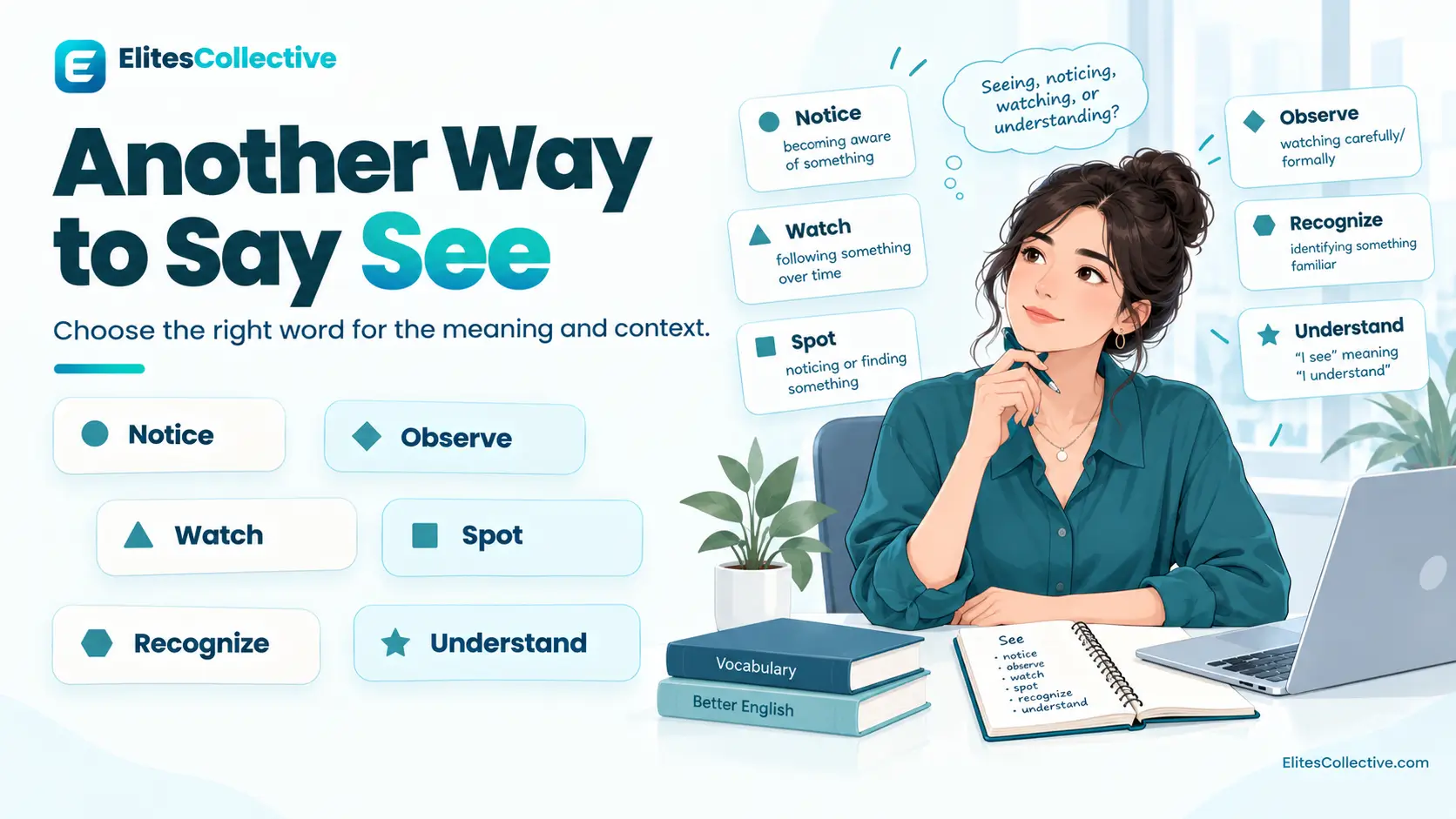
If you need another way to say “see,” the best alternative depends on what you mean. For example, notice works when you become aware of something, watch fits something happening over time, observe sounds more formal, and meet can replace “see” when you mean spending time with someone. Here are 12 natural alternatives with examples and usage tips.
Key Takeaways
- Notice means to become aware of something.
- Watch is best for something happening over a period of time.
- Observe is more formal and often suggests careful attention.
- Look at is a simple alternative for directing your eyes toward something.
- Meet can replace “see” when you mean spending time with someone.
- Understand can replace “see” when “I see” means “I understand.”
What Does “See” Mean?
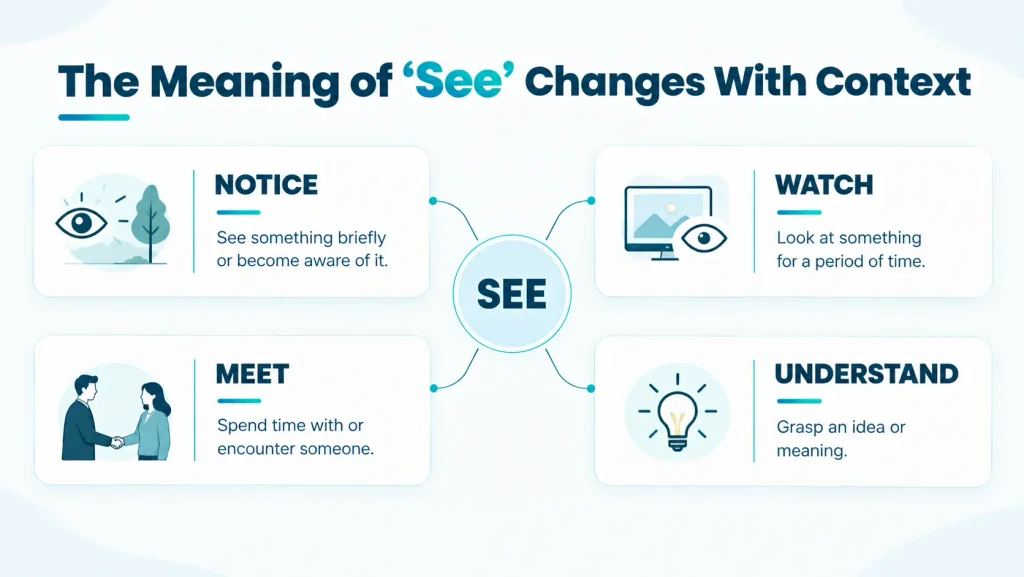
The verb “see” has several meanings in American English, so there is no single replacement that works in every sentence.
You can use “see” to mean:
- Notice something: “Did you see that mistake?”
- Look at something: “See the chart below.”
- Watch something: “We saw a movie last night.”
- Meet someone: “I’m seeing my friend tomorrow.”
- Understand something: “Oh, I see what you mean.”
- Visit someone: “I need to see my doctor.”
- Experience something: “We saw heavy rain during the trip.”
Because the meaning changes with context, choosing the right alternative is more useful than simply replacing “see” with a thesaurus synonym.
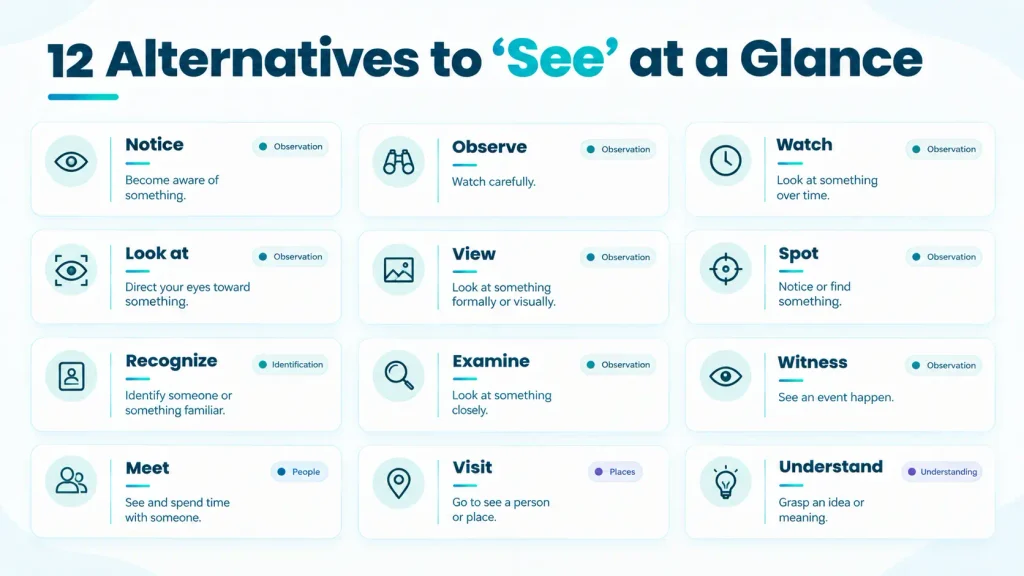
12 Natural Alternatives to “See”
1. Notice
Notice means to become aware of something, especially something you observe with your senses.
Example:
“I noticed that the door was open.”
Best for: Everyday conversation, observations, and details.
Tip: Use “notice” when the important idea is becoming aware of something rather than simply looking at it.
2. Observe
Observe means to watch or examine something carefully. It is more formal than “see.”
Example:
“The researcher observed changes in the participants’ behavior.”
Best for: Academic, professional, scientific, and formal writing.
Tip: “Observe” often suggests deliberate attention, while “see” can happen without trying.
3. Watch
Watch means to look at something for a period of time, especially when it is moving or changing.
Example:
“We watched the game together.”
Best for: Movies, sports, performances, videos, and events.
Tip: “Watch” is usually more natural than “see” when you focus on something as it happens.
4. Look at
Look at is a simple, direct alternative when you mean directing your eyes toward something.
Example:
“Look at this photo.”
Best for: Casual conversation and everyday situations.
Tip: “Look at” and “see” are not always interchangeable. “Look” usually describes an intentional action, while “see” can describe what you perceive.
5. View
View means to look at something, often in a more formal or neutral way.
Example:
“You can view the complete report online.”
Best for: Websites, documents, media, professional writing, and formal instructions.
Tip: “View” can sound more formal than “look at.”
6. Spot
Spot means to notice or identify something, especially when it is difficult to find.
Example:
“Can you spot the difference between these two pictures?”
Best for: Finding people, objects, errors, or differences.
Tip: “Spot” emphasizes successfully noticing something.
7. Recognize
Recognize means to identify someone or something because you have seen or encountered it before.
Example:
“I recognized her from the conference.”
Best for: People, places, objects, faces, voices, and familiar information.
Tip: Use “recognize” when familiarity is part of the meaning.
8. Examine
Examine means to look at something closely and carefully, usually to understand or evaluate it.
Example:
“The technician examined the damaged equipment.”
Best for: Professional, academic, medical, technical, and investigative contexts.
Tip: “Examine” implies much more careful attention than the general verb “see.”
9. Witness
Witness means to see an event happen, especially something important, unusual, or significant.
Example:
“Several people witnessed the accident.”
Best for: Events, incidents, performances, and formal descriptions.
Tip: “Witness” focuses on being present when something happens.
10. Meet
Meet can replace “see” when “see someone” means spending time with or getting together with that person.
Example:
“I’m meeting my friends after work.”
Best for: Plans, appointments, social activities, and professional meetings.
Tip: “See” and “meet” overlap in some contexts, but “meet” emphasizes the interaction or gathering.
11. Visit
Visit works when “see” means going to a person or place for a period of time.
Example:
“We visited our grandparents last weekend.”
Best for: Family, friends, doctors, cities, attractions, and places.
Tip: Use “visit” when the idea of going somewhere or spending time there matters.
12. Understand
When someone says “I see,” they may mean “I understand.”
Example:
“I see why you were upset.”
You could also say:
“I understand why you were upset.”
Best for: Conversations, explanations, disagreements, and clarifying ideas.
Tip: This is a meaning-based replacement rather than a visual synonym. It works only when “see” means “understand.”
Quick Comparison: Alternatives to “See”
| Alternative | Main Meaning | Tone | Best Context |
|---|---|---|---|
| Notice | Become aware of | Neutral | Everyday English |
| Observe | Watch carefully | Formal | Academic/professional |
| Watch | Look at over time | Neutral | Movies, sports, events |
| Look at | Direct your eyes toward | Casual | Everyday conversation |
| View | Look at or access | Neutral/Formal | Websites, documents |
| Spot | Notice or find | Casual/Neutral | Objects, errors, differences |
| Recognize | Identify as familiar | Neutral | People, places, things |
| Examine | Inspect closely | Formal | Technical/professional |
| Witness | See an event happen | Formal | Events/incidents |
| Meet | Get together with someone | Neutral | Social/professional |
| Visit | Go to someone/place | Neutral | People and places |
| Understand | Comprehend | Neutral | “I see” = “I understand” |
How to Choose the Right Alternative
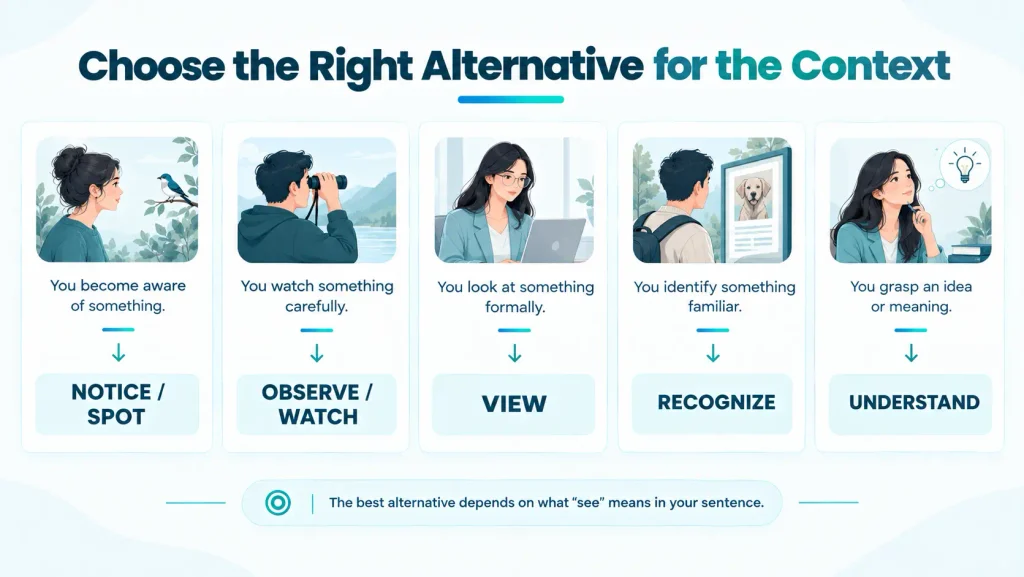
The easiest way to replace “see” is to identify what you actually mean.
If you mean “become aware of”
Use notice or spot.
- “I saw a small error.” → “I noticed a small error.”
- “I saw a typo in the report.” → “I spotted a typo in the report.”
If you mean “look carefully”
Use observe or examine.
- “The doctor saw the injury.” → “The doctor examined the injury.”
- “We saw the behavior closely.” → “We observed the behavior closely.”
If you mean “look at something happening”
Use watch.
- “We saw the football game.” → “We watched the football game.”
If you mean “spend time with someone”
Use meet or visit.
- “I’m seeing Sarah tomorrow.” → “I’m meeting Sarah tomorrow.”
- “I went to see my grandparents.” → “I went to visit my grandparents.”
If you mean “understand”
Use understand.
- “I see what you mean.” → “I understand what you mean.”
Common Mistakes When Replacing “See”
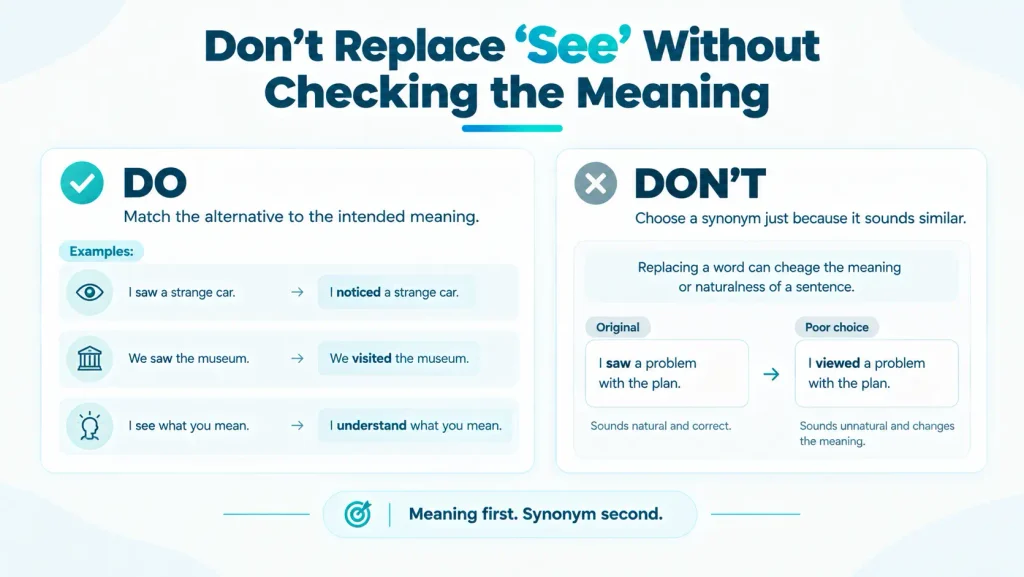
Using “watch” for a single moment
“Watch” usually suggests sustained attention.
Less natural:
“I watched a bird in the sky for one second.”
More natural:
“I saw a bird in the sky.”
But if you deliberately followed the bird with your eyes, watched can work.
Using “observe” in casual conversation
“Observe” is correct, but it can sound formal.
Formal:
“The manager observed the employee’s performance.”
More conversational:
“The manager noticed how the employee performed.”
Using “meet” when you mean visually perceive someone
“I met a man on the street” means you encountered or interacted with him. It does not simply mean that you saw him.
If you only noticed him, say:
“I saw a man on the street.”
Treating every synonym as interchangeable
“See,” “notice,” “watch,” “observe,” and “recognize” overlap, but they describe different actions. The surrounding sentence determines which alternative sounds natural.
Frequently Asked Questions
What is a better word for “see”?
There is no single best replacement. Notice, watch, observe, view, spot, recognize, and look at can all replace “see” in different contexts.
What is a formal word for “see”?
Observe, examine, and view can work as formal alternatives, depending on the sentence.
What is another way to say “I see”?
If you mean “I understand,” you can say “I understand,” “I get it,” “That makes sense,” or “I understand what you mean.” The most appropriate choice depends on how formal the conversation is.
What is another word for “see” in an essay?
In academic writing, observe, examine, identify, recognize, or demonstrate may work, but only when the meaning fits. “See” should not automatically be replaced with a more formal word.
What is another way to say “see someone”?
Depending on the meaning, you could say meet someone, visit someone, spend time with someone, or speak with someone.
Is “notice” the same as “see”?
Not exactly. See can simply mean perceiving something, while notice usually means becoming consciously aware of it.
Final Thoughts
The best alternative to “see” depends on the exact meaning of the sentence. Use notice for awareness, watch for something happening over time, observe for careful or formal attention, spot for finding something, meet for getting together with someone, and understand when “I see” means “I understand.” Choosing based on context will make your writing sound much more natural.

Role: Lead Author & Content Specialist
James Mitchell is an experienced Lead Author at Elite’s Collective. He specializes in creating high-impact editorial content and driving core written projects designed to inform and engage readers.