
If you’re looking for another way to say “will be,” the best choice depends on what you mean. You can use phrases such as “is going to be,” “is expected to be,” “is likely to be,” “is set to be,” “may be,” and “might be.” Each option gives the sentence a slightly different meaning or tone.
Key Takeaways
- “Is going to be” works well for plans and predictions.
- “Is expected to be” fits predictions and formal writing.
- “Is likely to be” shows that something has a good chance of happening.
- “May be” and “might be” show uncertainty.
- “Is scheduled to be” works well for planned events.
- “Is projected to be” fits forecasts based on data.
- You should choose the phrase that matches the meaning, not just replace “will be” with another phrase.
What Does “Will Be” Mean?
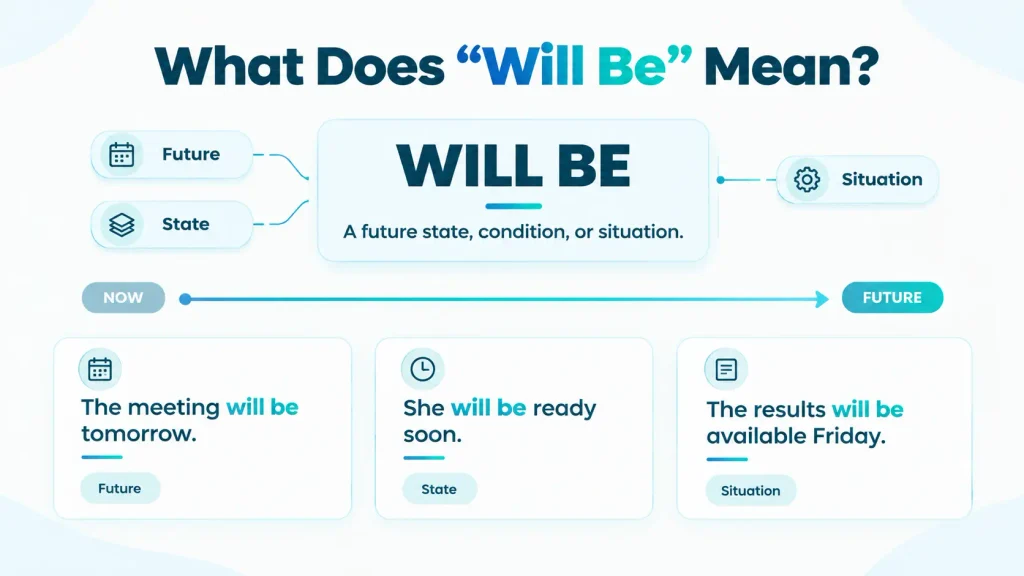
“Will be” talks about a future state, condition, place, or situation.
For example:
The meeting will be at 10 a.m.
The new office will be larger than the old one.
She will be ready by noon.
The phrase can express several ideas. It may describe a future fact, a prediction, a plan, or something the speaker expects to happen. Because of this, no single phrase works as a perfect replacement in every sentence.
12 Natural Alternatives to “Will Be”
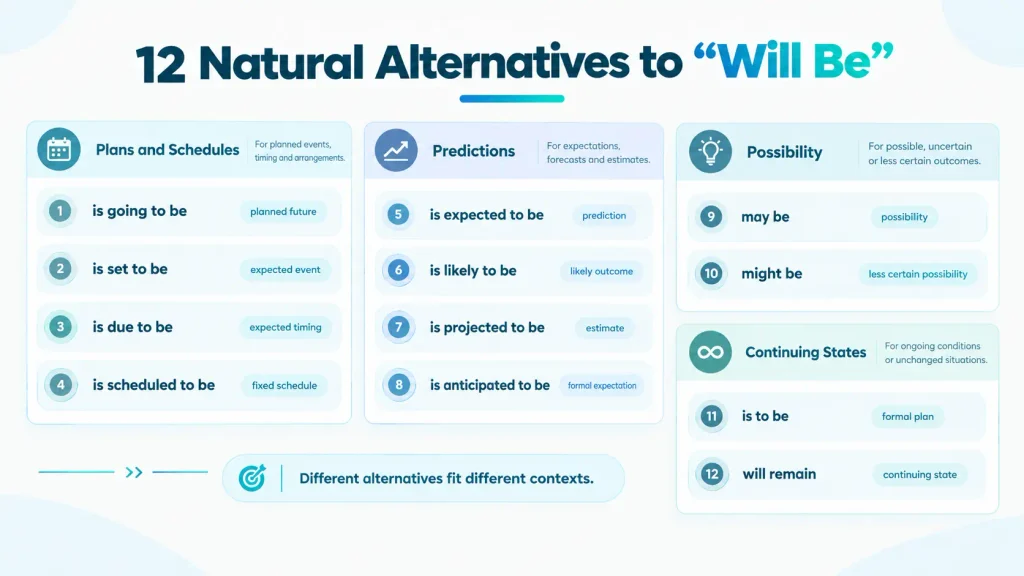
1. Is Going to Be
Best for: Everyday speech, plans, and predictions
“Is going to be” is one of the most natural alternatives to “will be.” People often use it when they have a plan or when something in the present gives them a reason to make a prediction.
Example:
The new restaurant is going to be popular.
You could also say:
The new restaurant will be popular.
The first version can sound more connected to a plan or present evidence.
2. Is Expected to Be
Best for: Predictions, reports, and formal writing
Use “is expected to be” when you believe something will happen based on current information.
Example:
The project is expected to be completed by June.
This phrase sounds more careful than “will be.” It shows that the outcome is expected, but it does not present it as an absolute fact.
For that reason, it works well in business reports, news writing, and other formal contexts.
3. Is Likely to Be
Best for: Probable outcomes
“Is likely to be” tells the reader that something has a good chance of happening or being true.
Example:
The new policy is likely to be controversial.
Compare these two sentences:
The new policy will be controversial.
The new policy is likely to be controversial.
The first sounds more certain. The second focuses on probability.
4. Is Set to Be
Best for: Upcoming events, plans, and announcements
“Is set to be” means that something is planned or expected to happen.
Example:
The festival is set to be one of the biggest events of the year.
You may see this phrase often in news stories, announcements, and promotional writing.
For casual conversation, however, “is going to be” may sound more natural.
5. Is Due to Be
Best for: Schedules and expected events
“Is due to be” works well when something should happen according to a schedule or plan.
Example:
The new building is due to be completed next spring.
You can also use it for timetables:
The train is due to be here at 6:30.
This phrase sounds more formal than “is going to be,” so it fits better in schedules, announcements, and informational writing.
6. Is Scheduled to Be
Best for: Official plans and fixed times
Use “is scheduled to be” when an event has an official date or time.
Example:
The ceremony is scheduled to be held on Friday.
This phrase gives the sentence a clear sense of planning. It works especially well for meetings, appointments, flights, events, and official programs.
For example:
The meeting is scheduled to be at 2 p.m.
7. Is Projected to Be
Best for: Business, statistics, and forecasts
“Is projected to be” describes a future estimate. It often appears when people use data or other information to predict an outcome.
Example:
The company’s revenue is projected to be higher next year.
This phrase sounds formal and works well in business reports and financial writing.
In everyday conversation, though, it can sound too technical.
8. Is Anticipated to Be
Best for: Formal predictions
“Is anticipated to be” means that something is expected to happen or have a certain quality.
Example:
Demand for the product is anticipated to be strong during the holiday season.
This phrase is more formal than “is expected to be.” You will often see it in business reports, official statements, and other professional writing.
9. May Be
Best for: Possibility
Use “may be” when something is possible but not certain.
Example:
The meeting may be longer than expected.
This sentence leaves room for another outcome.
Compare:
The meeting will be longer than expected.
The meeting may be longer than expected.
The first sentence sounds certain. The second only says that a longer meeting is possible.
10. Might Be
Best for: Uncertain possibilities
“Might be” also shows possibility. It can sound cautious and works naturally in everyday conversation.
Example:
The weather might be colder tomorrow.
You can use it when you do not know exactly what will happen.
For example:
She might be late.
This means that being late is possible, but you do not know for sure.
11. Is to Be
Best for: Formal plans and official announcements
“Is to be” is a formal way to talk about something that officials have planned or announced.
Example:
The new library is to be opened next month.
The phrase can sound formal in everyday American English. Therefore, “is going to be” or “is scheduled to be” may sound more natural in casual situations.
12. Will Remain
Best for: A condition that continues
“Will remain” is not a direct replacement for “will be” in every sentence. Still, it can work when you want to show that an existing condition will continue.
Example:
The store will remain open until 9 p.m.
Instead of:
The store will be open until 9 p.m.
“Will remain” puts more focus on the fact that the store is already open and will continue to stay open.
Which Alternative Should You Use?
The right choice depends on the meaning you want to express.
For everyday statements
Choose “is going to be” when you are talking about a plan or making a prediction based on what you know now.
The trip is going to be fun.
For predictions
Use “is expected to be” or “is likely to be”.
Sales are expected to be higher this year.
The new rule is likely to be unpopular.
For uncertain situations
Choose “may be” or “might be.”
The answer might be different for each person.
For scheduled events
Use “is scheduled to be” or “is due to be.”
The flight is scheduled to be here at 8 p.m.
For data-based forecasts
Use “is projected to be.”
The population is projected to be higher by 2035.
“Will Be” vs. “Is Going to Be”
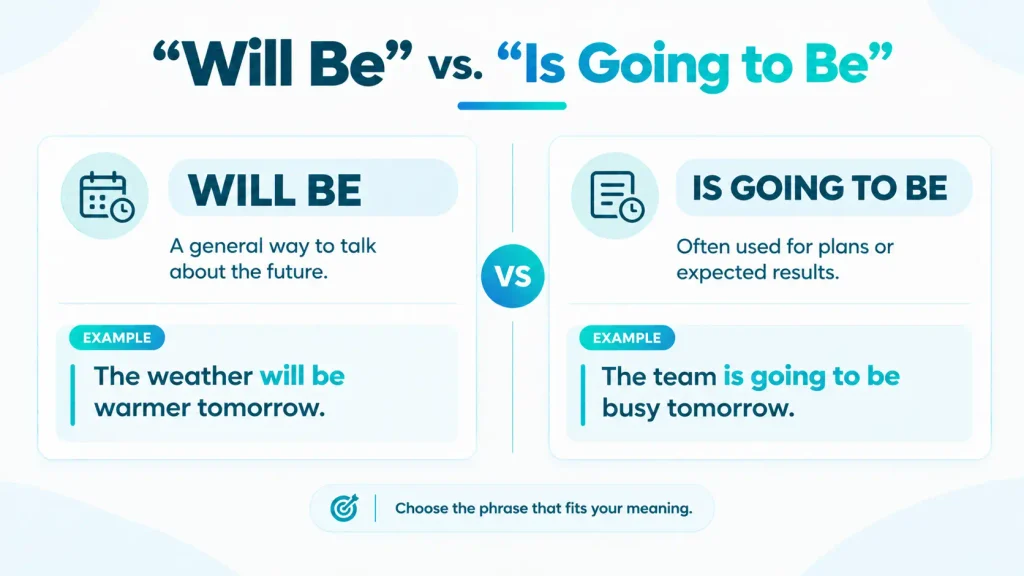
“Will be” and “is going to be” can often describe the same future event. Still, they can carry different shades of meaning.
Consider this example:
The restaurant will be busy tonight.
This sounds like a simple prediction.
Now look at this version:
Look at that line outside. The restaurant is going to be busy tonight.
Here, the speaker sees evidence in the present and uses it to make a prediction.
So, both forms can work. The best choice depends on the situation and the reason for your prediction.
“Will Be” vs. “May Be” vs. “Might Be”
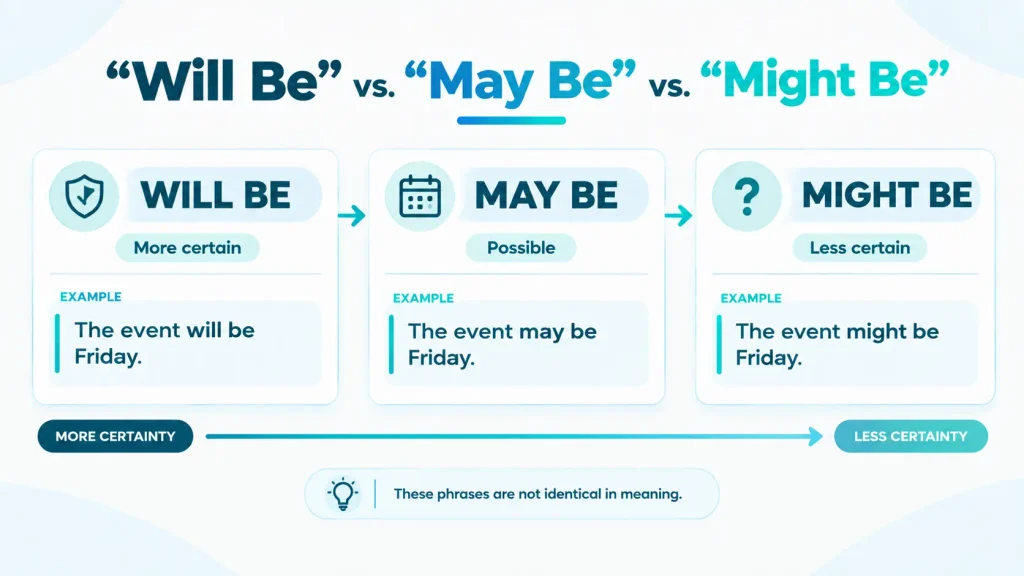
These phrases differ mainly in certainty.
| Phrase | Main idea | Level of certainty | Example |
|---|---|---|---|
| Will be | Future fact or strong prediction | Higher | The test will be difficult. |
| May be | Possible future situation | Uncertain | The test may be difficult. |
| Might be | Possible future situation | Uncertain | The test might be difficult. |
If you know something will happen, “will be” may be the clearest choice. If you are unsure, “may be” or “might be” gives the reader a more accurate picture.
Common Mistakes to Avoid
Treating Every Alternative as an Exact Synonym
Not every phrase has the same meaning as “will be.”
For example, “may be” shows possibility, while “will be” can show a stronger level of certainty.
Using Formal Language in Casual Situations
This sentence sounds overly formal:
The party is anticipated to be enjoyable.
A more natural choice would be:
The party is going to be fun.
The formal version is not necessarily wrong. It simply does not fit the casual setting as well.
Using “Projected” for Ordinary Plans
“Projected to be” usually suggests a forecast or estimate.
Revenue is projected to be $5 million.
For a personal plan, use simpler language:
The trip is going to be two weeks long.
Confusing “Due to Be” With “Going to Be”
“Due to be” often relates to a schedule.
The train is due to be here at 8 p.m.
“Going to be” has a much wider range of uses.
The train is going to be crowded.
These sentences communicate different ideas, so you should not swap the two without checking the context.
Changing “Will Be” When You Don’t Need To
Sometimes “will be” is already the clearest option.
The meeting will be tomorrow.
There is no need to replace it with a longer phrase simply to make the sentence sound different.
Good writing is not about avoiding a common phrase. It is about choosing the clearest phrase for the situation.
Frequently Asked Questions
What is another way to say “will be” in formal writing?
Depending on the meaning, you can use “is expected to be,” “is anticipated to be,” “is projected to be,” “is scheduled to be,” or “is due to be.”
What is a casual way to say “will be”?
“Is going to be” is a common everyday alternative.
It is going to be a great day.
Can I use “is going to be” instead of “will be”?
Often, yes. Both can talk about the future. However, “is going to be” can put more focus on an existing plan or present evidence.
What is another way to say “will be” when showing uncertainty?
Use “may be” or “might be.” You can also use “is likely to be” when something has a good chance of happening.
What is another way to say “will be” in an essay?
For formal or academic writing, phrases such as “is expected to be,” “is likely to be,” and “is projected to be” may work when their meanings fit the sentence.
Is “shall be” another way to say “will be”?
Sometimes, but “shall be” does not work as a universal replacement. In modern American English, “will be” is usually the more natural choice for future statements.
What is the best replacement for “will be”?
There is no single best replacement. “Is going to be” works well in many everyday situations, while “is expected to be,” “is likely to be,” “may be,” and “is scheduled to be” work better for specific meanings.
Conclusion
The best alternative to “will be” depends on what you want the sentence to communicate.
Use “is going to be” for many everyday plans and predictions. Choose “is expected to be” or “is likely to be” when discussing expected outcomes. For uncertainty, “may be” and “might be” work well. When you describe a fixed plan or timetable, “is scheduled to be” or “is due to be” can be more precise.
Most importantly, you do not need to replace “will be” every time. If the original phrase clearly expresses your meaning, keeping it may be the best choice.

Role: Author & Contributing Writer
Olivia Bennett is a dedicated Author at Elite’s Collective, focused on delivering clear, well-researched, and engaging articles tailored to the audience.