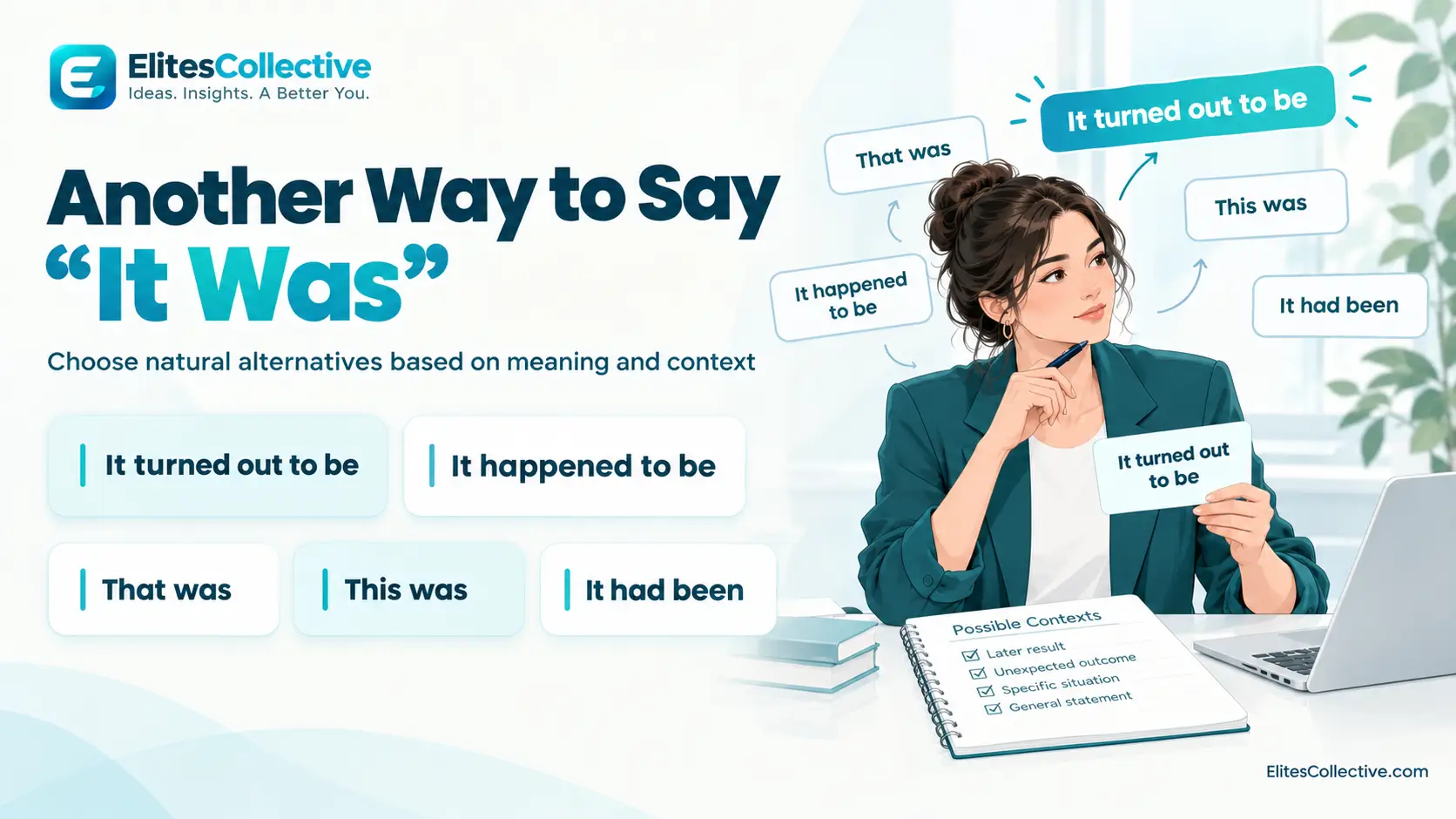
If you’re looking for another way to say “it was,” the best replacement depends on the sentence and what you want to emphasize. Natural alternatives include “it happened to be,” “it turned out to be,” “it had been,” “that was,” “the situation was,” and “the event was.” Some work only in specific contexts, so choosing the right phrase matters.
Key Takeaways
- “It was” is a common form of the verb to be used to describe a past state, condition, identity, or situation.
- There is no single synonym that works in every sentence.
- “It turned out to be” works well when revealing the eventual result.
- “It happened to be” adds a sense of coincidence or unexpected fact.
- “That was” can replace “it was” when referring to something already identified or discussed.
- In some sentences, the most natural alternative is to rewrite the sentence completely rather than replace “it was” word for word.
What Does “It Was” Mean?
“It was” is the past-tense form of “it is” and usually describes something that existed, happened, or had a particular quality in the past.
For example:
It was a beautiful day.
Here, “it was” describes the condition of the day in the past.
Another example:
It was my first day at college.
In this sentence, “it was” identifies a particular past experience.
Because “it was” can perform several grammatical functions, its best alternative depends heavily on the surrounding sentence.
Another Way to Say “It Was”
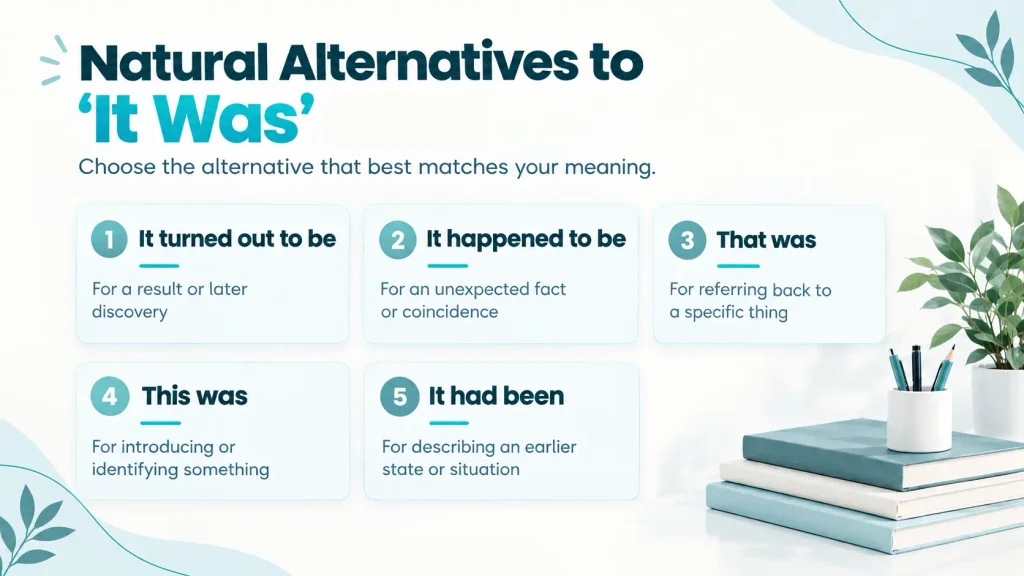
Here are natural alternatives and sentence rewrites to consider:
1. It turned out to be
“It turned out to be” is useful when something was eventually discovered to have a particular quality or identity.
Example:
I thought the movie would be boring, but it turned out to be excellent.
This phrase suggests that the final result was different from what someone initially expected.
Best for: Results, discoveries, surprises, and unexpected outcomes.
2. It happened to be
“It happened to be” suggests that something was true by coincidence or circumstance.
Example:
The person sitting next to me happened to be my old classmate.
This implies that the situation was coincidental.
Best for: Coincidences and unexpected facts.
3. That was
Sometimes “that was” is more natural than “it was,” especially when the thing being discussed has already been identified.
Example:
It was the best decision I ever made.
can become:
That was the best decision I ever made.
The second version works especially well when “that” clearly refers to a particular decision, event, or situation.
Best for: Referring back to something already mentioned.
4. It had been
Use “it had been” when describing something that existed or was true before another past event.
Example:
It was a difficult year before the company recovered.
Depending on the timeline, this could become:
It had been a difficult year before the company recovered.
“Had been” is the past perfect form, so it should not be used simply as a stylistic replacement for “it was.” The sentence needs to involve an earlier past state or event.
Best for: Earlier events or conditions in a past timeline.
5. The situation was
When “it” refers to a particular situation, replacing the pronoun with “the situation” can make the sentence clearer.
Example:
It was difficult for everyone.
can become:
The situation was difficult for everyone.
This is especially useful when the reader might not know what “it” refers to.
Best for: Problems, circumstances, and complicated situations.
6. The event was
If “it” refers to an event, you can sometimes use “the event was” instead.
Example:
It was a memorable experience.
can become:
The event was a memorable experience.
This version is more specific when you are talking about a particular event.
Best for: Meetings, celebrations, conferences, ceremonies, and other events.
7. The experience was
When “it” refers to something someone personally experienced, “the experience was” can be a clearer alternative.
Example:
It was difficult but rewarding.
can become:
The experience was difficult but rewarding.
The replacement makes the subject more specific.
Best for: Personal experiences, trips, challenges, jobs, and activities.
8. The result was
If “it was” introduces the outcome of an action, “the result was” may be more precise.
Example:
We changed the design, and it was much easier to use.
Depending on the intended meaning:
We changed the design, and the result was much easier to use.
However, this rewrite slightly changes the grammatical structure, so it should be used only when “it” actually refers to the result.
Best for: Outcomes, decisions, experiments, and changes.
9. The fact was
“The fact was” can introduce an important truth or circumstance, particularly in explanatory writing.
Example:
It was impossible to ignore the problem.
can sometimes become:
The fact was that the problem was impossible to ignore.
This is more emphatic and often more formal, so it should not be used as a direct replacement in every sentence.
Best for: Explanations, arguments, and emphasis.
10. This was
“This was” works when you are pointing to something specific that has just been mentioned or is clear from context.
Example:
The company introduced a four-day workweek. It was a major change.
can become:
The company introduced a four-day workweek. This was a major change.
“This” can create a stronger connection to the preceding statement.
Best for: Referring to a recently mentioned event, action, or situation.
Quick Comparison of Alternatives
| Alternative | Main Use | Tone | Example |
|---|---|---|---|
| It turned out to be | Unexpected result or discovery | Neutral | It turned out to be a mistake. |
| It happened to be | Coincidence | Neutral | It happened to be my birthday. |
| That was | Referring to something known | Neutral | That was a difficult decision. |
| It had been | Earlier past state | Neutral/Formal | It had been a difficult period. |
| The situation was | Clarifying circumstances | Neutral | The situation was complicated. |
| The event was | Referring to an event | Neutral | The event was successful. |
| The experience was | Referring to an experience | Neutral | The experience was unforgettable. |
| The result was | Referring to an outcome | Neutral/Formal | The result was unexpected. |
| The fact was | Emphasis or explanation | More formal | The fact was that we had no choice. |
| This was | Referring to something just mentioned | Neutral | This was an important development. |
How to Choose the Right Alternative
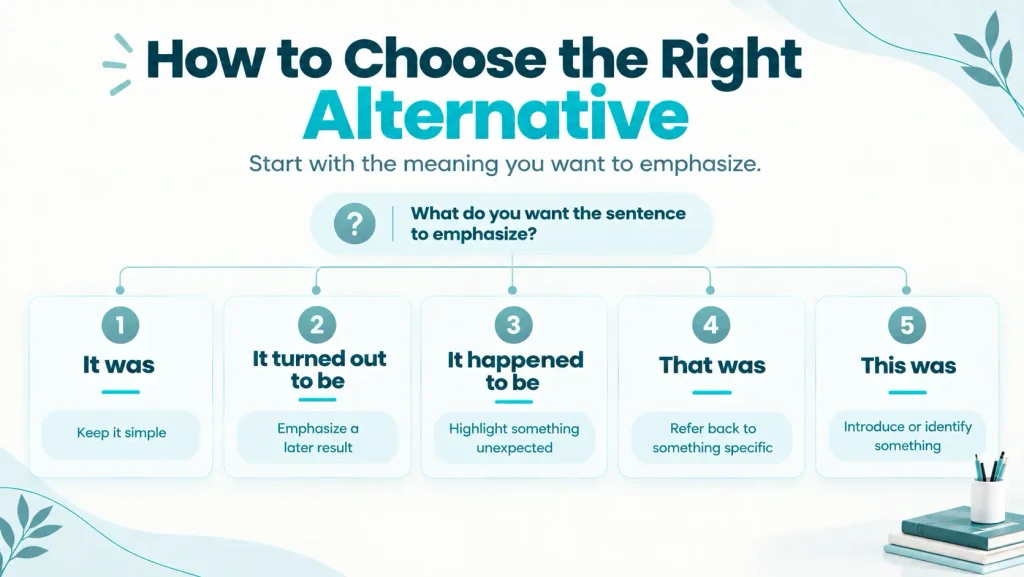
The most important question is: What does “it” refer to?
If “it” refers to a situation, you might use “the situation.”
It was difficult to understand.
→ The situation was difficult to understand.
If “it” refers to an experience:
It was an amazing experience.
→ The experience was amazing.
If you’re emphasizing an unexpected discovery:
We thought it was cheap, but it turned out to be expensive.
Here, “it turned out to be” is more appropriate because the sentence describes something that was discovered later.
If you’re describing an earlier state in relation to another past event:
It had been a difficult period before things improved.
Here, “it had been” is grammatically appropriate because the difficult period occurred before another past change.
“It Was” vs. “It Turned Out to Be”
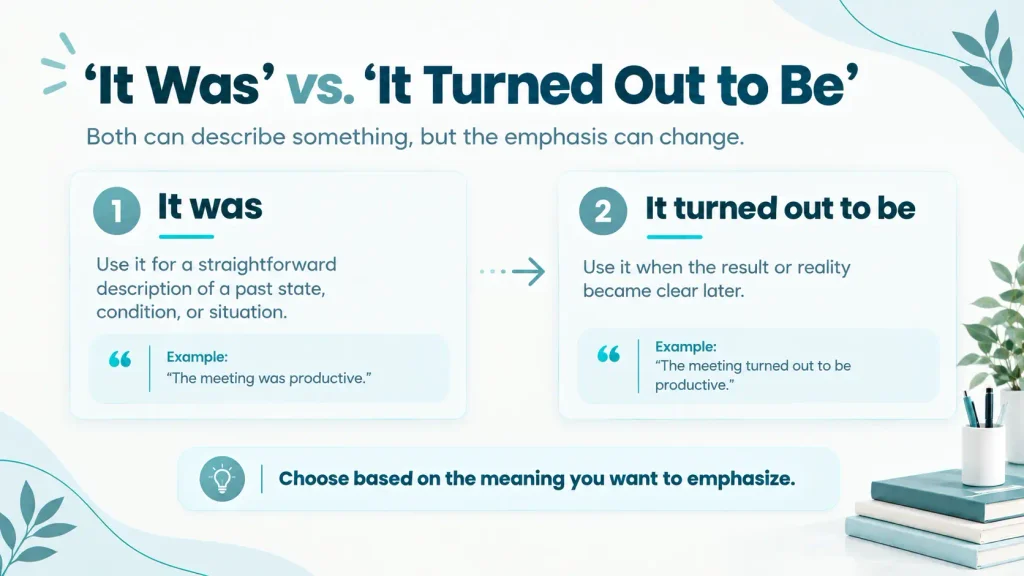
These expressions are related, but they are not interchangeable.
“It was” simply states something about the past:
It was a difficult exam.
“It turned out to be” suggests that the speaker discovered or realized something later:
I expected an easy exam, but it turned out to be difficult.
The second sentence contains an element of expectation and discovery that is missing from the first.
“It Was” vs. “It Happened to Be”
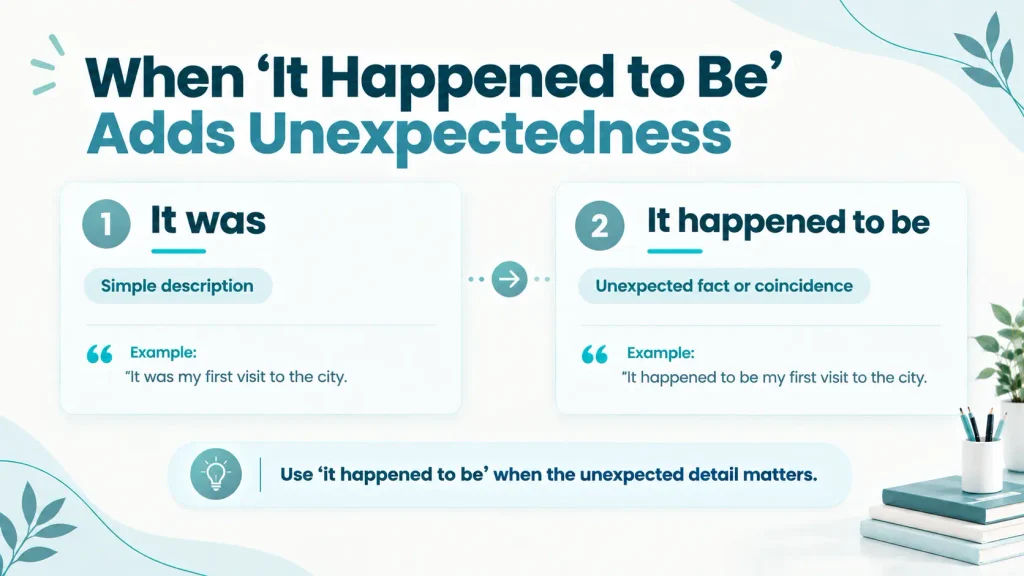
These also have different meanings.
It was Friday.
This simply identifies the day.
It happened to be Friday.
This suggests that Friday was relevant because of coincidence or circumstance.
For example:
I visited the restaurant on Friday, and it happened to be their anniversary.
The phrase “happened to be” adds a sense of coincidence.
When You Should Keep “It Was”
You do not always need to replace “it was.”
“It was” is completely natural, grammatical, and common in American English. Changing it simply to avoid repetition can actually make writing less natural.
For example:
It was a cold morning. It was quiet outside. It was still dark.
Rather than replacing every instance with an awkward synonym, you can improve the paragraph by changing the sentence structure:
It was a cold morning. Outside, everything was quiet, and darkness still covered the streets.
The goal is not to eliminate “it was.” The goal is to make the writing clear and varied when repetition becomes distracting.
Common Mistakes
Treating every alternative as an exact synonym
“It turned out to be” and “it was” do not always mean exactly the same thing. The first suggests a later discovery or result.
Using “it had been” without a past timeline
“Had been” is past perfect. It normally connects an earlier past state to another past event.
Incorrect:
Yesterday, it had been a beautiful day.
when there is no relevant later past reference.
More natural:
It was a beautiful day yesterday.
Replacing “it was” with overly formal language
Phrases such as “the fact was that” can sound unnecessarily heavy in casual writing.
Instead of:
The fact was that I was tired.
A natural sentence is often simply:
I was tired.
Replacing “it” without checking what it refers to
A sentence may become confusing if you replace “it” with a noun that does not match the intended meaning.
Before changing “it was,” identify whether “it” means a situation, event, experience, object, result, idea, or something else.
Frequently Asked Questions
What is another way to say “it was”?
Depending on the context, you can use “it turned out to be,” “it happened to be,” “that was,” “this was,” or a more specific phrase such as “the situation was” or “the experience was.” The correct choice depends on what “it” refers to.
Is “it turned out to be” the same as “it was”?
Not exactly. “It was” simply describes a past state or fact, while “it turned out to be” suggests that something was discovered or became clear later.
What is a formal way to say “it was”?
There is no single formal replacement. Depending on the sentence, you might use “the situation was,” “the result was,” “the circumstance was,” or rewrite the sentence entirely. In many formal contexts, “it was” itself is perfectly appropriate.
What is another way to say “it was” in an essay?
In an essay, consider using a more specific subject instead of repeatedly starting sentences with “it was.” For example, “the study found,” “the result was,” “the experience demonstrated,” or “the situation reflected” may be appropriate when they accurately describe the subject.
Can I use “that was” instead of “it was”?
Sometimes. “That was” is useful when “that” clearly refers to something already mentioned or identified. It is not a universal substitute for “it was.”
How can I avoid repeating “it was” in writing?
Instead of replacing every occurrence with a synonym, vary your sentence structure. You can introduce a specific noun, use an active verb, combine sentences, or rearrange the sentence. This usually sounds more natural than repeatedly searching for synonyms.
Is “it happened to be” formal or informal?
“It happened to be” is generally neutral and natural in both everyday and many written contexts. It is particularly useful when you want to emphasize coincidence.
Final Thoughts
There is no single perfect synonym for “it was.” The best alternative depends on what “it” represents and what the sentence needs to communicate. Use “it turned out to be” for discoveries, “it happened to be” for coincidences, “that was” or “this was” for clear references, and specific nouns such as “the situation was” or “the experience was” when greater clarity is helpful.
In many cases, though, “it was” is already the most natural choice. Good writing is not about replacing common words at every opportunity; it is about choosing the clearest expression for the meaning and context.

Role: English Language & Communication Writer
Daniel Carter is an English language writer specializing in workplace communication, professional vocabulary, resumes, emails, and career-focused English.