
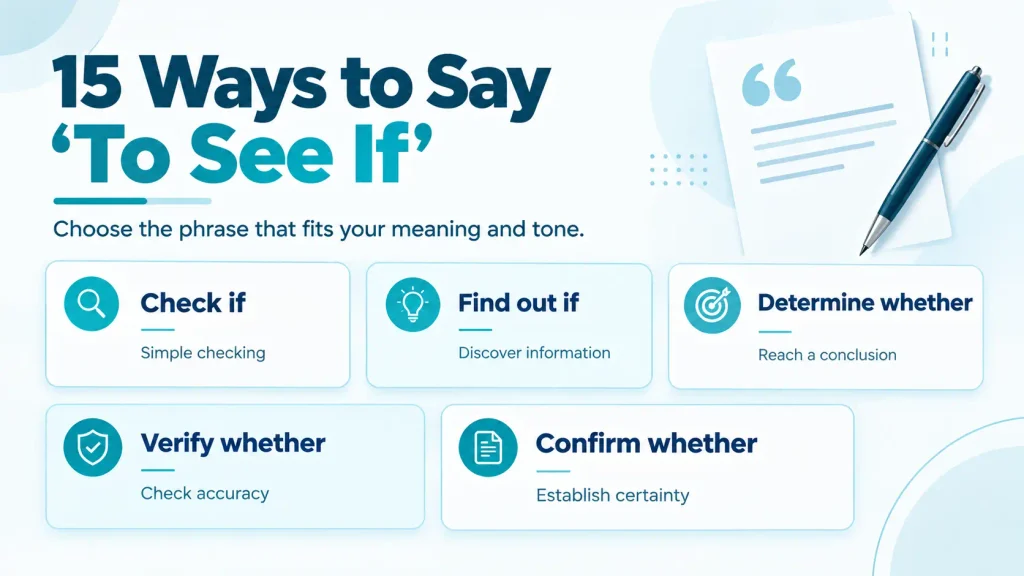
If you’re looking for another way to say “to see if,” you can use phrases such as “to check if,” “to find out whether,” “to determine whether,” “to verify whether,” or “to confirm whether.” The best choice depends on your tone and whether you mean checking, discovering, confirming, or evaluating something.
Key Takeaways
- “To see if” usually means to find out whether something is true, possible, or available.
- “To check if” is the most common direct replacement in everyday and professional English.
- “To find out whether” emphasizes discovering information.
- “To determine whether” sounds more formal and analytical.
- “To verify whether” suggests checking accuracy or correctness.
- “To confirm whether” is useful when you want to establish that something is definitely true.
What Does “To See If” Mean?
“To see if” means to check, discover, or determine whether something is true or will happen.
For example:
I’ll call the office to see if they’re open.
Here, “to see if” means “to find out whether.”
The phrase is natural and widely used in American English. It works well in casual conversation, emails, workplace communication, and many other situations. However, you may want a more precise alternative when you need to emphasize checking, confirmation, investigation, or formal decision-making.
15 Ways to Say “To See If”
1. To Check If
“To check if” is one of the closest and most natural alternatives to “to see if.” It works in both everyday and professional English.
Example:
I’ll check if the meeting room is available.
Best for: Everyday conversation, work, email, and general communication.
2. To Check Whether
“To check whether” has essentially the same meaning as “to check if,” but it can sound slightly more formal or deliberate.
Example:
Please check whether the payment has been processed.
Best for: Professional and formal writing.
Usage tip: “Whether” is especially useful when presenting two possible outcomes.
3. To Find Out If
“To find out if” emphasizes discovering information that you do not currently know.
Example:
I’m going to contact the airline to find out if my flight has been delayed.
Best for: Everyday and conversational English.
4. To Find Out Whether
This is a slightly more formal version of “to find out if.”
Example:
We need to find out whether the supplier can deliver the order by Friday.
Best for: Workplace communication, reports, and formal writing.
5. To Determine If
“To determine if” suggests reaching a conclusion after checking information, evidence, or conditions.
Example:
The technician will inspect the system to determine if it needs repairs.
Best for: Professional, technical, academic, and analytical contexts.
Usage tip: This phrase is more formal than “to see if,” so it may sound too serious for casual conversation.
6. To Determine Whether
“To determine whether” is a formal alternative that emphasizes establishing which of two possibilities is true.
Example:
The committee will review the application to determine whether it meets the requirements.
Best for: Business, academic, legal, and formal writing.
7. To Verify If
“To verify if” means to check something for accuracy or correctness. It is useful when the information may already exist but needs to be checked.
Example:
Please verify if the account information is correct.
Best for: Work, administration, technical communication, and customer service.
Usage tip: In more formal writing, “verify whether” is often a cleaner choice.
8. To Verify Whether
This phrase is useful when you need to establish whether something is accurate, valid, or correct.
Example:
We need to verify whether the documents were submitted correctly.
Best for: Formal, professional, technical, and administrative writing.
9. To Confirm If
“To confirm if” can be used when you want to establish whether something is definitely the case.
Example:
I’m calling to confirm if your appointment is still scheduled for Monday.
Best for: Conversations, customer service, and workplace communication.
Usage tip: “Confirm whether” is often more polished in formal writing.
10. To Confirm Whether
“To confirm whether” is a precise and professional alternative to “to see if.”
Example:
Could you confirm whether the client approved the proposal?
Best for: Professional emails, business communication, and formal writing.
11. To See Whether
“To see whether” is almost identical in meaning to “to see if.” It can sound slightly more formal or deliberate.
Example:
Let’s review the data to see whether there are any errors.
Best for: General, professional, and academic writing.
12. To Establish Whether
“To establish whether” means to determine something through evidence, investigation, or careful examination.
Example:
The investigation will establish whether the reported issue actually occurred.
Best for: Formal, legal, academic, investigative, and professional contexts.
Usage tip: This is stronger and more formal than the everyday phrase “to see if.”
13. To Ascertain Whether
“To ascertain whether” means to find out or establish something with a high degree of certainty. It is quite formal.
Example:
The company contacted the vendor to ascertain whether the shipment had been delivered.
Best for: Formal reports, legal writing, academic writing, and highly professional contexts.
Usage tip: “Ascertain” can sound unnecessarily formal in casual conversation.
14. To Assess Whether
“To assess whether” means to evaluate something before reaching a conclusion.
Example:
The manager will assess whether the proposed changes are practical.
Best for: Business, academic, technical, and decision-making contexts.
Usage tip: Unlike “to see if,” this phrase suggests evaluation rather than simply checking.
15. To Test Whether
“To test whether” means to conduct a test or experiment to determine if something is true, effective, or functional.
Example:
The researchers conducted an experiment to test whether the new method was effective.
Best for: Scientific, technical, academic, and experimental contexts.
Usage tip: Use this only when some form of testing or experimentation is actually involved.
Quick Comparison: Which Alternative Should You Use?
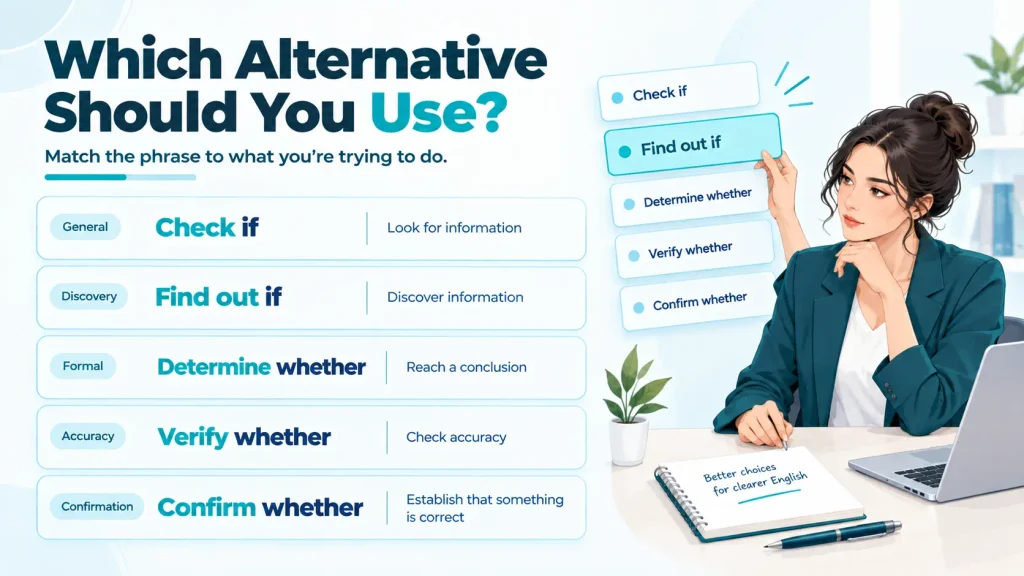
| Alternative | Meaning/Use | Tone | Best Context |
| To check if | Check or look for information | Neutral | Everyday and professional |
| To check whether | Check between possibilities | Neutral/Formal | Work and formal writing |
| To find out if | Discover information | Casual/Neutral | Conversation |
| To find out whether | Discover which possibility is true | Neutral/Formal | Work and writing |
| To determine if | Reach a conclusion | Formal | Professional and analytical |
| To verify whether | Check accuracy or correctness | Formal | Work and technical writing |
| To confirm whether | Establish that something is correct or true | Professional | Emails and business |
| To see whether | Find out whether something is true | Neutral | General writing |
| To establish whether | Establish a fact through evidence | Formal | Legal and academic |
| To ascertain whether | Determine with certainty | Very formal | Formal writing |
| To assess whether | Evaluate a situation or possibility | Formal | Business and academic |
| To test whether | Use a test to determine something | Technical | Scientific and technical contexts |
“To See If” vs. “To See Whether”
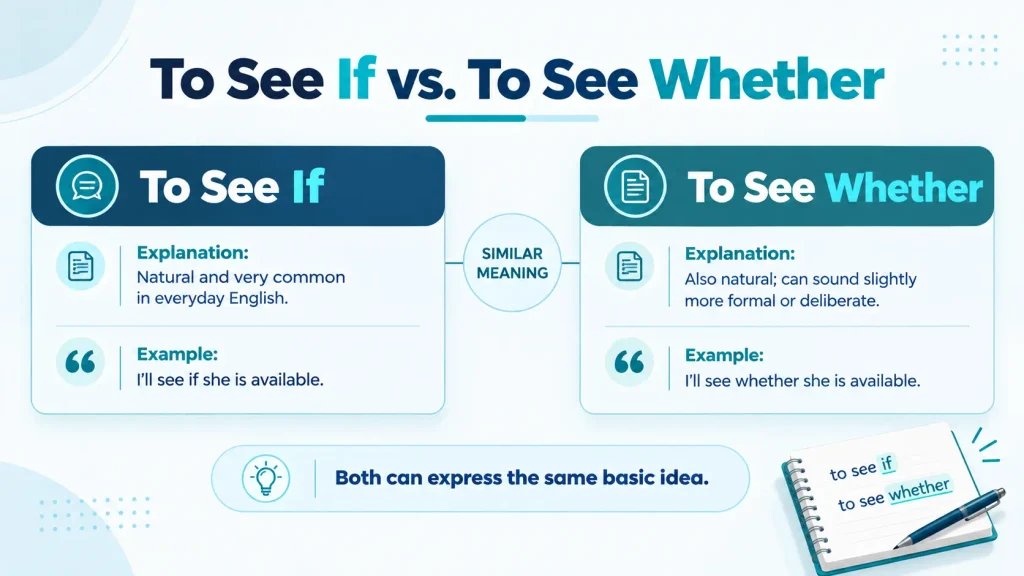
Both “to see if” and “to see whether” are standard English.
For example:
- I’ll see if she is available.
- I’ll see whether she is available.
Both sentences mean that you want to find out whether she is available.
In everyday American English, “if” is extremely common. “Whether” can sound a little more formal, especially in professional or academic writing.
Use “whether” when you want to emphasize two possible outcomes:
We need to determine whether the proposal is accepted or rejected.
You do not always need to replace “if” with “whether.” The choice should depend on context and style.
“To See If” in Professional Writing
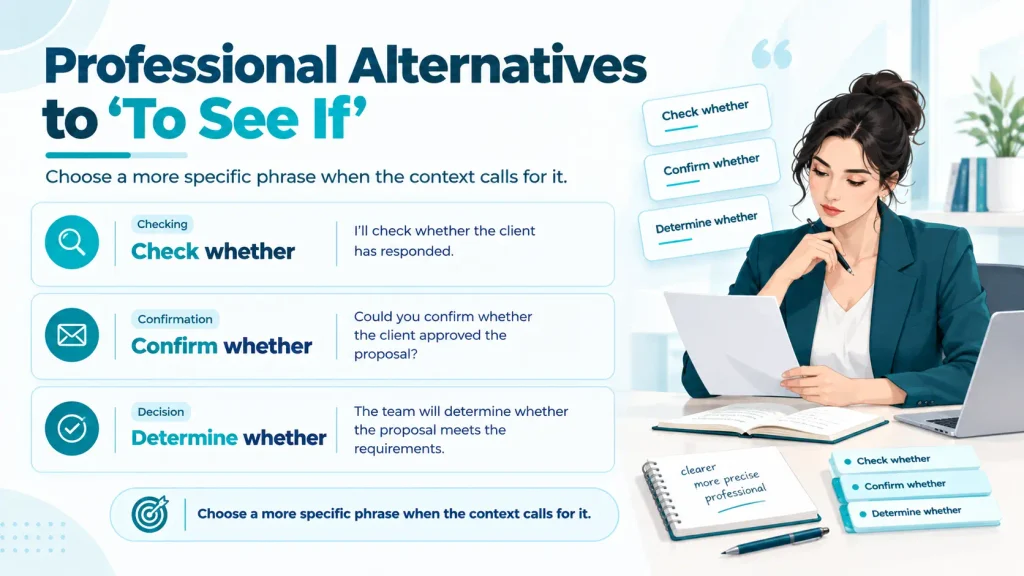
“To see if” is not incorrect or unprofessional. However, a more specific verb can make a business sentence clearer.
For example:
Everyday:
I’ll see if the client has responded.
Professional:
I’ll check whether the client has responded.
More formal:
I’ll confirm whether the client has responded.
The best choice depends on what you are actually doing. If you are simply checking an inbox, “check whether” is appropriate. If you are trying to establish that information is accurate, “verify whether” may be more precise.
Common Mistakes When Replacing “To See If”
Using “to make sure whether”
“To make sure” and “whether” generally do not combine naturally in this structure.
Awkward:
I’ll make sure whether the report is ready.
Better:
I’ll check whether the report is ready.
Or:
I’ll make sure the report is ready.
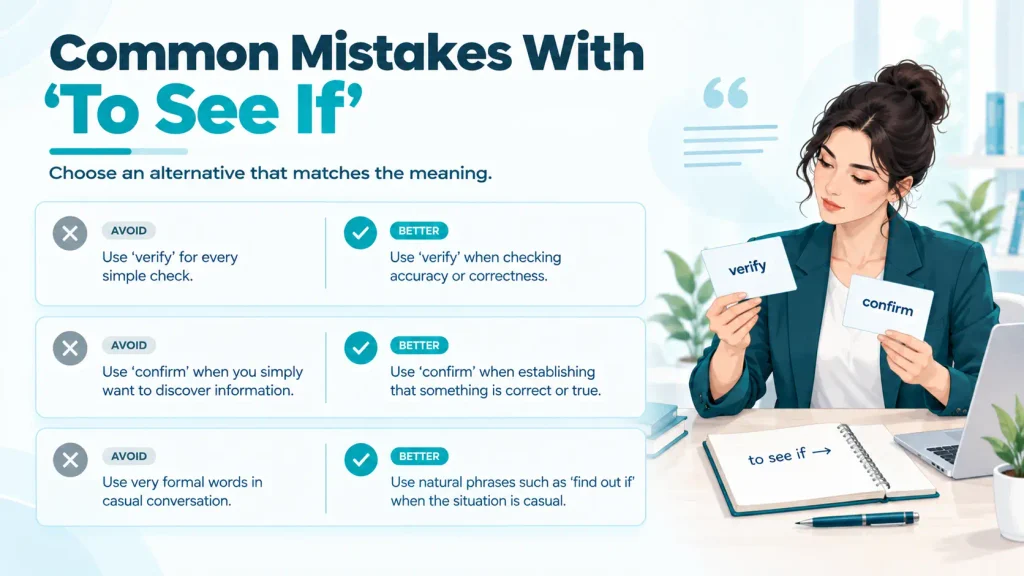
Using “to verify” for simple discovery
“Verify” usually implies checking accuracy or validity.
If you simply want to discover information, “find out” may be more natural.
Less natural:
I’ll verify if the store is open.
More natural:
I’ll check if the store is open.
Using overly formal vocabulary
Words such as “ascertain” and “establish” are grammatically correct, but they can sound excessive in casual conversation.
Instead of:
I’ll ascertain whether she is coming.
Most speakers would naturally say:
I’ll find out if she’s coming.
Treating every alternative as an exact synonym
Not every phrase above has precisely the same meaning.
“Check” emphasizes looking at information.
“Find out” emphasizes discovering information.
“Determine” emphasizes reaching a conclusion.
“Verify” emphasizes checking accuracy.
“Confirm” emphasizes establishing that something is correct or true.
“Assess” emphasizes evaluation.
Choosing the right phrase makes the sentence more precise.
Frequently Asked Questions
What is another way to say “to see if”?
Common alternatives include “to check if,” “to find out if,” “to determine whether,” “to verify whether,” and “to confirm whether.”
Is “to check if” better than “to see if”?
Neither is universally better. “To see if” is natural and conversational, while “to check if” emphasizes actively checking something.
What is a formal way to say “to see if”?
Depending on the meaning, you can use “to determine whether,” “to verify whether,” “to establish whether,” or “to ascertain whether.”
Can I use “whether” instead of “if”?
Yes. In many situations, “whether” can replace “if” after phrases such as “see,” “check,” “find out,” and “determine.” The exact choice depends on sentence structure and emphasis.
What is another way to say “to see if” in an email?
For a professional email, options such as “to check whether,” “to confirm whether,” “to determine whether,” or “to verify whether” can work well.
Is “to see whether” formal?
“To see whether” can sound slightly more formal than “to see if,” but it is still normal English and can be used in everyday conversation.
What is the difference between “check” and “verify”?
“Check” is broad and simply means to look at or examine something. “Verify” specifically suggests checking whether information is accurate, correct, or valid.
What is the most natural replacement for “to see if”?
“To check if” is one of the closest natural replacements. “To find out if” is another excellent choice when the main idea is discovering information.
Conclusion
“To see if” is already a natural expression in American English, so you do not always need to replace it. When you want a different tone or a more precise meaning, choose an alternative based on the situation. Use “check if” for a simple check, “find out if” for discovery, “determine whether” for formal decisions, “verify whether” for accuracy, and “confirm whether” when establishing that something is correct.

Role: English Language & Communication Writer
Daniel Carter is an English language writer specializing in workplace communication, professional vocabulary, resumes, emails, and career-focused English.