

“Have been” is a form of the verb be used to talk about situations that started in the past, continue into the present, or relate past experiences to the present. There is no single replacement that works in every sentence. Depending on the meaning, you can use phrases such as “have stayed,” “have worked,” “have lived,” or “have experienced,” or rewrite the sentence to sound more natural.
Key Takeaways
- The best alternative depends on the sentence and the meaning of “have been.”
- “Have been” often describes an ongoing situation, repeated activity, or past experience.
- Verbs such as “have lived” and “have worked” can replace it when they express the intended meaning.
- Some alternatives change the sentence structure rather than simply replacing two words.
- In formal writing, clarity and correct tense matter more than finding a different phrase.
What Does “Have Been” Mean?
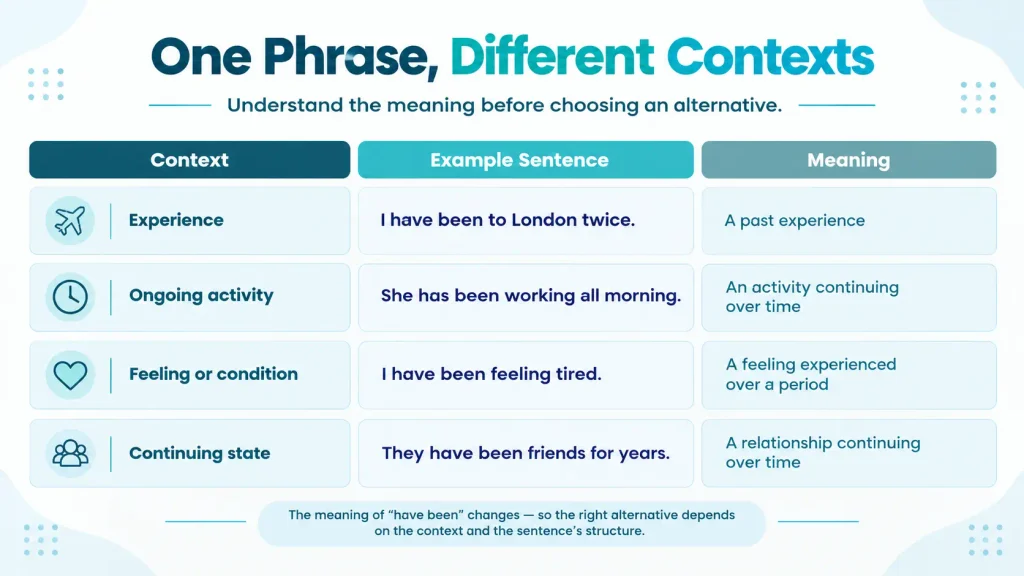
“Have been” combines the helping verb “have” with the past participle “been.” It commonly appears in the present perfect and present perfect continuous tenses.
Its meaning changes with the words that follow it.
- Ongoing state: “I have been busy all morning.”
- Life experience: “I have been to New York twice.”
- Ongoing activity: “She has been studying for three hours.”
- Repeated situation: “They have been late several times.”
- Passive voice: “The documents have been approved.”
Because these sentences use “have been” in different ways, the right replacement depends on the context. For example, “I have lived here for five years” can express a similar idea to “I have been living here for five years,” but “I have visited here” does not always preserve the same meaning.
15 Ways to Say “Have Been” in Different Contexts
The following alternatives work in specific situations. Choose the one that keeps the original meaning and fits your sentence.
1. Have Stayed
Use “have stayed” when you mean that someone has remained in a place or situation for a period of time.
Example:
- Original: We have been at the hotel for three days.
- Alternative: We have stayed at the hotel for three days.
The alternative emphasizes the time spent at the hotel.
2. Have Lived
Use “have lived” to describe where someone has lived over a period of time.
Example:
- Original: I have been in Chicago for five years.
- Alternative: I have lived in Chicago for five years.
Best for: Talking about your home, residence, or life in a particular place. The meaning changes if “have been in Chicago” refers only to a temporary visit.
3. Have Worked
Use “have worked” when describing employment or work experience.
Example:
- Original: I have been at this company since 2022.
- Alternative: I have worked at this company since 2022.
The second sentence makes your employment explicit.
4. Have Felt
Use “have felt” to describe emotions, physical sensations, or states of mind.
Example:
- Original: I have been tired lately.
- Alternative: I have felt tired lately.
Both sentences describe recent tiredness, although “have felt” focuses more directly on the experience of feeling tired.
5. Have Experienced
Use “have experienced” when discussing an event, condition, or situation that someone has encountered.
Example:
- Original: We have been through many challenges.
- Alternative: We have experienced many challenges.
This alternative is useful in personal stories, reports, and professional writing.
6. Have Visited
Use “have visited” when talking about places you have gone to and experienced, especially when the visit is complete.
Example:
- Original: I have been to Boston twice.
- Alternative: I have visited Boston twice.
Both sentences describe past visits. “Have visited” is especially clear when you want to emphasize the act of visiting.
7. Have Attended
Use “have attended” when referring to classes, meetings, events, or institutions.
Example:
- Original: We have been at every team meeting this month.
- Alternative: We have attended every team meeting this month.
The second sentence emphasizes participation rather than simply being present.
8. Have Remained
Use “have remained” when something has continued in the same state or condition.
Example:
- Original: The results have been consistent.
- Alternative: The results have remained consistent.
“Have remained” highlights that the consistency has continued over time.
Best for: Reports, academic writing, and professional communication.
9. Have Continued to
Use “have continued to” when an action or behavior has carried on over time.
Example:
- Original: They have been working on the project.
- Alternative: They have continued to work on the project.
The alternative emphasizes that the work has carried on. Depending on the context, it may suggest that the work was already underway and has not stopped.
10. Have Kept
Use “have kept” when someone has maintained a condition, followed a habit, or continued doing something.
Example:
- Original: I have been in touch with my old classmates.
- Alternative: I have kept in touch with my old classmates.
“Have kept in touch” is a natural expression for maintaining contact with people over time.
11. Have Gone Through
Use “have gone through” when describing experiences, especially difficult situations or major changes.
Example:
- Original: She has been through a difficult time.
- Alternative: She has gone through a difficult time.
Both expressions can describe hardship. “Have gone through” often emphasizes the experience of facing or dealing with it.
12. Have Spent
Use “have spent” when you want to emphasize the amount of time devoted to a place, activity, or person.
Example:
- Original: We have been together for ten years.
- Alternative: We have spent ten years together.
Both can describe a long relationship, but “have spent” puts more emphasis on the time shared.
13. Have Had
Use “have had” when describing a condition, possession, experience, or situation that extends into the present.
Example:
- Original: I have been a headache sufferer for years.
- Alternative: I have had headaches for years.
The second sentence is more direct and natural for describing recurring headaches.
14. Have Occurred
Use “have occurred” when discussing events or incidents, especially in formal or factual writing.
Example:
- Original: Several problems have been reported this week.
- Alternative: Several problems have occurred this week.
These sentences are not identical: the first means people have reported problems, while the second means problems have happened. Use “have occurred” only when that is what you intend to say.
15. Have Been Present
Use “have been present” when emphasizing attendance or physical presence.
Example:
- Original: Several experts have been at the conference.
- Alternative: Several experts have been present at the conference.
This is useful in formal reports, meeting records, and event summaries, although it can sound more formal than the original.
Which Alternative Should You Choose?
The most natural replacement depends on what follows “have been.” Here is a quick reference.
| Original meaning | Possible alternative | Example |
|---|---|---|
| Living somewhere | Have lived | I have lived here for years. |
| Staying somewhere | Have stayed | We have stayed at this hotel before. |
| Working somewhere | Have worked | She has worked here since 2023. |
| Feeling a certain way | Have felt | I have felt better lately. |
| Visiting a place | Have visited | We have visited Seattle twice. |
| Maintaining a state | Have remained | The situation has remained stable. |
| Continuing an action | Have continued to | He has continued to improve. |
| Maintaining contact | Have kept in touch | They have kept in touch for years. |
| Facing an experience | Have gone through | She has gone through a lot. |
| Spending time | Have spent | We have spent years together. |
These are contextual alternatives, not interchangeable synonyms. For example, “have lived” is appropriate for residence, while “have remained” describes continuity or stability. Neither can replace “have been” in every sentence.
How to Replace “Have Been” in Different Sentence Structures
Sometimes the best way to avoid repeating “have been” is to change the sentence structure. The important thing is to preserve the original tense and meaning.
“Have Been” + Adjective
When “have been” describes a condition, you can sometimes use a more specific verb.
- Original: They have been quiet lately.
- Alternative: They have remained quiet lately.
- Original: I have been unhappy with the results.
- Alternative: I have felt unhappy with the results.
The first replacement emphasizes that a condition continued. The second focuses on a person’s feelings.
“Have Been” + Verb Ending in -ing
This pattern describes an activity that started in the past and continues into the present, or a recent activity connected to the present.
- Original: I have been learning English for two years.
- Alternative: I have studied English for two years.
Both sentences can describe an ongoing learning period, but “have been learning” emphasizes the activity, while “have studied” can emphasize the experience or accumulated study.
Another example:
- Original: She has been working all morning.
- Alternative: She has worked all morning.
The first version emphasizes the ongoing activity. The second can emphasize the work completed or the period of work.
“Have Been” + Past Participle
This construction often forms the present perfect passive voice.
- Original: The invitations have been sent.
- Alternative: We have sent the invitations.
The alternative changes the sentence from passive to active voice. It also identifies who performed the action.
This approach works well when the person or group responsible for the action is known and relevant.
“Have Been” + To a Place
When describing a completed visit, you can often replace “have been to” with “have visited.”
- Original: Have you ever been to California?
- Alternative: Have you ever visited California?
Both ask about travel experience. However, “have been to” can be more conversational.
Be careful not to confuse “have been” with “have gone.” The former often indicates that someone visited a place and returned, while the latter usually means the person went there and has not yet returned.
Common Mistakes to Avoid
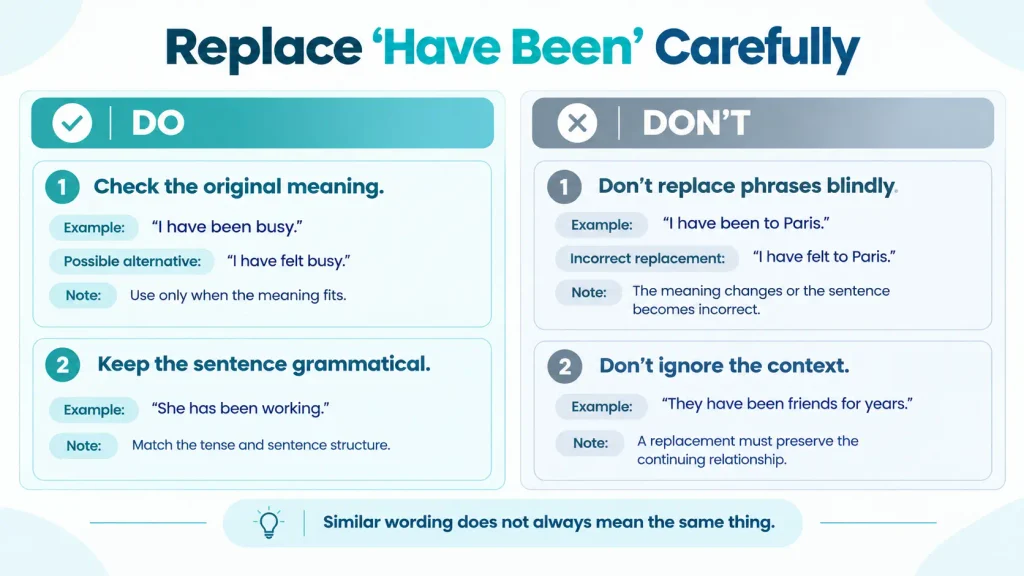
1. Treating Every Alternative as an Exact Synonym
“Have lived,” “have stayed,” and “have visited” describe different situations. Choose the verb that expresses what actually happened.
2. Changing the Tense Without a Reason
Consider this example:
- Correct for an ongoing situation: I have worked here for three years.
- Different time meaning: I worked here for three years.
The second sentence often suggests a completed period of employment. The first normally connects the employment to the present.
3. Using “Had Been” When You Mean “Have Been”
“Had been” is commonly used for a state or activity that relates to a later point in the past.
- Present connection: I have been busy all day.
- Past reference point: I had been busy before the meeting started.
Choose the form based on the time relationship you want to express.
4. Replacing “Have Been” With an Awkward Phrase
You do not always need an alternative. “I have been waiting for an hour” is natural American English. Replacing it with an unnecessarily complicated phrase can make your writing less clear.
Frequently Asked Questions
What is another word for “have been”?
There is no single word that replaces “have been” in every context. Depending on the sentence, alternatives include “have lived,” “have stayed,” “have worked,” “have felt,” and “have remained.”
What is a more formal way to say “have been”?
Formal alternatives depend on the intended meaning. “Have remained” can describe a continuing state, “have experienced” can describe an event or condition, and “have attended” can describe participation in an event.
For example, “The results have been stable” can become “The results have remained stable.”
What is another way to say “I have been”?
The best replacement depends on what comes next.
- “I have been here for years” → “I have stayed here for years,” if you mean you remained there.
- “I have been a teacher for years” → “I have taught for years.”
- “I have been feeling tired” → “I have felt tired.”
These alternatives are not interchangeable in every situation.
What is another way to say “have been doing”?
When appropriate, you can use “have continued to,” “have worked on,” “have practiced,” or another specific verb.
For example, “They have been practicing every day” can become “They have practiced every day.” The original emphasizes the ongoing activity, while the alternative can emphasize the repeated practice.
Can I use “have had” instead of “have been”?
Sometimes. “Have had” works when the intended meaning involves possession, an experience, or a condition.
For example, “I have been dealing with headaches” can become “I have had headaches,” although the second version does not emphasize the ongoing process of dealing with them.
Is “have been” grammatically correct?
Yes. “Have been” is correct with subjects such as I, you, we, and they in the present perfect. It can describe states, experiences, and ongoing activities.
For example, “I have been busy,” “We have been to Florida,” and “They have been studying” are all grammatically correct.
What is the difference between “have been” and “have gone”?
“Have been to” generally describes a visit that has taken place, with the person having returned. “Have gone to” generally indicates that the person went somewhere and is still away.
For example, “Maya has been to the store” usually means Maya has returned. “Maya has gone to the store” usually means she is still there or on her way.
Conclusion
The best alternative to “have been” is the one that expresses your intended meaning naturally. Use “have lived” for residence, “have worked” for employment, “have felt” for emotions, and “have remained” for a continuing state. When no alternative fits perfectly, keep “have been.” Correct grammar and clear meaning are more important than avoiding a phrase simply because it appears more than once.

Role: Lead Author & Content Specialist
James Mitchell is an experienced Lead Author at Elite’s Collective. He specializes in creating high-impact editorial content and driving core written projects designed to inform and engage readers.