
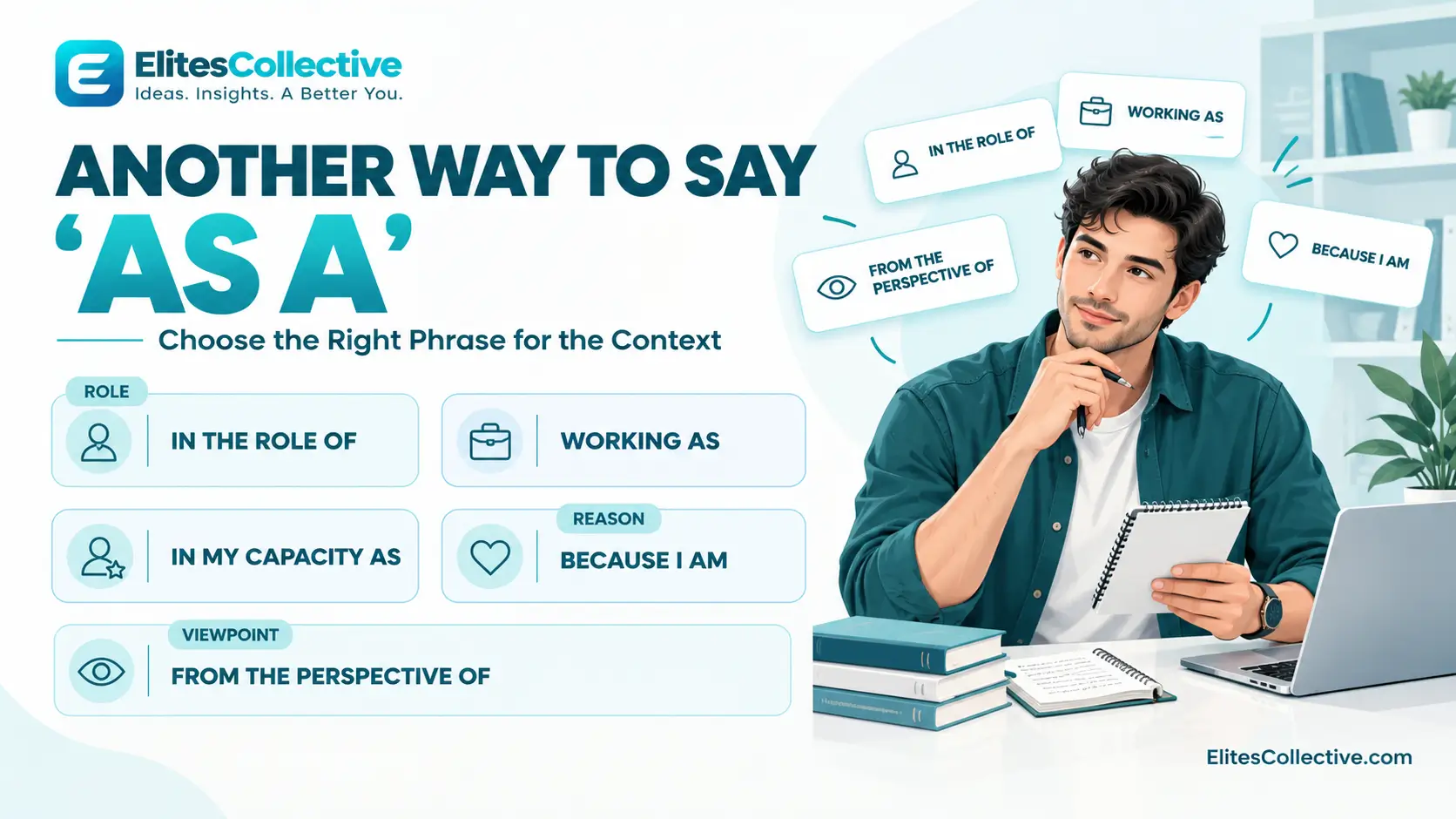
The best alternative to “as a” depends on what you mean. You can use in the role of, in my capacity as, or working as when describing someone’s job or position. For comparisons, like may fit, while because I am or since I am can work when “as a” introduces a person’s role as a reason.
Key Takeaways
- In the role of works when describing someone’s function or position.
- In my capacity as is a formal choice for professional writing.
- Working as emphasizes someone’s job or occupation.
- Like can express similarity, but it does not fit every use of “as a.”
- Because I am and since I am can replace some sentences that use “as a” to explain a reason.
- The right alternative depends on the full sentence because “as a” has several grammatical uses.
What Does “As a” Mean?
The phrase “as a” commonly introduces someone’s role, identity, occupation, or function. It can also appear in sentences that describe a person’s perspective or explain why they do something.
For example:
- Role: As a teacher, I encourage students to ask questions.
- Function: She spoke as a representative of the company.
- Reason: As a beginner, I need more time to learn the basics.
These examples do not all mean the same thing. Some alternatives work well for describing a role, while others are better for explaining a reason or expressing a point of view.
15 Alternatives to “As a” With Examples
1. In the Role of
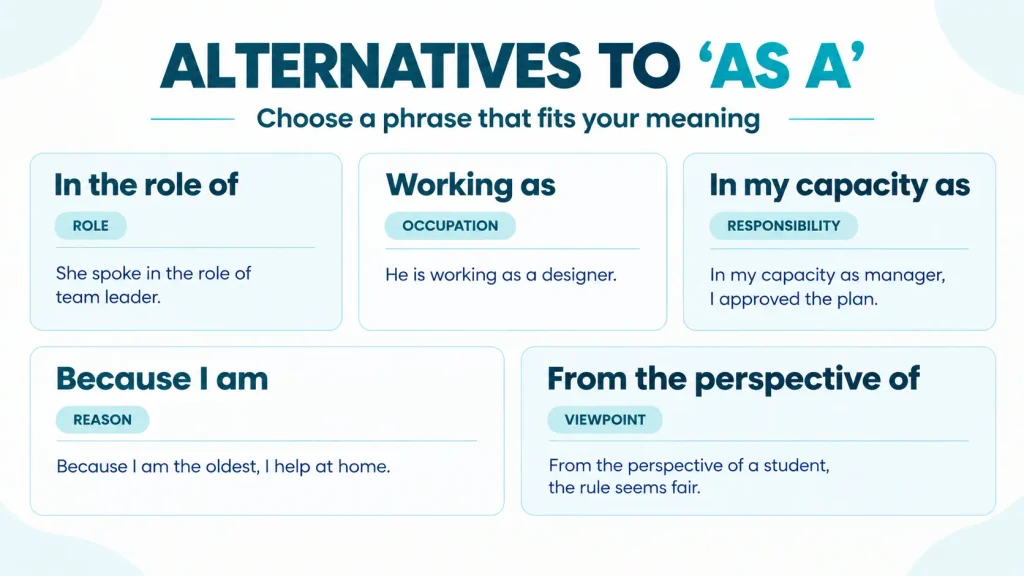
This phrase emphasizes the position or function someone performs. It is useful when explaining responsibilities in professional, academic, or organizational settings.
Example: In the role of team leader, Marcus helps coordinate daily tasks.
Best for: Professional writing, leadership, and formal descriptions.
2. In My Capacity as
A formal expression used to describe the authority, responsibilities, or position from which someone acts.
Example: In my capacity as project manager, I approved the final schedule.
Best for: Business correspondence, official statements, and workplace communication.
3. Working As
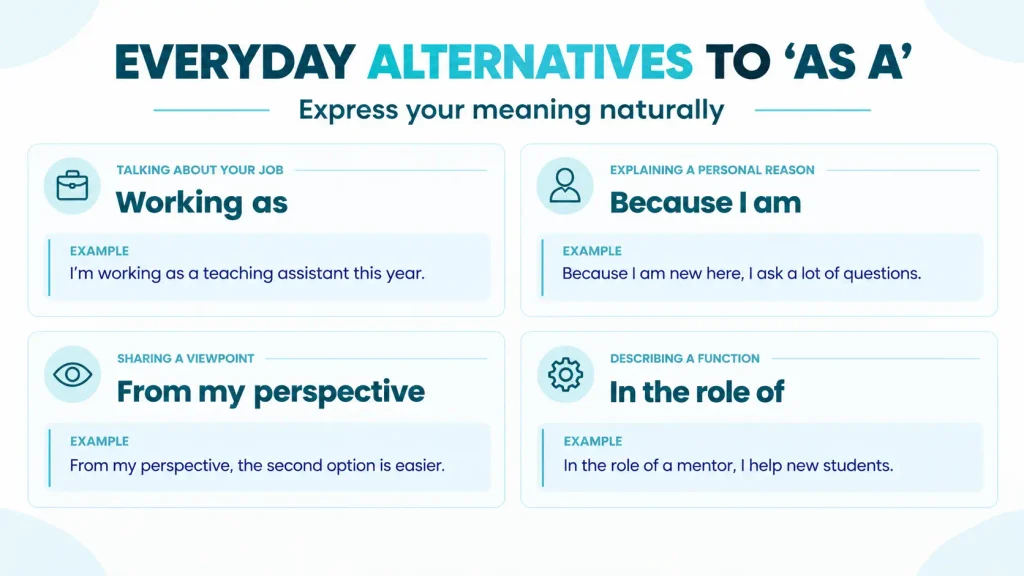
Use this phrase when talking about someone’s occupation or current work.
Example: Working as a nurse has taught Elena how to stay calm under pressure.
Best for: Career discussions, biographies, and everyday conversation.
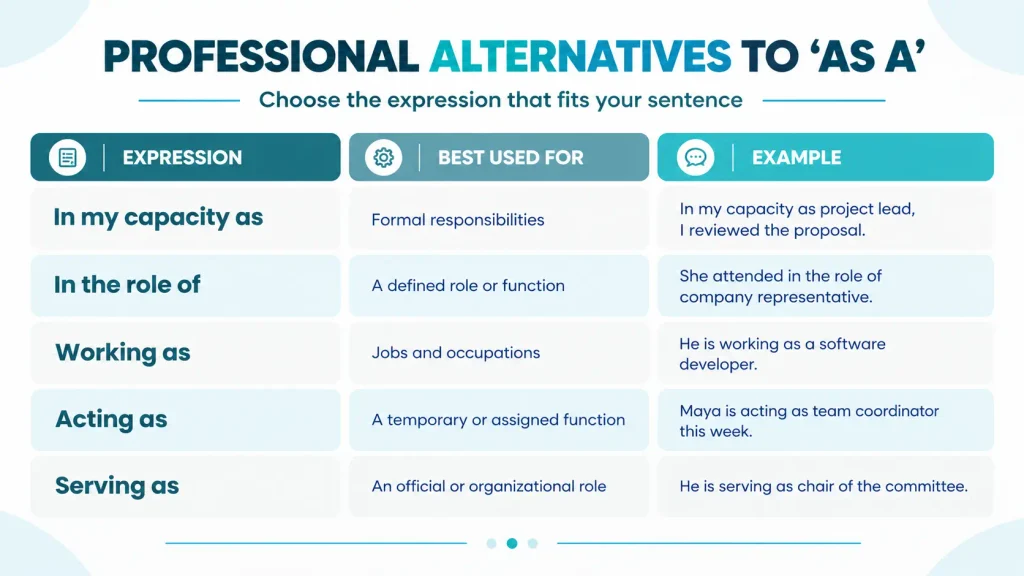
4. Serving As
This phrase emphasizes a duty, appointment, or position someone holds.
Example: Daniel is serving as the interim director until a permanent replacement is hired.
Best for: Leadership, volunteer roles, and temporary appointments.
5. Acting As
Use this expression when someone performs a particular function, especially temporarily or in place of another person.
Example: Priya is acting as the main contact while her manager is away.
Best for: Temporary responsibilities and workplace situations.
6. In the Position of
This phrase highlights a person’s place within an organization or situation.
Example: In the position of department head, she must make difficult decisions.
Best for: Formal explanations of authority and responsibilities.
7. As Someone Who
This expression introduces a person’s experience, identity, or characteristics as relevant to the rest of the sentence.
Example: As someone who travels frequently, I always pack light.
Alternative: As a frequent traveler, I always pack light.
Best for: Personal statements, explanations, and conversational writing.
8. From the Perspective of
Use this phrase when explaining how someone views a situation based on their role, experience, or interests.
Example: From the perspective of a parent, school safety is a major concern.
Best for: Essays, discussions, analysis, and opinion writing.
9. In the Eyes of
This expression describes how someone or a group perceives a person or situation.
Example: In the eyes of her students, she is a trusted mentor.
Best for: Opinions, relationships, and discussions of reputation.
10. In the Form of
This phrase describes the particular shape, type, or expression something takes.
Example: The company offered support in the form of a training program.
Best for: Explanations, descriptions, and formal writing.
Note: This is not a direct replacement for “as a” when describing a person’s occupation.
11. Like
Use “like” to compare something with a similar person or thing. It does not always preserve the meaning of “as a.”
Example: She works like a professional, even though she is still learning.
Best for: Casual comparisons and descriptions.
Important distinction: “She works as a teacher” describes her job. “She works like a teacher” compares her behavior with that of a teacher.
12. Being a
This phrase can introduce a characteristic or circumstance that influences an action or experience.
Example: Being a new employee, Jordan had several questions about the company policies.
Best for: Explanations and everyday writing.
13. Since I Am
Use this phrase when someone’s identity or situation provides a reason for an action.
Example: Since I am a beginner, I prefer lessons that explain each step.
Best for: Giving reasons and explaining personal circumstances.
14. Because I Am
This is a clear alternative when the original sentence uses “as a” to express a reason rather than a role alone.
Example: Because I am a parent, I pay close attention to school schedules.
Best for: Direct explanations and conversational writing.
15. As Someone in
This expression can describe a person’s membership in a profession, group, or particular situation.
Example: As someone in the medical field, she understands the importance of patient privacy.
Alternative: As a medical professional, she understands the importance of patient privacy.
Best for: Professional introductions and discussions of experience.
Which Alternative Should You Choose?
| Alternative | Main purpose | Tone |
|---|---|---|
| In the role of | Describing a function | Neutral to formal |
| In my capacity as | Explaining authority or responsibility | Formal |
| Working as | Describing employment | Neutral |
| Serving as | Describing a position or duty | Neutral to formal |
| Acting as | Describing a temporary function | Neutral |
| From the perspective of | Expressing a viewpoint | Neutral to formal |
| Like | Making a comparison | Casual to neutral |
| Being a | Introducing a circumstance | Neutral |
| Since I am | Giving a reason | Neutral |
| Because I am | Explaining a cause | Neutral |
| As someone who | Connecting experience to a statement | Neutral |
How to Replace “As a” Naturally
Before choosing an alternative, identify what the phrase means in your sentence.
- For a job: “As a designer, I create website layouts.” → “Working as a designer, I create website layouts.”
- For responsibility: “As a team leader, I organize meetings.” → “In my role as team leader, I organize meetings.”
- For a reason: “As a beginner, I need extra practice.” → “Because I am a beginner, I need extra practice.”
- For a viewpoint: “As a customer, I expect helpful service.” → “From a customer’s perspective, helpful service matters.”
- For a comparison: “She speaks as a native speaker would.” → “She speaks like a native speaker.”
Remember that “as a” is often already the most natural choice. Replacing it is useful when you want to clarify your meaning, avoid repetition, or adjust the tone.
Common Mistakes to Avoid
Using “like” to describe an actual job
“Like a doctor” usually expresses similarity, while “as a doctor” identifies someone’s role.
Using formal phrases in casual conversation
“In my capacity as” can sound stiff when “as” or “working as” would be clearer.
Treating every alternative as interchangeable
“In the form of” describes how something appears or is provided. It cannot replace “as a” in every sentence.
Ignoring the sentence structure
Some alternatives require a complete rewrite. For example, “As a beginner, I need help” becomes “Because I am a beginner, I need help,” not simply “Because a beginner, I need help.”
Frequently Asked Questions
What is the most common alternative to “as a”?
There is no single replacement for every situation. “In the role of” works for functions, “working as” suits occupations, and “because I am” works when the phrase expresses a reason.
How can I say “as a” in formal writing?
Use “in my capacity as,” “in the role of,” or “serving as,” depending on the sentence. These expressions are particularly useful in professional and official contexts.
Can I use “like” instead of “as a”?
Sometimes, but the meaning may change. “As a teacher” identifies someone as a teacher, while “like a teacher” usually describes someone or something that resembles a teacher.
Is “being a” a synonym for “as a”?
It can replace “as a” in some sentences, especially when introducing a circumstance. For example, “As a beginner, I need practice” can become “Being a beginner, I need practice,” although “Because I am a beginner” may sound clearer.
What is a professional way to say “as a team leader”?
“In my role as team leader” and “in my capacity as team leader” are professional alternatives. The second sounds more formal and is often best suited to official communication.
How do I avoid repeating “as a” in an essay?
Rewrite sentences according to their meaning. Try “in the role of” for responsibilities, “from the perspective of” for viewpoints, and “because I am” for reasons. Keep “as a” wherever it remains the clearest option.
Conclusion
The best alternative to “as a” depends on whether you are describing a job, explaining a responsibility, expressing a viewpoint, or giving a reason. Choose expressions such as “in the role of,” “working as,” or “because I am” when they make your meaning clearer. In many sentences, the original phrase remains the simplest and most natural choice.

Role: Lead Author & Content Specialist
James Mitchell is an experienced Lead Author at Elite’s Collective. He specializes in creating high-impact editorial content and driving core written projects designed to inform and engage readers.