

When writing an essay, research paper, book review, or literary analysis, you may need another way to say “according to the author.” Although this phrase helps you introduce information or explain a writer’s viewpoint, repeating it too often can make your writing sound monotonous. Fortunately, several alternatives can help you express the same idea more clearly and naturally.
Some of the best alternatives include as the author explains, the author argues, according to the writer, as noted by the author, the author suggests, and in the author’s view. However, each expression has a slightly different meaning. For example, “the author argues” introduces an argument, while “the author explains” introduces an explanation.
In this guide, you will learn more than 25 alternatives to “according to the author,” including their meanings, example sentences, and tips for using them in academic and everyday writing.
Quick Answer: What Is Another Way to Say “According to the Author”?
Here are some common alternatives to “according to the author”:
- As the author explains
- According to the writer
- As stated by the author
- The author argues that
- The author suggests that
- In the author’s view
- As noted by the author
- The author points out that
- As the writer observes
- The author maintains that
- The writer emphasizes that
- Based on the author’s account
- As described by the author
- The author indicates that
- The author believes that
- As the author mentions
- The author claims that
- The text suggests that
- As outlined by the author
- The author highlights that
- According to the text
- As the writer explains
- The author concludes that
- The author proposes that
- The passage indicates that
Best overall choice: “As the author explains” is a natural alternative when introducing an explanation. For an academic argument, “the author argues that” is often more precise.
Best Alternatives to “According to the Author” With Examples
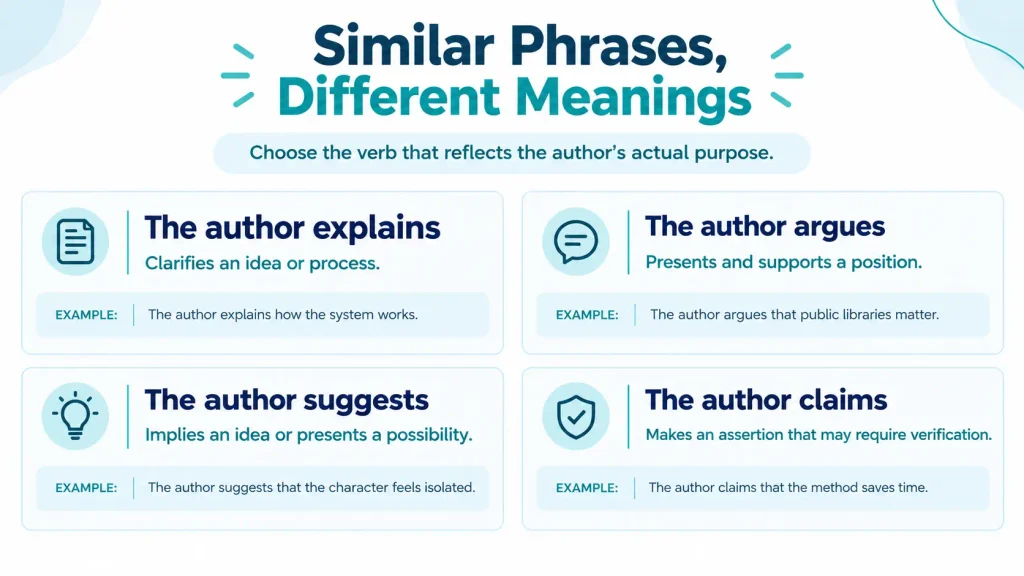
The following table highlights useful alternatives and explains when each one works best.
| Alternative | Best Use | Example |
|---|---|---|
| As the author explains | Introducing an explanation | As the author explains, education encourages critical thinking. |
| According to the writer | General attribution | According to the writer, communication builds trust. |
| As stated by the author | Reporting a specific statement | As stated by the author, the policy changed in 2020. |
| The author argues that | Presenting an argument | The author argues that public libraries remain essential. |
| The author suggests that | Presenting an interpretation or possibility | The author suggests that exercise may improve concentration. |
| In the author’s view | Expressing an opinion | In the author’s view, honesty strengthens relationships. |
| As noted by the author | Highlighting a detail | As noted by the author, the results varied between groups. |
| The author points out that | Drawing attention to a fact or issue | The author points out that access to education remains unequal. |
| The author observes that | Reporting an observation | The author observes that social habits change over time. |
| The author maintains that | Reporting a sustained position | The author maintains that creativity requires practice. |
| The writer emphasizes that | Highlighting an important idea | The writer emphasizes that preparation improves performance. |
| Based on the author’s account | Summarizing reported information | Based on the author’s account, the journey lasted several weeks. |
| As described by the author | Describing an event or situation | As described by the author, the village was surrounded by mountains. |
| The author indicates that | Reporting what evidence or wording suggests | The author indicates that further research is necessary. |
| The author claims that | Reporting a claim | The author claims that the method saves time. |
1. As the Author Explains
“As the author explains” is one of the most versatile alternatives to “according to the author.” Use it when a writer clarifies a concept, provides background information, or explains how something works.
Examples:
- Original: According to the author, effective communication reduces misunderstandings.
- Alternative: As the author explains, effective communication reduces misunderstandings.
- Original: According to the author, regular exercise supports overall well-being.
- Alternative: As the author explains, regular exercise can support overall well-being.
Best for: Essays, educational writing, book reviews, and explanatory paragraphs.
2. According to the Writer
“According to the writer” is a direct alternative that retains almost exactly the same meaning as the original phrase. It is especially useful when you want to avoid repeating the word “author.”
Examples:
- According to the writer, patience is essential for personal growth.
- According to the writer, technology has changed how people communicate.
Best for: General essays, summaries, reading responses, and informal academic writing.
Use “writer” when it sounds natural for the source you are discussing. In literary analysis, “author” may be more appropriate when referring to the creator of a novel, poem, or book.
3. As Stated by the Author
“As stated by the author” works well when you want to report a specific statement made in a source. It is more formal than many everyday alternatives.
Examples:
- As stated by the author, the research involved 500 participants.
- As stated by the author, the organization was founded in 1998.
Best for: Academic assignments, research summaries, reports, and formal documents.
However, avoid this phrase when the source only implies an idea rather than explicitly stating it.
4. The Author Argues That
Use “the author argues that” when a writer presents a position and supports it with reasoning or evidence.
Examples:
- According to the author, schools should teach financial literacy.
- The author argues that schools should teach financial literacy.
- According to the author, public transportation deserves more investment.
- The author argues that public transportation deserves more investment.
Best for: Argumentative essays, critical analysis, persuasive writing, and academic discussions.
This phrase is particularly helpful because it identifies the author’s statement as an argument rather than presenting it as an established fact.
5. The Author Suggests That
“The author suggests that” introduces an idea, possibility, interpretation, or recommendation without necessarily presenting it as a firm conclusion.
Examples:
- The author suggests that reading before bed may improve relaxation.
- The author suggests that community involvement can strengthen local relationships.
Best for: Literary analysis, research discussions, interpretations, and essays involving possible explanations.
Remember that “suggests” can indicate an indirect meaning. It is not always interchangeable with “states.”
6. In the Author’s View
“In the author’s view” is a useful phrase for introducing an opinion, judgment, or interpretation.
Examples:
- In the author’s view, success depends on consistency rather than luck.
- In the author’s view, strong leadership begins with listening.
Best for: Opinion analysis, book reviews, essays, and discussions of an author’s perspective.
This alternative also helps distinguish a writer’s opinion from objective evidence.
7. As Noted by the Author
“As noted by the author” highlights a detail, observation, or piece of information mentioned in the source.
Examples:
- As noted by the author, the community faced several economic challenges.
- As noted by the author, the study included participants from different age groups.
Best for: Research papers, reports, informative articles, and academic summaries.
Use this phrase when you want to draw attention to information that matters to your discussion.
8. The Author Points Out That
“The author points out that” emphasizes a detail the writer considers relevant or worth noticing.
Examples:
- The author points out that small changes can produce meaningful results.
- The author points out that access to clean water remains a major concern.
Best for: Analytical essays, informative writing, research summaries, and discussions of important details.
9. The Author Observes That
“The author observes that” is suitable when reporting an observation about behavior, events, trends, or conditions.
Examples:
- The author observes that people often communicate differently online.
- The author observes that urban neighborhoods have changed significantly.
Best for: Social science writing, literature analysis, reports, and descriptive essays.
Unlike “argues,” this expression does not necessarily suggest that the author is trying to prove a position.
10. The Author Maintains That
“The author maintains that” introduces a position or belief the writer continues to support.
Examples:
- The author maintains that education should be accessible to everyone.
- The author maintains that responsible leadership requires accountability.
Best for: Academic argumentation, critical essays, policy discussions, and persuasive writing.
This expression is slightly formal, so it works better in academic contexts than in casual conversations.
More Ways to Say “According to the Author”
You can also use the following alternatives to improve variety and precision in your writing.
11. The Writer Emphasizes That
Use this phrase when the writer gives special importance to an idea.
Example: “The writer emphasizes that teamwork requires mutual respect.”
12. Based on the Author’s Account
This phrase introduces information based on the author’s description or report of events.
Example: “Based on the author’s account, the expedition encountered severe weather.”
13. As Described by the Author
Use this alternative when summarizing a scene, experience, event, or process.
Example: “As described by the author, the town was quiet and peaceful.”
14. The Author Indicates That
This phrase reports information that the writer communicates or that the evidence in the text points toward.
Example: “The author indicates that the project may require additional funding.”
15. The Author Believes That
Use this expression when reporting a writer’s belief or opinion.
Example: “The author believes that lifelong learning helps people adapt to change.”
16. As the Author Mentions
This phrase refers to a detail the author mentions in the source.
Example: “As the author mentions, the company expanded into international markets.”
A smoother alternative in formal writing may be “as the author notes.”
17. The Author Claims That
“The author claims that” introduces a statement or assertion made by the writer. Depending on context, it can sound neutral or suggest that the statement needs further verification.
Example: “The author claims that the new approach improves productivity.”
Use this expression carefully because “claims” can imply that the statement is disputed or not yet proven.
18. The Text Suggests That
This phrase is useful when discussing an implication of a passage rather than a statement the author makes directly.
Example: “The text suggests that the character feels isolated from society.”
19. As Outlined by the Author
Use this expression when referring to a plan, framework, set of steps, or explanation presented in a source.
Example: “As outlined by the author, the process involves three stages.”
20. The Author Highlights That
This alternative emphasizes an important point, issue, or finding.
Example: “The author highlights that affordable housing remains a significant challenge.”
21. According to the Text
This phrase is especially useful when discussing a passage, article, or assigned reading rather than focusing on the person who wrote it.
Example: “According to the text, the experiment produced unexpected results.”
22. As the Writer Explains
This expression works well when the writer clarifies a subject or provides supporting details.
Example: “As the writer explains, consistent practice helps learners develop new skills.”
23. The Author Concludes That
Use this phrase when summarizing the conclusion a writer reaches after presenting information or reasoning.
Example: “The author concludes that further investigation is necessary.”
Do not use it for an idea mentioned only in the introduction or middle of a text.
24. The Author Proposes That
This alternative introduces a recommendation, plan, theory, or suggested solution.
Example: “The author proposes that cities invest more in public transportation.”
25. The Passage Indicates That
This phrase focuses on what a particular passage communicates or implies.
Example: “The passage indicates that the main character has changed over time.”
26. The Writer Contends That
“Contends” is a formal alternative to “argues.” It is suitable when the author defends a particular position.
Example: “The writer contends that access to education should be a public priority.”
27. As Evidenced in the Text
Use this phrase when an interpretation is supported by details or evidence in the source.
Example: “As evidenced in the text, the character becomes more confident throughout the story.”
For academic writing, identify the specific textual evidence whenever possible.
28. The Author’s Perspective Is That
This expression explicitly introduces the viewpoint expressed by the author.
Example: “The author’s perspective is that cooperation leads to better outcomes.”
A more concise version is “The author believes that cooperation leads to better outcomes,” provided that this accurately reflects the source.
How to Choose the Right Alternative
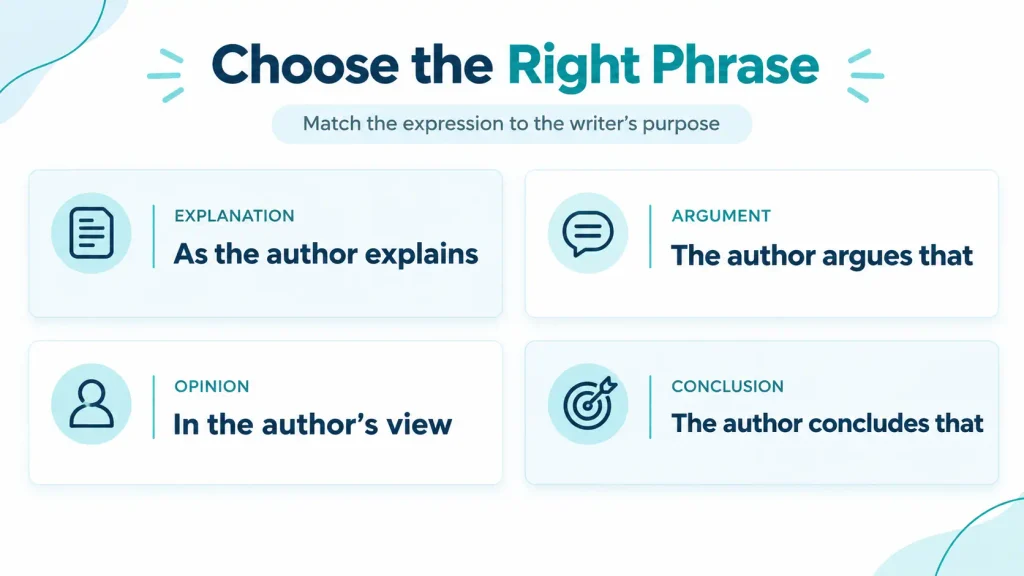
The best replacement depends on what you want to communicate. Before choosing a phrase, determine whether the source presents a fact, opinion, argument, observation, or conclusion.
| Purpose | Best Alternative |
|---|---|
| Explain an idea | As the author explains |
| Report a direct statement | As stated by the author |
| Introduce an argument | The author argues that |
| Present an opinion | In the author’s view |
| Highlight a detail | The author points out that |
| Describe an observation | The author observes that |
| Introduce a recommendation | The author proposes that |
| Summarize a conclusion | The author concludes that |
| Discuss a passage | The text suggests that |
| Report a personal account | Based on the author’s account |
Example: Improving an Academic Sentence
Consider the original sentence:
“According to the author, social media influences how people communicate.”
You can rewrite it in several ways, depending on the intended meaning.
- For an argument: The author argues that social media influences how people communicate.
- For an observation: The author observes that social media influences how people communicate.
- For an opinion: In the author’s view, social media influences how people communicate.
- For an implication: The text suggests that social media influences how people communicate.
Although these sentences discuss the same general topic, they communicate different relationships between the writer and the idea. Therefore, choose the version that accurately reflects the original source.
Common Mistakes to Avoid
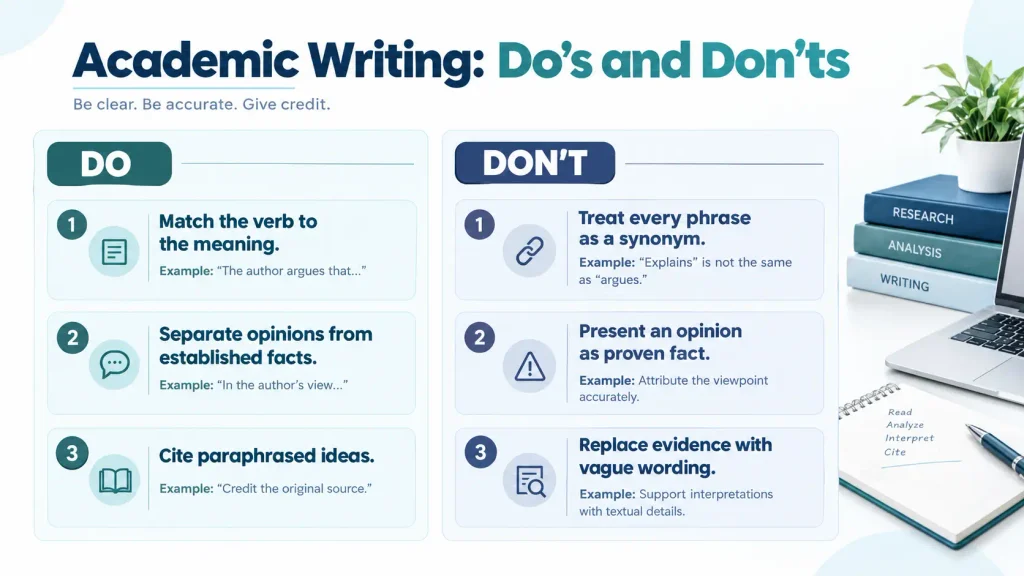
Treating Every Alternative as an Exact Synonym
Not every phrase has the same meaning. For example, “the author argues” suggests a reasoned position, whereas “the author mentions” simply reports that an idea appears in the text.
Choose the phrase that best represents the author’s actual purpose.
Presenting an Author’s Opinion as a Fact
If a writer expresses a personal opinion, make that distinction clear. For instance, “The author believes that remote work improves productivity” is more precise than presenting the claim as an established fact without supporting evidence.
Overusing Formal Language
Phrases such as “the writer contends” and “as evidenced in the text” can be useful in academic writing. However, simpler alternatives often work better in everyday writing.
For example, “The author says that practice improves performance” may be more appropriate for a simple reading response than “The author contends that practice improves performance.”
Forgetting to Cite the Original Source
In academic writing, changing the wording does not remove the need to credit the original author. If you paraphrase a source, provide the citation required by your assignment or citation style.
Additionally, use quotation marks when reproducing the author’s exact words, and include the appropriate citation.
Frequently Asked Questions
What is the most formal way to say “according to the author”?
Formal alternatives include “as stated by the author,” “the author contends that,” and “as outlined by the author.” The best choice depends on whether you are reporting a statement, an argument, or a proposed framework.
What is another way to say “according to the author” in an essay?
You can write “as the author explains,” “the author argues that,” “in the author’s view,” or “the text suggests that.” Select a phrase that accurately represents the idea you are discussing.
How can I avoid repeating “according to the author”?
Vary your sentence structure and choose verbs that describe the author’s purpose. For example, use “the author explains,” “the writer argues,” “the text indicates,” or “the author concludes” where appropriate.
Is “according to the writer” the same as “according to the author”?
Yes, they often have the same meaning. Both phrases introduce information or opinions attributed to the person who wrote a text. However, “author” is often preferred in discussions of books, novels, and scholarly publications.
Can I use “the author states that” in academic writing?
Yes. “The author states that” is appropriate when reporting a statement made by the author. If the writer is interpreting evidence or defending a position, expressions such as “the author suggests that” or “the author argues that” may be more accurate.
What is another way to say “according to the author” in literary analysis?
Useful alternatives include “the narrator suggests,” “the text reveals,” “the author portrays,” and “the passage indicates.” These phrases can be especially effective when analyzing themes, characters, symbolism, or narrative techniques. Remember that the narrator and the author are not necessarily the same person.
What is a shorter alternative to “according to the author”?
“The author says,” “the text states,” and “the writer notes” are concise options. However, choose a verb that accurately describes the information being presented.
Is “as per the author” correct?
“As per the author” can be understood, but it often sounds awkward when introducing an author’s opinion or interpretation. In most cases, “according to the author” or “as the author explains” sounds more natural.
Conclusion
Finding another way to say “according to the author” can make your academic writing, essays, and reading responses more varied and precise. The best alternative depends on the purpose of the sentence.
Use “as the author explains” for explanations, “the author argues that” for arguments, “in the author’s view” for opinions, and “the author concludes that” for conclusions. Meanwhile, “the text suggests that” works well when discussing an implication found in a passage.
Ultimately, effective writing is not about replacing every repeated phrase. Instead, focus on choosing accurate expressions that communicate the author’s meaning clearly while keeping your writing natural and easy to understand.

Role: Lead Author & Content Specialist
James Mitchell is an experienced Lead Author at Elite’s Collective. He specializes in creating high-impact editorial content and driving core written projects designed to inform and engage readers.