

If you’re looking for another way to say “hi” in another language, you have many options depending on the language and situation. Common examples include “hola” in Spanish, “bonjour” in French, “ciao” in Italian, “hallo” in German, and “namaste” in Hindi. The right greeting depends on the culture, setting, and level of formality.
Key Takeaways
- “Hi” has different natural equivalents across languages.
- Some greetings are casual, while others are more polite or formal.
- “Hello” and “hi” do not always have an exact one-to-one translation.
- Cultural context matters when choosing a greeting.
- Learning a local greeting can make conversations feel warmer and more respectful.
What Does “Hi” Mean in Another Language?
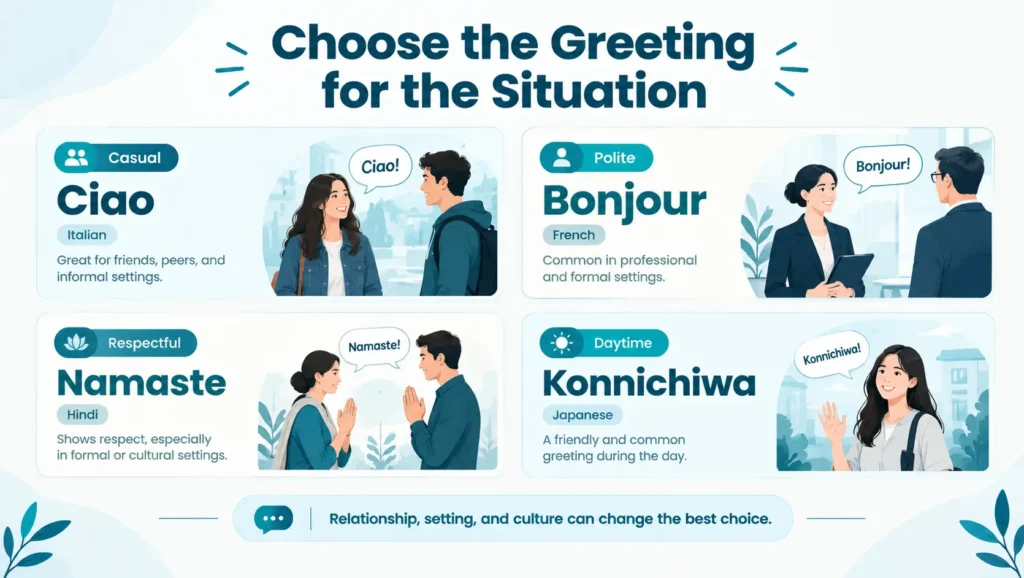
“Hi” is a casual English greeting used when meeting someone, starting a conversation, or acknowledging another person. Many languages have a direct equivalent, but the most natural choice can change depending on the situation.
For example, “hola” is commonly used in Spanish, while “bonjour” is a standard French greeting. In Italian, “ciao” can mean either “hi” or “bye,” depending on the context.
Some languages also use greetings that carry cultural meaning beyond a simple “hi.” That is why a literal translation is not always the best choice.
10 Ways to Say “Hi” in Another Language
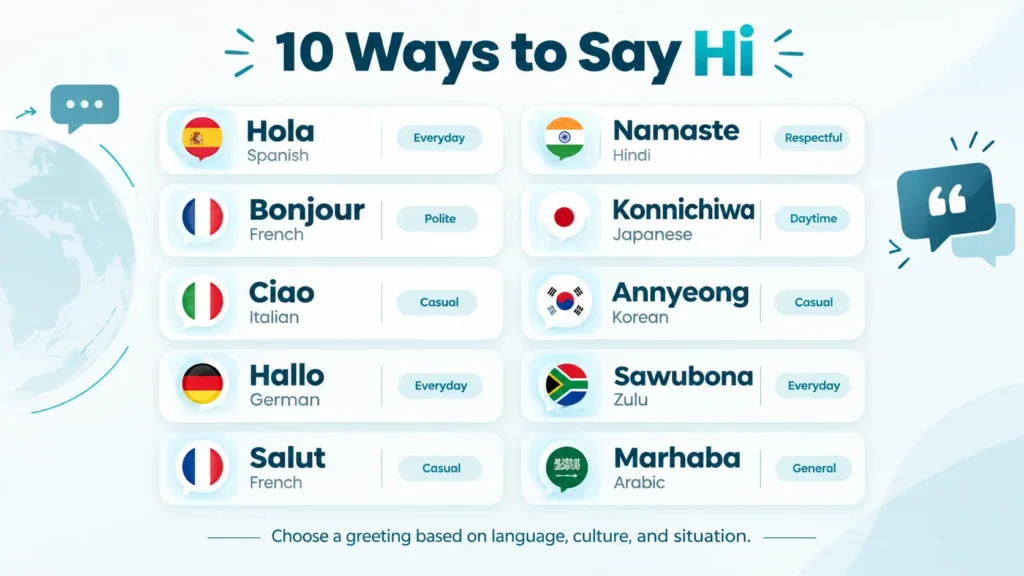
Here are 10 common ways to greet someone in different languages.
1. Hola — Spanish
Hola is the standard Spanish equivalent of “hi” or “hello.” It works in many everyday situations and is widely understood across Spanish-speaking countries.
Example:
“¡Hola! ¿Cómo estás?”
“Hi! How are you?”
Best for: Casual and general conversations.
2. Bonjour — French
Bonjour means “hello” and is one of the most common French greetings. It is generally more polite than the casual English “hi.”
It can be used when greeting someone during the daytime, including in stores, workplaces, and social situations.
Example:
“Bonjour, comment allez-vous?”
“Hello, how are you?”
Best for: Polite, everyday, and formal situations.
3. Ciao — Italian
Ciao is a familiar Italian greeting that can mean both “hi” and “bye.”
Because it is informal, it is most appropriate when speaking with friends, family, or people in casual settings.
Example:
“Ciao! Come stai?”
“Hi! How are you?”
Best for: Casual and friendly conversations.
4. Hallo — German
Hallo is a common German greeting that can be used much like “hello” or “hi” in English.
It is useful in everyday conversations and does not have the strongly formal tone associated with some other German greetings.
Example:
“Hallo! Wie geht’s?”
“Hi! How are you?”
Best for: Everyday conversations.
5. Salut — French
Salut is a casual French greeting. Unlike bonjour, it is generally used with friends, family, or people you know.
It is closer in tone to the English “hi” than to the more polite “hello.”
Example:
“Salut! Ça va?”
“Hi! How are you?”
Best for: Casual and friendly situations.
6. Namaste — Hindi
Namaste is a well-known greeting used in Hindi and several other South Asian languages and cultural contexts.
It can be used as a respectful greeting and is often associated with a gesture in which the palms are brought together.
Example:
“Namaste! Aap kaise hain?”
“Hello! How are you?”
Best for: Respectful greetings and cultural settings.
7. Konnichiwa — Japanese
Konnichiwa is a common Japanese greeting, usually associated with daytime.
It is more closely related to “hello” than the very casual English “hi,” but it is widely recognized as a standard Japanese greeting.
Example:
“Konnichiwa! Ogenki desu ka?”
“Hello! How are you?”
Best for: Polite daytime greetings.
8. Annyeong — Korean
Annyeong is a casual Korean greeting often used among friends and people of similar age or familiar relationships.
A more polite form is annyeonghaseyo, which is commonly used when addressing someone respectfully.
Example:
“Annyeong! Jal jinaesseo?”
“Hi! How have you been?”
Best for: Casual conversations with familiar people.
9. Sawubona — Zulu
Sawubona is a greeting in isiZulu, one of South Africa’s major languages.
It is commonly translated as “hello,” although its cultural meaning can be richer than a simple English greeting.
Example:
“Sawubona! Unjani?”
“Hello! How are you?”
Best for: Greetings in Zulu-speaking contexts.
10. Marhaba — Arabic
Marhaba is a common Arabic greeting that can be translated as “hello” or “hi.”
Arabic has many greetings that vary by country, region, formality, and religious or cultural context, so the most natural expression can depend on where you are.
Example:
“Marhaba! Kayfa haluk?”
“Hello! How are you?”
Best for: General greetings in many Arabic-speaking contexts.
Quick Comparison
| Greeting | Language | Meaning | Typical Use |
| Hola | Spanish | Hi / Hello | Everyday |
| Bonjour | French | Hello | Polite / Everyday |
| Ciao | Italian | Hi / Bye | Casual |
| Hallo | German | Hi / Hello | Everyday |
| Salut | French | Hi | Casual |
| Namaste | Hindi | Hello / Greeting | Respectful |
| Konnichiwa | Japanese | Hello | Polite / Daytime |
| Annyeong | Korean | Hi | Casual |
| Sawubona | Zulu | Hello | Everyday / Cultural |
| Marhaba | Arabic | Hi / Hello | General |
How Do You Choose the Right Greeting?
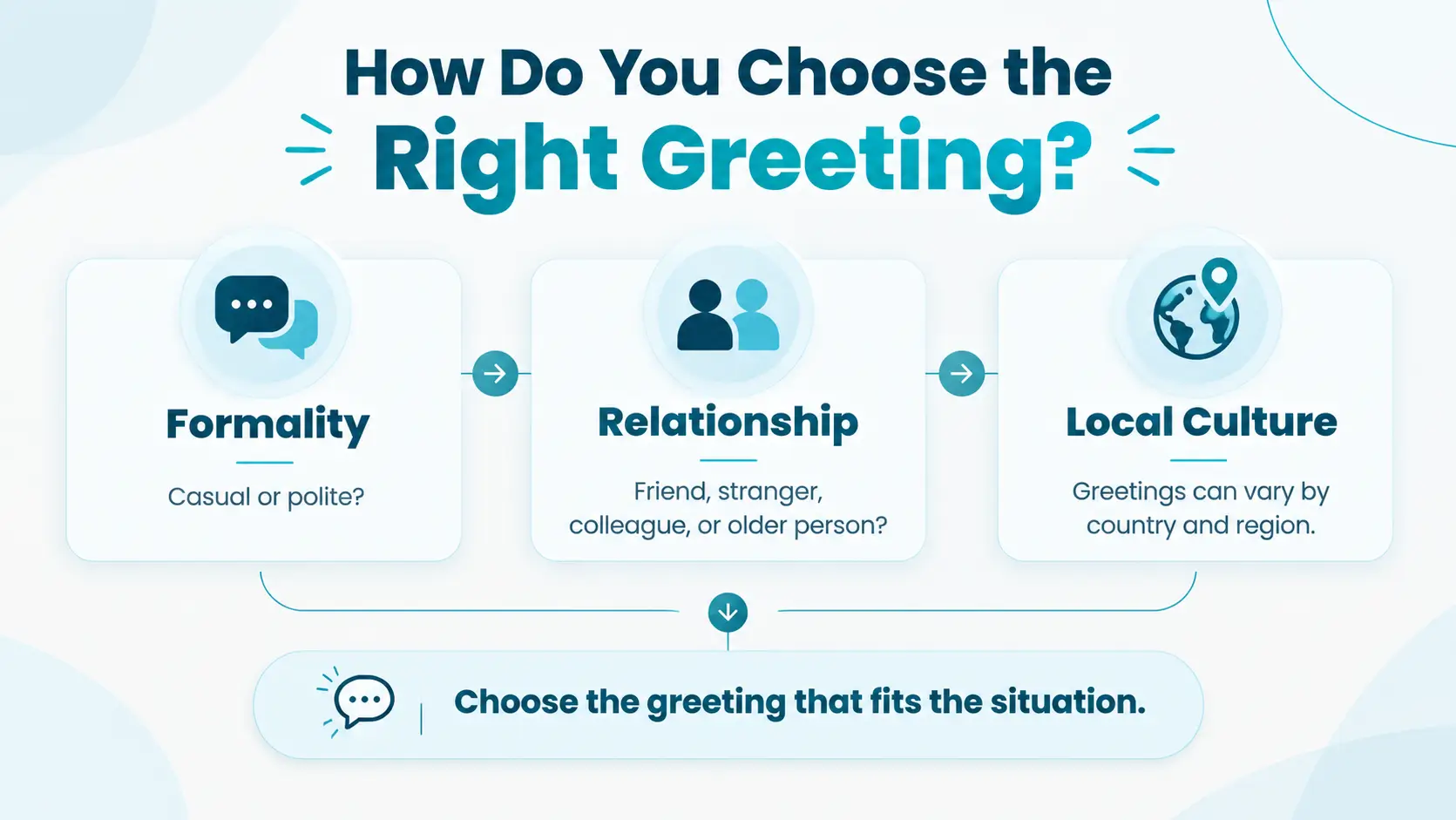
The best greeting depends on more than the language itself. Consider these three factors.
1. Formality
Some greetings are suitable for almost any situation, while others are strongly casual.
For example, bonjour is appropriate when speaking politely to someone in French, while salut is more familiar and casual.
2. Relationship
Think about who you are greeting.
A casual expression may work well with a friend but sound too familiar when speaking to a stranger, teacher, customer, or older person.
3. Local Culture
A greeting can vary between countries and regions where the same language is spoken.
For example, Arabic has many regional variations, and the preferred greeting can differ depending on the country and social setting.
“Hi” vs. “Hello” in Other Languages
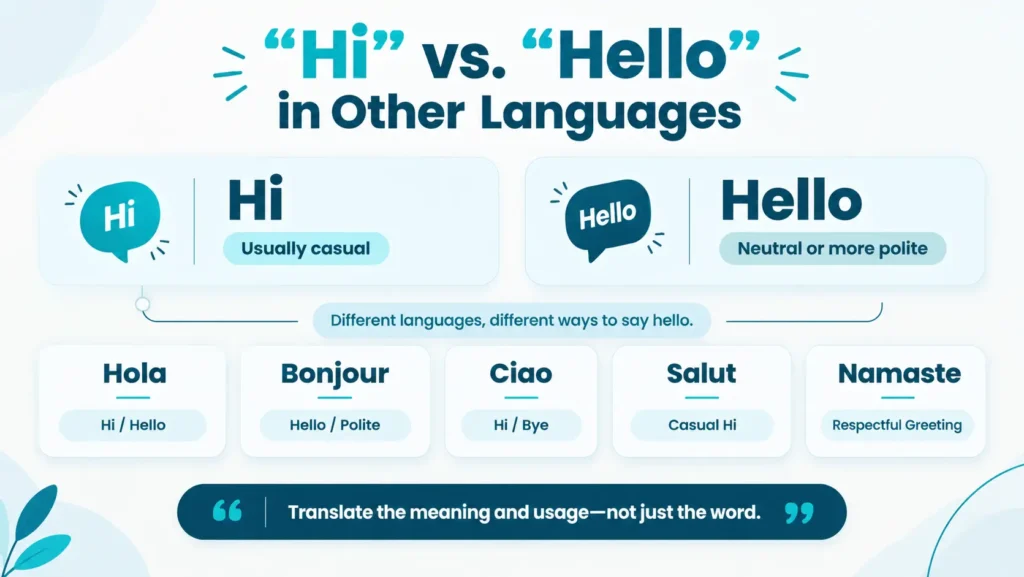
English makes a simple distinction between “hi” and “hello,” but other languages do not always make the same distinction.
For example:
- Hola can mean either “hi” or “hello.”
- Bonjour is generally closer to “hello” but can serve as an everyday greeting.
- Ciao is informal and can mean both “hi” and “bye.”
- Salut is a casual French equivalent of “hi.”
- Namaste functions as a respectful greeting rather than simply matching the English word “hi.”
So, when translating a greeting, focus on how the expression is actually used, not just its dictionary translation.
Common Mistakes When Using Foreign Greetings
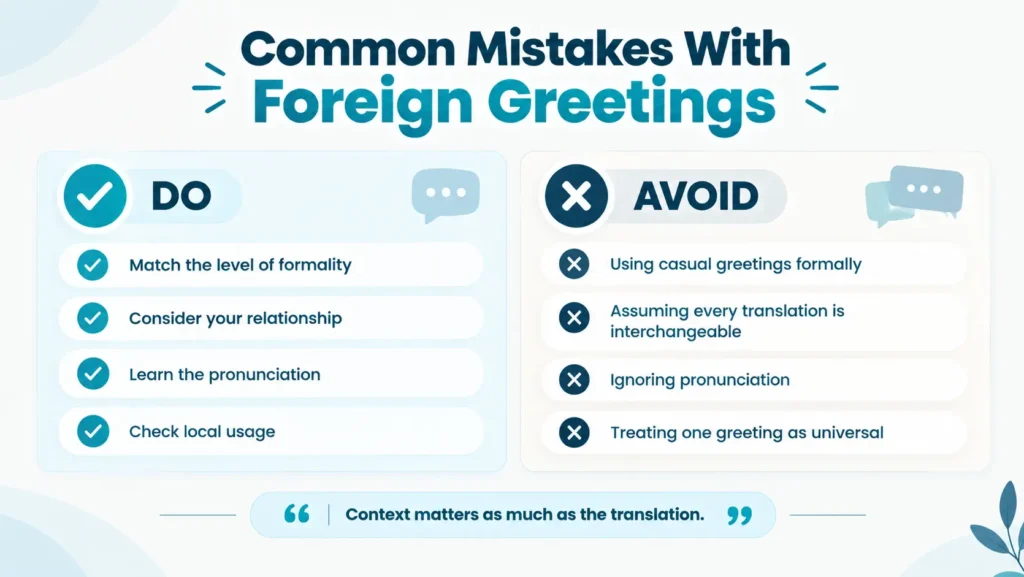
Using a casual greeting in a formal setting
A phrase that works perfectly with a friend may not be appropriate when speaking to a professional contact or someone you have just met.
Assuming every translation is interchangeable
Words translated as “hi” or “hello” can have different levels of politeness and cultural meaning.
Ignoring pronunciation
Using the correct written word but pronouncing it incorrectly can make communication harder. If you’re learning a greeting for travel or conversation, listen to native speakers and practice the pronunciation.
Assuming one greeting represents an entire language
Languages often have regional and social variations. A greeting that is common in one country may be less common or carry a different tone somewhere else.
Frequently Asked Questions
What is another way to say “hi” in Spanish?
Hola is the most common Spanish equivalent of “hi” or “hello.” It is widely used in everyday conversations.
What is another way to say “hi” in French?
You can say salut for a casual “hi.” Bonjour is a more polite and widely appropriate greeting, especially when addressing someone you do not know well.
What is another way to say “hi” in Italian?
Ciao is a common informal way to say “hi” in Italian. It can also mean “bye.”
What is the most respectful way to say hello in another language?
There is no single greeting that is most respectful across all languages. The appropriate choice depends on the language, culture, relationship, and setting.
Is “namaste” another way to say “hi”?
Yes. Namaste can function as a respectful greeting in Hindi and related cultural contexts, although its cultural meaning is broader than a simple translation of “hi.”
Can I use “hello” instead of “hi” when translating?
Sometimes, but not always. “Hi” is generally casual in English, while “hello” can be neutral or more formal. The closest natural translation depends on how the greeting is used in the target language.
Final Thoughts
There are many ways to say “hi” in another language, but the best choice depends on the language, culture, and situation. Hola, bonjour, ciao, hallo, salut, namaste, konnichiwa, annyeong, sawubona, and marhaba are useful examples, but their levels of formality are not identical.
If you’re learning a greeting for travel, conversation, or cultural communication, learn not only the word but also when and with whom native speakers use it.

Role: Author & Contributing Writer
Olivia Bennett is a dedicated Author at Elite’s Collective, focused on delivering clear, well-researched, and engaging articles tailored to the audience.