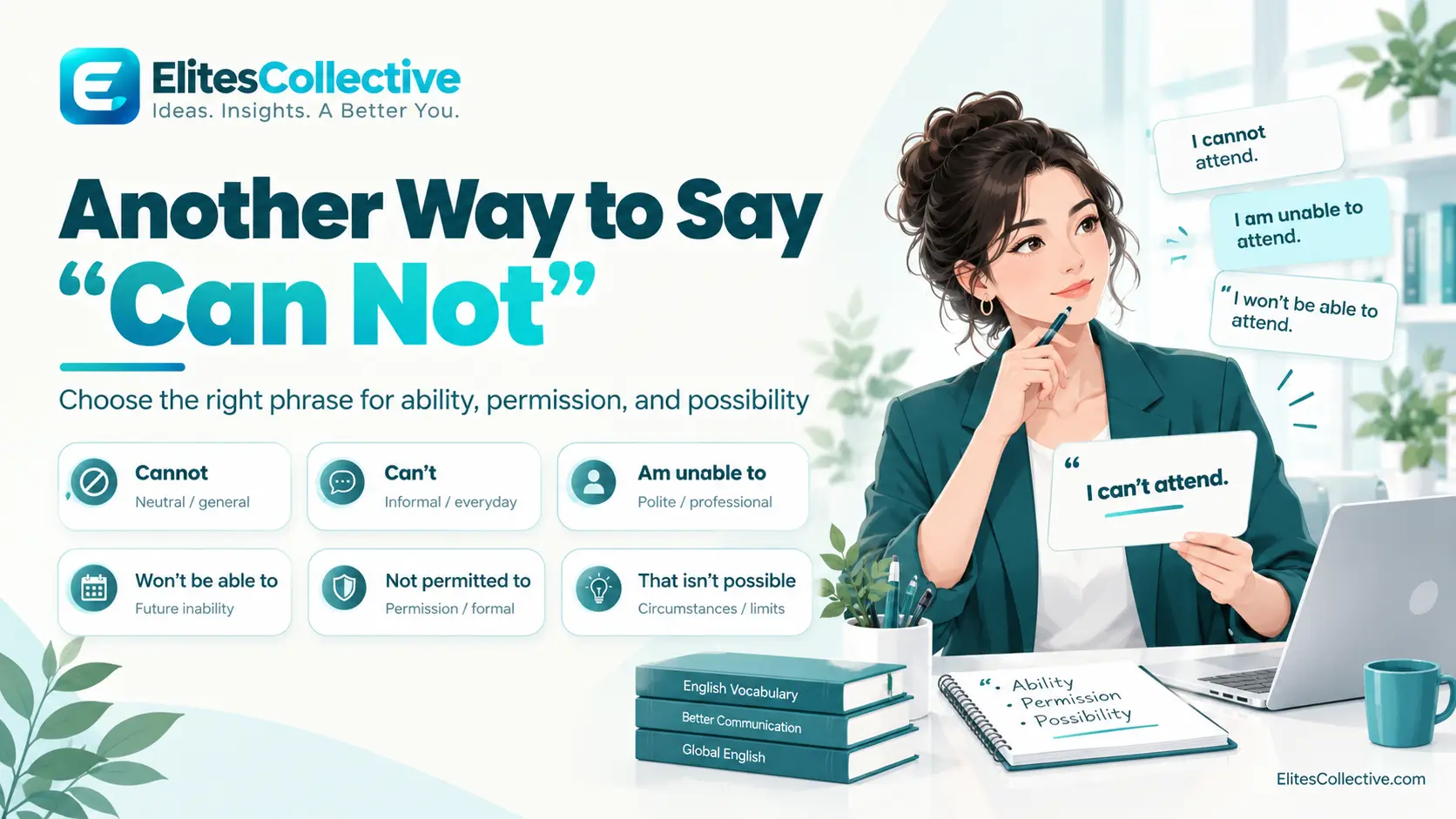
If you’re looking for another way to say “can not,” the best choice depends on what you mean. In standard American English, “cannot” is the usual spelling, while “can’t” is the common contraction. Other alternatives include “am unable to,” “am not able to,” “won’t be able to,” “am not permitted to,” and “it isn’t possible for me to.” Each one has a slightly different meaning or tone.
Key Takeaways
- “Cannot” is the standard form for expressing inability or impossibility.
- “Can’t” is the natural informal contraction of “cannot.”
- “Am unable to” is more formal and useful in professional writing.
- “Won’t be able to” refers specifically to a future inability.
- “Am not permitted to” means you are not allowed to do something, rather than simply being unable to do it.
- “It isn’t possible for me to” works well when circumstances make an action impossible.
What Does “Can Not” Mean?
“Can not” generally expresses that someone is unable to do something, that something is impossible, or, depending on context, that someone does not have permission to do it.
However, in standard American English, “cannot” is normally written as one word when it means “not be able to.”
For example:
I cannot attend the meeting tomorrow.
In casual conversation, you would usually say:
I can’t attend the meeting tomorrow.
The phrase “can not” as two separate words can occur in specific grammatical constructions, but it is not usually the preferred spelling when you simply mean “not able to.”
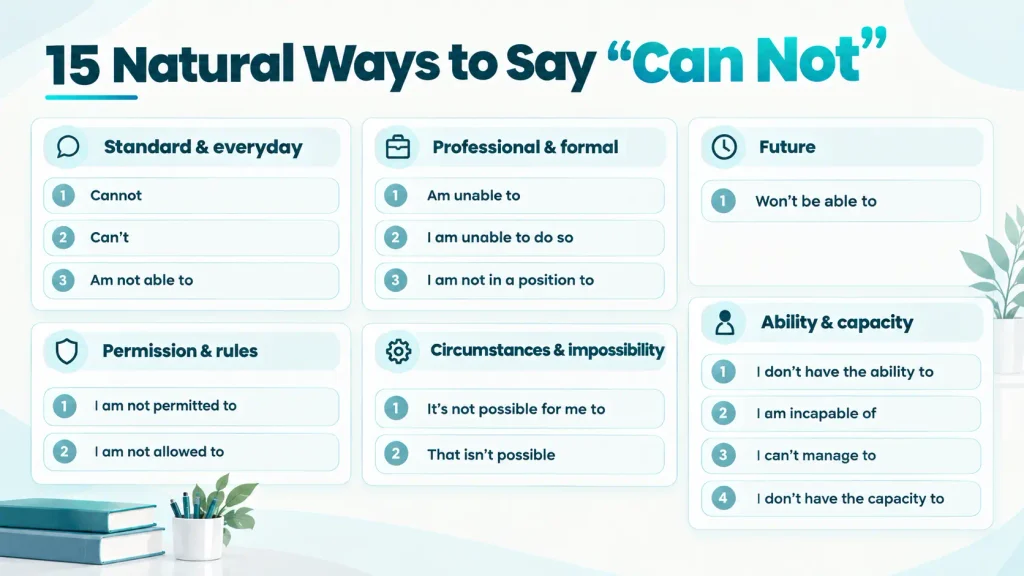
15 Natural Ways to Say “Can Not”
1. Cannot
Best for: Neutral, formal, and general writing
“Cannot” is the most direct replacement for “can not” when you mean that something is not possible or that someone is unable to do something.
Example:
I cannot attend the meeting this afternoon.
Usage tip:
Use “cannot” when you want a clear, standard form that works in both professional and everyday writing.
2. Can’t
Best for: Casual conversation, texts, and informal writing
“Can’t” is the contraction of “cannot.” It is extremely common in spoken American English.
Example:
I can’t finish the report today.
Usage tip:
Use “can’t” with friends, coworkers in casual communication, or in conversational writing. For formal documents, “cannot” or “am unable to” may be more appropriate.
3. Am Unable to
Best for: Professional and formal communication
“Am unable to” is a polished alternative when you want to explain that you cannot do something.
Example:
I am unable to attend the scheduled meeting.
Usage tip:
This phrase sounds more formal than “I can’t.” It is particularly useful in professional emails and official communication.
4. Am Not Able to
Best for: Neutral explanations
“Am not able to” communicates inability without sounding especially formal or casual.
Example:
I am not able to access the account right now.
Usage tip:
This is useful when you want to emphasize a person’s current ability or circumstances.
5. Won’t Be Able to
Best for: Future situations
Use “won’t be able to” when someone will be unable to do something in the future.
Example:
I won’t be able to join the call tomorrow.
Usage tip:
This is not simply another form of “cannot” in every situation. It specifically points to a future inability.
6. It’s Not Possible for Me to
Best for: Explaining that circumstances prevent an action
This phrase focuses on the situation rather than simply stating personal inability.
Example:
It’s not possible for me to complete the project by Friday.
Usage tip:
It can sound more explanatory and less abrupt than “I can’t.”
7. I Don’t Have the Ability to
Best for: Discussing capability
Use this expression when the issue is a lack of ability, skill, capacity, or capability.
Example:
I don’t have the ability to edit the file without administrator access.
Usage tip:
This can sound stronger than “I can’t,” so make sure the context actually involves ability.
8. I Am Incapable of
Best for: Strong statements about ability or capacity
“Incapable of” means lacking the ability or capacity to do something.
Example:
The damaged device is incapable of processing the file.
Usage tip:
When referring to a person, “incapable of” can sound harsh or overly strong. In many everyday situations, “unable to” is more natural.
9. I Am Not in a Position to
Best for: Professional or diplomatic situations
“I am not in a position to” is useful when circumstances, authority, responsibility, or timing prevent you from doing something.
Example:
I am not in a position to approve the request at this time.
Usage tip:
This does not necessarily mean you lack the physical ability. It can mean that you lack the authority, opportunity, or appropriate circumstances.
10. I Am Not Permitted to
Best for: Rules and restrictions
Use “I am not permitted to” when you are not allowed to do something.
Example:
I am not permitted to share confidential client information.
Usage tip:
This is different from “I cannot” when “cannot” means simple inability. “Not permitted” specifically indicates a rule or restriction.
11. I Am Not Allowed to
Best for: Everyday rules and restrictions
“I am not allowed to” is a natural alternative when someone has prohibited you from doing something.
Example:
I’m not allowed to use my phone during the exam.
Usage tip:
This is more conversational than “I am not permitted to.”
12. I Am Unable to Do So
Best for: Formal writing when the action has already been mentioned
“I am unable to do so” avoids repeating the action.
Example:
I understand your request, but I am unable to do so at this time.
Usage tip:
This expression is formal and can work well in business correspondence, official notices, and customer-service communication.
13. I Can’t Manage To
Best for: Situations involving difficulty or failure to accomplish something
“I can’t manage to” suggests that someone has tried or is struggling to accomplish an action.
Example:
I can’t manage to finish all the work before noon.
Usage tip:
This has a different nuance from simply saying “I can’t.” It often suggests difficulty rather than a straightforward restriction.
14. I Don’t Have the Capacity to
Best for: Workload, resources, or technical limitations
This phrase is useful when the limitation involves time, resources, workload, or system capacity.
Example:
We don’t have the capacity to take on another large project this month.
Usage tip:
“Capacity” often refers to available resources rather than personal skill.
15. That Isn’t Possible
Best for: General statements about impossibility
“That isn’t possible” is useful when the situation itself prevents something from happening.
Example:
Unfortunately, changing the order after shipment isn’t possible.
Usage tip:
This can sound more neutral than directly saying “You can’t do that,” especially when explaining a rule or limitation.
Quick Comparison of “Can Not” Alternatives
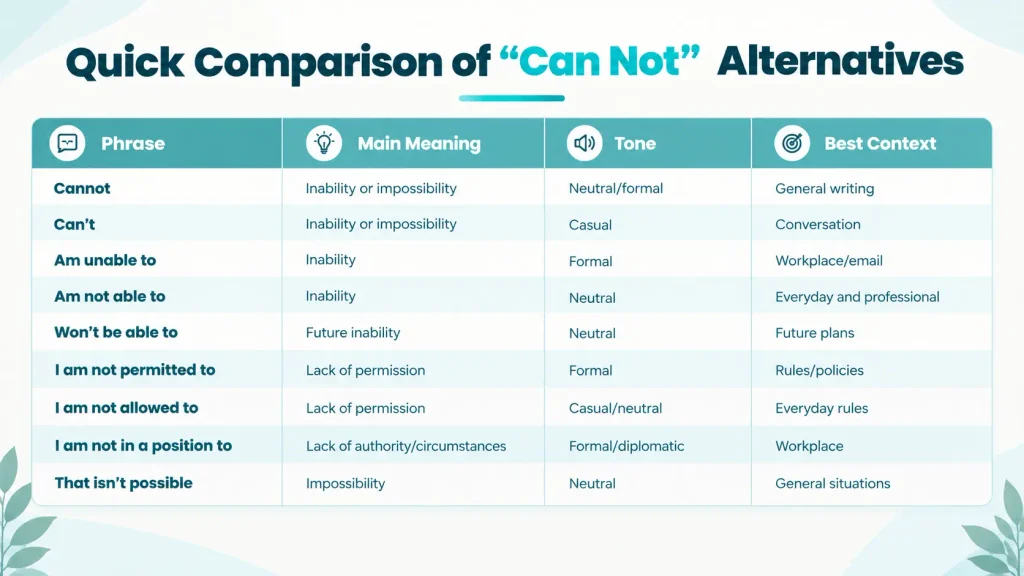
| Alternative | Main Meaning | Tone | Best Context |
|---|---|---|---|
| Cannot | Inability or impossibility | Neutral/formal | General writing |
| Can’t | Inability or impossibility | Casual | Conversation |
| Am unable to | Inability | Formal | Workplace/email |
| Am not able to | Inability | Neutral | Everyday and professional |
| Won’t be able to | Future inability | Neutral | Future plans |
| It’s not possible for me to | Impossibility | Neutral | Explanations |
| I don’t have the ability to | Lack of ability | Neutral | Capability |
| I am incapable of | Lack of capability | Strong/formal | Specific limitations |
| I am not in a position to | Lack of authority/circumstances | Formal/diplomatic | Workplace |
| I am not permitted to | Lack of permission | Formal | Rules/policies |
| I am not allowed to | Lack of permission | Casual/neutral | Everyday rules |
| I am unable to do so | Inability | Formal | Professional writing |
| I can’t manage to | Difficulty accomplishing something | Casual | Conversation |
| I don’t have the capacity to | Lack of resources/capacity | Neutral/formal | Work/business |
| That isn’t possible | Impossibility | Neutral | General situations |
Which Alternative Should You Use?
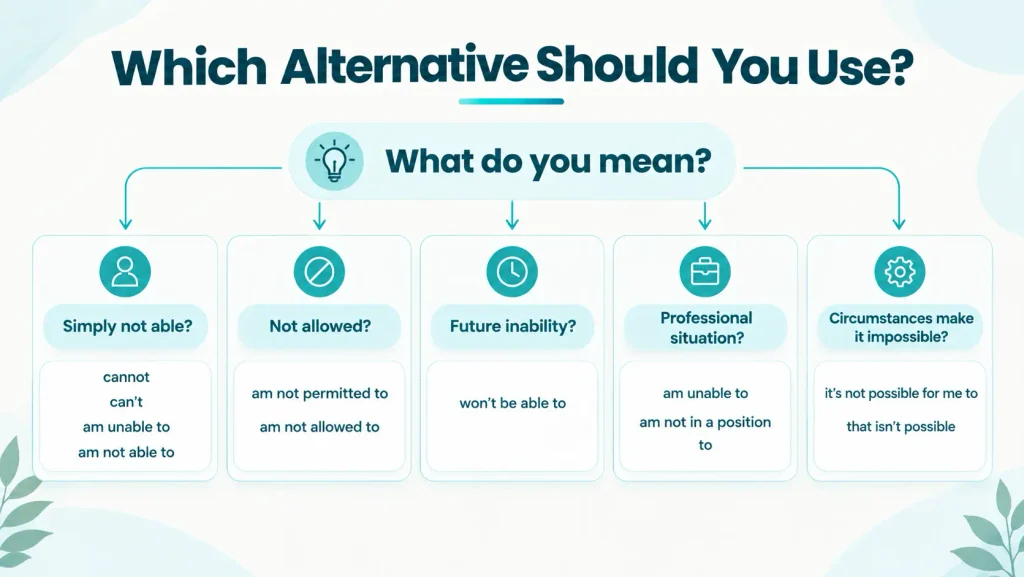
The right replacement depends on why you cannot do something.
If you simply mean “not able”
Use “cannot,” “can’t,” “am unable to,” or “am not able to.”
- I cannot attend.
- I can’t attend.
- I am unable to attend.
- I am not able to attend.
If you mean “not allowed”
Use “am not permitted to” or “am not allowed to.”
- I am not permitted to enter this area.
- I’m not allowed to enter this area.
These expressions indicate a restriction rather than an inability.
If you mean a future inability
Use “won’t be able to.”
- I won’t be able to attend tomorrow.
This is more precise than simply saying “I cannot attend” when you’re talking about a future situation.
If you want to sound professional
Use “am unable to” or “am not in a position to.”
For example:
I am unable to provide the requested information at this time.
Or:
I am not in a position to approve the request.
If circumstances make something impossible
Use “it’s not possible for me to” or “that isn’t possible.”
For example:
It’s not possible for me to complete the work today.
“Cannot” vs. “Can’t”
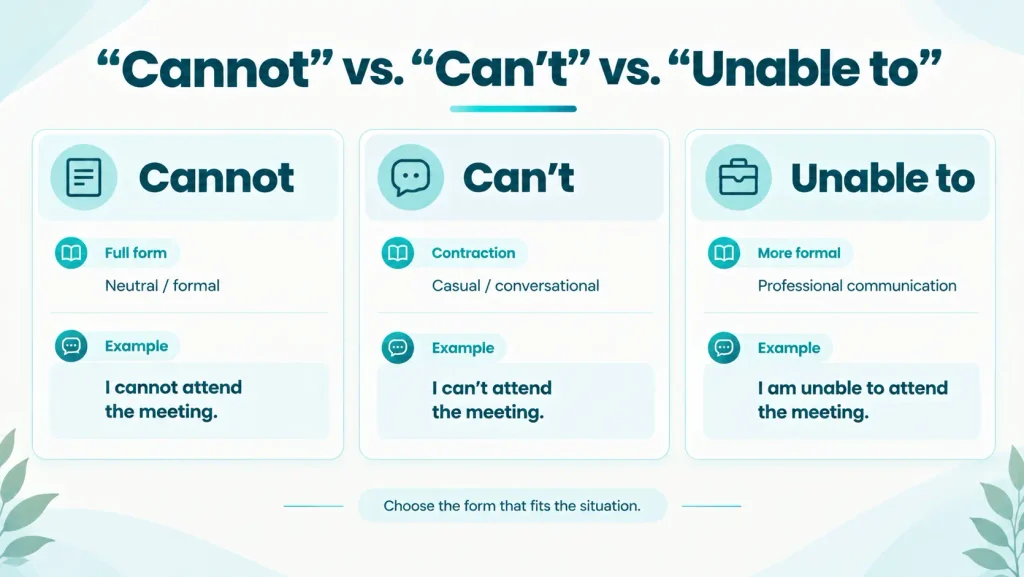
“Cannot” and “can’t” usually communicate the same basic idea, but their tone differs.
Cannot is the standard full form:
I cannot access the website.
Can’t is the contraction:
I can’t access the website.
“Can’t” is common in conversation, text messages, and informal emails. “Cannot” is often preferable when you want a more formal or deliberate tone.
“Cannot” vs. “Unable to”
These expressions are close, but “unable to” often sounds more formal.
Neutral:
I cannot attend the meeting.
More formal:
I am unable to attend the meeting.
In professional communication, “unable to” can be useful when you want to state a limitation without sounding overly casual.
“Cannot” vs. “Not Allowed To”
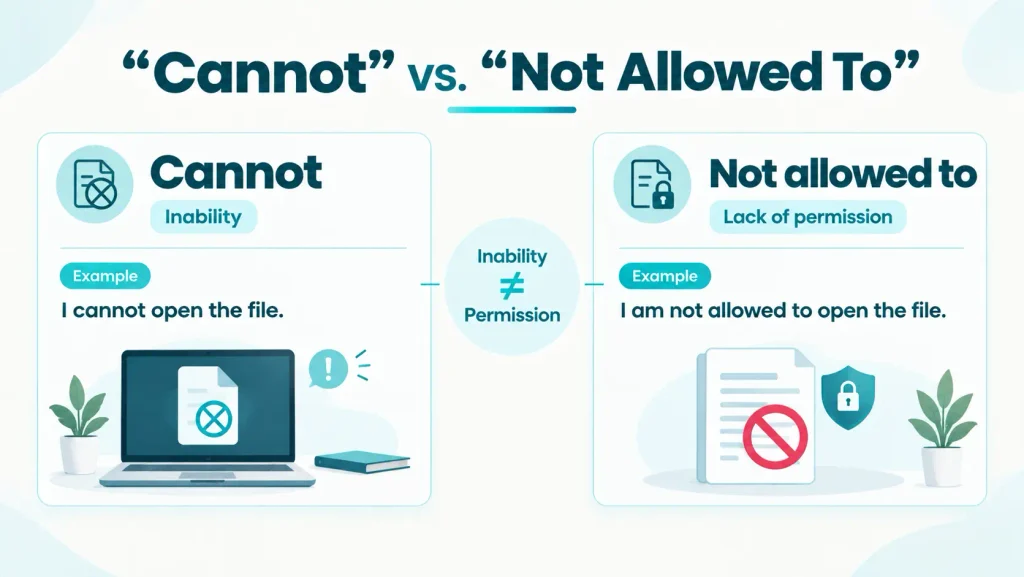
These phrases should not be treated as exact synonyms.
Cannot:
I cannot open the file.
This could mean that the file is inaccessible, the software is malfunctioning, or some other obstacle prevents access.
Not allowed to:
I am not allowed to open the file.
This clearly means that a rule or authority prevents you from opening it.
The distinction is important because inability and lack of permission are different ideas.
Common Mistakes When Replacing “Can Not”
Using “cannot” and “can not” interchangeably in every sentence
“Cannot” is normally the standard spelling when you mean “not be able to.”
I cannot attend the meeting.
The two-word form can appear in particular constructions, so it should not automatically be treated as an error in every context. However, “cannot” is the normal choice for ordinary negation.
Using “incapable of” when the problem is temporary
“Incapable of” can sound much stronger than “unable to.”
Instead of:
I am incapable of attending today’s meeting.
A more natural choice may be:
I am unable to attend today’s meeting.
Using “not allowed to” when you mean lack of ability
If a computer won’t open a file because of a technical problem, saying:
I am not allowed to open the file.
may incorrectly suggest that someone has prohibited you from opening it.
Using “can’t” in highly formal writing
“Can’t” is grammatically normal, but a formal document may benefit from the full form:
I cannot provide the requested documentation.
rather than:
I can’t provide the requested documentation.
Frequently Asked Questions
What is another word for “cannot”?
Common alternatives include “can’t,” “am unable to,” “am not able to,” “won’t be able to,” and “it’s not possible to.” The best choice depends on whether you mean inability, future inability, or impossibility.
Is “cannot” or “can not” correct?
“Cannot” is normally the standard spelling when you mean “not be able to.” “Can not” can occur in certain grammatical constructions, but it is less common as the ordinary negative form.
Is “can’t” the same as “cannot”?
Yes, in most ordinary contexts. “Can’t” is the contraction of “cannot” and is more conversational, while “cannot” is the full form and often works better in formal writing.
What is a professional way to say “I can’t”?
“I am unable to” is a common professional alternative.
For example:
I am unable to attend the meeting due to a scheduling conflict.
Depending on the situation, “I am not in a position to” can also work when authority or circumstances are the issue.
What is a polite way to say “I cannot”?
You can soften the statement by giving a brief reason:
Unfortunately, I won’t be able to attend.
Or:
I’m afraid I’m unable to assist with that request.
The best wording depends on the relationship and situation.
What is another way to say “I cannot do this”?
You could say:
- I am unable to do this.
- I am not able to do this.
- I can’t do this.
- I’m not in a position to do this.
- This isn’t possible for me right now.
Choose the phrase based on whether you want to emphasize inability, circumstances, permission, or formality.
Conclusion
The most natural alternative to “can not” is often “cannot” or “can’t,” but the right expression depends on the intended meaning. Use “am unable to” for a more formal tone, “won’t be able to” for future situations, and “am not permitted to” or “am not allowed to” when a rule prevents an action. Choosing the phrase that matches the exact situation will make your American English sound clearer and more natural.

Role: Author & Contributing Writer
Olivia Bennett is a dedicated Author at Elite’s Collective, focused on delivering clear, well-researched, and engaging articles tailored to the audience.