

If you’re looking for another way to say taking on, the best choice depends on the meaning. For example, assuming, accepting, or undertaking can describe accepting a responsibility. On the other hand, tackling works well for a difficult task or challenge. When the meaning is hiring someone, bringing on is more natural.
Key Takeaways
- “Taking on” can describe accepting a task, duty, challenge, or role.
- Assuming works well for duties and responsibilities.
- Undertaking is a more formal choice for projects and tasks.
- Tackling suggests dealing with a difficult problem or challenge.
- Taking up often means starting a new activity or role.
- Bringing on is useful when talking about hiring someone.
What Does “Taking On” Mean?
“Taking on” is a common phrasal verb with several meanings. Most often, it means accepting something that you agree to handle or deal with.
For example:
She is taking on more responsibilities at work.
The phrase can also refer to hiring or adding someone to a team:
The company is taking on three new employees.
Because the meaning changes with the situation, one replacement will not work in every sentence. Instead, choose a phrase that matches the exact idea you want to express.
15 Natural Alternatives to “Taking On”
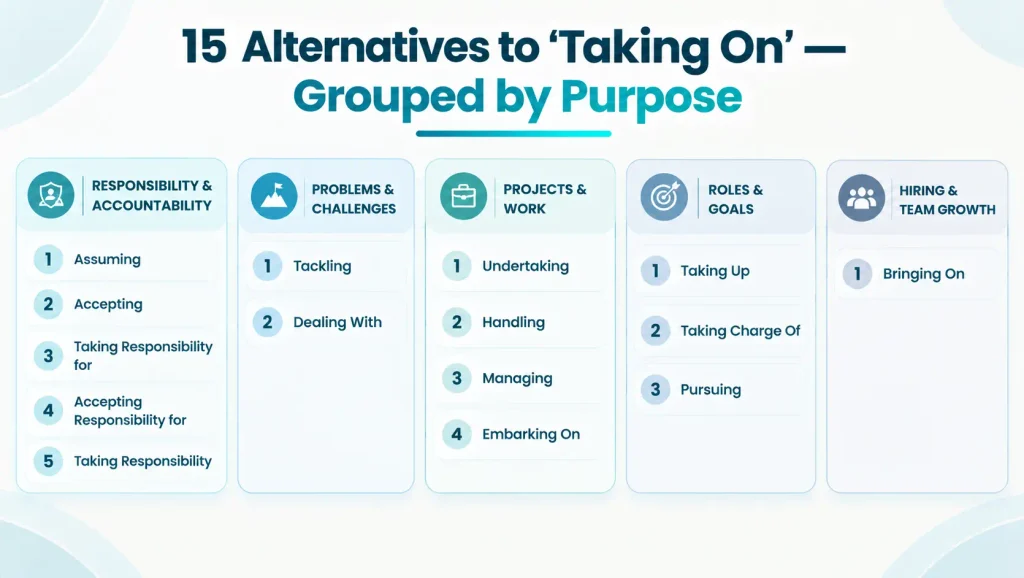
1. Assuming
Best for: Responsibilities, duties, and roles
“Assuming” is a good choice when someone accepts responsibility or takes control of a role.
Example:
Maria is assuming responsibility for the new project.
This phrase is common in professional and formal writing.
2. Accepting
Best for: Tasks, duties, responsibilities, and offers
“Accepting” focuses on agreeing to receive or handle something.
Example:
He is accepting more responsibility within the department.
It is a simple and clear option for everyday and professional writing.
3. Undertaking
Best for: Projects, tasks, and formal writing
“Undertaking” means agreeing to do or complete something. It sounds more formal than “taking on.”
Example:
The organization is undertaking a major renovation project.
Therefore, this option works especially well in business, academic, and formal content.
4. Tackling
Best for: Problems, challenges, and difficult tasks
“Tackling” shows that someone is actively dealing with something that needs effort.
Example:
The team is tackling several technical problems this week.
Unlike “accepting,” this word puts more focus on action and problem-solving.
5. Taking Up
Best for: Activities, hobbies, subjects, and roles
“Taking up” often means starting something new.
Example:
She is taking up a new role in the marketing department.
It can also describe starting a hobby:
He recently took up photography.
6. Handling
Best for: Tasks, responsibilities, and situations
“Handling” means managing or dealing with something.
Example:
James is handling client communication for the project.
Use this option when you want to stress the person’s role in managing the work.
7. Managing
Best for: Projects, teams, and ongoing responsibilities
“Managing” suggests organizing, controlling, or overseeing something.
Example:
She is managing a new team of developers.
This isn’t always an exact replacement because it suggests active control rather than simply accepting a task.
8. Taking Responsibility for
Best for: Duties, decisions, mistakes, and accountability
This phrase makes the meaning very clear.
Example:
He is taking responsibility for the project’s final results.
It is useful when accountability is the main point.
9. Accepting Responsibility for
Best for: Duties, mistakes, and accountability
This expression highlights a person’s willingness to be accountable.
Example:
The manager accepted responsibility for the delay.
As a result, it can work well in formal workplace writing.
10. Dealing With
Best for: Problems, situations, and challenges
“Dealing with” means handling or addressing something.
Example:
The support team is dealing with a large number of customer requests.
It sounds natural in both everyday and professional English. However, it does not always suggest that the person chose to accept the task.
11. Taking Charge of
Best for: Teams, projects, and situations
“Taking charge of” means assuming control or leadership.
Example:
Sarah is taking charge of the website redesign.
Choose this phrase when the original meaning involves leading or directing something.
12. Embarking On
Best for: Projects, plans, and major activities
“Embarking on” means starting something, especially something important or significant.
Example:
The company is embarking on a major expansion project.
It has a more formal tone, so it may sound out of place in casual conversation.
13. Pursuing
Best for: Goals, opportunities, and objectives
“Pursuing” works when someone is actively working toward something.
Example:
She is pursuing a new career opportunity.
Keep in mind that this word changes the meaning slightly. It focuses on working toward a goal rather than accepting a responsibility.
14. Taking Responsibility
Best for: Accountability and duties
“Taking responsibility” is a clear option when someone becomes accountable for something.
Example:
The supervisor is taking responsibility for the team’s performance.
It is especially useful in workplace and formal communication.
15. Bringing On
Best for: Employees, contractors, and team members
“Bringing on” can mean hiring or adding someone to a team.
Example:
The company is bringing on two new developers this month.
When the subject is a person, this option can be much clearer than using a general synonym.
Which Alternative Should You Use?
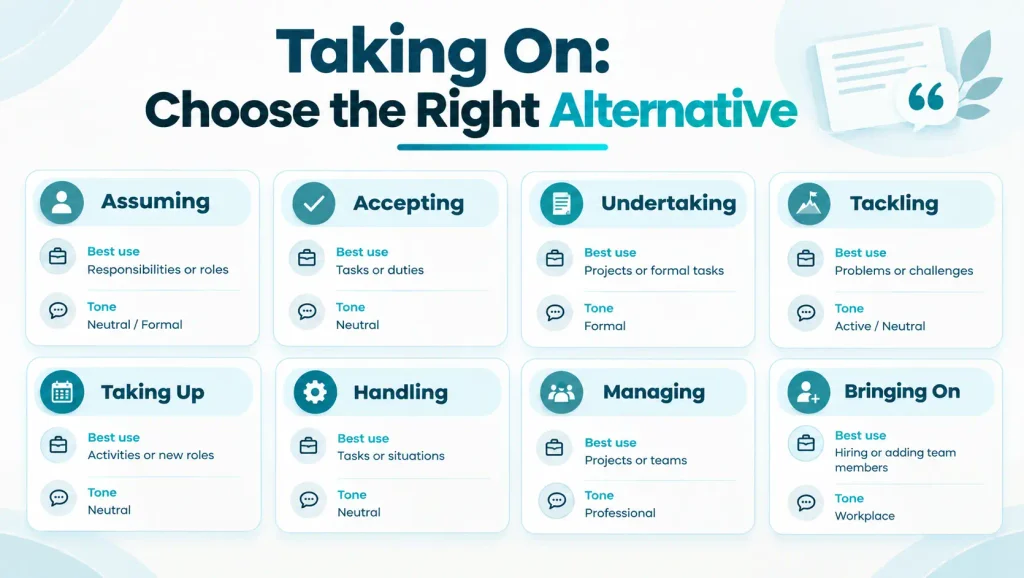
The right choice depends on what you mean.
| Alternative | Main Use | Tone |
|---|---|---|
| Assuming | Accepting responsibility or a role | Neutral/Formal |
| Accepting | Agreeing to a task or duty | Neutral |
| Undertaking | Starting or agreeing to a formal task | Formal |
| Tackling | Dealing with a difficult problem | Neutral/Active |
| Taking up | Starting an activity or role | Neutral |
| Handling | Managing a task or situation | Neutral |
| Managing | Overseeing people or projects | Professional |
| Taking responsibility for | Becoming accountable | Neutral/Formal |
| Accepting responsibility for | Agreeing to be accountable | Formal |
| Dealing with | Addressing a problem or situation | Neutral |
| Taking charge of | Assuming control or leadership | Direct |
| Embarking on | Beginning a major project | Formal |
| Pursuing | Working toward a goal | Neutral/Formal |
| Taking responsibility | Becoming accountable | Neutral |
| Bringing on | Hiring or adding someone | Workplace |
Choosing the Right Phrase for Different Situations
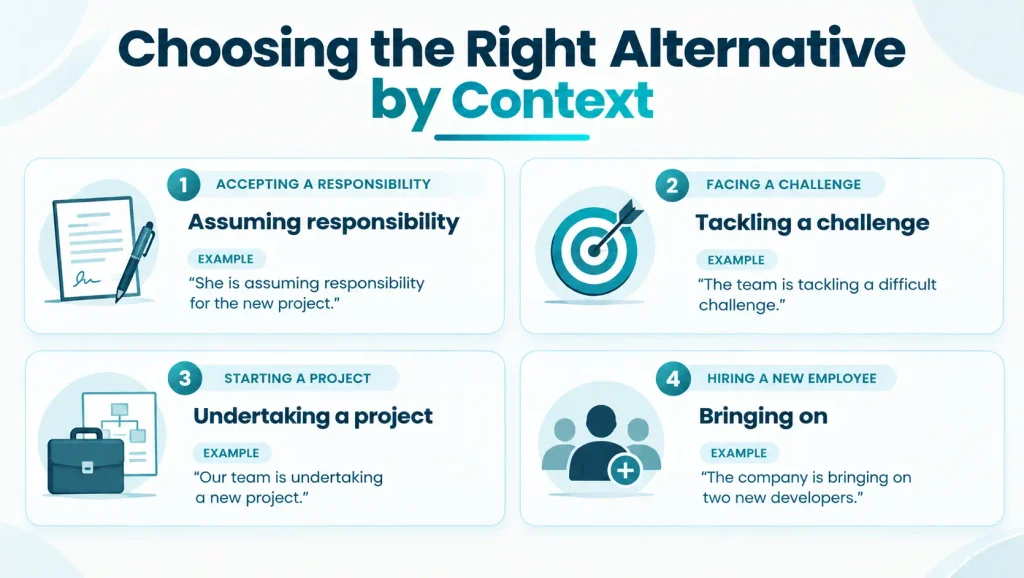
Accepting a Responsibility
If someone agrees to handle a duty, assuming, accepting, or taking responsibility for can work well.
Original:
She is taking on additional responsibilities.
Possible alternatives:
She is assuming additional responsibilities.
She is accepting additional responsibilities.
She is taking responsibility for additional duties.
For formal writing, “assuming responsibility” often sounds polished without being too complex.
Facing a Challenge
When the idea is dealing with something difficult, tackling is a strong choice.
Original:
The team is taking on a difficult challenge.
Alternative:
The team is tackling a difficult challenge.
You could also say:
The team is facing a difficult challenge.
Here, “tackling” focuses on action, while “facing” focuses on the situation itself.
Starting a Project
Several options can work for a new project. The best one depends on what you want to emphasize.
Example:
Our team is taking on a new project.
You could write:
Our team is undertaking a new project.
Or:
Our team is handling a new project.
“Undertaking” sounds more formal. In contrast, “handling” focuses on managing the work.
Hiring a New Employee
When the phrase refers to hiring, bringing on or simply hiring is usually clearer.
Example:
The company is taking on five new employees.
Better alternatives include:
The company is hiring five new employees.
The company is bringing on five new employees.
In this situation, “assuming” or “undertaking” would not have the same meaning.
Common Mistakes to Avoid
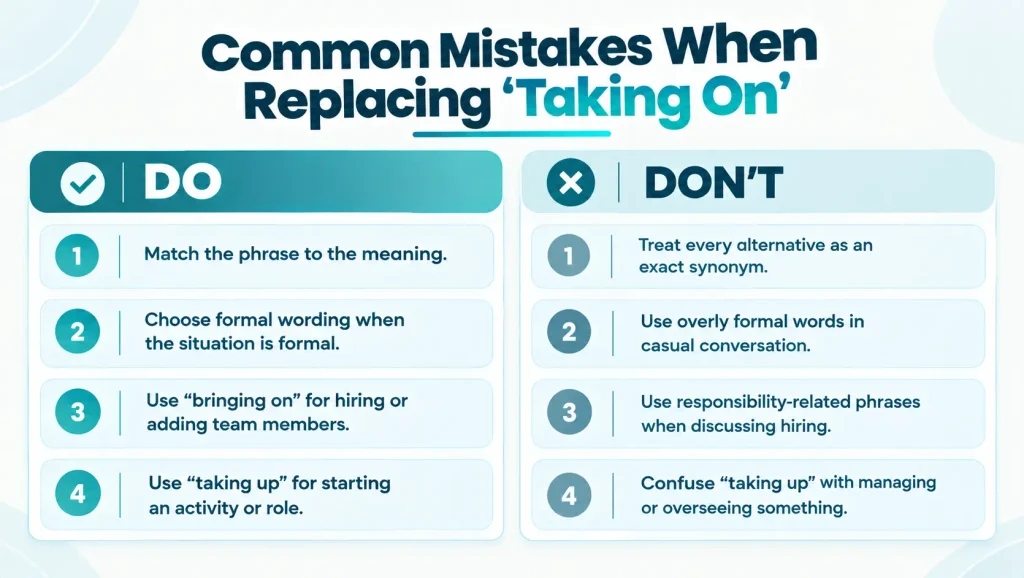
1. Treating Every Alternative as an Exact Synonym
These expressions are related, but they are not interchangeable in every sentence.
For example, “tackling” suggests active work on a challenge. Meanwhile, “accepting” focuses on agreeing to something.
2. Using Formal Words in Casual Writing
“Undertaking” is correct, but it can sound formal in everyday conversation.
Instead of:
I’m undertaking a new task.
A more natural casual option is:
I’m taking on a new task.
3. Confusing Hiring With Accepting a Task
The phrase can refer to either work or people. Therefore, context matters.
The company is taking on new employees.
Here, hiring or bringing on is more precise.
4. Confusing Starting With Managing
“Taking up” often means beginning something. By contrast, “managing” suggests ongoing responsibility.
For example:
She is taking up a new position.
is different from:
She is managing a new department.
The first sentence focuses on starting a role. The second focuses on overseeing a department.
Frequently Asked Questions
What is a professional alternative to “taking on”?
“Undertaking” is a formal alternative for projects, tasks, and responsibilities. For accountability, “assuming responsibility” is also a useful choice.
How can I say “taking on responsibility” differently?
You can use assuming responsibility, accepting responsibility, undertaking a responsibility, or taking responsibility for something. The best option depends on the sentence and level of formality.
What is another way to describe taking on a challenge?
“Tackling a challenge” is a natural choice. You can also use “facing a challenge” when you want to focus on the difficulty rather than the action.
What can I say instead of taking on a project?
Depending on the meaning, you can use undertaking a project, managing a project, handling a project, or taking responsibility for a project.
Is “undertaking” the same as “taking on”?
The two can have similar meanings when you are talking about accepting or beginning a task. However, “undertaking” is more formal and often emphasizes carrying out the work.
Is “taking up” the same as “taking on”?
Not always. “Taking up” usually means starting an activity, hobby, subject, or role. “Taking on” more often refers to accepting a task, responsibility, challenge, or person.
What can I say instead in a workplace?
Useful choices include assuming, undertaking, handling, managing, taking responsibility for, taking charge of, and bringing on. Select the one that matches the specific situation.
Final Thoughts
There are many ways to replace “taking on,” but the best option depends on the context. For responsibilities, assuming or accepting responsibility may be more precise. For a difficult task, tackling sounds natural. For formal projects, undertaking can be a better fit. When the meaning involves hiring, bringing on or hiring is clearer.
Rather than choosing a synonym just because it looks similar, check the meaning first. A good replacement should sound natural while keeping the original idea intact.

Role: Author & Contributing Writer
Olivia Bennett is a dedicated Author at Elite’s Collective, focused on delivering clear, well-researched, and engaging articles tailored to the audience.