

Another Way to Say Male and Female: 10 Natural Alternatives
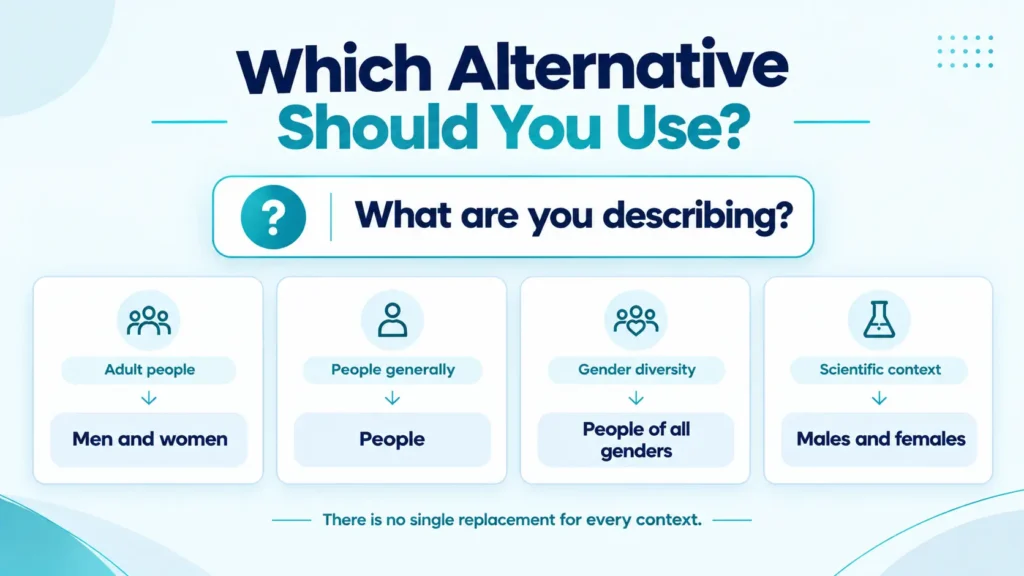
If you’re looking for another way to say “male and female,” the best choice depends on what you mean. For people, “men and women” is often the most natural choice when referring specifically to adults. In broader or more inclusive contexts, “people,” “individuals,” “people of all genders,” or “people of different genders” may work better. For biological or scientific contexts, “males and females” can be appropriate.
Key Takeaways
- Men and women is a natural choice when referring specifically to adult people.
- People or individuals works when sex or gender is not relevant.
- People of all genders is useful when you want explicitly inclusive wording.
- Boys and girls is appropriate when talking about children.
- Males and females fits scientific, medical, biological, or research contexts.
- Avoid treating every alternative as an exact synonym because the meaning and context can change.
What Does “Male and Female” Mean?
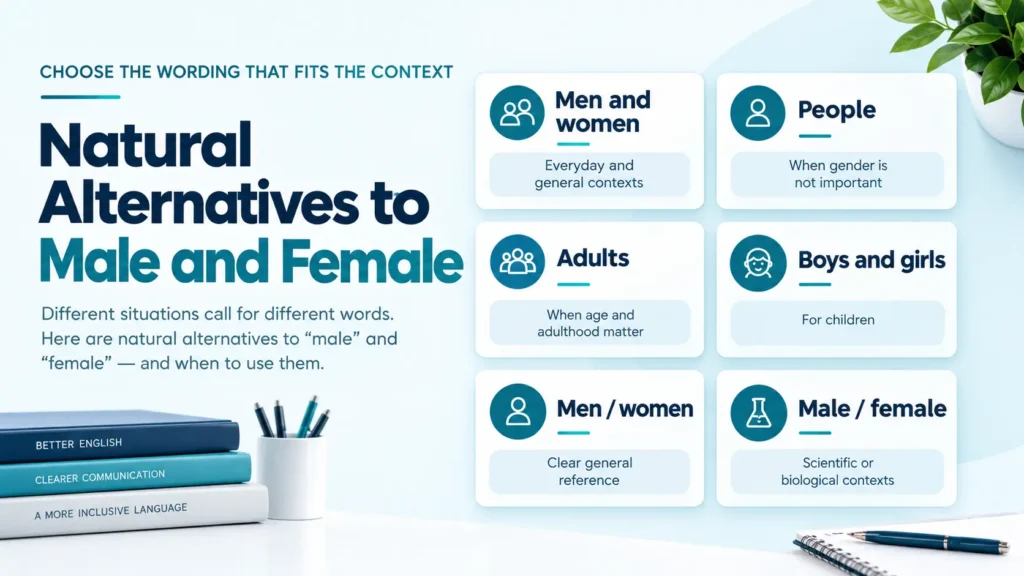
Male and female are terms used to distinguish people or other organisms by sex. The right alternative depends on whether you’re talking about people, biological sex, gender, age, or a specific group.
For example:
- Male and female patients → men and women if the patients are adults and that distinction matters.
- Male and female participants → participants if their sex or gender is not relevant.
- Male and female reproductive systems → male and female reproductive systems is appropriate because the biological distinction matters.
- Male and female students → students of all genders or simply students, depending on the intended meaning.
It’s also useful to distinguish sex from gender. Gender and sex are not interchangeable concepts, and some style and inclusive-language guides recommend choosing terminology based on what the writer actually needs to describe.
10 Natural Alternatives to “Male and Female”
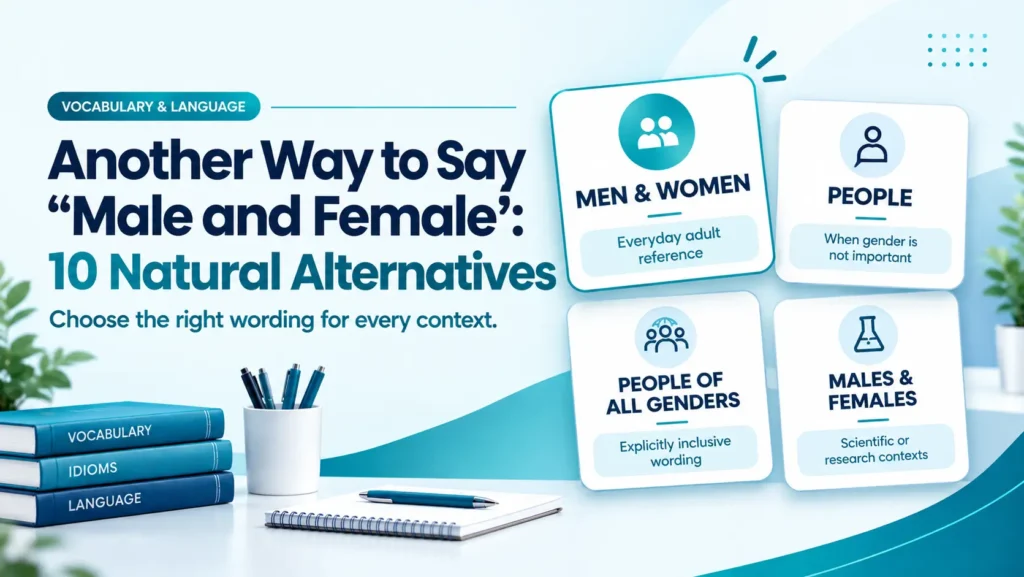
1. Men and Women
Best for: Adult people, everyday English, general writing
Men and women is often the most natural replacement when “male and female” refers specifically to adult people.
Example:
- Original: The survey included male and female employees.
- Natural: The survey included men and women.
Use this when you specifically mean adult men and adult women. It is not an exact replacement in every context.
2. Males and Females
Best for: Scientific, medical, biological, or research contexts
Males and females keeps the original biological meaning while changing the grammatical form.
Example:
The study compared the responses of males and females.
This wording can sound clinical when used in casual conversation about people, so men and women may sound more natural in everyday contexts.
3. People
Best for: General, neutral writing
If the distinction between male and female isn’t important, people is often the cleanest option.
Example:
- Original: The program is open to male and female applicants.
- Better: The program is open to all applicants.
Or:
The event is designed for people of all backgrounds.
A major benefit is that it avoids adding a distinction that the reader does not need.
4. Individuals
Best for: Formal, academic, professional, or research writing
Individuals can replace a gendered description when you’re talking about people as separate persons rather than emphasizing their sex or gender.
Example:
The study examined how individuals responded to the questions.
This is more formal than people, so it may fit academic or professional writing better.
5. People of All Genders
Best for: Explicitly inclusive language
Use people of all genders when your purpose is to make it clear that the group is not limited to two genders.
Example:
The organization welcomes people of all genders.
This is not an exact synonym for “male and female.” Instead, it changes the wording to communicate broader inclusion.
Several university and institutional language guides recommend avoiding binary group descriptions when the writer intends to include people beyond a male/female binary.
6. People of Different Genders
Best for: General and inclusive descriptions
People of different genders is useful when the fact that a group contains people with different gender identities is relevant.
Example:
The researchers interviewed people of different genders.
It can sound more natural than repeatedly using “male and female” when discussing a diverse group.
7. People of Both Sexes
Best for: Contexts specifically discussing sex
People of both sexes can work when the discussion is explicitly about sex rather than gender.
Example:
The researchers studied adults of both sexes.
However, this expression describes a binary distinction. It should not be used automatically when the subject involves a broader range of sex characteristics.
8. Men and Boys / Women and Girls
Best for: Groups containing both adults and children
If “male and female” refers to people across different ages, simply saying men and women may be too narrow.
For example:
The program serves men and boys as well as women and girls.
This is much clearer when age matters.
Don’t use boys or girls to describe adults merely as an alternative to men or women.
9. Male and Female Participants → Participants
Best for: Research, surveys, events, and general group descriptions
Sometimes the best alternative isn’t another gendered expression at all. You can simply remove the unnecessary distinction.
Example:
- Male and female participants completed the survey.
- Participants completed the survey.
If sex or gender does not affect the research question, the shorter version is clearer.
10. Everyone
Best for: General statements, invitations, and public communication
Everyone is a useful alternative when you mean a group without needing to identify its members by sex or gender.
Example:
- The event is open to male and female students.
- The event is open to everyone.
This is especially natural in announcements, invitations, websites, and everyday communication.
Quick Comparison: Which Alternative Should You Use?
| Alternative | Best Use | Tone |
| Men and women | Adult people | Natural, neutral |
| Males and females | Biological or research contexts | Clinical, scientific |
| People | General groups | Neutral, natural |
| Individuals | Academic or formal writing | Formal |
| People of all genders | Inclusive communication | Inclusive, neutral |
| People of different genders | Discussing gender diversity | Neutral, inclusive |
| People of both sexes | Specific sex-based contexts | Formal |
| Men and boys / women and girls | Groups across ages | Specific |
| Participants | Studies, surveys, events | Neutral, professional |
| Everyone | General audiences | Friendly, inclusive |
Male vs. Female: Which Word Sounds More Natural?
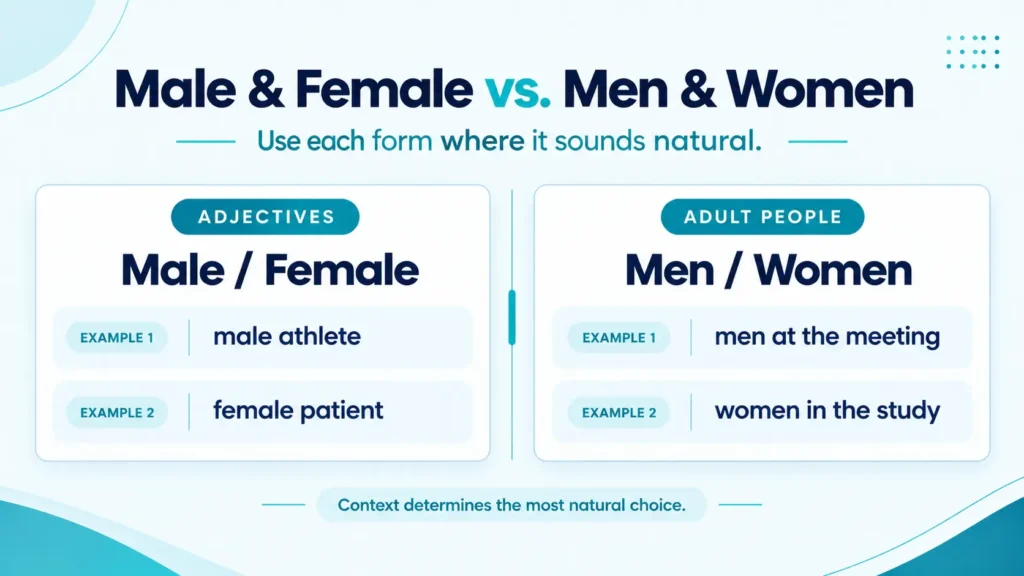
When describing people in everyday American English, male and female are often more natural as adjectives than as replacements for man and woman.
For example:
- a male athlete
- a female athlete
- male students
- female students
But when talking about adult people as nouns, these are often more natural:
- men
- women
For example:
The company hired several men and women.
This generally sounds more conversational than:
The company hired several males and females.
Style guidance from universities similarly recommends using male and female carefully and avoiding them as nouns when a more natural human-centered term is available.
When “Male and Female” Is the Better Choice
You don’t always need to replace male and female.
The phrase can be appropriate when biological sex is directly relevant.
For example:
- male and female reproductive organs
- male and female anatomy
- male and female animals
- male and female hormones
- male and female reproductive patterns
In scientific or medical writing, precision matters more than simply choosing a more conversational expression.
The key is to ask: Is sex actually relevant to what I’m saying?
If yes, keep the specific terminology. If not, a neutral term such as people, participants, or individuals may be clearer.
Common Mistakes to Avoid
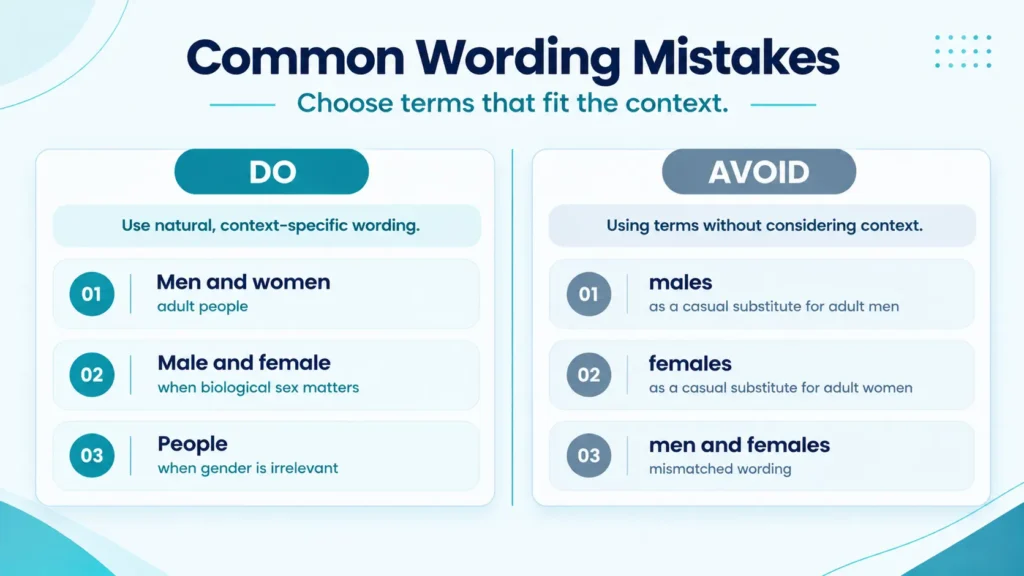
1. Using “female” and “male” as if they always mean “woman” and “man”
They aren’t interchangeable in every sentence.
Less natural:
There were 20 females at the meeting.
More natural:
There were 20 women at the meeting.
The second version is usually better when referring to adult women in an ordinary social setting.
2. Using “men and females”
Avoid mixing terms that don’t match grammatically or stylistically.
Instead, use:
- men and women
- males and females
- male and female participants
Keeping the terms parallel makes the sentence clearer.
3. Using “men and women” when children are included
If the group includes children, men and women may not describe everyone accurately.
Use a more specific phrase such as:
boys and girls or men, women, boys, and girls, depending on the context.
4. Using “both genders” when you mean everyone
If your intended meaning includes people beyond a male/female binary, both genders can be too narrow.
Depending on the sentence, all genders, people of all genders, or simply everyone may be more appropriate.
5. Adding a gender distinction when it doesn’t matter
Compare:
Male and female customers can use the service.
with:
Customers can use the service.
If sex or gender has no relevance, the second sentence is simpler and more direct.
Frequently Asked Questions
What is another word for male and female?
Depending on the context, alternatives include men and women, males and females, people, individuals, people of all genders, participants, and everyone. The best choice depends on whether you’re referring to sex, gender, age, or a specific group.
What is a gender-neutral way to say male and female?
People, individuals, everyone, and people of all genders can be gender-neutral alternatives. Choose the one that best fits the sentence and the meaning you want to express.
Is “men and women” better than “male and female”?
For ordinary references to adult people, men and women often sounds more natural. Male and female is still appropriate when the distinction concerns biological sex or when it functions naturally as an adjective.
Can I use “males and females” in academic writing?
Yes. Males and females can be appropriate in scientific, medical, or research contexts, especially when biological sex is relevant. In other academic contexts, men and women or a neutral term may be more natural.
What is another way to say “male and female students”?
Depending on your meaning, you could say students, students of all genders, or male and female students. If sex or gender does not matter to the statement, simply using students is usually the clearest choice.
What is another way to say “male and female participants”?
You can say participants, participants of all genders, or men and women who participated, depending on what information matters. In research, keep the sex-based wording if the study specifically analyzes differences by sex.
Is “female” a polite word for a woman?
Female is a standard English word, but its naturalness depends on how it is used. As an adjective, it is often unremarkable: female athlete or female patient. As a noun for an adult woman in casual conversation, woman is usually more natural.
Final Thoughts
The best alternative to “male and female” depends on what you are actually trying to describe. For adult people, “people of all genders” is often the most natural choice. For a broader group, “people” or “individuals” may be better. If inclusion across genders matters, “people of all genders” is clearer. And when biological sex is central to the topic, “male and female” or “males and females” may be exactly right.
The goal isn’t to replace the phrase every time. The goal is to choose the wording that gives the reader the most accurate meaning with the least unnecessary complexity.

Role: English Language & Communication Writer
Daniel Carter is an English language writer specializing in workplace communication, professional vocabulary, resumes, emails, and career-focused English.