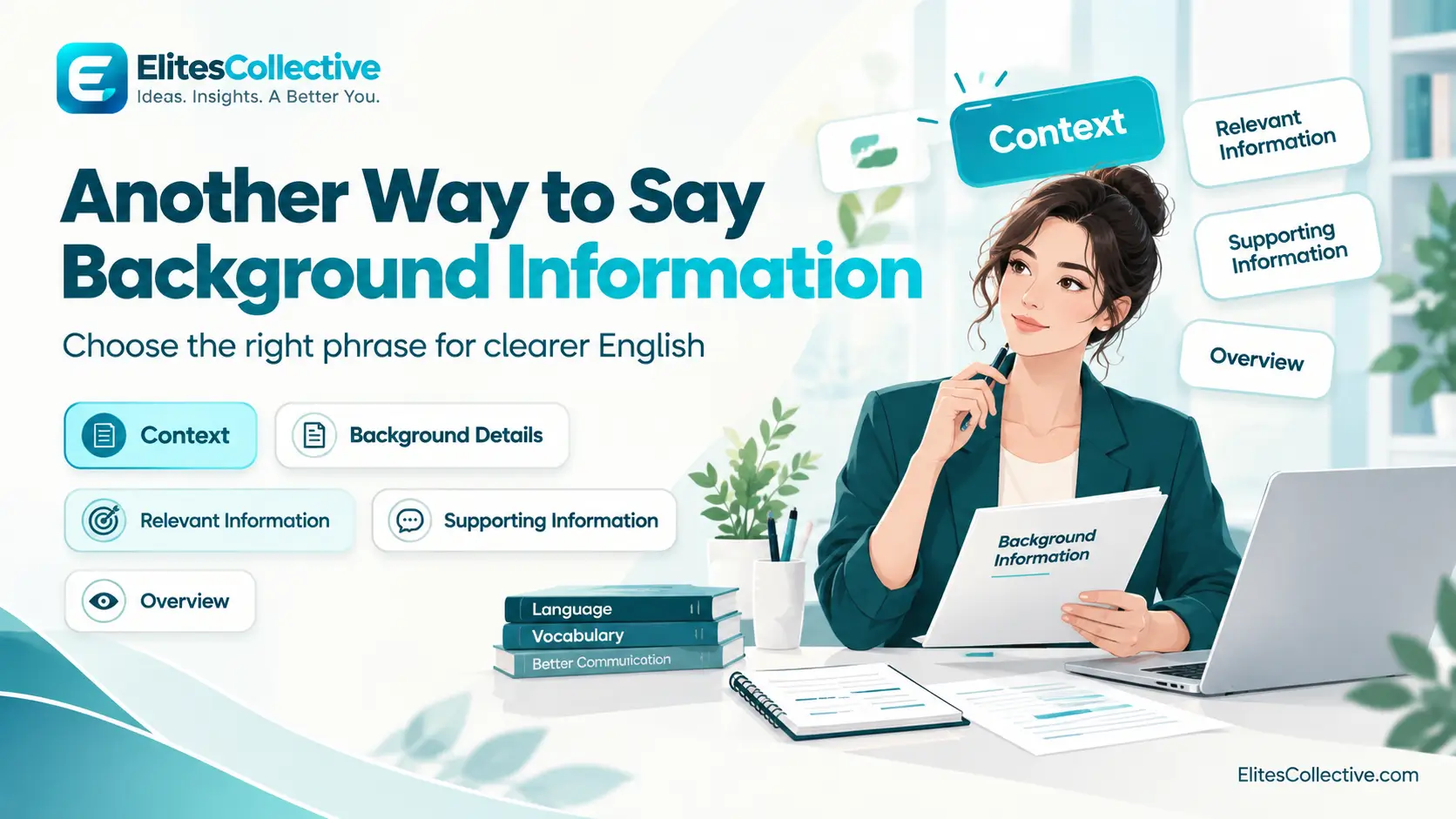
Another way to say “background information” is context, background details, relevant information, supporting information, introductory information, or additional details. The best choice depends on what you want to describe. For example, context works well for a situation, while background details is useful for facts about a person or topic.
Key Takeaways
- Context is a natural choice when you want to explain a situation.
- Background details works well for facts about a person, topic, or event.
- Relevant information is a good choice for professional writing.
- Supporting information describes details that explain or support a main point.
- Introductory information works well for guides and educational content.
- The best alternative depends on the meaning and tone of your sentence.
What Does “Background Information” Mean?
Background information means facts or details that help someone understand a person, topic, event, or situation.
For example:
Before discussing the project, the manager provided some background information about the company.
In this sentence, the information gives people a better understanding of the company before the main discussion begins.
You can replace “background information” with several phrases. However, the best choice depends on the type of information you want to describe.
10 Ways to Say “Background Information”
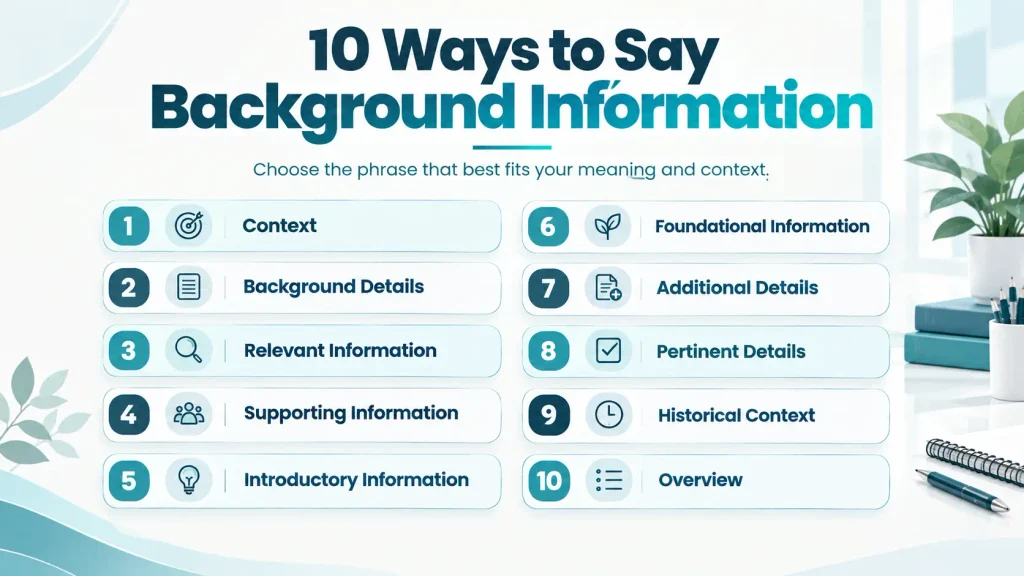
1. Context
Context is one of the most useful alternatives to “background information.” It means information that helps explain a situation or event.
Example:
The report gives readers more context about the company’s decision.
Best for: Professional writing, academic writing, articles, and general use.
Tip: Use “context” when the information helps explain why something happened or how it should be understood.
2. Background Details
Background details refers to specific facts about a person, topic, event, or situation.
Example:
The application asks for background details about your previous work experience.
Best for: Applications, profiles, interviews, and personal or professional history.
This phrase is especially useful when you want to talk about several specific facts rather than a general explanation.
3. Relevant Information
Relevant information means information that is directly connected to the topic.
Example:
Please provide any relevant information before the meeting.
Best for: Business writing, academic writing, emails, and formal communication.
This phrase is useful when you do not want to focus on history or context. Instead, you want to highlight information that matters to the subject.
4. Supporting Information
Supporting information means extra details that help explain or support a main point.
Example:
The report includes supporting information for each recommendation.
Best for: Reports, research papers, presentations, and business documents.
Use this phrase when the extra information helps prove, explain, or strengthen an idea.
5. Introductory Information
Introductory information means basic information given at the start of a topic.
Example:
The first section provides introductory information about the research process.
Best for: Guides, courses, manuals, articles, and educational material.
This phrase works well when readers need some basic information before moving to a more detailed discussion.
6. Foundational Information
Foundational information means basic knowledge that helps someone understand a more advanced topic.
Example:
Students should review the foundational information before starting the advanced course.
Best for: Education, training, technical subjects, and academic writing.
This phrase has a more formal tone than “basic information,” so it may not be the best choice for casual writing.
7. Additional Details
Additional details refers to extra information that gives the reader a fuller picture.
Example:
The article provides additional details about the company’s history.
Best for: Articles, reports, emails, and general writing.
Choose this phrase when the information is useful but not the main focus of the discussion.
8. Pertinent Details
Pertinent details means details that are directly related to the subject.
Example:
The witness provided pertinent details about the event.
Best for: Formal, professional, legal, and investigative writing.
“Pertinent” is more formal than “relevant,” so “relevant details” may sound more natural in everyday writing.
9. Historical Context
Historical context means information about the past that helps explain a person, event, idea, or situation.
Example:
The article provides historical context for the development of the policy.
Best for: History, literature, academic writing, and social science topics.
Use this phrase only when the information is connected to past events or conditions.
10. Overview
An overview gives a general explanation of a topic. It usually covers the main points without going into great detail.
Example:
The introduction gives an overview of the company’s services.
Best for: Reports, presentations, websites, guides, and educational content.
“Overview” is useful when you want to give someone a quick understanding of a subject.
Comparison of “Background Information” Alternatives
| Alternative | Meaning | Tone | Best Context |
|---|---|---|---|
| Context | Information that explains a situation | Neutral | General, academic, professional |
| Background details | Specific facts about a subject | Neutral | Profiles, applications |
| Relevant information | Information related to the topic | Formal | Business, academic |
| Supporting information | Details that support a main point | Professional | Reports, research |
| Introductory information | Basic information given at the start | Formal | Guides, education |
| Foundational information | Basic knowledge needed for understanding | Formal | Education, technical writing |
| Additional details | Extra information about a subject | Neutral | General, professional |
| Pertinent details | Details that are directly relevant | Formal | Legal, professional |
| Historical context | Past information that explains something | Academic | History, research |
| Overview | A general summary of a subject | Neutral | Reports, presentations |
Which Alternative Should You Use?
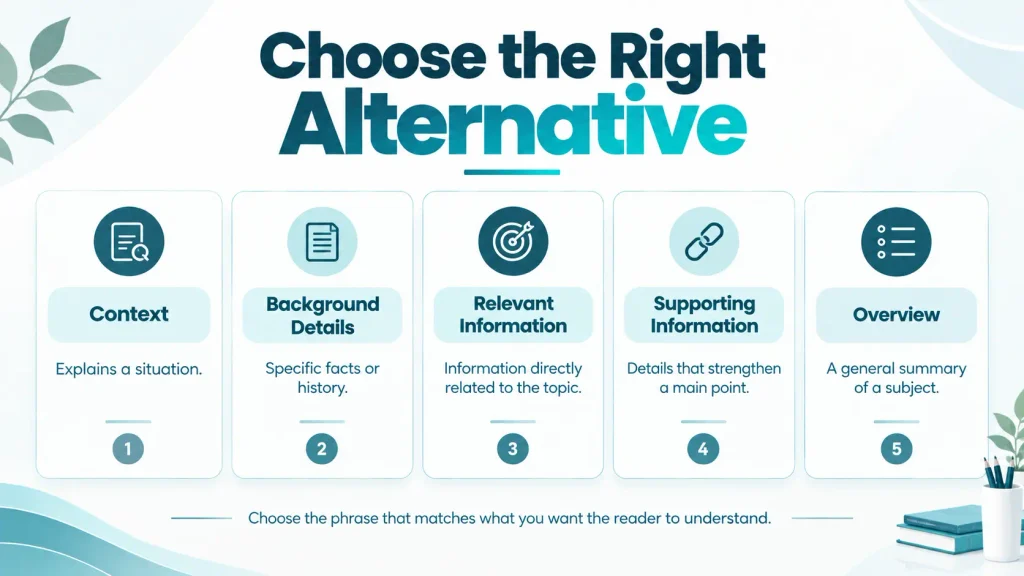
The right replacement depends on what you mean by “background information.”
Use “context” for situations
Choose context when you want to explain the circumstances around an event, decision, or idea.
The article gives readers more context about the decision.
Use “background details” for specific facts
Choose background details when you are talking about facts related to a person, organization, or subject.
The interviewer asked for background details about the candidate.
Use “relevant information” for professional writing
Relevant information is a safe choice when you want a clear and professional expression.
Please provide any relevant information before the meeting.
Use “supporting information” for evidence
Choose supporting information when the details help explain or support a claim.
The proposal contains supporting information for the estimated costs.
Use “foundational information” for basic knowledge
This phrase works well when someone needs basic knowledge before learning something more advanced.
The course begins with foundational information about financial planning.
Formal Alternatives to “Background Information”
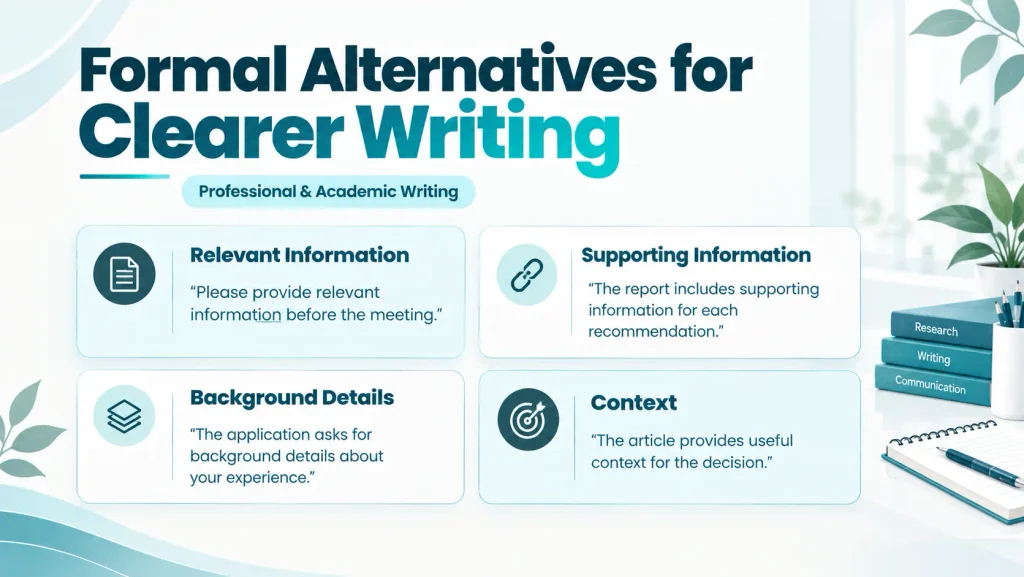
If you are writing an email, report, application, or academic paper, these alternatives can work well:
- Context
- Relevant information
- Supporting information
- Background details
- Foundational information
- Historical context
- Pertinent details
For example, instead of:
Please provide background information about your previous employment.
You could write:
Please provide relevant information about your previous employment.
You could also make the sentence more specific:
Please provide details about your previous employment history.
The last version is more direct because it tells the reader exactly what information you need.
Common Mistakes to Avoid
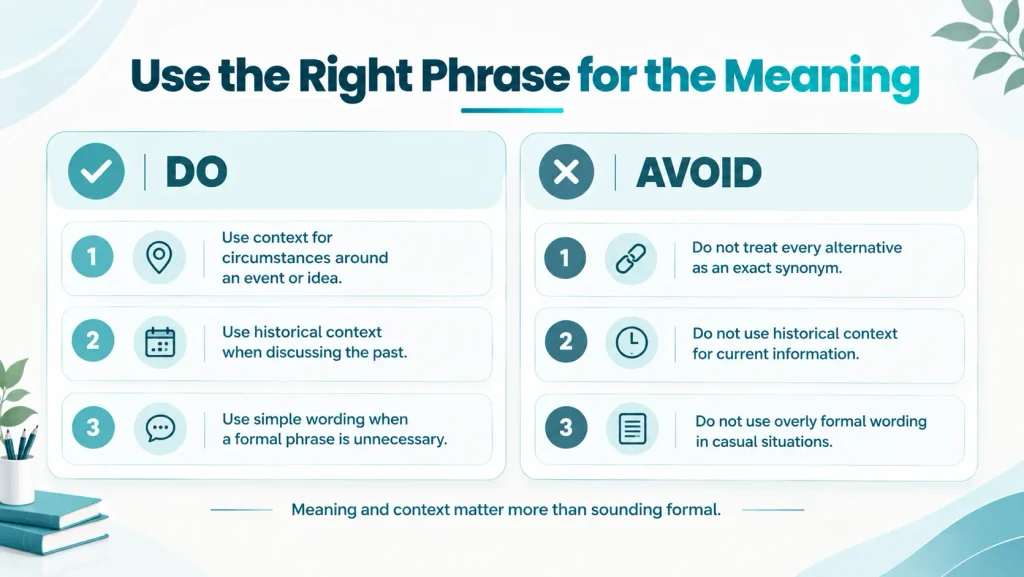
1. Treating every alternative as an exact synonym
Some alternatives have slightly different meanings.
Context usually explains the circumstances around something. Background information can have a wider meaning and may include facts, history, or general details.
2. Using “historical context” for current information
Historical context relates to the past. Avoid using it when you are only talking about someone’s current job, a company’s present services, or a current event.
3. Using “foundational information” in casual writing
“Foundational information” is correct, but it can sound formal. In a casual conversation, basic information or background details may sound more natural.
4. Using “additional details” for essential information
Additional details usually suggests extra information. If readers need the information to understand the main subject, context or background information may be a better choice.
5. Choosing a formal phrase when a simple one works
You do not always need a formal replacement.
For example:
Please provide pertinent details about the project.
is correct, but:
Please provide relevant details about the project.
may sound more natural for everyday professional communication.
Another Way to Say “Provide Background Information”
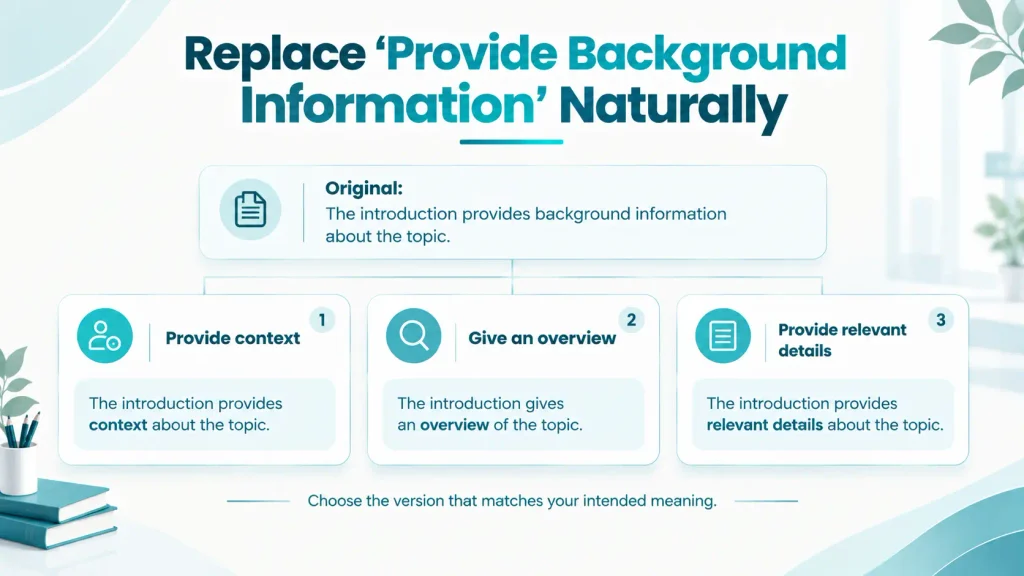
If you want to replace the full phrase “provide background information,” you can use:
- Provide context
- Give some background
- Provide background details
- Give an overview
- Share relevant information
- Explain the background
- Provide additional details
For example:
The introduction provides background information about the topic.
You could write:
The introduction provides context about the topic.
Or:
The introduction gives an overview of the topic.
The best choice depends on whether you want to focus on context, history, or a general summary.
Another Way to Say “Background Information About a Person”
When talking about a person, these phrases may work:
- Personal background
- Biographical information
- Background details
- Personal history
- Relevant personal information
For example:
The article includes background information about the author.
You could say:
The article includes biographical information about the author.
Biographical information is more specific because it refers to facts about a person’s life.
Another Way to Say “Background Information About a Topic”
For a topic, useful alternatives include:
- Context
- Background details
- Introductory information
- Foundational information
- Overview
- Relevant information
For example:
The guide provides background information about digital marketing.
You could write:
The guide provides an overview of digital marketing.
If the goal is to explain the history or circumstances behind the topic, context may be a better choice.
Frequently Asked Questions
What is the closest synonym for “background information”?
Context is often the closest natural alternative. It works especially well when the information helps explain a situation, decision, or event.
What is another way to say “provide background information”?
You can say provide context, give some background, provide relevant details, give an overview, or explain the background.
What is a professional way to say “background information”?
Good professional alternatives include relevant information, supporting information, background details, and context. Your choice should depend on what the information is meant to do.
Is “context” the same as “background information”?
Not always. Context usually explains the circumstances around something. Background information can include context, history, facts, or other details that help someone understand a subject.
What is another way to say “background information about a person”?
You can use personal background, biographical information, background details, or personal history. Biographical information is a good choice when you are describing a person’s life.
What is another way to say “background information about a topic”?
Useful choices include context, background details, introductory information, foundational information, and overview.
What is the difference between “background information” and “additional information”?
Background information usually helps someone understand the main topic. Additional information simply means extra information and does not always provide context.
Conclusion
There are several natural ways to say “background information.” The best choice depends on your sentence and the type of information you want to describe. Use context for circumstances, background details for specific facts, relevant information for professional writing, and supporting information when the details support a main point.
Choosing a more precise phrase can make your writing clearer and easier to understand.

Role: Lead Author & Content Specialist
James Mitchell is an experienced Lead Author at Elite’s Collective. He specializes in creating high-impact editorial content and driving core written projects designed to inform and engage readers.