

Direct answer: Common alternatives to “needless to say” include obviously, clearly, of course, naturally, as you might expect, it goes without saying, unsurprisingly, and as expected. The best choice depends on whether you want to sound neutral, formal, conversational, or slightly emphatic.
Key Takeaways
- “Needless to say” introduces something the writer believes is already obvious or expected.
- “Obviously” and “clearly” are direct alternatives but can sometimes sound blunt.
- “Of course” is more conversational and can sound natural in everyday writing.
- “It goes without saying” is very close in meaning and slightly more formal.
- “As you might expect” works well when the information follows logically from what came before.
- In professional or academic writing, a direct statement is often stronger than using “needless to say.”
What Does “Needless to Say” Mean?
“Needless to say” means that the information that follows is considered obvious, expected, or already understood.
For example:
Needless to say, everyone was disappointed by the cancellation.
The phrase suggests that the writer does not think the statement needs much explanation because the reader can reasonably anticipate it.
It can also introduce an especially important or predictable consequence:
Needless to say, missing the deadline caused several problems.
Although the phrase is common and grammatically correct, you may want an alternative when you want your writing to sound more direct, conversational, formal, or precise.
Best Alternatives to “Needless to Say”
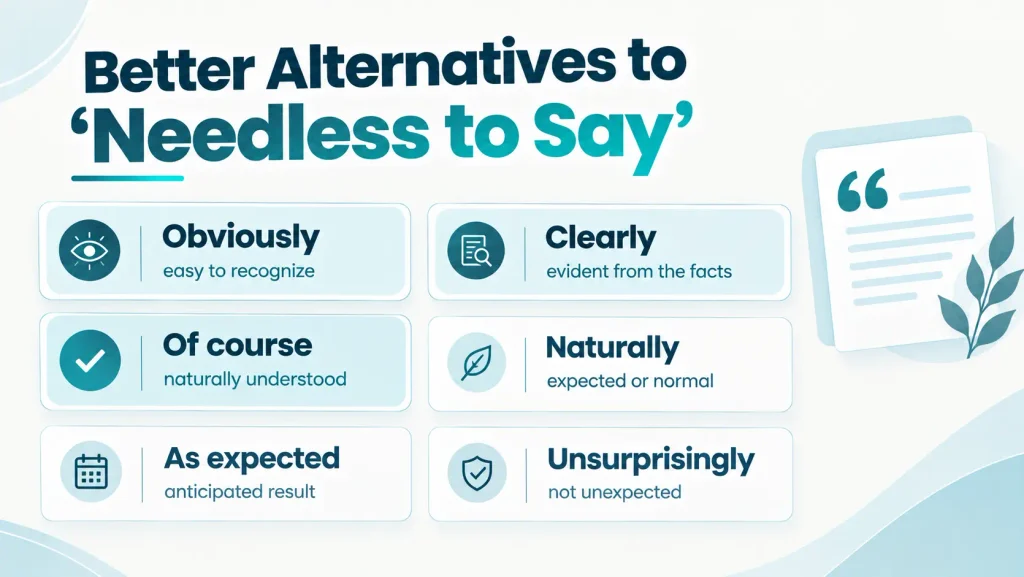
1. Obviously
“Obviously” is useful when something is easy to understand or recognize from the circumstances.
Example:
Obviously, the team needed more time to finish the project.
Best for: Direct, confident writing.
Note: Depending on the situation, “obviously” can sound as though you are implying that the reader should already understand something.
2. Clearly
“Clearly” works when the evidence or situation makes something apparent.
Example:
Clearly, the company needs to improve its customer service.
Best for: Professional, analytical, and persuasive writing.
It is often a better choice than “needless to say” when you want to connect the statement to observable evidence.
3. Of Course
“Of course” is a natural conversational alternative.
Example:
Of course, everyone was excited about the announcement.
Best for: Everyday conversation, friendly writing, and informal communication.
It can also soften a statement:
Of course, we understand that plans can change.
4. It Goes Without Saying
“It goes without saying” is one of the closest alternatives to “needless to say.”
Example:
It goes without saying that customer privacy should be protected.
Best for: Formal and semi-formal writing.
However, it has essentially the same function as “needless to say,” so it may not be the best choice if your goal is to make the sentence more concise.
5. Naturally
“Naturally” suggests that something happened or is true as a normal or expected result.
Example:
Naturally, the students were nervous before the exam.
Best for: Neutral, conversational, and moderately formal writing.
6. As You Might Expect
This phrase is useful when the information is a predictable result of what has already been explained.
Example:
As you might expect, sales increased after the new product launched.
Best for: Explanatory, educational, and professional writing.
It often sounds less blunt than “obviously.”
7. Unsurprisingly
“Unsurprisingly” means that something was not surprising given the circumstances.
Example:
Unsurprisingly, the most popular products sold out quickly.
Best for: Articles, reports, commentary, and analytical writing.
It is particularly useful when the preceding information explains why the result was predictable.
8. As Expected
“As expected” is concise and emphasizes that an outcome matched what people anticipated.
Example:
As expected, the meeting lasted longer than planned.
Best for: Reports, professional writing, and factual descriptions.
9. Predictably
“Predictably” indicates that an outcome was expected based on the circumstances.
Example:
Predictably, the sudden change created confusion among employees.
Best for: Analytical or critical writing.
Be careful with the tone: “predictably” can sometimes sound critical or sarcastic.
10. Without a Doubt
“Without a doubt” is useful when you want to emphasize certainty rather than simply say something is obvious.
Example:
Without a doubt, this was one of the team’s strongest performances.
Best for: Emphatic, persuasive, and conversational writing.
It is not an exact synonym for “needless to say” in every situation because it focuses more on certainty than obviousness.
Comparison of Alternatives
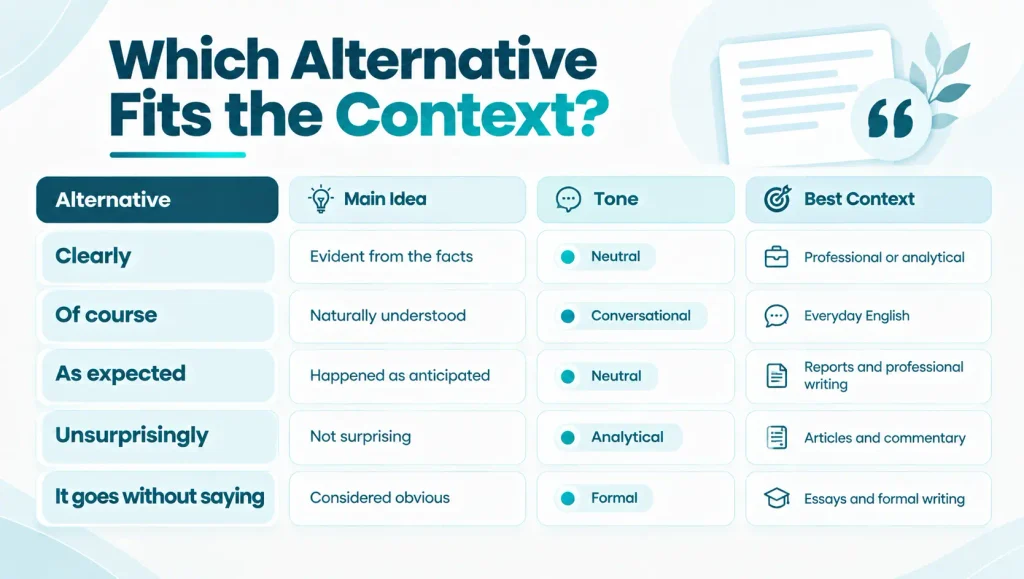
| Alternative | Main Meaning | Tone | Best Context |
|---|---|---|---|
| Obviously | Easy to recognize or understand | Direct | General writing |
| Clearly | Evident from facts or circumstances | Neutral/formal | Professional or analytical |
| Of course | Naturally expected or understood | Conversational | Everyday English |
| It goes without saying | So obvious it needs no explanation | Formal | Essays and professional writing |
| Naturally | Expected or normal | Neutral | General writing |
| As you might expect | Predictable based on context | Polished | Explanatory writing |
| Unsurprisingly | Not surprising | Analytical | Articles and reports |
| As expected | Happened as anticipated | Neutral | Reports and professional writing |
| Predictably | Happened in a foreseeable way | Analytical | Commentary |
| Without a doubt | Certainly or unquestionably | Emphatic | Persuasive writing |
Which Alternative Should You Use?
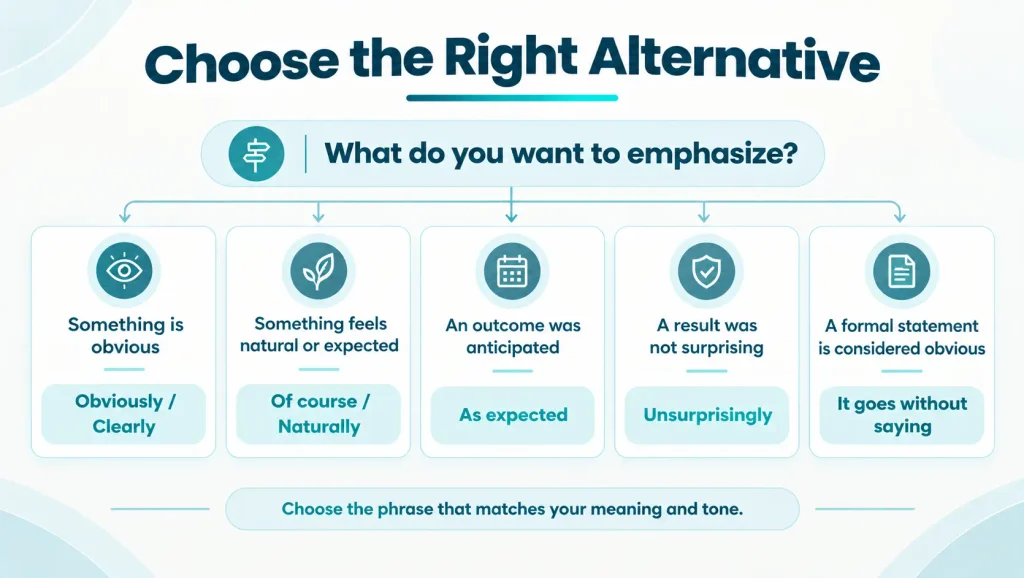
The right replacement depends on what you actually mean.
For everyday conversation
Use:
- Of course
- Naturally
- Obviously
Of course, she was happy to hear the news.
For professional writing
Use:
- Clearly
- As expected
- As you might expect
Clearly, the company needs a more efficient process.
For formal writing
Use:
- It goes without saying
- Clearly
- As expected
It goes without saying that accurate records are essential.
For analytical writing
Use:
- Unsurprisingly
- Predictably
- Clearly
Unsurprisingly, customer demand increased after the price reduction.
For emphasizing certainty
Use:
- Without a doubt
- Certainly
- Clearly
Without a doubt, the decision had a significant impact.
“Needless to Say” vs. “Obviously”
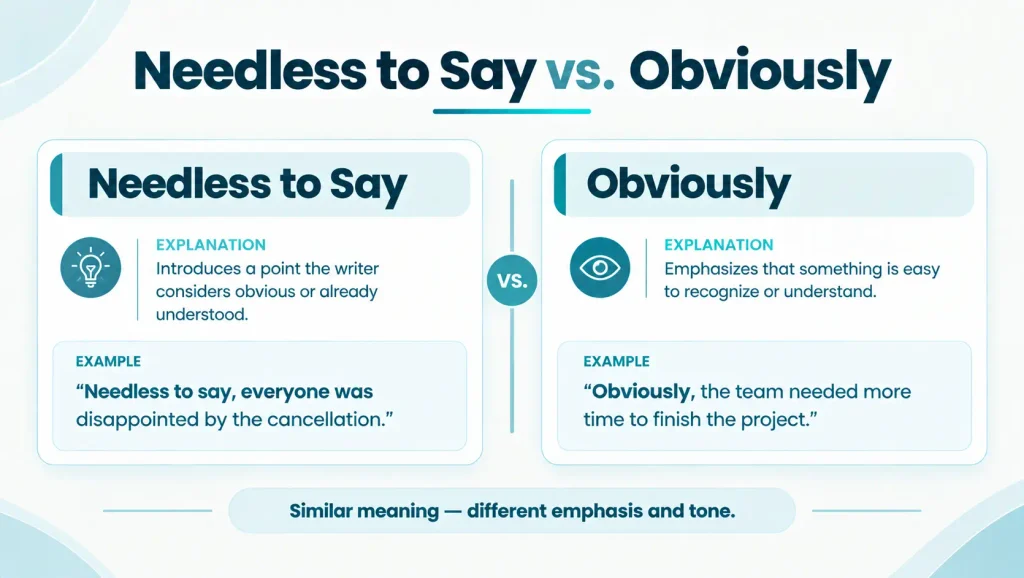
These expressions are similar, but they are not always interchangeable.
Needless to say emphasizes that the writer considers the information unnecessary to explain.
Needless to say, the unexpected announcement caused concern.
Obviously emphasizes that the information is easy to recognize or understand.
Obviously, the unexpected announcement caused concern.
The second sentence can sound more forceful. In some situations, “obviously” may even sound dismissive if the reader does not actually find the point obvious.
“Needless to Say” vs. “Of Course”
“Of course” is generally more conversational.
Of course, we were disappointed.
“Needless to say” has a stronger sense that the statement should already be understood.
Needless to say, we were disappointed.
For friendly or everyday communication, “of course” will often sound more natural.
“Needless to Say” vs. “It Goes Without Saying”
These are extremely close in meaning.
Needless to say, safety should come first.
It goes without saying that safety should come first.
Both suggest that the point is so obvious or important that it does not require explanation.
If you want a completely different-sounding sentence, simply stating the point directly may be better:
Safety should come first.
Is “Needless to Say” Formal?
“Needless to say” is acceptable in both formal and informal English, but it can sometimes sound unnecessary because it announces that the following information is obvious.
For concise professional or academic writing, consider removing it:
Needless to say, accurate data is important.
can become:
Accurate data is important.
The second version is more direct and avoids telling the reader that the point is obvious.
Common Mistakes
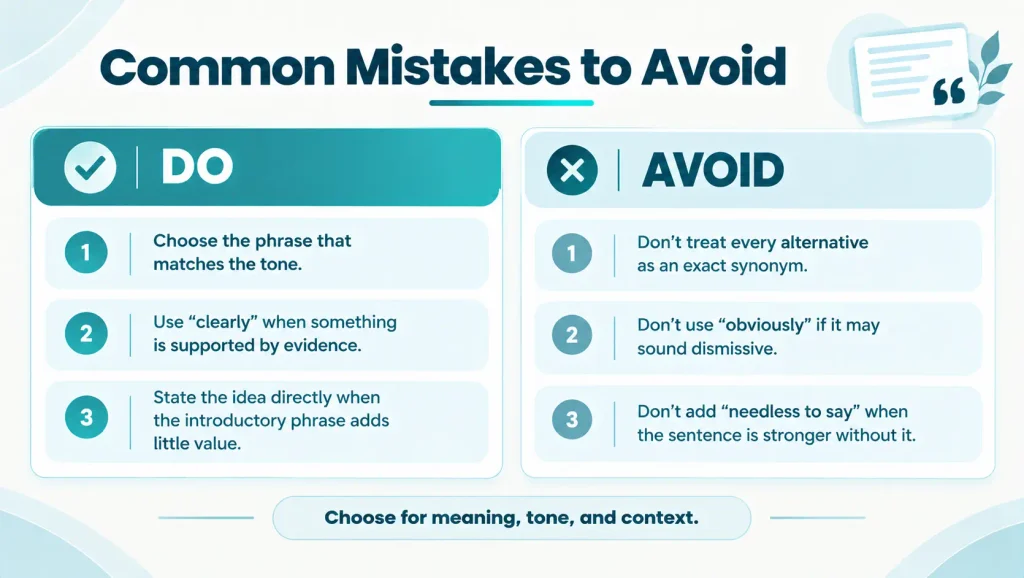
Using “Obviously” to Sound More Professional
“Obviously” does not automatically make writing more professional. In some contexts, it can sound blunt.
Instead of:
Obviously, you made a mistake.
A more neutral version might be:
It appears that an error was made.
Treating Every Alternative as an Exact Synonym
Words such as “without a doubt” emphasize certainty, while “as expected” emphasizes predictability. They overlap with “needless to say,” but they do not have exactly the same meaning.
Choose the phrase based on the idea you want to communicate.
Overusing “Needless to Say”
If a statement is important, you usually do not need to announce that it is obvious.
Instead of:
Needless to say, employees should arrive on time.
A cleaner version is:
Employees should arrive on time.
Direct writing is often stronger.
FAQ
What is another way to say “needless to say”?
Common alternatives include obviously, clearly, of course, naturally, it goes without saying, as expected, unsurprisingly, and as you might expect.
What is a more professional way to say “needless to say”?
“Clearly,” “as expected,” or “as you might expect” can work well in professional writing, depending on the context.
Is “it goes without saying” the same as “needless to say”?
Yes. They have very similar meanings and both introduce information that the writer considers obvious or already understood.
What is a casual alternative to “needless to say”?
“Of course” is usually a natural casual alternative. “Obviously” can also work, although its tone may be stronger.
Is “needless to say” grammatically correct?
Yes. “Needless to say” is a standard English expression used to introduce an obvious, expected, or easily understood point.
Can I use “needless to say” in academic writing?
You can, but use it selectively. Academic writing often benefits from stating the information directly rather than telling the reader that something is obvious.
What is the difference between “needless to say” and “unsurprisingly”?
“Needless to say” means the writer considers the statement obvious or unnecessary to explain. “Unsurprisingly” specifically indicates that an event or result was not surprising.
Conclusion
“Needless to say” is a useful expression for introducing an obvious or expected point, but it is not always the most precise or concise choice. For a conversational tone, try “of course” or “naturally.” For professional writing, “clearly,” “as expected,” or “as you might expect” may work better. When the information is simply obvious, you can often make the sentence stronger by stating it directly and removing the introductory phrase altogether.

Role: Lead Author & Content Specialist
James Mitchell is an experienced Lead Author at Elite’s Collective. He specializes in creating high-impact editorial content and driving core written projects designed to inform and engage readers.