
Direct answer: Common ways to say “make sense” include be understandable, be clear, be logical, add up, be reasonable, be coherent, be easy to understand, and be plausible. The best alternative depends on whether you mean something is easy to understand, logically sound, reasonable, or believable.
Key Takeaways
- “Make sense” can mean that something is understandable, logical, reasonable, or believable.
- “Be clear” works well when the focus is understanding.
- “Be logical” emphasizes reasoning or sound thinking.
- “Add up” is useful when checking whether facts or details are consistent.
- “Be reasonable” focuses on whether an idea or decision seems sensible.
- Not every alternative works in every sentence, so context matters.
What Does “Make Sense” Mean?
“Make sense” is a common American English expression with several related meanings. It can describe something that is easy to understand, logically consistent, reasonable, or believable.
For example:
“Your explanation makes sense.”
This can mean that the explanation is clear and logically understandable.
The phrase can also be used when evaluating a decision:
“It makes sense to leave early.”
Here, it means that leaving early is a reasonable or sensible choice.
Because the expression has several uses, the best replacement depends on what you want to emphasize.
Best Alternatives to “Make Sense”
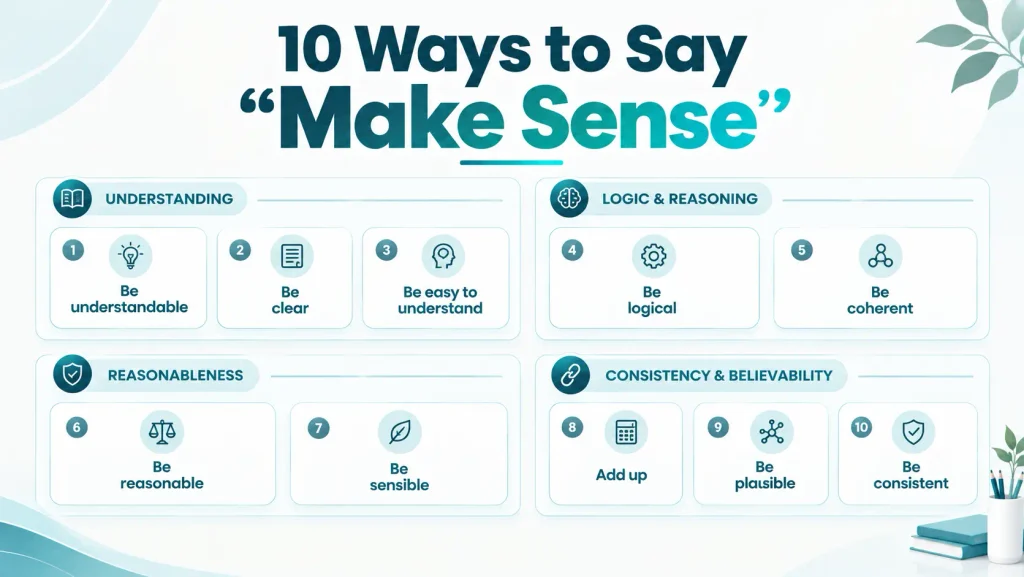
1. Be Understandable
Use “be understandable” when you mean that something can be understood clearly.
Example:
“Her explanation was understandable even though the topic was complicated.”
Best for: explanations, instructions, ideas, and information.
2. Be Clear
“Be clear” is one of the most natural alternatives when you are talking about whether something is easy to understand.
Example:
“Is my explanation clear?”
You could also say:
“Does my explanation make sense?”
Both are natural, but “clear” focuses more directly on how easily someone can understand the information.
3. Be Logical
Use “be logical” when the idea follows sound reasoning.
Example:
“Her conclusion is logical based on the evidence.”
This is more specific than “make sense” because it emphasizes reasoning rather than simple comprehension.
4. Be Reasonable
“Be reasonable” works when something seems sensible, fair, or appropriate.
Example:
“Given the circumstances, his request seems reasonable.”
It is especially useful when discussing decisions, requests, expectations, or proposed actions.
5. Add Up
“Add up” is an informal expression often used when facts, numbers, or explanations appear consistent.
Example:
“His explanation doesn’t add up.”
This means that something seems inconsistent or doesn’t fit the available information.
Note: “Add up” is not a universal synonym for “make sense.” It is most useful when you’re evaluating whether details are consistent.
6. Be Coherent
“Be coherent” means that ideas are logically connected and organized in a way that can be understood.
Example:
“Her argument was coherent and well organized.”
This is particularly useful for essays, arguments, explanations, and formal writing.
7. Be Sensible
Use “be sensible” when an action, decision, or idea seems practical and wise.
Example:
“Taking an umbrella seems sensible because it may rain.”
This alternative usually refers to a choice or course of action rather than simply whether information is understandable.
8. Be Plausible
“Be plausible” means that something seems believable or reasonably possible.
Example:
“His explanation sounds plausible.”
This is useful when you’re evaluating whether an explanation or theory could realistically be true.
9. Be Easy to Understand
This is a straightforward replacement when “make sense” means that something is understandable.
Example:
“The instructions are easy to understand.”
It is especially useful for explaining information to a general audience.
10. Be Consistent
Use “be consistent” when information, facts, or behavior agree with each other without contradictions.
Example:
“Her story is consistent with the available evidence.”
This can overlap with “make sense,” but it specifically emphasizes agreement between different pieces of information.
Which Alternative Should You Use?
| Alternative | Main meaning | Tone | Best context |
|---|---|---|---|
| Be understandable | Can be understood | Neutral | Explanations, information |
| Be clear | Easy to understand | Neutral | Conversation, writing |
| Be logical | Follows sound reasoning | Neutral/Formal | Arguments, decisions |
| Be reasonable | Sensible or appropriate | Neutral | Requests, decisions |
| Add up | Details are consistent | Casual | Facts, explanations |
| Be coherent | Ideas connect logically | Formal | Essays, arguments |
| Be sensible | Practical or wise | Neutral | Decisions, actions |
| Be plausible | Seems believable | Neutral/Formal | Explanations, theories |
| Be easy to understand | Simple to comprehend | Neutral | Instructions, explanations |
| Be consistent | Doesn’t contradict other information | Neutral/Formal | Facts, evidence |
“Make Sense” in Different Contexts
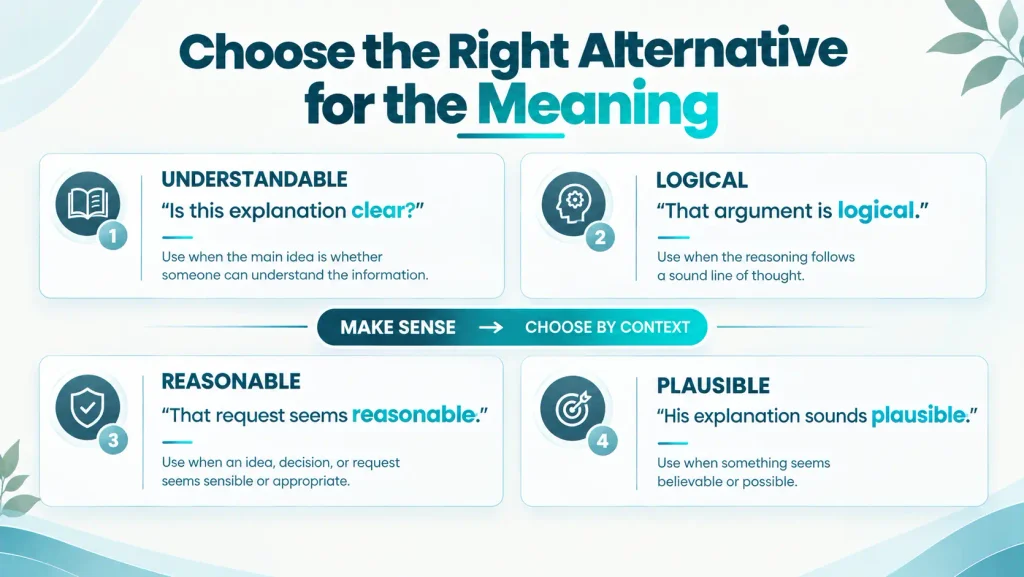
When You Mean “Understandable”
Original:
“Does this explanation make sense?”
Natural alternatives:
- “Is this explanation clear?”
- “Is this explanation understandable?”
- “Is this easy to understand?”
Here, “be clear” is usually the most natural choice.
When You Mean “Logical”
Original:
“That argument makes sense.”
Possible alternatives:
- “That argument is logical.”
- “That argument is coherent.”
- “That reasoning is sound.”
These alternatives emphasize the quality of the reasoning rather than simply whether the listener understands it.
When You Mean “Reasonable”
Original:
“It makes sense to wait until tomorrow.”
Possible alternatives:
- “It seems reasonable to wait until tomorrow.”
- “It seems sensible to wait until tomorrow.”
- “Waiting until tomorrow is a practical choice.”
Here, “reasonable” or “sensible” is more precise than “clear.”
When You Mean “Believable”
Original:
“His explanation makes sense.”
If you’re specifically talking about whether the explanation seems believable, you could say:
“His explanation sounds plausible.”
This changes the emphasis slightly: plausible focuses on whether something seems believable or possible.
Formal Alternatives to “Make Sense”
For professional or academic writing, these options can sound more precise:
- be logical
- be coherent
- be reasonable
- be consistent
- be understandable
- be justified
- be plausible
For example:
Casual:
“Your plan makes sense.”
More formal:
“Your plan seems reasonable.”
Or:
Casual:
“Her argument makes sense.”
Formal:
“Her argument is logically coherent.”
Choose the wording based on what you actually mean rather than simply replacing the phrase with a more formal-sounding expression.
Casual Alternatives to “Make Sense”
In everyday conversation, these are natural:
- add up
- be clear
- be understandable
- seem reasonable
- seem logical
- check out
For example:
“That doesn’t make sense.”
Depending on the situation, you might say:
“That doesn’t add up.”
or
“That isn’t clear to me.”
or
“That doesn’t seem logical.”
“Check out” is more informal and often means that something appears correct or believable:
“His story checks out.”
It should not be treated as a universal replacement for “make sense.”
Common Mistakes When Replacing “Make Sense”
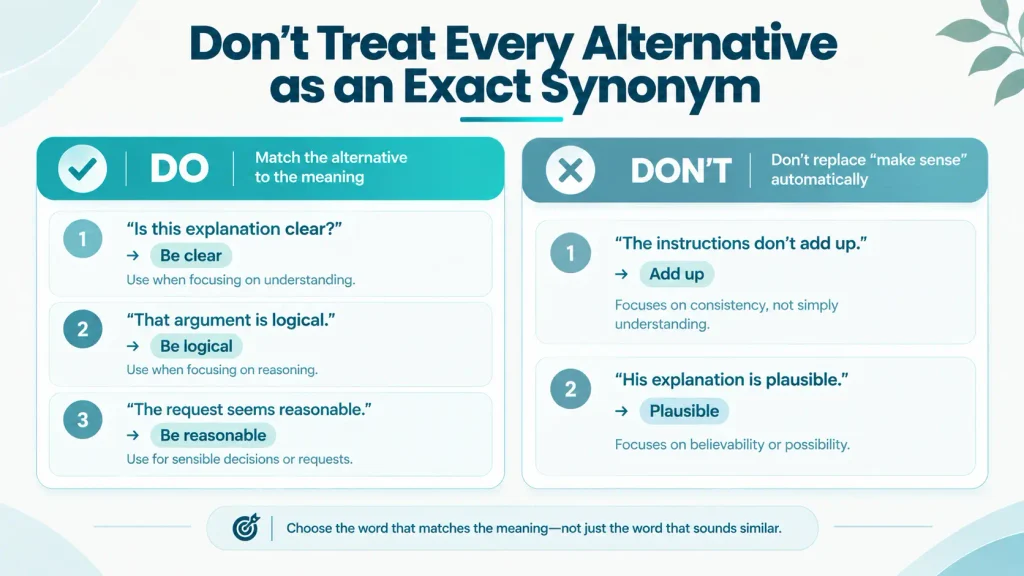
Using “logical” when you only mean “clear”
If someone doesn’t understand an explanation, saying it is not logical may suggest that the reasoning itself is flawed.
Better:
“The explanation isn’t clear.”
Using “reasonable” for simple comprehension
“Reasonable” usually evaluates an idea, action, request, or decision.
For example:
“Her request is reasonable.”
It doesn’t normally mean simply:
“Her sentence is understandable.”
Treating “add up” as an exact synonym
“Add up” often implies that details are consistent.
“The numbers don’t add up.”
This is different from:
“The instructions don’t make sense.”
The first concerns consistency; the second could simply mean the instructions are confusing.
Using “plausible” when certainty is intended
“Plausible” means something seems believable or possible. It does not mean that something has been proven true.
“His explanation is plausible.”
This is more cautious than:
“His explanation is correct.”
Frequently Asked Questions

What is another way to say “make sense” professionally?
Depending on the context, you can use “be clear,” “be logical,” “be reasonable,” “be coherent,” or “be consistent.” The best choice depends on whether you’re discussing clarity, reasoning, practicality, or consistency.
What is a synonym for “make sense”?
Common alternatives include be understandable, be clear, be logical, be reasonable, be coherent, be sensible, and add up. These are related alternatives rather than perfect synonyms because “make sense” has multiple meanings.
What is a formal way to say “that makes sense”?
You could say “That is reasonable,” “That is logical,” “That is clear,” “That is coherent,” or “That is understandable,” depending on the intended meaning.
What is a casual way to say “make sense”?
In casual conversation, “add up” or “check out” can work in certain contexts. For example, “His story checks out” means that the story appears consistent or believable.
Is “make sense” grammatically correct?
Yes. “Make sense” is a standard English expression. For example, “That makes sense” and “Does that make sense?” are both natural and widely used.
What is another way to say “Does that make sense?”
You can say “Is that clear?”, “Is that understandable?”, or “Am I explaining that clearly?” The most natural choice depends on whether you’re checking comprehension or asking whether your explanation was clear.
Is “make sense” formal or informal?
“Make sense” is neutral. It works in everyday conversation, workplace communication, and many forms of professional writing. More formal alternatives such as “be coherent” or “be logically sound” may be appropriate in academic or technical contexts.
Conclusion
“Make sense” is a flexible expression, so the best alternative depends on the intended meaning. Use “be clear” for understanding, “be logical” for reasoning, “be reasonable” for sensible decisions, “add up” for consistent details, and “be plausible” for something that seems believable. Choosing the alternative that matches the exact meaning will make your English sound more precise and natural.

Role: Lead Author & Content Specialist
James Mitchell is an experienced Lead Author at Elite’s Collective. He specializes in creating high-impact editorial content and driving core written projects designed to inform and engage readers.