

Direct answer: Common alternatives to “shed light” include clarify, explain, illuminate, reveal, make clear, provide insight into, bring to light, uncover, and help explain. The best choice depends on whether you want to emphasize explanation, discovery, revealing information, or gaining a better understanding.
Key Takeaways
- “Shed light on” means to make something easier to understand or reveal useful information about it.
- Clarify is one of the most natural alternatives when something is confusing.
- Explain works well when you are describing or making a topic understandable.
- Reveal and bring to light emphasize previously unknown information.
- Provide insight into sounds more analytical or professional.
- Not every synonym has exactly the same meaning, so context matters.
What Does “Shed Light On” Mean?
The phrase “shed light on” is an idiom meaning to make something clearer, easier to understand, or better known.
For example:
The report shed light on why the project was delayed.
This means the report provided information that helped people understand the reason for the delay.
The expression can be used in everyday, academic, professional, journalistic, and analytical writing. It is usually neutral in tone.
10 Natural Alternatives to “Shed Light On”
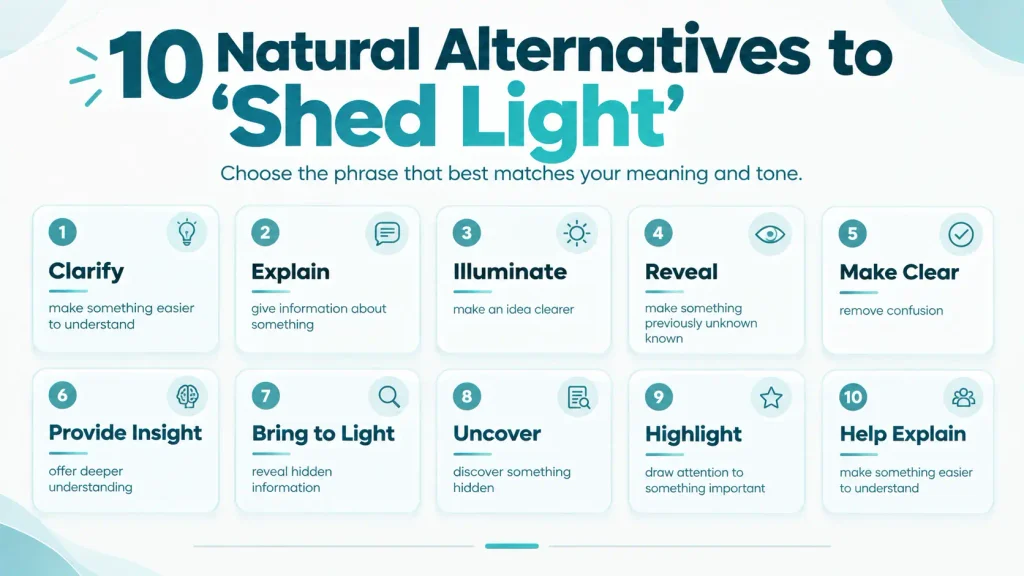
1. Clarify
Clarify means to make something easier to understand by removing confusion or uncertainty.
Example:
The manager clarified the reasons behind the policy change.
Best for: Professional, academic, and everyday English.
Usage tip: Use clarify when the main idea is making something confusing more understandable.
2. Explain
Explain is a straightforward alternative when someone provides information that helps another person understand something.
Example:
The researcher explained how the new process works.
Best for: Everyday, academic, and professional contexts.
Usage tip: Explain is broader and more direct than “shed light on,” so it often sounds more natural in simple sentences.
3. Illuminate
Illuminate can mean to make something clearer or provide a deeper understanding of a subject.
Example:
The study illuminates the factors that influence consumer behavior.
Best for: Academic, analytical, and formal writing.
Usage tip: This is a more sophisticated alternative and can sound overly formal in casual conversation.
4. Reveal
Reveal means to make information known, especially information that was previously hidden or unknown.
Example:
The investigation revealed several problems with the original plan.
Best for: Investigations, discoveries, reports, and news writing.
Usage tip: Choose reveal when the important idea is that previously unknown information has become known.
5. Make Clear
Make clear is a simple, natural phrase for showing or explaining something so that people understand it.
Example:
The updated guidelines make clear what employees are expected to do.
Best for: Everyday and professional communication.
Usage tip: This is an excellent choice when you want plain, direct American English.
6. Provide Insight Into
Provide insight into means to offer useful understanding of a subject, situation, or problem.
Example:
The interviews provided insight into how students experienced remote learning.
Best for: Academic, professional, research, and analytical writing.
Usage tip: This phrase often suggests deeper understanding rather than simply explaining a basic fact.
7. Bring to Light
Bring to light means to reveal something that was previously unknown, overlooked, or hidden.
Example:
The audit brought several accounting errors to light.
Best for: Investigations, journalism, reports, and formal writing.
Usage tip: This is close to reveal, but it often carries a stronger sense that something was uncovered.
8. Uncover
Uncover means to discover or expose information that was previously hidden or unknown.
Example:
The investigation uncovered evidence of serious safety problems.
Best for: Investigations, research, journalism, and discoveries.
Usage tip: Uncover focuses on the process or result of discovering something that was not previously known.
9. Highlight
Highlight means to draw attention to an important fact, issue, or feature.
Example:
The report highlights the challenges faced by small businesses.
Best for: Reports, presentations, articles, and professional communication.
Usage tip: Highlight is not a perfect synonym for “shed light on.” It emphasizes drawing attention rather than necessarily explaining something.
10. Help Explain
Help explain is a natural alternative when new information contributes to understanding why something happened.
Example:
The new evidence helps explain the sudden change in sales.
Best for: Everyday, professional, and analytical writing.
Usage tip: This wording is especially useful when the evidence doesn’t provide a complete explanation but makes the situation easier to understand.
Which Alternative Should You Use?
| Alternative | Main Meaning | Tone | Best Context |
| Clarify | Make something easier to understand | Neutral | Professional, academic, everyday |
| Explain | Make a subject understandable | Neutral | General use |
| Illuminate | Provide deeper understanding | Formal | Academic, analytical |
| Reveal | Make unknown information known | Neutral | Reports, investigations |
| Make clear | Remove confusion | Plain | Everyday, professional |
| Provide insight into | Offer deeper understanding | Professional | Research, analysis |
| Bring to light | Uncover previously hidden information | Formal/neutral | Investigations, journalism |
| Uncover | Discover hidden information | Neutral | Research, investigations |
| Highlight | Draw attention to something important | Neutral | Reports, presentations |
| Help explain | Contribute to understanding | Neutral | General, analytical |
“Shed Light On” vs. “Clarify”
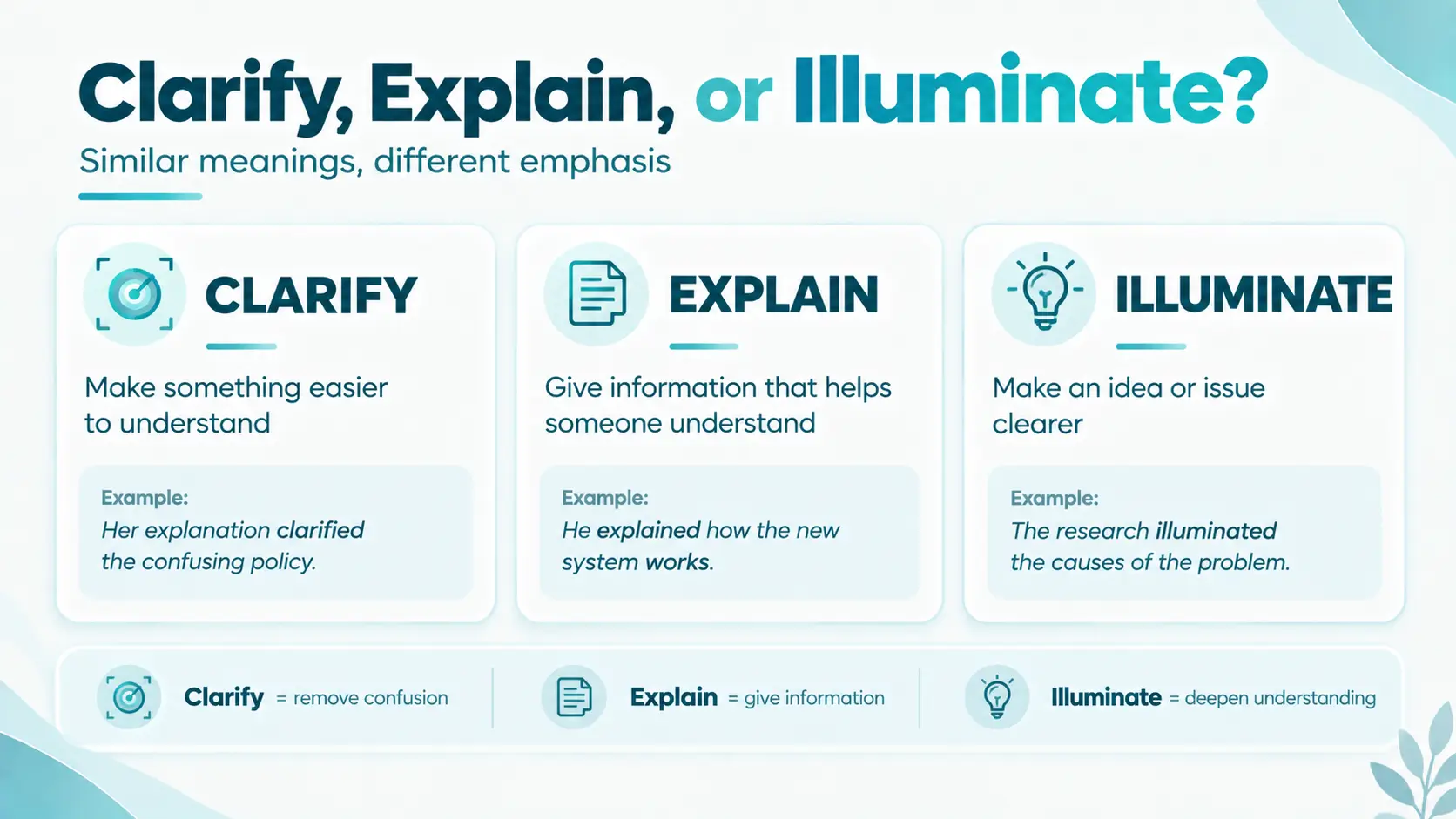
These expressions are closely related, but they are not always interchangeable.
Shed light on often means that information helps people understand a broader issue:
The interviews shed light on the challenges faced by first-generation students.
Clarify usually focuses more directly on removing confusion:
The professor clarified the requirements for the assignment.
If something is confusing, clarify is usually the more direct choice. If new information gives you a better understanding of a broader situation, shed light on may fit better.
“Shed Light On” vs. “Reveal”
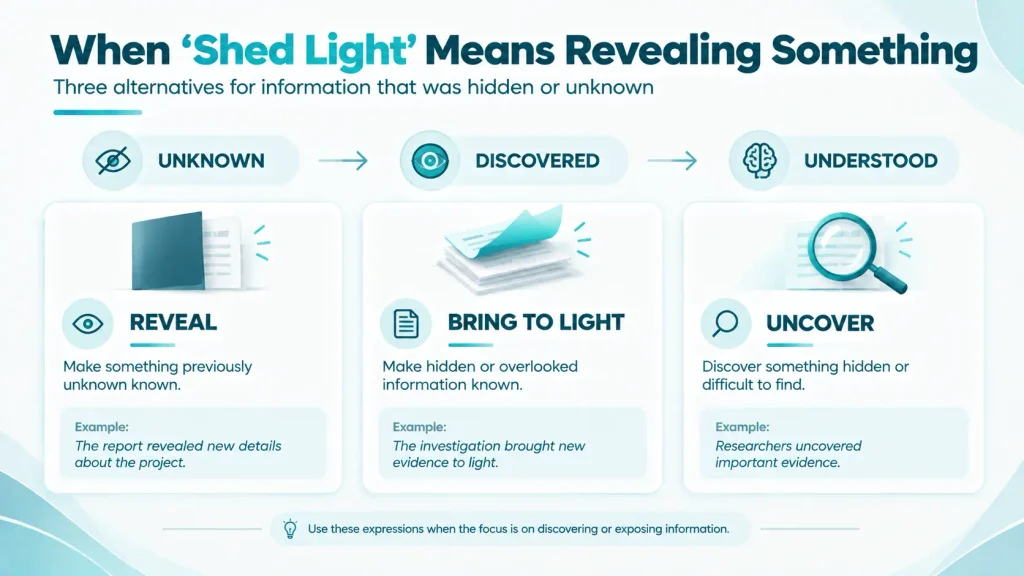
The distinction is mainly about what happens to the information.
Reveal emphasizes making something previously unknown known:
The investigation revealed a serious security flaw.
Shed light on emphasizes helping people understand something:
The investigation shed light on how the security flaw occurred.
So, reveal is more about discovery, while shed light on is more about understanding.
Formal Alternatives for “Shed Light On”
For academic, business, or analytical writing, these options can work particularly well:
- Provide insight into
- Illuminate
- Clarify
- Elucidate
- Offer a clearer understanding of
- Help explain
For example:
The findings provide insight into consumer behavior.
This may sound more appropriate in a research paper than:
The findings shed light on consumer behavior.
Both are grammatical, but the first has a more analytical tone.
Casual Alternatives for “Shed Light On”
In everyday American English, simpler wording is often better:
- Explain
- Make clear
- Help me understand
- Show
- Help explain
- Clear up
For example:
Can you shed some light on what happened?
could become:
Can you explain what happened?
or:
Can you clear up what happened?
The best choice depends on how formal you want to sound.
Common Mistakes to Avoid
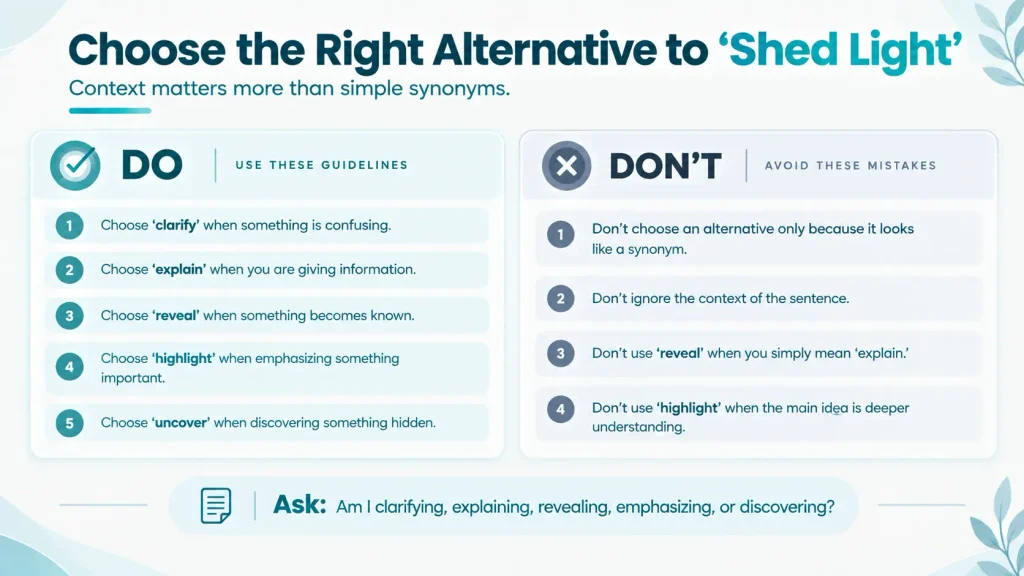
Using “reveal” when you only mean “explain”
If the information was already known, reveal may suggest something was previously hidden.
Less precise:
The teacher revealed the homework instructions.
Better:
The teacher clarified the homework instructions.
Treating “highlight” as an exact synonym
Highlight means to draw attention to something. It does not necessarily mean to explain it.
The report highlighted the problem.
This tells readers that the report drew attention to the problem, not necessarily that it explained the problem.
Using overly formal vocabulary in casual writing
Words such as illuminate and elucidate can be appropriate in academic or formal contexts but may sound unnecessarily formal in everyday conversation.
Instead of:
Could you illuminate the situation for me?
A natural speaker would usually say:
Could you explain the situation?
Frequently Asked Questions
What is another word for “shed light on”?
Depending on the context, useful alternatives include clarify, explain, illuminate, reveal, uncover, highlight, make clear, provide insight into, bring to light, and help explain.
Is “shed light on” formal?
“Shed light on” is neutral and widely accepted in American English. It works in casual conversation as well as professional, academic, and journalistic writing.
Is “shed light on” the same as “clarify”?
They are similar but not identical. Clarify usually means making something confusing easier to understand, while shed light on can mean providing new information or perspective that improves understanding.
What is a formal way to say “shed light on”?
Depending on the context, provide insight into, illuminate, clarify, or offer a clearer understanding of can work well.
What is a simple way to say “shed light on”?
Use explain, make clear, or help explain. These are straightforward and natural choices.
What is another way to say “shed some light on the situation”?
You could say “explain the situation,” “clarify the situation,” “help me understand the situation,” or “provide some insight into the situation.”
Is “bring to light” the same as “shed light on”?
They overlap, but bring to light more strongly suggests uncovering information that was hidden or unknown. Shed light on focuses more on improving understanding.
Conclusion
“Shed light on” is a versatile phrase for saying that something makes a subject clearer or easier to understand. The best replacement depends on the exact meaning you want.
Use clarify for confusion, explain for straightforward understanding, reveal or uncover for previously unknown information, provide insight into for deeper analysis, and bring to light when something hidden is uncovered. For simple everyday writing, make clear and help explain are often the most natural choices

Role: English Language & Communication Writer
Daniel Carter is an English language writer specializing in workplace communication, professional vocabulary, resumes, emails, and career-focused English.