
“Good work” is a way to praise someone for doing something well, completing a task successfully, or showing effort and skill. The best alternative depends on what you want to recognize. For example, “Great job!” sounds friendly and casual, “Excellent work!” offers stronger praise, and “Well done!” works in both personal and professional settings.
Key Takeaways
- Great job! is a natural, everyday way to praise someone’s work.
- Excellent work! expresses strong approval of the quality of a task.
- Well done! is suitable for both casual conversations and professional settings.
- Nice work! sounds friendly and encouraging.
- Impressive work! highlights a result that stands out.
- Thank you for your effort. recognizes someone’s contribution rather than just the final result.
What Does “Good Work” Mean?
“Good work” is an expression of approval used when someone does a task well, produces a strong result, or makes a worthwhile effort. It can refer to the quality of the work, the person’s performance, or the effort behind an achievement.
For example, a manager might say “Good work on the report,” a teacher might praise a student’s progress, or a friend might compliment a creative project.
The phrase is positive and easy to understand, but a more specific compliment can make your praise feel more genuine.
20 Other Ways to Say Good Work
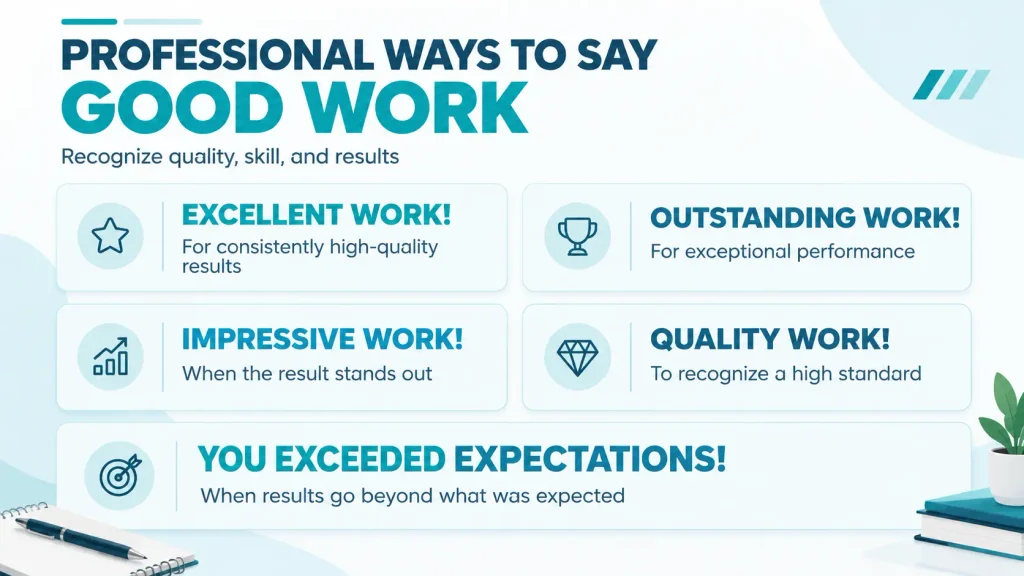
These alternatives cover everyday conversations, professional feedback, academic achievements, and situations where you want to recognize someone’s effort.
1. Great Job!
Meaning: A friendly and enthusiastic way to praise someone for doing something well.
Best for: Everyday conversations, school, and informal workplace communication.
Example: “Great job on the presentation! You explained everything clearly.”
Use this phrase when you want to sound upbeat and encouraging without being overly formal.
2. Excellent Work!
Meaning: Strong praise for work that meets a high standard.
Best for: Professional feedback, assignments, reports, and completed projects.
Example: “Excellent work on the final report. The research is clear and well organized.”
This phrase is a good choice when you want to sound professional while expressing genuine approval.
3. Well Done!
Meaning: An expression of praise for completing something successfully.
Best for: Workplace conversations, school, and personal achievements.
Example: “Well done on finishing the project before the deadline.”
“Well done” is versatile and works in many situations. It can sound slightly more polished than “Great job!”
4. Nice Work!
Meaning: A warm, straightforward compliment that recognizes a good result or a task handled well.
Best for: Casual conversations and friendly professional feedback.
Example: “Nice work on the new website. The layout looks clean and easy to use.”
Choose this phrase when you want to keep your praise relaxed and natural.
5. Impressive Work!
Meaning: Praise for work that stands out because of its quality, creativity, or difficulty.
Best for: Creative projects, technical tasks, and achievements that exceed expectations.
Example: “Impressive work on that design. You found a clever way to solve the problem.”
Use it when something genuinely catches your attention rather than for every routine task.
6. Outstanding Work!
Meaning: Strong praise for work that is exceptionally good.
Best for: Major accomplishments, performance reviews, and important projects.
Example: “Your team delivered outstanding work throughout the product launch.”
“Outstanding” is stronger than “good” or “nice.” Save it for work that deserves a higher level of recognition.
7. Fantastic Job!
Meaning: An enthusiastic expression of approval for a successful result.
Best for: Friendly conversations, team celebrations, and personal accomplishments.
Example: “Fantastic job organizing the event! Everything went smoothly.”
This expression adds energy and excitement to your compliment.
8. Nicely Done!
Meaning: A way to praise someone for handling a task skillfully or successfully.
Best for: Everyday conversations, creative work, and small accomplishments.
Example: “Nicely done! That explanation made a difficult topic much easier to understand.”
It works especially well when someone handles a task with care or skill.
9. You Nailed It!
Meaning: An informal expression meaning someone did something extremely well or achieved the desired result.
Best for: Friends, teammates, presentations, and creative projects.
Example: “You nailed it with that presentation. The client loved your ideas.”
This phrase is conversational and enthusiastic. It is less suitable for formal reports or highly traditional business communication.
10. Keep Up the Good Work!
Meaning: Encouragement to continue performing well.
Best for: Ongoing projects, learning, and recognizing steady progress.
Example: “Your writing has improved a lot this month. Keep up the good work!”
Unlike “Well done,” this phrase looks toward future performance. Use it when you want someone to continue their positive progress.
11. You Did a Great Job!
Meaning: Direct praise for someone’s performance or completed task.
Best for: Personal encouragement, schoolwork, and workplace conversations.
Example: “You did a great job handling the customer’s questions.”
This phrase sounds personal and supportive because it speaks directly to the person’s effort or performance.
12. Quality Work!
Meaning: Recognition that a task or product meets a good standard of quality.
Best for: Craftsmanship, writing, design, construction, and professional projects.
Example: “This is quality work. The details are consistent, and the finished product looks polished.”
Use it when the quality of the result is what you want to highlight.
13. Superb Work!
Meaning: Strong praise for work of a very high standard.
Best for: Exceptional results, polished presentations, and formal recognition.
Example: “Superb work on the campaign. Every part of the plan was carefully executed.”
“Superb” sounds more elevated than “Great job,” so it is best used when you want to emphasize excellence.
14. Brilliant Work!
Meaning: Praise for work that shows exceptional intelligence, creativity, or skill.
Best for: Clever solutions, innovative ideas, and impressive problem-solving.
Example: “Brilliant work finding that error before the report was submitted.”
This expression is particularly useful when someone has demonstrated insight or come up with an excellent idea.
15. You Did Really Well!
Meaning: A natural way to recognize someone’s successful performance.
Best for: Exams, presentations, interviews, and challenging tasks.
Example: “You did really well in the interview. Your answers were clear and confident.”
It focuses on how someone performed rather than simply labeling the finished work.
16. That’s Impressive!
Meaning: A reaction to something that deserves admiration or attention.
Best for: Achievements, creative work, and difficult tasks.
Example: “You built the entire website in a week? That’s impressive!”
This is a useful conversational alternative when you want your compliment to sound spontaneous.
17. You Exceeded Expectations!
Meaning: Recognition that someone’s performance was better than what was expected.
Best for: Performance reviews, client projects, and significant professional achievements.
Example: “Your proposal exceeded expectations and addressed every major concern.”
This is more specific than general praise. Use it when the result genuinely went beyond the original standard.
18. You Put in Great Effort!
Meaning: Recognition of the time, energy, or persistence someone invested in a task.
Best for: Learning, difficult assignments, training, and long-term projects.
Example: “You put in great effort preparing for the competition, and your progress shows.”
This phrase emphasizes the process rather than claiming that every result was perfect.
19. Your Contribution Was Valuable!
Meaning: Recognition that someone’s work or input helped a team or project.
Best for: Meetings, group projects, workplace communication, and team recognition.
Example: “Your contribution was valuable during the planning stage. Your suggestions helped us identify the main risks.”
Choose this phrase when you want to acknowledge someone’s impact rather than simply praise their performance.
20. I Appreciate Your Effort!
Meaning: A sincere way to recognize someone’s work and express gratitude.
Best for: Professional messages, teamwork, and situations where someone has made a meaningful effort.
Example: “I appreciate your effort in revising the document and addressing all the feedback.”
This phrase combines appreciation with recognition. It can be especially appropriate when the effort matters even if the final outcome is still being improved.
Professional Ways to Say Good Work
When praising a coworker, employee, client, or team member, choose wording that matches the accomplishment and your relationship with the person.
Here are six useful options for professional settings.
| Phrase | Example |
|---|---|
| Excellent work | “Excellent work on the revised proposal.” |
| Outstanding performance | “Your outstanding performance helped the team meet its goals.” |
| You exceeded expectations | “You exceeded expectations with the final deliverable.” |
| Your contribution was valuable | “Your contribution was valuable to the success of this project.” |
| You handled that well | “You handled that client concern professionally.” |
| Thank you for your effort | “Thank you for your effort in completing the revisions.” |
For workplace communication, specific praise is often more meaningful than a general compliment. Instead of saying “Good work,” explain what the person did well.
For example:
- General: “Good work on the report.”
- More specific: “Excellent work on the report. Your analysis made the key findings easy to understand.”
The second version identifies the quality you appreciated, making the feedback more useful.
Casual Ways to Say Good Work
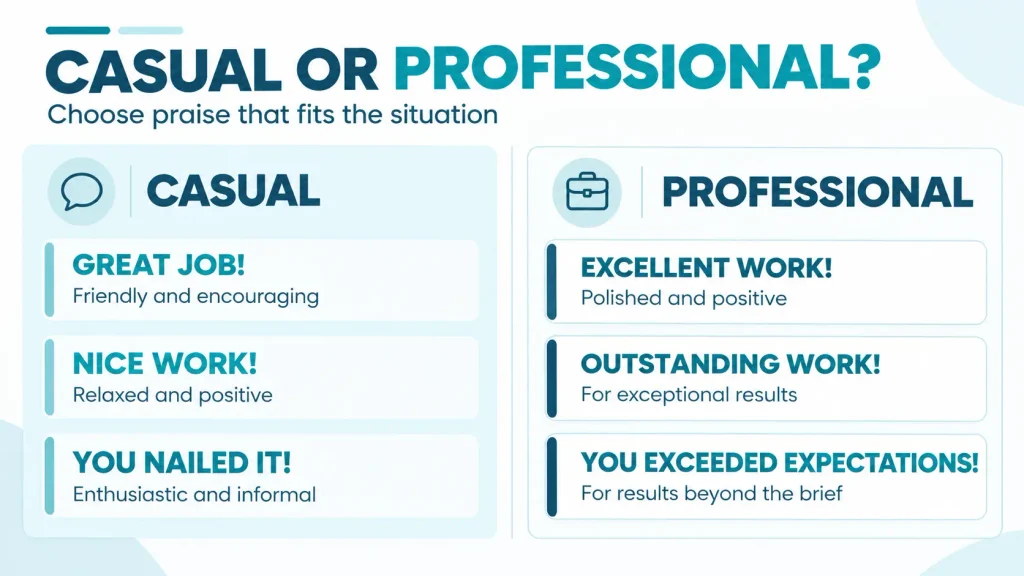
For friends, classmates, family members, or close teammates, relaxed expressions often sound more natural.
- You nailed it! — “You nailed it with that new design.”
- Awesome job! — “Awesome job finishing the race!”
- Way to go! — “Way to go! You passed your driving test.”
- Nice one! — “Nice one! That was a clever solution.”
- That’s amazing! — “That’s amazing! You finished the whole project yourself.”
These expressions are conversational and friendly. Some, such as “You nailed it!” and “Nice one!”, may feel too informal in a formal business email.
How to Choose the Best Alternative
The best expression depends on what you want to praise. Use this table to find the right phrase quickly.
| What you want to recognize | Best phrase |
|---|---|
| A task completed successfully | Well done! |
| Excellent quality | Excellent work! |
| An impressive achievement | Outstanding work! |
| Creativity or clever thinking | Brilliant work! |
| A friendly, everyday accomplishment | Great job! |
| Continued improvement | Keep up the good work! |
| Hard work and persistence | I appreciate your effort! |
| A helpful team contribution | Your contribution was valuable! |
| A result beyond expectations | You exceeded expectations! |
| A task handled skillfully | Nicely done! |
Remember that these expressions are not exact synonyms in every situation. “Keep up the good work” encourages continued effort, while “You exceeded expectations” specifically compares performance with an expected standard.
Common Mistakes to Avoid
1. Using overly strong praise for routine tasks
“Outstanding work” and “superb work” express strong approval. For an ordinary completed task, “Nice work” or “Well done” may sound more natural.
2. Praising effort when you mean quality
“I appreciate your effort” recognizes someone’s work and commitment. It does not necessarily mean the result was excellent.
If you want to praise the finished product, say “Excellent work on the final design.”
3. Using casual expressions in formal communication
“You nailed it!” is perfectly natural in a friendly team chat, but “Excellent work on the presentation” is usually a safer choice for a formal client email.
4. Giving praise without explaining what was good
A general compliment is fine for a small task. For important work, mention a specific strength, such as accuracy, creativity, organization, or problem-solving.
Frequently Asked Questions
What is the best synonym for good work?
“Great job,” “well done,” “nice work,” and “excellent work” are common alternatives. “Great job” is friendly and versatile, while “excellent work” places stronger emphasis on quality.
How do you say good work professionally?
You can say “Excellent work,” “Outstanding performance,” “You exceeded expectations,” or “Your contribution was valuable.” For the most meaningful feedback, identify the specific result or skill you appreciated.
How do you praise someone for working hard?
Say “I appreciate your effort,” “You worked really hard on this,” or “Your dedication really shows.” These phrases recognize persistence and commitment rather than focusing only on the final outcome.
Is “well done” better than “good work”?
Neither is always better. “Well done” often praises successful completion, while “good work” directly recognizes the quality or value of someone’s work. Both are natural in American English.
What is a short way to say good work?
“Great job,” “Nice work,” “Well done,” “Excellent,” and “Nicely done” are all concise options. Choose one that matches the situation and the strength of your praise.
How do you say good work in an email?
You could write, “Excellent work on the project. Your attention to detail made the final version much clearer. Thank you for your effort.”
For a more casual email, “Great job on the presentation!” is often enough.
What is another way to say good work without sounding repetitive?
Vary your wording based on what you want to recognize. Use “Impressive work” for an achievement, “Brilliant work” for a clever solution, and “I appreciate your effort” when you want to acknowledge someone’s contribution.
Conclusion
There are many natural ways to say “good work,” from simple expressions such as “Great job!” and “Well done!” to professional phrases such as “You exceeded expectations” and “Your contribution was valuable.”
The best choice depends on the person, the situation, and what you want to recognize. When possible, pair your compliment with a specific detail about what the person did well. That small change can make your praise more sincere, clear, and memorable.

Role: English Language & Communication Writer
Daniel Carter is an English language writer specializing in workplace communication, professional vocabulary, resumes, emails, and career-focused English.