

Another way to say mysterious is enigmatic, puzzling, secretive, cryptic, or hard to figure out. The best choice depends on what you want to describe. Use enigmatic for someone who is difficult to understand, puzzling for something confusing, and secretive for someone who keeps information private.
Key Takeaways
- Enigmatic describes someone or something that is difficult to understand.
- Puzzling works when something is confusing or hard to explain.
- Cryptic describes a message or statement with a hidden meaning.
- Secretive refers to someone who hides information or avoids sharing details.
- Uncanny describes something strange in a way that feels unsettling.
- Intriguing is a positive alternative when something sparks curiosity.
25 Other Ways to Say Mysterious
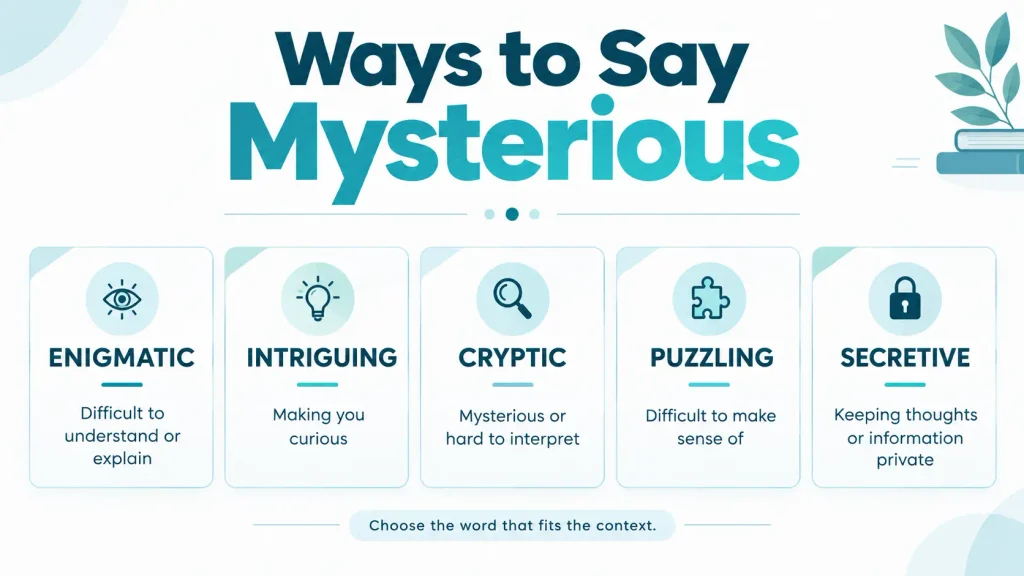
The word mysterious can describe a person, an event, a place, a message, or something that seems impossible to explain. These alternatives share parts of its meaning, but each has a slightly different use.
1. Enigmatic
Enigmatic describes a person, expression, or situation that is difficult to understand or interpret. It is one of the closest alternatives to mysterious.
Example: Her enigmatic smile left everyone wondering what she knew.
Best for: People, expressions, personalities, and behavior.
2. Puzzling
Puzzling means confusing or difficult to explain. It emphasizes the questions something raises rather than a hidden secret.
Example: His sudden decision to leave was puzzling to his friends.
Best for: Unexpected behavior, strange events, and confusing situations.
3. Intriguing
Intriguing describes something that makes you curious and encourages you to learn more. It usually has a positive tone.
Example: The author introduced an intriguing character in the first chapter.
Best for: Stories, people, ideas, discoveries, and unusual details.
4. Cryptic
Cryptic describes something whose meaning is unclear or deliberately hidden, such as a message, comment, or clue.
Example: She sent me a cryptic text that said, “You’ll understand tomorrow.”
Best for: Messages, clues, remarks, and coded communication.
5. Secretive
Secretive describes someone who tends to hide information or avoid revealing their plans. Unlike mysterious, it often suggests intentional secrecy.
Example: He became secretive about his weekend plans.
Best for: People’s habits, private activities, and concealed intentions.
6. Unfathomable
Unfathomable means extremely difficult or impossible to understand. It often suggests great depth or complexity.
Example: The universe still holds many unfathomable secrets.
Best for: Complex ideas, human behavior, nature, and profound questions.
7. Elusive
Elusive describes something that is difficult to find, catch, identify, or understand.
Example: The detective struggled to find the elusive suspect.
Best for: Missing people, difficult answers, hidden truths, and hard-to-reach goals.
8. Unexplained
Unexplained refers to something for which no clear explanation has been given or found.
Example: Several unexplained noises came from the empty house.
Best for: Events, sounds, disappearances, and unusual occurrences.
9. Obscure
Obscure means unclear, little known, or difficult to understand because information is limited.
Example: The old manuscript contained obscure references to a forgotten king.
Best for: Historical details, unfamiliar ideas, unclear references, and lesser-known facts.
10. Bewildering
Bewildering describes something so confusing that it leaves people unsure what to think or do.
Example: The sudden change in the rules was bewildering to the entire team.
Best for: Complicated events, unexpected changes, and confusing experiences.
11. Arcane
Arcane refers to knowledge or information understood by only a few people, often because it is specialized or obscure.
Example: The professor explained an arcane theory from medieval philosophy.
Best for: Specialized knowledge, ancient traditions, and obscure subjects.
12. Uncanny
Uncanny describes something strangely familiar, unusual, or unsettling in a way that is difficult to explain.
Example: The abandoned house had an uncanny resemblance to the one in her dream.
Best for: Eerie experiences, strange similarities, and unsettling situations.
13. Mystifying
Mystifying means confusing or difficult to explain, often because something does not make sense.
Example: The machine stopped working for a mystifying reason.
Best for: Unexpected problems, strange behavior, and confusing events.
14. Enigmatical
Enigmatical has essentially the same meaning as enigmatic, describing something difficult to interpret. However, enigmatic is the more natural choice in modern American English.
Example: His enigmatic remarks made the conversation even more confusing.
Best for: Literary descriptions and formal writing.
15. Ambiguous
Ambiguous describes something that can be understood in more than one way. It does not always imply secrecy or mystery.
Example: The witness gave an ambiguous answer that could be interpreted in two ways.
Best for: Statements, instructions, messages, and unclear meanings.
16. Imponderable
Imponderable refers to something difficult or impossible to assess, predict, or fully understand.
Example: The final outcome depended on several imponderable factors.
Best for: Complex questions, uncertain outcomes, and difficult-to-measure factors.
17. Shadowy
Shadowy can describe something literally hidden in shadows or something secretive, vague, or suspicious.
Example: A shadowy figure stood near the edge of the forest.
Best for: Fiction, suspense, hidden identities, and suspicious activities.
18. Veiled
Veiled describes something concealed or expressed indirectly rather than openly.
Example: She made a veiled reference to the disagreement without naming anyone.
Best for: Hidden intentions, indirect comments, and concealed meanings.
19. Secret
Secret describes something kept hidden from others. It is more direct than mysterious because it focuses on concealment.
Example: They discovered a secret passage behind the bookshelf.
Best for: Hidden information, private plans, and concealed places.
20. Esoteric
Esoteric describes knowledge or ideas understood by a small group with specialized knowledge.
Example: The book explored esoteric symbols used by ancient scholars.
Best for: Specialized subjects, uncommon ideas, and obscure traditions.
21. Bewitching
Bewitching describes someone or something so captivating that it seems almost magical.
Example: The actress had a bewitching presence on screen.
Best for: Beauty, charm, magical settings, and captivating personalities.
22. Magical
Magical describes something that seems extraordinary, enchanting, or full of wonder. It conveys a positive feeling rather than simply a lack of explanation.
Example: The village looked magical beneath the winter stars.
Best for: Beautiful places, fairy tales, special moments, and fantasy.
23. Otherworldly
Otherworldly describes something that seems to belong to another world or feels unlike ordinary human experience.
Example: The glowing landscape had an otherworldly beauty.
Best for: Fantasy, unusual landscapes, supernatural settings, and extraordinary experiences.
24. Unknowable
Unknowable describes something that cannot be known or fully understood, even with careful thought or investigation.
Example: The true motives behind his decision remained unknowable.
Best for: Hidden motives, philosophical questions, and things beyond human understanding.
25. Perplexing
Perplexing means confusing or difficult to make sense of, often because the available information does not provide a clear answer.
Example: The scientist encountered a perplexing result during the experiment.
Best for: Difficult questions, unusual results, and complicated situations.
Which Alternative for Mysterious Should You Choose?
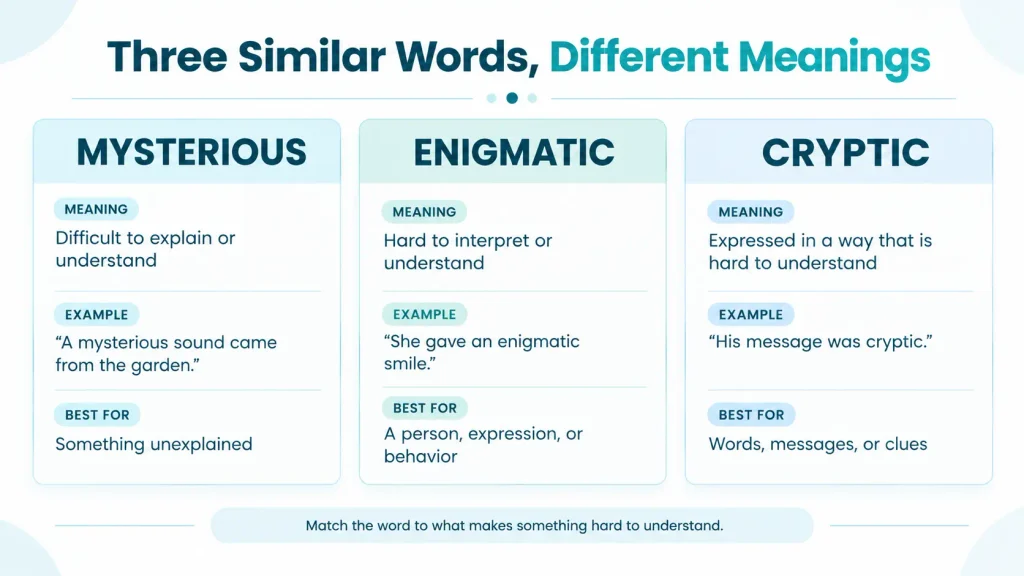
Different words fit different situations. Use this comparison to find the most natural option.
| Alternative | Main meaning | Tone | Best context |
|---|---|---|---|
| Enigmatic | Difficult to interpret | Thoughtful | People and expressions |
| Puzzling | Confusing | Neutral | Events and behavior |
| Intriguing | Makes you curious | Positive | People and stories |
| Cryptic | Hidden or unclear meaning | Neutral to secretive | Messages and clues |
| Secretive | Hides information | Often negative | People and plans |
| Elusive | Difficult to find or grasp | Neutral | Answers and suspects |
| Uncanny | Strange or unsettling | Eerie | Experiences and similarities |
| Obscure | Little known or unclear | Neutral | Facts and references |
| Unfathomable | Impossible to fully understand | Serious | Deep questions |
| Bewitching | Captivating or enchanting | Positive | Beauty and charm |
Another Way to Say Mysterious in Different Contexts
When describing a mysterious person
Use enigmatic, secretive, intriguing, or hard to read, depending on the person’s behavior.
- She is an enigmatic woman who rarely reveals her thoughts.
- He is secretive about his personal life.
- The new neighbor seems intriguing.
- My manager is difficult to read during meetings.
Tip: Choose enigmatic if the person is hard to understand, but secretive if they actively hide information.
When describing a mysterious place
Use eerie, shadowy, otherworldly, or unexplored.
- The abandoned hospital had an eerie atmosphere.
- We followed a narrow path into the shadowy forest.
- The landscape looked otherworldly at sunset.
- They discovered an unexplored cave beyond the river.
Tip: Eerie suggests an unsettling feeling, while otherworldly suggests something extraordinary or unlike the ordinary world.
When describing a mysterious event
Use unexplained, puzzling, baffling, or inexplicable.
- Police investigated the unexplained disappearance.
- Her reaction to the news was puzzling.
- The sudden power failure was baffling.
- The strange occurrence seemed inexplicable.
Tip: Use unexplained when no explanation is available, and inexplicable when something seems impossible to explain.
When describing a mysterious message
Use cryptic, ambiguous, or veiled.
- His cryptic message left us guessing.
- The instructions were ambiguous.
- She made a veiled comment about the surprise.
Tip: Cryptic suggests a hidden meaning, ambiguous allows multiple interpretations, and veiled suggests indirect communication.
When describing something mysterious in a positive way
Use intriguing, fascinating, captivating, or bewitching.
- The documentary explored a fascinating historical mystery.
- Her intriguing personality drew people toward her.
- The singer gave a captivating performance.
- The garden had a bewitching charm.
These words emphasize interest or attraction rather than confusion or secrecy.
Common Mistakes When Choosing a Synonym for Mysterious
- Using “secretive” for every mysterious person: A person can be difficult to understand without deliberately hiding anything.
- Treating “ambiguous” as an exact synonym: Something ambiguous has more than one possible meaning, while something mysterious may simply be unknown.
- Using “cryptic” for an entire place: It usually describes a message, remark, symbol, or clue rather than a general atmosphere.
- Using “eerie” when you mean “intriguing”: Eerie suggests an unsettling feeling, while intriguing usually expresses curiosity.
- Choosing overly formal words in casual conversation: Unfathomable and imponderable may sound unnatural when hard to understand or hard to figure out would work better.
Frequently Asked Questions
What is the best synonym for mysterious?
Enigmatic is one of the closest synonyms for mysterious, especially when describing a person, expression, or situation that is difficult to understand. For a confusing event, puzzling may be more natural.
What is a positive word for mysterious?
Intriguing, fascinating, and captivating are positive alternatives. They suggest curiosity, interest, or attraction rather than confusion or suspicion.
What is a fancy word for mysterious?
Enigmatic, unfathomable, arcane, and esoteric can sound more formal or literary. Each has a different meaning, so choose the one that fits the context.
What is a simple way to say mysterious?
You can say hard to understand, hard to figure out, not easy to explain, or full of secrets. These expressions work well in everyday American English.
What is another word for mysterious and strange?
Uncanny, eerie, bizarre, and otherworldly may fit. Use uncanny for something strangely unsettling, eerie for something frightening or spooky, and otherworldly for something that seems beyond ordinary experience.
What is the difference between mysterious and enigmatic?
Mysterious is a broad word for something unknown, unexplained, or difficult to understand. Enigmatic focuses more specifically on something that is hard to interpret, such as a person’s expression, personality, or words.
Can mysterious describe a person?
Yes. You can describe someone as mysterious if you know little about them or cannot easily understand their personality or motives. Enigmatic emphasizes their hard-to-read nature, while secretive suggests they intentionally keep information private.
Conclusion
The best alternative to mysterious depends on the meaning you want to convey. Choose enigmatic for someone hard to understand, cryptic for a message with a hidden meaning, puzzling for a confusing event, or intriguing for something that sparks curiosity. Matching the word to the situation makes your writing more precise and natural.

Role: Author & Editorial Specialist
Sophia Williams serves as an Author at Elite’s Collective, bringing strong communication skills and fresh perspectives to the team through high-quality written content.