

“Does not” is already a correct and relatively formal way to express a negative statement. In many situations, the most natural alternative is the contraction “doesn’t,” especially in conversation and informal writing. In other cases, you can rewrite the sentence with a more specific verb or phrase, such as “fails to,” “is unable to,” “is not,” or “lacks.” The right choice depends on the meaning and context.
Key Takeaways
- “Doesn’t” is the most common conversational alternative to “does not.”
- “Does not” is often preferable in formal, academic, and professional writing.
- “Fails to” can suggest that an expected action or result did not happen.
- “Is unable to” focuses on inability rather than simple non-action.
- “Is not” works when “does not” is followed by a verb describing a state or condition.
- Many apparent synonyms change the original meaning, so choose an alternative based on context.
What Does “Does Not” Mean?
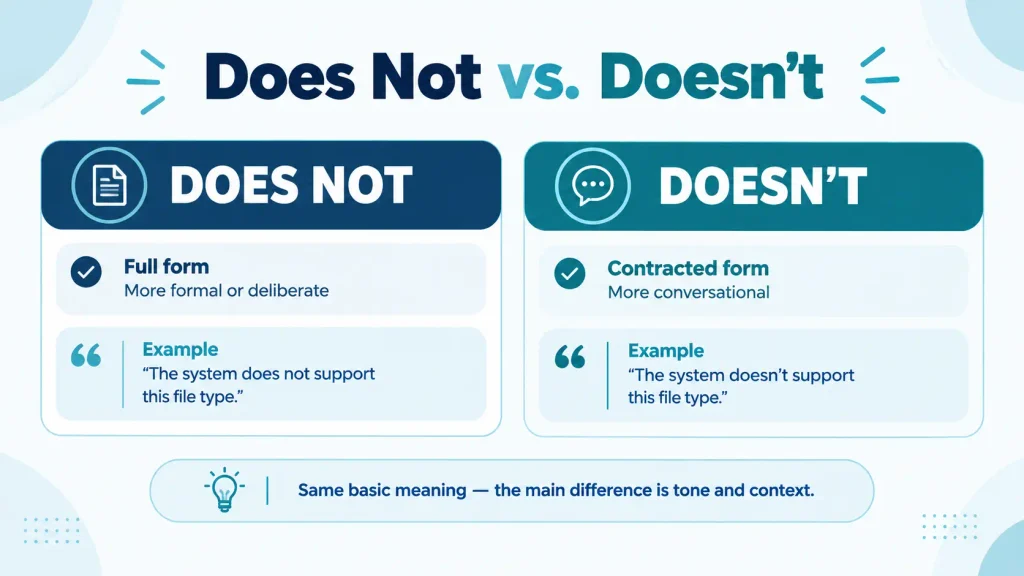
“Does not” is the negative form of “does.” It is used with third-person singular subjects such as “he,” “she,” “it,” or a singular noun.
For example:
- She does not understand the question.
- The machine does not work properly.
- The company does not offer refunds.
- This method does not produce reliable results.
“Does not” can be shortened to “doesn’t.” Cambridge Dictionary defines “doesn’t” as the short form of “does not.”
The full form is generally useful when you want a more deliberate or formal tone, while the contraction is common in everyday speech and informal writing.
15 Natural Alternatives to “Does Not”
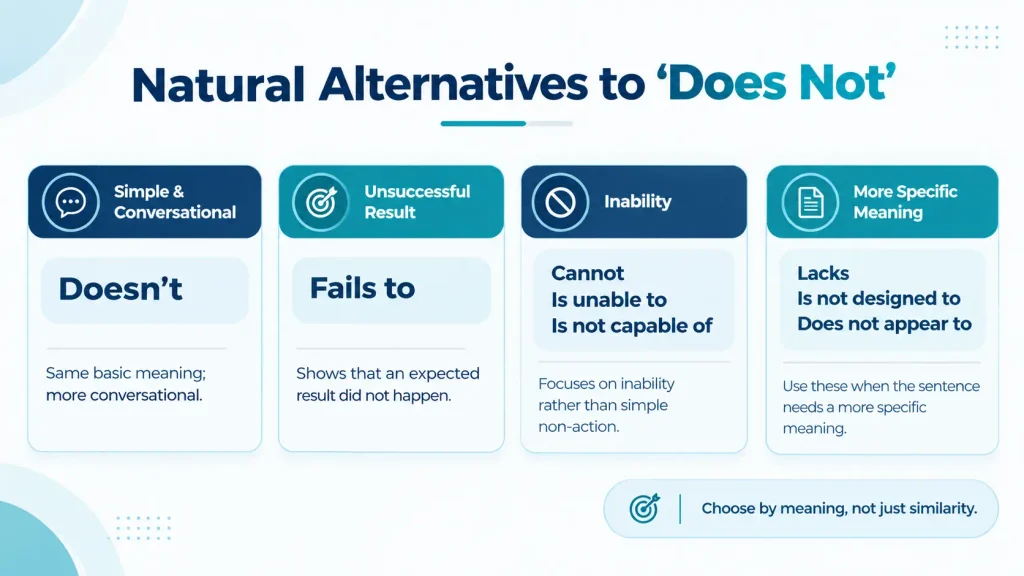
Not every alternative below is a direct synonym. Some are useful sentence-level replacements that preserve the main idea while adding a slightly different meaning.
1. Doesn’t
“Doesn’t” is simply the contracted form of “does not.” It is the most natural choice for everyday conversation and informal writing.
Example:
- Formal: The software does not support this file type.
- Conversational: The software doesn’t support this file type.
Best for: Conversation, texts, casual emails, and general writing.
2. Fails to
“Fails to” means that something does not accomplish an expected action or result. It can imply that the expected outcome was not achieved.
Example:
The system fails to recognize the new password.
This is slightly different from “does not recognize.” It emphasizes the unsuccessful result rather than simple negation.
Best for: Professional, technical, and analytical writing.
3. Is Not
“Is not” can replace “does not” when the original sentence expresses a state, identity, quality, or condition.
Example:
- The explanation does not clear. ❌
- The explanation is not clear. ✅
You cannot replace “does not” with “is not” in every sentence because they perform different grammatical functions.
Best for: Describing conditions, qualities, identities, or states.
4. Is Unable to
“Is unable to” emphasizes inability rather than simply stating that something does not happen.
Example:
The device does not connect to the network.
→ The device is unable to connect to the network.
The second version suggests that the device cannot perform the action.
Best for: Technical, professional, and formal contexts.
5. Cannot
“Cannot” is useful when “does not” means that someone or something is unable to perform an action.
Example:
The application does not access the database.
If the intended meaning is inability, you might write:
The application cannot access the database.
Best for: Clear, direct statements about inability.
6. Lacks
“Lacks” can replace certain sentences containing “does not have.” It means that someone or something is missing a particular quality, feature, or resource.
Example:
The proposal does not have sufficient detail.
→ The proposal lacks sufficient detail.
This is more concise, but it should only be used when the original sentence means “does not have.”
Best for: Academic, professional, and analytical writing.
7. Is Not Equipped to
“Is not equipped to” means that someone or something does not have the necessary ability, resources, or features to perform an action.
Example:
The current system does not handle large data sets effectively.
→ The current system is not equipped to handle large data sets effectively.
Best for: Professional and technical writing.
8. Is Not Designed to
“Is not designed to” is useful when something intentionally lacks a particular function or purpose.
Example:
This tool does not analyze financial data.
→ This tool is not designed to analyze financial data.
The second sentence provides more information about the intended purpose of the tool.
Best for: Product descriptions, technical writing, instructions, and professional communication.
9. Is Not Intended to
“Is not intended to” is appropriate when an action, product, statement, or policy was not meant for a particular purpose.
Example:
This document does not provide legal advice.
→ This document is not intended to provide legal advice.
The meaning changes slightly because the second version focuses on intention.
Best for: Formal notices, policies, disclaimers, and professional writing.
10. Does Not Appear to
“Does not appear to” makes a statement less absolute. It suggests that something seems not to be true based on the available evidence.
Example:
The new approach does not solve the problem.
→ The new approach does not appear to solve the problem.
The second sentence is more cautious.
Best for: Reports, analysis, research writing, and situations where certainty is limited.
11. Does Not Seem to
“Does not seem to” has a similar meaning to “does not appear to,” but it often sounds more conversational.
Example:
The plan does not seem to address the main concern.
Best for: Everyday conversation, emails, discussions, and less formal analysis.
12. Is Not Capable of
“Is not capable of” emphasizes a limitation or lack of ability.
Example:
The old computer does not run the software.
→ The old computer is not capable of running the software.
This version is stronger because it focuses on capability.
Best for: Technical, professional, and explanatory contexts.
13. Is Not Permitted to
When “does not” refers to a rule or restriction, “is not permitted to” can make the reason clearer.
Example:
Employees do not enter this area after hours.
If the meaning is that company rules prohibit them from entering:
Employees are not permitted to enter this area after hours.
Best for: Policies, rules, workplace communication, and official notices.
14. Refrain From
“Refrain from” can sometimes replace a negative construction when the intended meaning is that someone deliberately avoids doing something.
Example:
Please do not use your phone during the examination.
→ Please refrain from using your phone during the examination.
This is not a universal synonym for “does not.” It works when the sentence involves intentionally avoiding an action.
Best for: Formal instructions, policies, notices, and professional communication.
15. Avoids
“Avoids” can replace some negative sentences when a person or organization deliberately chooses not to do something.
Example:
She does not discuss personal matters at work.
→ She avoids discussing personal matters at work.
The second sentence suggests an active choice rather than simple non-action.
Best for: Everyday, professional, and descriptive writing.
“Does Not” vs. “Doesn’t”
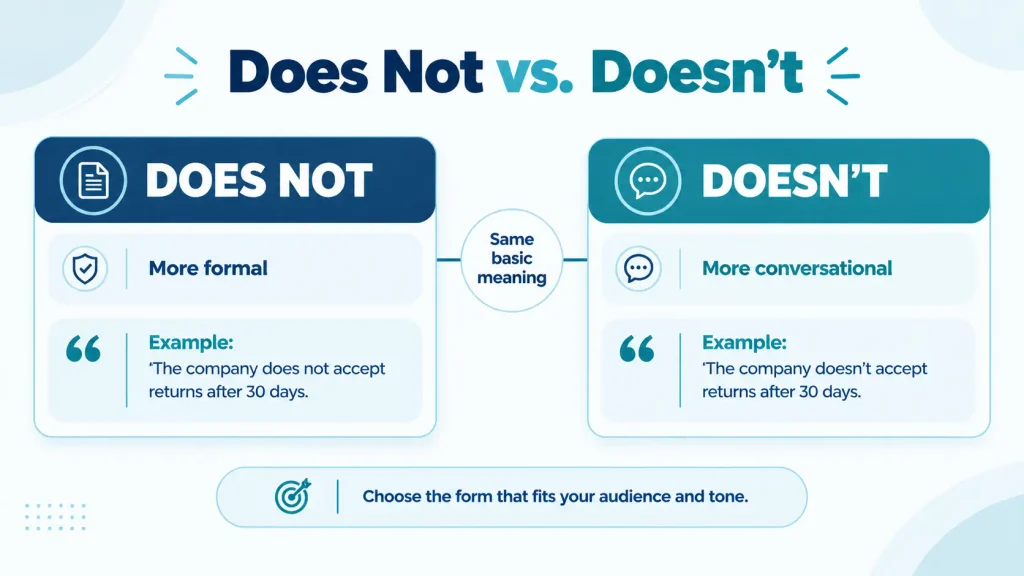
The simplest alternative is “doesn’t,” because it has exactly the same basic meaning.
| Phrase | Tone | Best Context |
| Does not | Formal, neutral | Academic and professional writing |
| Doesn’t | Conversational, natural | Speech, texts, casual writing |
| Fails to | More specific | Reports and analysis |
| Is unable to | Focuses on inability | Professional and technical writing |
| Cannot | Direct | General and professional writing |
| Does not appear to | Cautious | Analysis and reports |
| Does not seem to | Conversational and cautious | Discussion and emails |
For example:
Formal:
The product does not meet the required standards.
Conversational:
The product doesn’t meet the required standards.
Both are grammatically correct. The main difference is tone and context rather than meaning.
How to Choose the Right Alternative
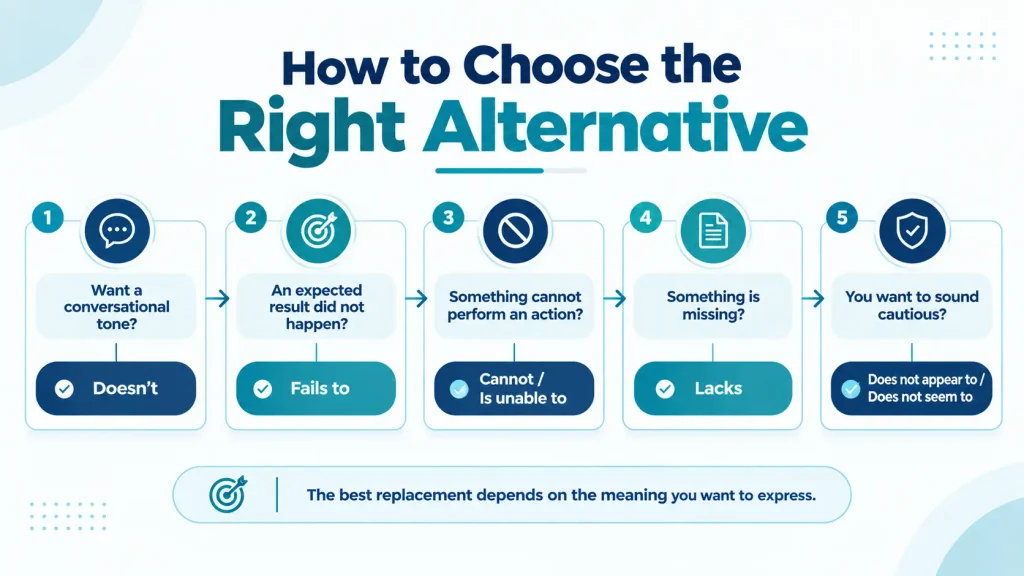
The best replacement depends on what you actually mean.
Use “doesn’t” for everyday English
If you’re talking to a friend or writing a casual message, “doesn’t” usually sounds natural.
My phone doesn’t charge properly.
Use “fails to” when an expected result is missing
The new process fails to reduce processing time.
This emphasizes that the process was expected to produce a particular result.
Use “is unable to” when something cannot perform an action
The device is unable to connect to Wi-Fi.
This focuses on inability.
Use “lacks” when something is missing
The report lacks sufficient evidence.
This is more concise than:
The report does not have sufficient evidence.
Use “does not appear to” when you want to avoid absolute certainty
The evidence does not appear to support the claim.
This is useful when the available information suggests something but does not establish it conclusively.
Common Mistakes When Replacing “Does Not”
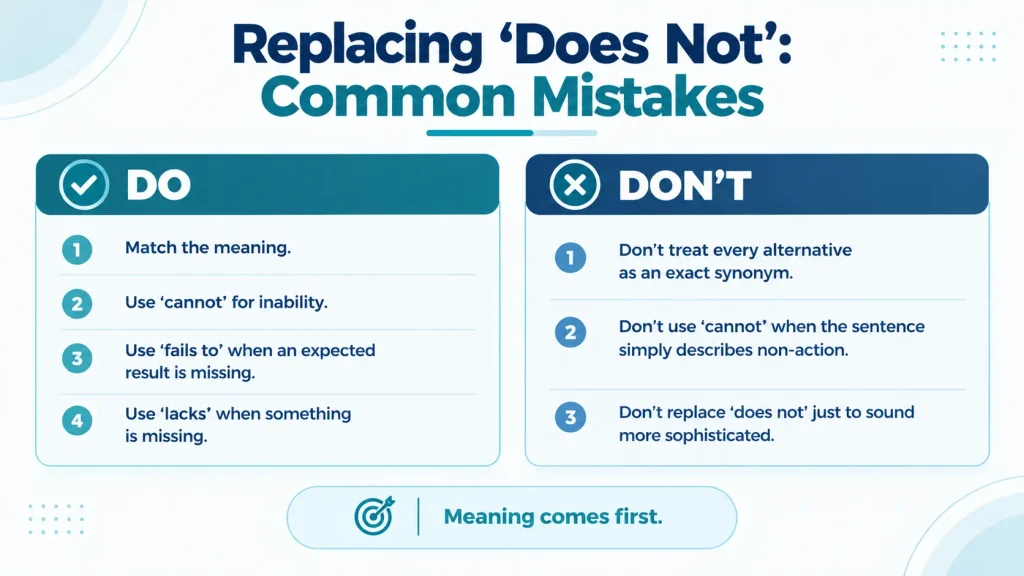
Treating every alternative as an exact synonym
“Does not,” “fails to,” “cannot,” and “avoids” are not interchangeable in every sentence.
For example:
The employee does not attend every meeting.
does not necessarily mean:
The employee fails to attend every meeting.
“Fails to” can imply that attending was expected.
Using “cannot” when the issue is choice
Compare:
She does not attend the event.
with:
She cannot attend the event.
The first simply states that she doesn’t attend. The second indicates that she is unable to attend.
Using “is not” with the wrong verb structure
“Does not” and “is not” have different grammatical functions.
Correct:
He does not understand the instructions.
Correct:
He is not ready.
Incorrect:
He does not understand the instructions.
Assuming formal writing always needs complicated alternatives
“Does not” is already perfectly appropriate in formal English. There is no need to replace it simply to make a sentence sound more sophisticated. A language discussion about formal alternatives similarly notes that there is not necessarily a more formal equivalent of “does not”; often, rewriting the sentence changes the emphasis rather than simply making it more formal.
Does “Does Not” Sound Formal?
Yes, compared with “doesn’t,” the full form “does not” generally sounds more formal or deliberate.
Compare:
The company doesn’t accept returns after 30 days.
and:
The company does not accept returns after 30 days.
Both are correct. The second can sound more appropriate in a policy, official notice, or formal document.
That does not mean “doesn’t” is incorrect or unprofessional in every workplace situation. The appropriate choice depends on the document, audience, and desired tone.
What Is the Best Alternative to “Does Not”?
There is no single replacement that works in every sentence.
For most everyday situations, “doesn’t” is the closest direct alternative because it is simply the contracted form of “does not.” For more specific meanings, alternatives such as “fails to,” “cannot,” “is unable to,” “lacks,” or “does not appear to” can make the sentence more precise.
The key is to replace “does not” only when the new wording preserves the intended meaning.
Frequently Asked Questions
What is another way to say “does not” in formal writing?
Often, you can simply keep “does not.” It is already suitable for formal writing. If you need a different construction, the best option depends on the meaning, such as “fails to,” “is unable to,” or “lacks.”
What is the shorter way to say “does not”?
The contraction is “doesn’t.” It is common in speech and informal writing.
Is “doesn’t” less formal than “does not”?
Generally, yes. “Doesn’t” is more conversational, while “does not” can sound more formal or emphatic.
Can I use “cannot” instead of “does not”?
Only when the intended meaning involves inability. “Cannot” means that someone or something is unable to do something, so it is not a universal replacement.
Can “fails to” replace “does not”?
Sometimes. “Fails to” is useful when an expected action or result did not occur. It can add an implication of unsuccessful performance.
What is a professional alternative to “does not”?
In professional writing, “does not” itself is often the clearest choice. Depending on context, “fails to,” “is unable to,” “lacks,” or “does not appear to” may be more precise.
Is “does not” grammatically correct?
Yes. “Does not” is the standard negative form used with third-person singular subjects in the present simple. For example, “She does not agree” and “The system does not work.” Standard English uses “doesn’t” as its contracted form.
Final Thoughts
If you’re looking for another way to say “does not,” start by asking whether you actually need a replacement. “Does not” is already clear, correct, and appropriate for many formal situations.
Use “doesn’t” for a more conversational tone, “fails to” when an expected result is missing, “cannot” or “is unable to” for inability, and “lacks” when something is missing. For cautious statements, “does not appear to” or “does not seem to” can work well.
The most natural alternative is the one that preserves both the meaning and the tone of your original sentence.

Role: Author & Editorial Specialist
Sophia Williams serves as an Author at Elite’s Collective, bringing strong communication skills and fresh perspectives to the team through high-quality written content.