

If you need another way to say “spread out,” the best choice depends on what you mean. For people or objects moving apart, use phrases such as “disperse,” “scatter,” “fan out,” or “move apart.” For something covering a larger area, “extend,” “expand,” “stretch out,” or “widen” may fit better. The phrase can also describe something arranged over a larger space.
Key Takeaways
- “Spread out” has several meanings, so there is no single perfect synonym.
- “Disperse” and “scatter” work well when people or things move apart.
- “Fan out” suggests people or things moving outward from a central point.
- “Extend,” “expand,” and “stretch out” work better for areas, objects, or physical dimensions.
- “Lay out” is useful when arranging objects across a surface.
- “Widespread” describes something that exists across a large area, rather than the action of spreading it out.
What Does “Spread Out” Mean?
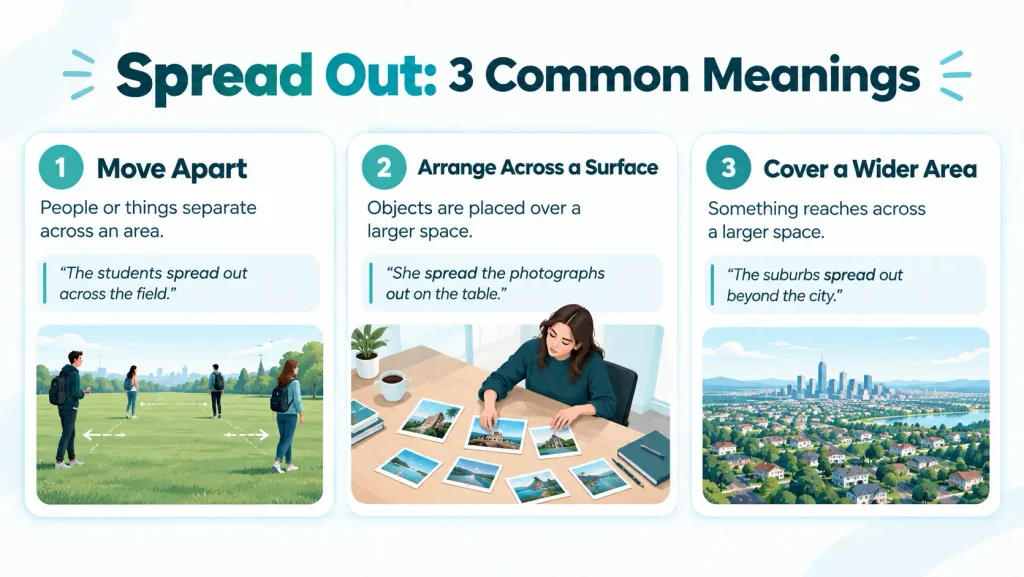
“Spread out” is a phrasal verb with several related uses. It can mean moving people or things farther apart, arranging objects across a larger space, or covering a wider area. Cambridge gives examples involving people separating across an area and things covering more space.
For example:
- “The students spread out across the field.”
- “She spread the papers out on the desk.”
- “The city has spread out over the surrounding area.”
Because the meaning changes with the sentence, replacing “spread out” requires attention to context.
15 Alternatives to “Spread Out”
1. Disperse
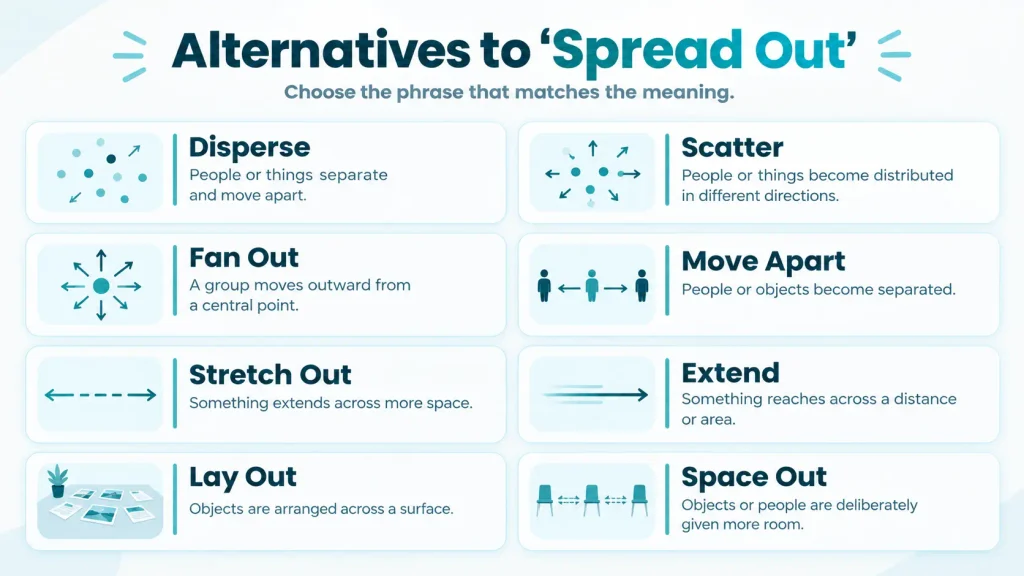
“Disperse” means to separate and move in different directions or to distribute people or things across an area.
Best for: Groups, crowds, people, or objects.
Example:
“The police asked the crowd to disperse.”
“Disperse” is more formal than “spread out,” so it works particularly well in news, academic, or official writing.
2. Scatter
“Scatter” means to cause people or things to move or fall in different directions so they are no longer together.
Best for: Objects, people, animals, or things distributed irregularly.
Example:
“The children scattered across the playground.”
“Scatter” often suggests less organization than “spread out.”
3. Fan Out
“Fan out” describes people or things moving outward from a central point into different directions.
Best for: Search teams, groups, roads, objects, or movement patterns.
Example:
“The search team fanned out across the park.”
This is a particularly natural alternative when a group deliberately separates to cover a larger area.
4. Move Apart
“Move apart” is a simple, direct expression for people or objects becoming separated.
Best for: Everyday conversation and physical separation.
Example:
“The two cars moved apart to make room for the truck.”
Unlike some more specialized alternatives, “move apart” is easy to understand in almost any ordinary context.
5. Separate
“Separate” means to move people or things away from one another or to keep them apart.
Best for: People, objects, groups, and general situations.
Example:
“We separated the chairs so everyone had more room.”
“Separate” is broader than “spread out,” so it does not always imply that the items occupy a large area.
6. Stretch Out
“Stretch out” means to extend over a greater distance or to arrange something across a larger space.
Best for: Bodies, objects, lines, roads, and physical spaces.
Example:
“She stretched out the blanket on the grass.”
It can also describe a person changing position:
“I need to stretch out after the long flight.”
Oxford includes “stretch your body” and arranging things over a larger area among the meanings related to “spread out.”
7. Extend
“Extend” means to reach or continue over a particular distance, area, or period.
Best for: Roads, buildings, areas, periods, networks, and physical dimensions.
Example:
“The trail extends for several miles along the coast.”
“Extend” is often more precise than “spread out” when the focus is on how far something reaches.
8. Expand
“Expand” means to become larger or make something larger.
Best for: Businesses, cities, spaces, ideas, systems, and physical objects.
Example:
“The city has expanded into the surrounding countryside.”
“Expand” emphasizes growth in size, while “spread out” often emphasizes distribution across space.
9. Widen
“Widen” means to become or make something broader.
Best for: Roads, gaps, spaces, openings, and physical areas.
Example:
“The road widens as it approaches the highway.”
It is not a universal synonym for “spread out,” but it can work when the main idea is increasing width.
10. Lay Out
“Lay out” means to arrange things across a surface or area so they can be seen or used.
Best for: Papers, clothes, tools, plans, products, and other objects.
Example:
“She laid out the documents on the conference table.”
This is one of the better alternatives when “spread out” means deliberately arranging objects.
11. Unfold
“Unfold” means to open something that has been folded so that it occupies a larger area.
Best for: Maps, blankets, papers, chairs, and other foldable objects.
Example:
“He unfolded the map across the table.”
“Unfold” should not replace “spread out” when the objects are already separated.
12. Open Out
“Open out” can mean to become wider or to extend into a larger area.
Best for: Spaces, roads, views, and physical structures.
Example:
“The narrow path opens out into a large field.”
This expression describes something becoming more spacious rather than simply placing separate objects farther apart.
13. Distribute
“Distribute” means to give, place, or arrange something among different people, places, or areas.
Best for: Resources, materials, products, information, and organized arrangements.
Example:
“The company distributed its offices across several states.”
“Distribute” emphasizes allocation rather than physical movement.
14. Space Out
“Space out” means to arrange people or things with gaps between them.
Best for: Seating, objects, people, appointments, and organized arrangements.
Example:
“Please space out the chairs so everyone has enough room.”
This is especially useful when the important idea is leaving a deliberate amount of space between items.
15. Be Scattered
“Be scattered” describes people or things that are located in different places rather than concentrated in one area.
Best for: Locations, objects, buildings, communities, and groups.
Example:
“Small towns are scattered throughout the valley.”
Unlike “spread out,” this construction describes the resulting arrangement rather than the action of creating it.
Quick Comparison: Which Alternative Should You Use?
| Alternative | Main Meaning | Tone | Best Context |
| Disperse | Separate and move apart | Formal | Groups, crowds |
| Scatter | Become distributed irregularly | Neutral | People, objects, animals |
| Fan out | Move outward from a center | Neutral | Teams, searches |
| Move apart | Become separated | Neutral | Everyday situations |
| Separate | Put or move apart | Neutral | People and objects |
| Stretch out | Extend over more space | Neutral | Bodies, objects, areas |
| Extend | Reach over a distance | Neutral/Formal | Areas, roads, periods |
| Expand | Become larger | Neutral | Cities, businesses, spaces |
| Widen | Become broader | Neutral | Roads, gaps, spaces |
| Lay out | Arrange across a surface | Neutral | Objects and materials |
| Unfold | Open something folded | Neutral | Maps, papers, blankets |
| Open out | Become wider or more spacious | Neutral | Paths, spaces, views |
| Distribute | Allocate across places or people | Formal | Resources, offices |
| Space out | Leave gaps between things | Neutral | Seating, objects |
| Be scattered | Exist in different locations | Neutral | Places, objects, groups |
How to Choose the Right Alternative

The easiest way to choose is to identify what is actually being spread.
When people move apart
Use:
- disperse
- scatter
- fan out
- move apart
- separate
Example:
“The volunteers spread out across the neighborhood.”
Possible alternatives:
- “The volunteers dispersed across the neighborhood.”
- “The volunteers fanned out across the neighborhood.”
“Fan out” suggests an organized outward movement, while “disperse” sounds more formal.
When objects are arranged across a surface
Use:
- lay out
- space out
- stretch out
- arrange
Example:
“She spread out the photographs on the table.”
A natural alternative would be:
“She laid out the photographs on the table.”
When something covers a larger area
Use:
- extend
- expand
- stretch out
- widen
- spread across
Example:
“The suburbs spread out beyond the city.”
You could write:
“The suburbs extend beyond the city.”
Here, “extend” focuses on the area the suburbs reach.
When something becomes larger
Use:
- expand
- grow
- extend
- widen
Example:
“The business spread out into new markets.”
If the emphasis is on growth into additional locations, “expanded” may be more natural:
“The business expanded into new markets.”
“Spread Out” vs. “Scattered”
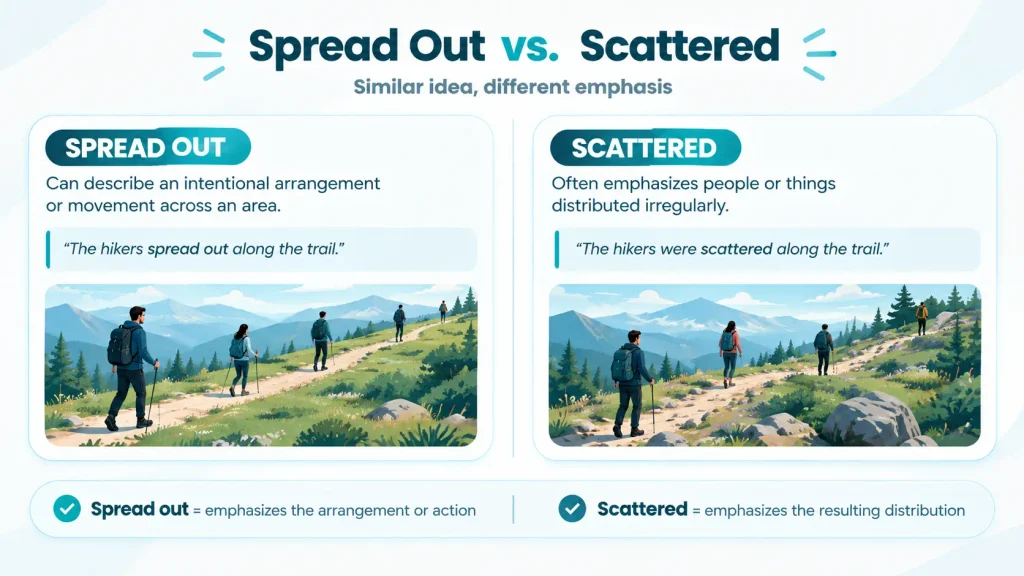
These expressions are related, but they are not always interchangeable.
“Spread out” often describes an action or an intentional arrangement:
“The hikers spread out along the trail.”
“Scattered” usually describes a condition in which people or things are found in different places:
“The hikers were scattered along the trail.”
The distinction is small but useful: “spread out” can emphasize the process, while “scattered” often emphasizes the resulting distribution.
“Spread Out” vs. “Disperse”
“Disperse” is generally more formal than “spread out.”
Compare:
“The students spread out across the room.”
“The crowd dispersed after the event.”
“Disperse” is especially natural when a group separates or breaks up. It can sound less natural when you simply mean arranging objects on a table.
“Spread Out” vs. “Space Out”
These two phrases are close when talking about physical arrangement.
“Spread out” can mean occupying a larger area:
“The students spread out across the classroom.”
“Space out” specifically emphasizes the gaps between people or objects:
“Space out the chairs so people can walk between them.”
If the distance between individual items matters, “space out” is often more precise.
Common Mistakes When Replacing “Spread Out”
Using “expand” for people who are separating
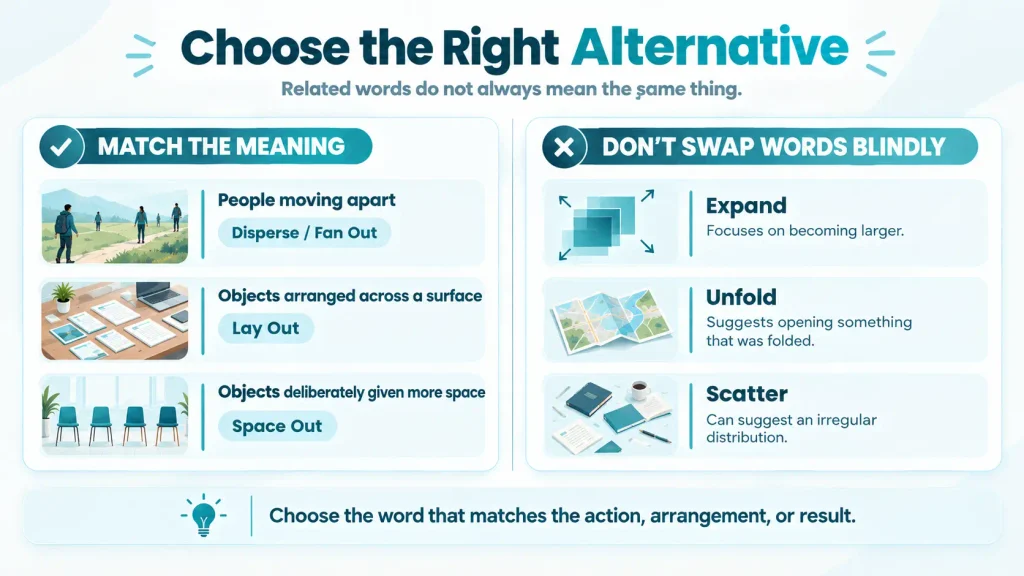
“Expand” usually focuses on becoming larger, not on people moving away from one another.
Less natural:
“The players expanded across the field.”
Better:
“The players spread out across the field.”
Or:
“The players fanned out across the field.”
Using “scatter” when the arrangement is organized
“Scatter” can suggest an irregular or uncontrolled distribution.
If a group deliberately moves into assigned positions, “fan out” may communicate the idea better.
Using “unfold” for unrelated objects
“Unfold” specifically suggests opening something that was folded.
You can say:
“She unfolded the map.”
But you generally would not say:
“She unfolded the books across the desk.”
“Lay out” or “spread out” would be more natural.
Treating every synonym as interchangeable
Words such as “disperse,” “expand,” “scatter,” and “extend” overlap with “spread out,” but they emphasize different ideas. Cambridge’s thesaurus similarly groups different senses of “spread out” with words such as “diffuse,” “scattered,” “dispersed,” “extended,” “expand,” “extend,” and “unfold.”
The safest approach is to choose the alternative that matches the exact action or result you want to describe.
Frequently Asked Questions
What is the best synonym for “spread out”?
There is no single best synonym. “Disperse,” “scatter,” “fan out,” “extend,” “stretch out,” “expand,” and “lay out” can all work, depending on the sentence.
What is another way to say “spread out across an area”?
You can say “extend across,” “stretch across,” “be distributed across,” “be scattered across,” or “cover an area.” The best choice depends on whether you are describing people, objects, or something that physically covers space.
What is another word for people spreading out?
Useful choices include “disperse,” “scatter,” “fan out,” “separate,” and “move apart.” “Fan out” is especially useful when people deliberately move in different directions to cover an area.
What is a formal way to say “spread out”?
“Disperse,” “distribute,” “extend,” and “be distributed across” can work in formal writing, depending on the meaning.
Is “spread out” the same as “scattered”?
Not always. “Spread out” can describe an intentional arrangement or movement across an area, while “scattered” often suggests that people or things are distributed irregularly.
What is another way to say “spread out on a table”?
“Lay out,” “arrange across the table,” or “place across the table” can work. “Lay out” is especially natural when someone deliberately arranges several objects for viewing or use.
What is another way to say “spread out over time”?
Depending on the meaning, you could say “extend over time,” “be distributed over time,” or “be spaced out over time.” “Space out” works particularly well when events are deliberately given gaps between them.
Final Takeaway
“Spread out” is a flexible phrase, so the right alternative depends on the intended meaning. Use “disperse” or “scatter” when people or things separate, “fan out” for organized outward movement, “space out” when gaps matter, and “lay out” when objects are arranged across a surface. For something covering or reaching across a larger area, “extend,” “stretch out,” or “expand” may be more precise.

Role: Lead Author & Content Specialist
James Mitchell is an experienced Lead Author at Elite’s Collective. He specializes in creating high-impact editorial content and driving core written projects designed to inform and engage readers.