

Direct Answer:
Common alternatives to “scenario” include situation, case, possibility, circumstance, outcome, eventuality, condition, example, context, and what-if situation. The best choice depends on what you mean. Use “situation” for a general state of affairs, “case” for a specific instance, and “possibility” when you are discussing something that might happen.
Key Takeaways
- Situation is the most natural general alternative to “scenario.”
- Case works well for a specific example or instance.
- Possibility emphasizes something that may happen.
- Circumstance focuses on conditions surrounding an event.
- Outcome refers to the result, not the entire situation.
- Eventuality is useful when planning for something that might happen.
What Does “Scenario” Mean?
“Scenario” usually refers to a possible situation or a particular set of events, especially one being imagined, discussed, or planned for.
For example:
We need to prepare for several possible scenarios.
Here, “scenarios” means different things that might happen.
The word is common in business, education, planning, risk management, technology, and everyday conversation. Because its meaning can shift slightly depending on context, there isn’t one replacement that works perfectly in every sentence.
10 Natural Ways to Say “Scenario”
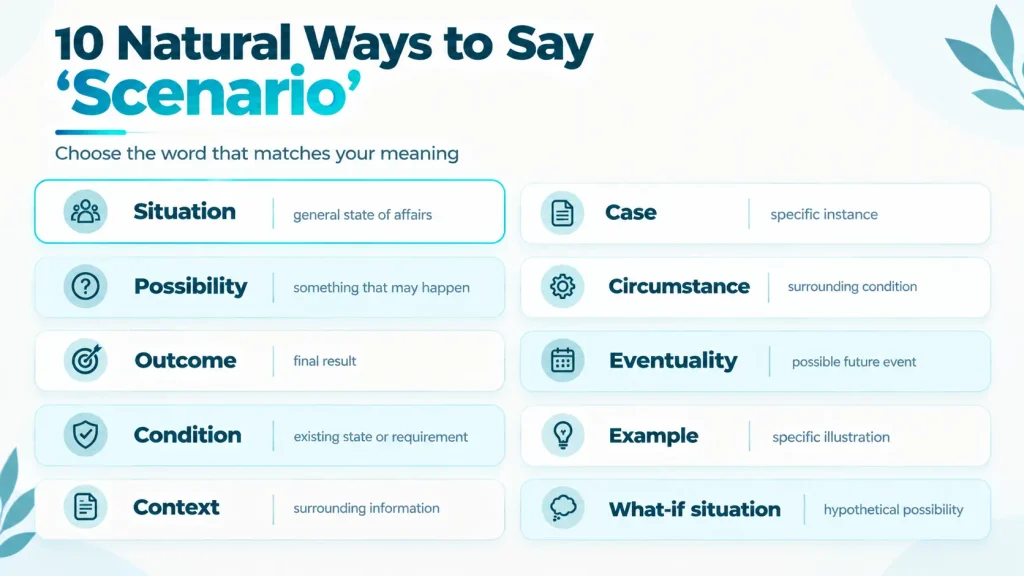
1. Situation
Meaning: A set of circumstances or the overall state of affairs.
Best for: Everyday, professional, and general writing.
We need to consider the current situation before making a decision.
“Situation” is often the easiest replacement when you are talking about what is happening generally. Unlike “scenario,” it doesn’t necessarily suggest something hypothetical or in the future.
2. Case
Meaning: A particular instance or example.
Best for: Professional, academic, legal, and analytical writing.
In this case, the customer will receive a full refund.
“Case” is especially useful when you’re discussing one specific example rather than several possible future situations.
3. Possibility
Meaning: Something that may happen or be true.
Best for: Future events and potential outcomes.
One possibility is that the project will be delayed.
Choose “possibility” when the important point is that something could happen. It is more focused than “scenario” because it doesn’t necessarily describe a complete sequence of events.
4. Circumstance
Meaning: A condition or fact that affects an event or situation.
Best for: Formal and professional writing.
Under these circumstances, we may need to change the schedule.
“Circumstance” focuses on the conditions surrounding something rather than the entire imagined situation. It can be singular or plural, although “circumstances” is especially common in phrases such as “under the circumstances.”
5. Outcome
Meaning: The result of an event, decision, or process.
Best for: Planning, predictions, business, and analysis.
We should consider the possible outcomes before moving forward.
“Outcome” is not a direct synonym for every use of “scenario.” Use it when you’re talking specifically about what happens as a result.
6. Eventuality
Meaning: A possible future event that may need to be prepared for.
Best for: Formal planning, business, and risk management.
The team has a plan for every possible eventuality.
“Eventuality” sounds more formal than “scenario” and is particularly useful when discussing things that might happen unexpectedly or require preparation.
7. Condition
Meaning: The state or circumstances affecting something.
Best for: Technical, professional, academic, and general contexts.
The decision depends on the current market conditions.
“Condition” works when you are emphasizing the state something is in rather than describing a complete chain of possible events.
8. Example
Meaning: A specific instance used to illustrate an idea.
Best for: Teaching, explanations, presentations, and general writing.
Consider this example: a customer receives the wrong product.
“Example” is useful when a scenario is being presented mainly to explain or demonstrate something.
9. Context
Meaning: The surrounding facts or circumstances that help explain something.
Best for: Academic, professional, and analytical writing.
The decision makes more sense when viewed in context.
“Context” is related to “scenario,” but it isn’t an exact replacement. It describes the background surrounding an event rather than the possible event itself.
10. What-If Situation
Meaning: A hypothetical situation that could happen.
Best for: Casual conversation, teaching, brainstorming, and planning.
Let’s discuss a what-if situation where sales suddenly drop.
This phrase is more conversational than “scenario.” It works especially well when you are explicitly asking someone to imagine a possible situation.
Which Alternative Should You Use?
| Alternative | Main Meaning | Tone | Best Context |
| Situation | Overall state of affairs | Neutral | Everyday and professional |
| Case | Specific instance | Neutral/Formal | Academic and professional |
| Possibility | Something that may happen | Neutral | Future planning |
| Circumstance | Surrounding condition | Formal | Professional writing |
| Outcome | Result of an event | Neutral | Planning and analysis |
| Eventuality | Possible future event | Formal | Risk planning |
| Condition | Existing state or requirement | Neutral/Formal | Technical and professional |
| Example | Specific illustration | Neutral | Teaching and explanations |
| Context | Surrounding information | Neutral/Formal | Academic and analytical |
| What-if situation | Hypothetical possibility | Casual | Conversation and brainstorming |
Scenario vs. Situation: What’s the Difference?
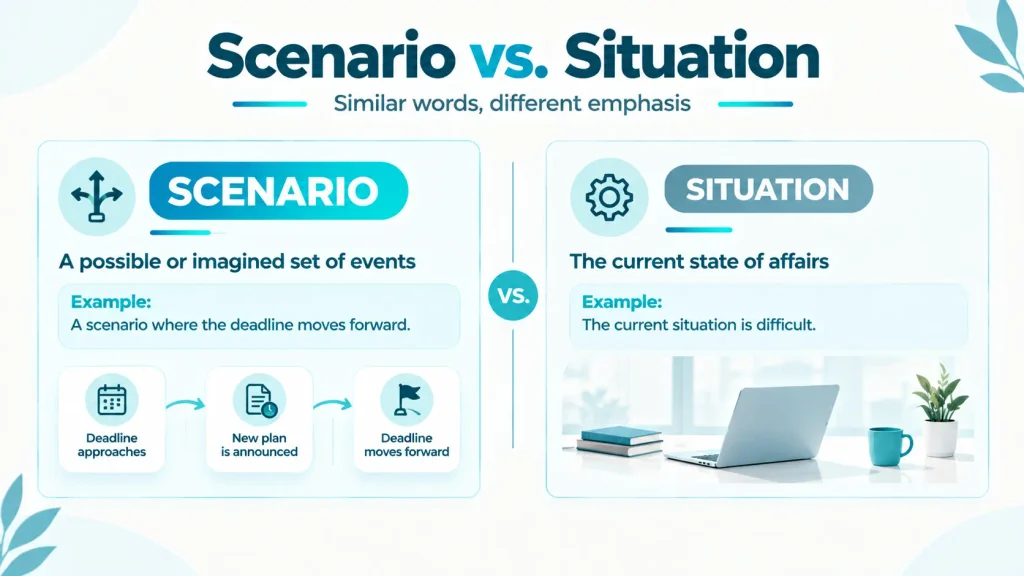
“Scenario” and “situation” are close, but they are not always interchangeable.
A situation usually describes the state of things as they are:
The current situation is difficult.
A scenario often describes a possible or imagined set of events:
Let’s consider a scenario in which the deadline is moved forward.
So, use situation when you mean the overall circumstances, and scenario when you are imagining, planning for, or analyzing a particular possibility.
Scenario vs. Possibility
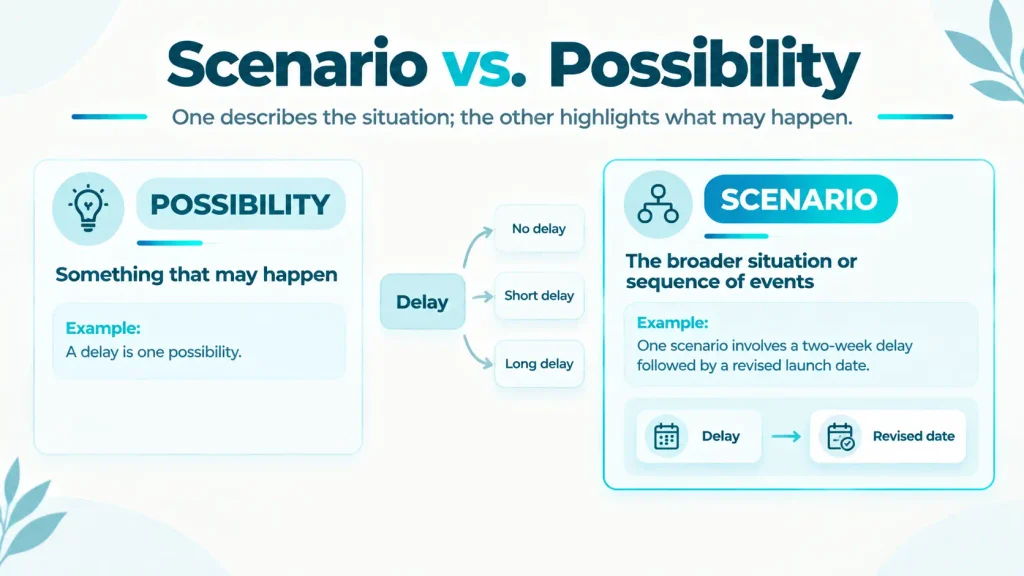
“Possibility” is narrower than “scenario.”
A possibility simply tells you that something could happen:
A delay is one possibility.
A scenario can describe the broader circumstances surrounding that possibility:
One scenario involves a two-week delay followed by a revised launch date.
If you’re only naming what might happen, “possibility” is usually clearer.
Scenario vs. Outcome
These words describe different parts of an event.
A scenario describes a possible situation or sequence of events.
An outcome describes the result:
Scenario: The company reduces its prices and increases advertising.
Outcome: Sales increase over the following quarter.
This distinction matters in business and analytical writing. Calling an outcome a “scenario” can make the sentence less precise.
Common Mistakes When Replacing “Scenario”
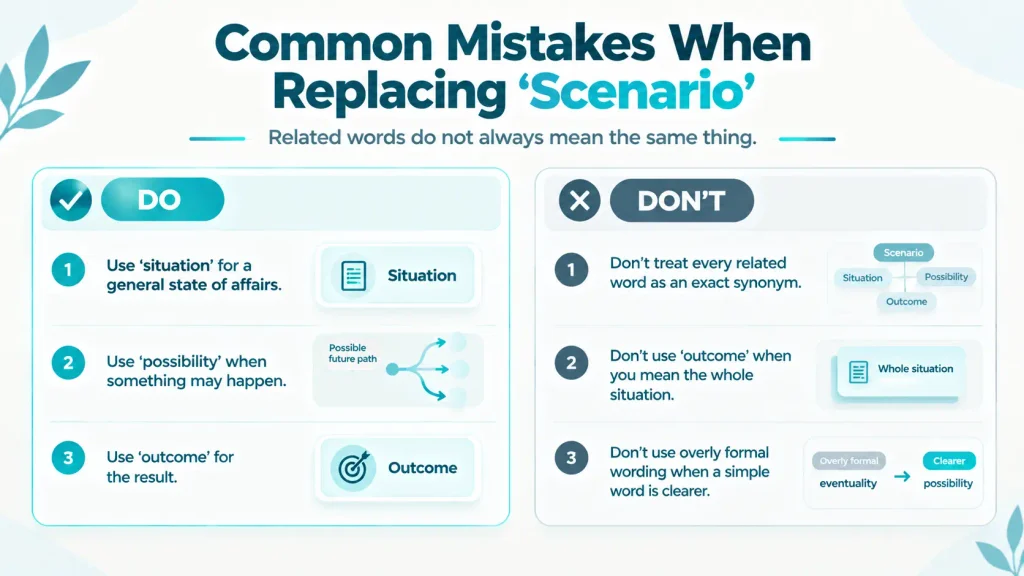
Using “outcome” when you mean a situation
Incorrect:
We need to prepare for every possible outcome where employees work remotely.
Better:
We need to prepare for every possible scenario involving remote work.
Using “context” as a direct synonym
“Context” refers to surrounding information or circumstances. It doesn’t necessarily mean a possible course of events.
The historical context explains the decision.
You wouldn’t normally replace “context” with “scenario” here.
Using “case” for every hypothetical situation
“Case” is excellent for a particular instance:
In this case, the customer qualifies for a refund.
But if you’re describing a complete hypothetical sequence of events, “scenario” may be more natural:
Consider a scenario in which the system fails during checkout.
Choosing overly formal language
Words such as “eventuality” can be accurate but may sound unnecessarily formal in casual conversation. In everyday American English, “situation” or “possibility” will often sound more natural.
How to Choose the Right Alternative
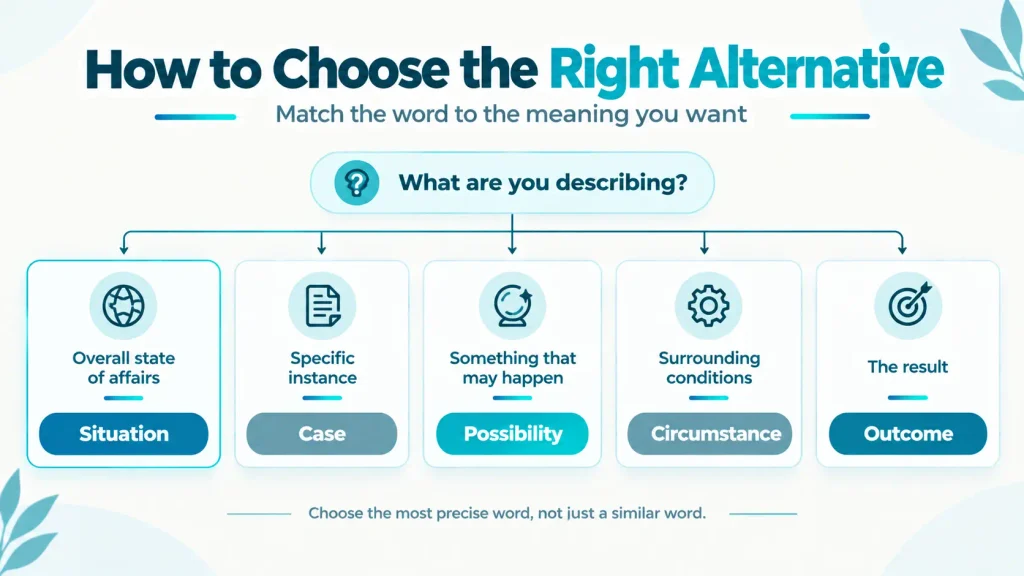
A simple way to choose is to ask what you are actually describing:
- The overall state of things? → Use situation
- A specific instance? → Use case
- Something that might happen? → Use possibility
- The surrounding conditions? → Use circumstance
- The result? → Use outcome
- A future event you need to prepare for? → Use eventuality
- A state or requirement? → Use condition
- An illustration? → Use example
- Background information? → Use context
- A casual hypothetical? → Use what-if situation
The key is not to replace “scenario” mechanically. Choose the word that describes the specific idea you want to communicate.
Frequently Asked Questions
What is the best synonym for “scenario”?
Situation is usually the most natural general alternative. However, “case,” “possibility,” “circumstance,” and “eventuality” may be more precise depending on the context.
What is a formal word for “scenario”?
Eventuality and circumstance can work in formal writing, depending on the meaning. “Case” is also common in professional and academic contexts.
Can I use “situation” instead of “scenario”?
Yes, when you mean a general state of affairs. But “scenario” is often better when you’re describing a hypothetical or possible sequence of events.
Is “possibility” the same as “scenario”?
Not exactly. A possibility is something that may happen, while a scenario can describe the broader situation or sequence of events surrounding that possibility.
What is a casual way to say “scenario”?
What-if situation is a natural conversational alternative when you’re asking someone to imagine a hypothetical situation.
Is “circumstance” a synonym for “scenario”?
They overlap, but they emphasize different things. A scenario is often a possible situation or course of events, while a circumstance is a condition or fact surrounding an event.
What is another word for “worst-case scenario”?
Depending on the sentence, you could say worst-case outcome, worst possibility, or most unfavorable situation. “Worst-case scenario” itself is also a standard and widely understood expression.
Conclusion
The best alternative to “scenario” depends on the meaning you want to emphasize. Situation is the most flexible choice, while case works for specific examples, possibility highlights something that may happen, and outcome focuses on the result. For formal planning, eventuality can be useful.
Choosing the most precise word will make your writing clearer and more natural than simply replacing “scenario” with a random synonym.

Role: Lead Author & Content Specialist
James Mitchell is an experienced Lead Author at Elite’s Collective. He specializes in creating high-impact editorial content and driving core written projects designed to inform and engage readers.