
The focus keyword is “another way to say half-assed.” The article should explain natural American English alternatives for describing work that is careless, incomplete, rushed, or done with little effort. Because half-assed is informal and mildly vulgar, useful alternatives should cover both casual conversations and professional situations.
Key Takeaways
- Carelessly done is a clear, neutral alternative to half-assed.
- Sloppy describes work that lacks care, accuracy, or attention to detail.
- Half-hearted emphasizes a lack of enthusiasm or commitment.
- Rushed means something was completed too quickly, often at the expense of quality.
- Poorly executed works well in professional and formal settings.
- Cut corners describes taking shortcuts that can reduce quality or leave important work unfinished.
What Does Half-Assed Mean?
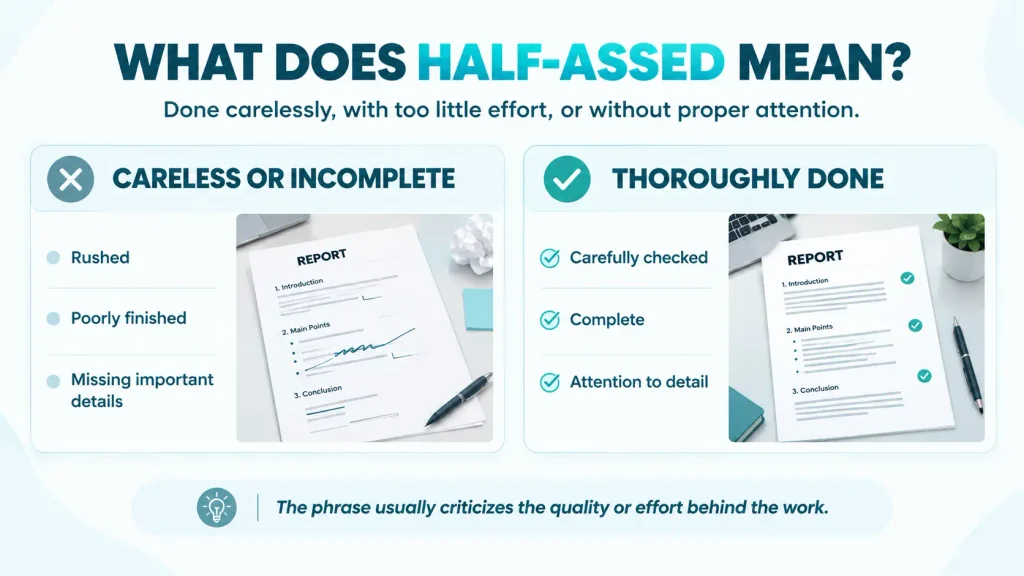
Half-assed is an informal American English expression for something done carelessly, incompletely, or without enough effort. It often suggests that someone did not take the task seriously or failed to give it the attention it deserved.
For example:
- “The contractor did a half-assed job fixing the kitchen.”
- “I don’t want to submit a half-assed report.”
- “They rushed the project and delivered a half-assed result.”
The expression can sound rude or critical, especially in professional settings. Choosing a different phrase lets you express the same concern with the right level of directness.
15 Other Ways to Say Half-Assed
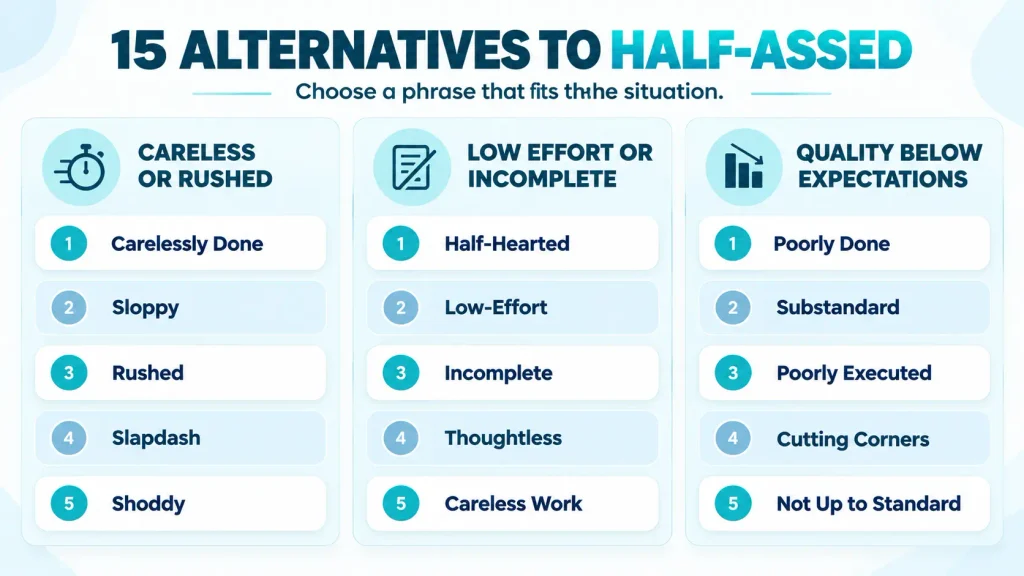
1. Carelessly Done
This is one of the most versatile alternatives. It describes work completed without enough attention, caution, or concern for quality.
Example: “The instructions were carelessly written, so nobody understood the process.”
Best for: Everyday conversations, feedback, and neutral criticism.
2. Sloppy
Sloppy describes work that is messy, inaccurate, poorly organized, or full of avoidable mistakes.
Example: “The designer submitted a sloppy layout with inconsistent spacing and several typos.”
Best for: Work with visible errors or a lack of attention to detail.
3. Half-Hearted
Half-hearted means lacking enthusiasm, commitment, or genuine effort. It focuses more on a person’s attitude than the quality of the final result.
Example: “He gave a half-hearted apology and refused to take responsibility.”
Best for: Apologies, attempts, promises, and actions that lack sincerity.
4. Rushed
Use rushed when something was completed too quickly, leaving little time for careful work or review.
Example: “The presentation looked rushed because several slides were unfinished.”
Best for: Deadlines, last-minute assignments, and hurried decisions.
5. Poorly Done
This straightforward expression means a task was completed badly or did not meet reasonable expectations.
Example: “The repairs were poorly done, and the door still won’t close properly.”
Best for: General criticism when you want to avoid slang.
6. Low-Effort
Low-effort describes something that appears to require little thought, work, creativity, or preparation.
Example: “The article felt low-effort because it repeated the same points without useful examples.”
Best for: Creative work, school assignments, online content, and casual feedback.
7. Incomplete
Incomplete means something is unfinished or missing important parts. Unlike half-assed, it does not necessarily suggest carelessness or a lack of commitment.
Example: “The application is incomplete because you left two required sections blank.”
Best for: Reports, applications, assignments, and tasks with missing requirements.
8. Substandard
Substandard means below the expected or required level of quality.
Example: “The inspection revealed substandard work that needed to be corrected.”
Best for: Formal complaints, quality assessments, and professional reports.
9. Shoddy
Shoddy describes work or products that are poorly made, unreliable, or lacking in quality.
Example: “The company received complaints about its shoddy installation work.”
Best for: Repairs, construction, manufacturing, and services.
10. Slapdash
Slapdash means done hastily and carelessly, with little attention to detail.
Example: “The team produced a slapdash proposal without checking the figures.”
Best for: Writing, planning, presentations, and rushed projects.
11. Poorly Executed
This phrase describes a plan, idea, or task that was carried out ineffectively.
Example: “The marketing campaign was poorly executed despite having a promising concept.”
Best for: Business communication, project reviews, and constructive criticism.
12. Thoughtless
Thoughtless describes an action or decision made without enough consideration. It can also refer to behavior that disregards other people’s feelings.
Example: “It was thoughtless to send the report without checking whether the figures were accurate.”
Best for: Decisions, actions, communication, and interpersonal situations.
13. Careless Work
This phrase emphasizes a lack of attention, caution, or effort during the process of completing a task.
Example: “The manager returned the document because it contained too many errors from careless work.”
Best for: Workplace feedback, school assignments, and quality control.
14. Cutting Corners
Cutting corners means taking shortcuts to save time, effort, or money, often at the expense of quality or safety.
Example: “The contractor cut corners by using cheaper materials than the project required.”
Best for: Work processes, construction, business practices, and safety concerns.
Usage tip: Use cut corners when shortcuts caused or risked a lower-quality result. It does not simply mean doing a bad job.
15. Not Up to Standard
This expression means that something does not meet the expected level of quality or performance.
Example: “The final website design was not up to standard, so the team requested revisions.”
Best for: Professional feedback, performance reviews, and client communication.
Which Alternative Should You Choose?
The best replacement depends on what you mean by half-assed. Some expressions criticize the quality of the result, while others focus on effort, speed, or shortcuts.
| Alternative | Main meaning | Tone |
|---|---|---|
| Carelessly done | Lacking attention | Neutral |
| Sloppy | Messy or full of mistakes | Direct |
| Half-hearted | Lacking commitment | Critical |
| Rushed | Completed too quickly | Neutral |
| Low-effort | Showing little effort | Casual |
| Incomplete | Missing essential parts | Neutral |
| Substandard | Below required quality | Formal |
| Shoddy | Poorly made | Strong criticism |
| Slapdash | Hasty and careless | Informal |
| Poorly executed | Carried out badly | Professional |
| Cutting corners | Using quality-reducing shortcuts | Critical |
| Not up to standard | Failing to meet expectations | Professional |
Professional Ways to Say Half-Assed
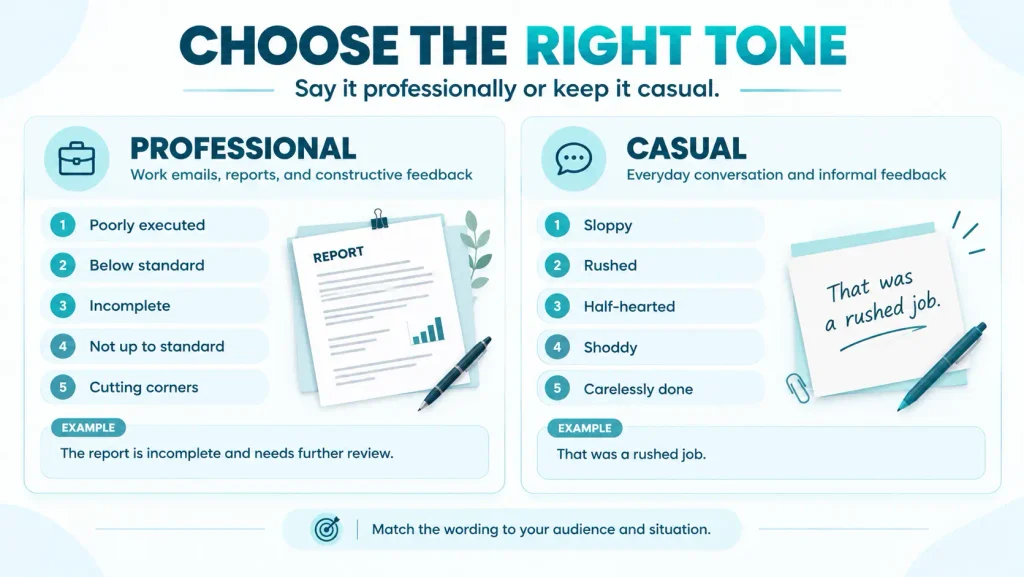
If you are speaking to a client, colleague, employee, or manager, avoid using half-assed in formal communication. These alternatives sound more constructive:
- Below expectations: “The final deliverable was below expectations.”
- Needs improvement: “The report needs improvement in several areas.”
- Lacks attention to detail: “The draft lacks attention to detail.”
- Not completed to the required standard: “The installation was not completed to the required standard.”
- Requires further refinement: “The design requires further refinement before approval.”
- Insufficiently developed: “The proposal is insufficiently developed to support the recommendation.”
These phrases identify the problem without sounding unnecessarily insulting.
Casual and Strong Alternatives
For conversations with friends or informal messages, you may want something more direct.
- Lazy: Suggests someone avoided making the necessary effort.
- Crappy: A vulgar, informal way to describe something of poor quality.
- Janky: Describes something makeshift, unreliable, or poorly put together.
- Bare-bones: Means minimal or basic, but not necessarily careless.
- Slapped together: Suggests something was assembled quickly without much planning or refinement.
- Phoned in: Describes work done with little enthusiasm or commitment, especially when someone is capable of doing better.
For example, “They slapped together the presentation at the last minute” suggests rushed preparation, while “He phoned in his performance” emphasizes a lack of effort or engagement.
Common Mistakes When Replacing Half-Assed
Using “incomplete” when you mean “careless.” A task can be fully finished but still poorly executed. Use carelessly done or sloppy when the problem is quality rather than missing parts.
Using “half-hearted” for every poor result. A half-hearted attempt lacks commitment, but the final result might still be good. Choose poorly done if the outcome itself is the main concern.
Using “bare-bones” as an exact synonym. A bare-bones design may be intentionally simple and effective. It does not automatically mean the work was careless.
Using slang in formal feedback. Words like crappy and janky may sound unprofessional in client emails or workplace reports. Use substandard, below expectations, or poorly executed instead.
Frequently Asked Questions
What is a polite way to say half-assed?
“Not up to standard,” “carelessly done,” and “needs further improvement” are useful alternatives. For professional feedback, describe the specific issue and explain what needs to change.
What is a professional word for half-assed?
Substandard is a strong formal option when something falls below an expected level of quality. Poorly executed is useful when a task or plan was carried out badly.
What is a slang word for half-assed?
Sloppy, crappy, and janky can work in informal American English, although they differ in meaning and intensity. Slapped together is another natural phrase for something assembled hastily.
Does half-hearted mean the same as half-assed?
Not exactly. Half-hearted emphasizes a lack of enthusiasm or commitment, while half-assed usually criticizes the effort, care, or quality involved in doing something.
What does it mean to phone something in?
To phone something in means to put little effort or enthusiasm into a task or performance, especially when more effort would reasonably be expected.
Is half-assed a swear word?
It is informal and mildly vulgar because it contains ass. It is common in casual American English, but more polite or professional alternatives are usually better in formal situations.
What is another way to say a half-assed job?
You could say “a sloppy job,” “a poorly done job,” “substandard work,” or “a rushed job.” Choose the phrase that best describes whether the problem is carelessness, quality, or lack of time.
Conclusion
The best alternative to half-assed depends on the problem you want to describe. Use carelessly done for a general lack of attention, sloppy for work full of mistakes, half-hearted for a lack of commitment, and poorly executed for professional criticism. Choosing a precise expression makes your feedback clearer and more appropriate for the situation.

Role: English Language & Communication Writer
Daniel Carter is an English language writer specializing in workplace communication, professional vocabulary, resumes, emails, and career-focused English.