
If you’re looking for another way to say being able, the best alternative depends on your sentence. “Capable of,” “having the ability to,” “being in a position to,” and “having the skills to” can express ability, opportunity, or competence. However, these phrases are not interchangeable in every situation. Choosing the right one helps you sound clear and natural in American English.
15 Other Ways to Say Being Able
Here are 15 useful alternatives, with examples to help you choose the right expression for your sentence.
1. Capable of
Meaning: Having the ability, skill, or potential to do something.
Example: She is capable of managing several projects at once.
Best for: Professional, academic, and everyday English.
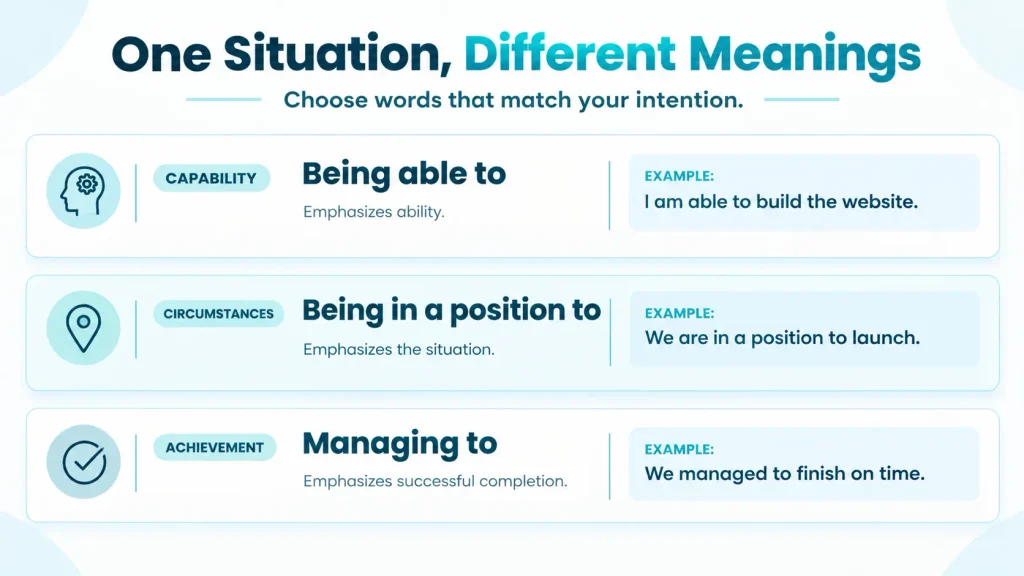
Use “capable of” when you want to emphasize someone’s ability or potential. It is usually followed by a noun or a verb ending in -ing.
2. Having the Ability to
Meaning: Possessing the power, skill, or capacity to do something.
Example: He has the ability to explain complex ideas clearly.
Best for: Formal writing, professional communication, and educational content.
This phrase is a clear alternative when you want to describe a person’s general ability rather than a single opportunity.
3. Being in a Position to
Meaning: Having the circumstances, authority, or resources needed to do something.
Example: Our team is in a position to complete the project by Friday.
Best for: Workplace communication and formal situations.
This expression often describes an opportunity or favorable circumstances, not necessarily a person’s skill.
4. Having the Skills to
Meaning: Possessing the knowledge or practical skills needed for a task.
Example: Maya has the skills to lead the new marketing campaign.
Best for: Resumes, interviews, and professional writing.
Choose this phrase when you want to emphasize learned or developed skills.
5. Having the Capacity to
Meaning: Having the ability, resources, or mental or physical potential to do something.
Example: The department has the capacity to handle additional requests.
Best for: Business, technical, and formal writing.
“Capacity” can refer to a person, team, system, or organization. It may emphasize available resources as well as ability.
6. Being Qualified to
Meaning: Having the required training, experience, or credentials for a task or role.
Example: She is qualified to teach advanced English classes.
Best for: Employment, education, and professional contexts.
Being qualified is not exactly the same as being able. Someone may have the practical ability to do something without holding the required qualification.
7. Being Competent to
Meaning: Having enough skill or knowledge to perform a task adequately.
Example: He is competent to handle the basic responsibilities of the role.
Best for: Formal assessments and professional contexts.
This expression emphasizes adequate competence. In everyday American English, “competent enough to” or “able to handle” may sound more natural in some sentences.
8. Having the Means to
Meaning: Having the money, tools, resources, or other practical support needed to do something.
Example: They now have the means to expand their business.
Best for: Financial, business, and practical situations.
Use this phrase when resources make an action possible. It does not necessarily mean someone has the necessary skills.
9. Being Free to
Meaning: Having permission or freedom to do something.
Example: You’re free to leave once you’ve finished your work.
Best for: Everyday conversation and workplace communication.
This expression emphasizes freedom or permission rather than ability. Use it when that is the intended meaning.
10. Being Allowed to
Meaning: Having permission under a rule, policy, or decision.
Example: Employees are allowed to work remotely two days a week.
Best for: Policies, instructions, and everyday situations.
“Being allowed to” is a good alternative only when the original sentence concerns permission. It does not mean someone has the skill to do something.
11. Having the Opportunity to
Meaning: Having a chance to do something.
Example: I had the opportunity to present my research at the conference.
Best for: Professional, academic, and personal writing.
This phrase focuses on the chance to act, not necessarily the ability to complete the action.
12. Being in a Position Where You Can
Meaning: Having circumstances that make an action possible.
Example: After saving enough money, she was in a position where she could buy a home.
Best for: Explanatory writing and conversation.
This longer expression is useful when you need to explain how someone’s circumstances allow an action.
13. Being Equipped to
Meaning: Having the tools, knowledge, skills, or preparation needed for a task.
Example: The training program left new employees equipped to handle customer concerns.
Best for: Workplace, educational, and technical writing.
Use this phrase to emphasize preparation or readiness rather than ability alone.
14. Being Prepared to
Meaning: Being ready or willing to do something.
Example: The team is prepared to respond to customer questions.
Best for: Professional communication and formal writing.
“Prepared to” emphasizes readiness. It does not always guarantee that someone has the ability to complete the task successfully.
15. Managing to
Meaning: Succeeding in doing something, often despite difficulty.
Example: Despite the delays, we managed to finish the project on time.
Best for: Everyday conversation and narrative writing.
Use “managed to” when the focus is on successfully completing an action, especially when it required effort. It is not a direct replacement for every use of “being able.”
How to Choose the Best Alternative
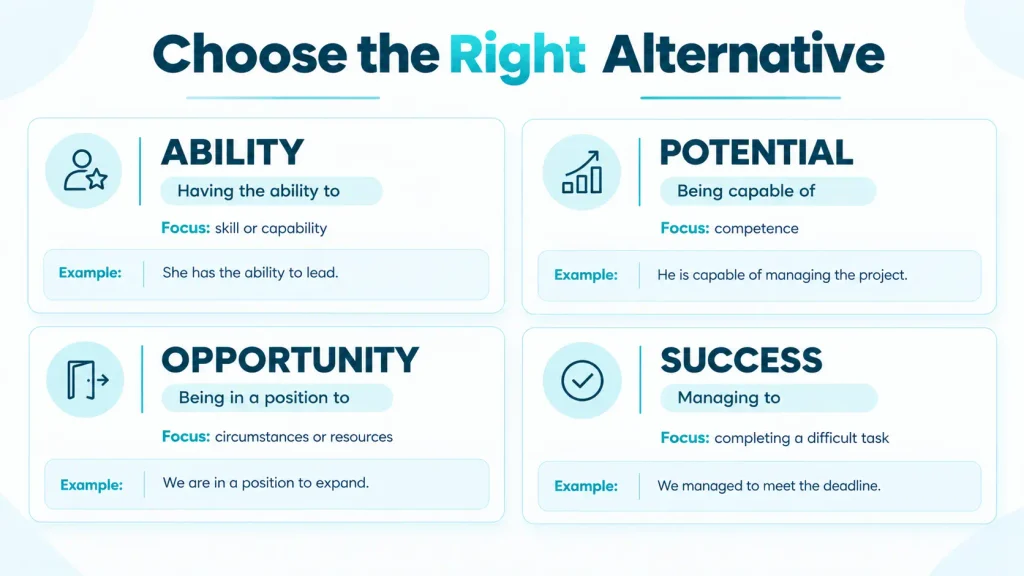
The best expression depends on what you mean by ability.
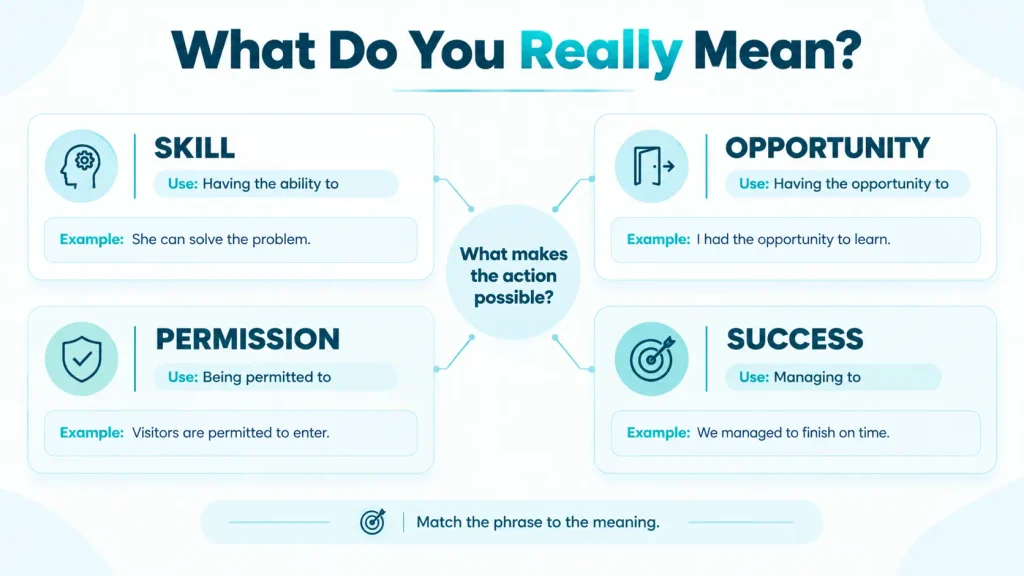
- For skills or potential: Use “capable of” or “having the ability to.”
- For professional qualifications: Use “qualified to.”
- For practical resources: Use “having the means to.”
- For opportunity or circumstances: Use “being in a position to.”
- For permission: Use “being allowed to” or “being free to.”
- For preparation: Use “being equipped to” or “being prepared to.”
- For success after difficulty: Use “managing to.”
Before replacing a phrase, check whether your sentence describes skill, permission, opportunity, readiness, or a successful result. That distinction helps you select an accurate alternative.
Comparison Table: Alternatives to Being Able
| Alternative | Main Meaning | Tone | Best Context |
|---|---|---|---|
| Capable of | Ability or potential | Neutral | General and professional |
| Having the ability to | Possessing an ability | Formal or neutral | Explanations and reports |
| In a position to | Favorable circumstances | Professional | Workplace and business |
| Having the skills to | Practical competence | Professional | Careers and training |
| Having the capacity to | Ability or available resources | Formal | Business and technical writing |
| Qualified to | Meeting requirements | Professional | Jobs and education |
| Having the means to | Having necessary resources | Neutral | Financial and practical contexts |
| Free to | Having freedom or permission | Neutral | Everyday communication |
| Allowed to | Having permission | Neutral | Rules and policies |
| Having the opportunity to | Having a chance | Neutral | Personal and professional writing |
| Equipped to | Having tools or preparation | Professional | Training and work |
| Prepared to | Being ready | Neutral | Planning and communication |
| Managing to | Succeeding despite difficulty | Conversational | Narratives and everyday English |
Common Mistakes to Avoid
Treating ability and permission as the same thing
“I am able to enter the building” suggests that entering is possible. “I am allowed to enter the building” specifically means that permission has been granted.
Using “capable of” with the wrong verb form
Use a noun or an -ing verb after “capable of.”
- Correct: She is capable of solving the problem.
- Incorrect: She is capable of solve the problem.
Confusing qualifications with ability
“Qualified to” usually suggests that someone meets relevant requirements. “Able to” simply indicates that the action is possible.
Choosing a formal phrase for casual conversation
In everyday American English, “I can help you” is often clearer and more natural than “I am in a position to provide assistance.”
Frequently Asked Questions
What is the simplest alternative to being able?
“Capable of” is a useful alternative when discussing someone’s ability or potential. In many sentences, however, “can” or “able to” is shorter and more natural.
What is a professional way to say being able?
“Capable of,” “qualified to,” “equipped to,” and “having the capacity to” can work in professional writing. Choose the phrase that accurately describes the person’s skills, qualifications, or resources.
Is “capable of” the same as “able to”?
They are similar, but their grammar differs. “Capable of” is followed by a noun or an -ing verb, while “able to” is followed by the base form of a verb.
- She is capable of leading the team.
- She is able to lead the team.
How can I say “being able to” in a formal sentence?
Depending on the meaning, you can use “having the ability to,” “being qualified to,” or “having the capacity to.” For example, “The department has the capacity to process additional applications.”
What is another way to say able to do something?
You can say “capable of doing something,” “equipped to do something,” or “having the skills to do something.” The best choice depends on whether you mean general ability, preparation, or specific skills.
Can “in a position to” replace “being able”?
Sometimes. “In a position to” usually describes having the circumstances, authority, or resources to act. It is less suitable when you are describing a person’s skill alone.
Is “managing to” a synonym for “being able”?
Not exactly. “Managing to” describes successfully completing an action, often despite a challenge. “Being able” describes ability or possibility, whether or not the action has been completed.
Conclusion
The best alternative to being able depends on the meaning you want to convey. Use “capable of” for ability, “qualified to” for credentials, “in a position to” for favorable circumstances, and “having the means to” for available resources. When a shorter expression works, “can” or “able to” is often the clearest choice in American English.

Role: English Language & Communication Writer
Daniel Carter is an English language writer specializing in workplace communication, professional vocabulary, resumes, emails, and career-focused English.