
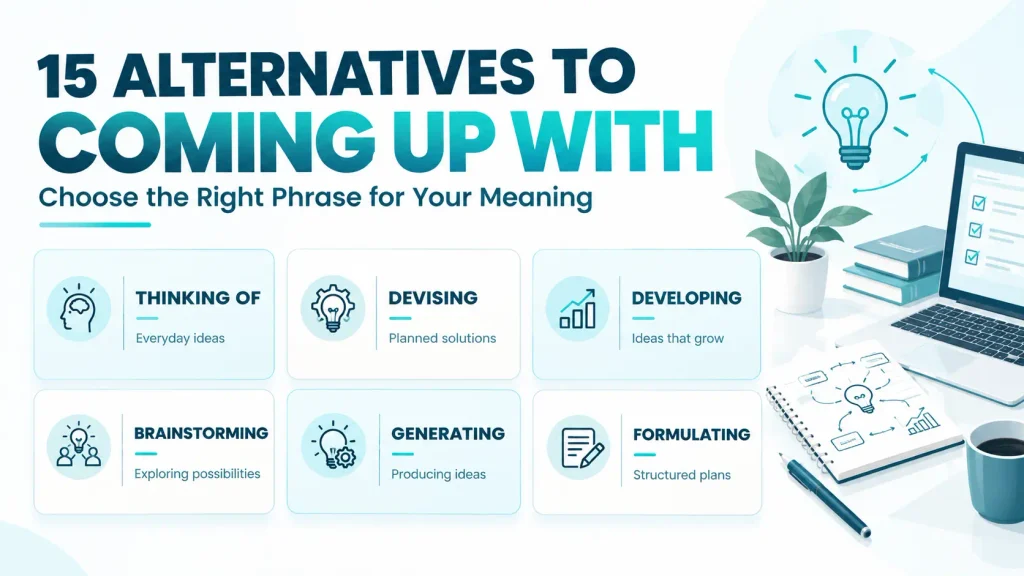
If you are looking for another way to say coming up with, useful alternatives include thinking of, devising, developing, brainstorming, generating, creating, and formulating. Each phrase has a slightly different meaning. The best choice depends on whether you are describing a new idea, a practical solution, a creative plan, or a possible answer.
What Does “Coming Up With” Mean?
“Coming up with” is a common English expression that means thinking of, creating, or finding an idea, answer, plan, or solution. It is often used in everyday conversations, at work, and in academic settings.
For example:
- She came up with a creative idea for the project.
- We need to come up with a solution to this problem.
- He is coming up with new ways to attract customers.
The expression is natural and widely understood. However, choosing a more specific alternative can make your writing clearer, more precise, or more professional.
15 Other Ways to Say Coming Up With
1. Thinking Of
Meaning: To form an idea in your mind or consider a possible answer, plan, or suggestion.
“Thinking of” is one of the closest alternatives to “coming up with.” It works well in casual conversations and everyday writing.
Example: I’m thinking of a new way to organize our weekly meetings.
Best for: Everyday conversations, ideas, suggestions, and possible plans.
2. Devising
Meaning: To plan or invent a method, system, or solution, usually with careful thought.
“Devising” sounds more deliberate than “thinking of.” It is especially useful when someone works through a challenge to develop a practical approach.
Example: The engineering team is devising a safer way to transport the equipment.
Best for: Problem-solving, strategies, technical projects, and formal writing.
3. Developing
Meaning: To create or improve an idea, plan, product, or method over time.
Use “developing” when an idea requires research, planning, or further work rather than a single moment of inspiration.
Example: Our team is developing a new strategy to improve customer service.
Best for: Business projects, products, plans, and long-term ideas.
4. Brainstorming
Meaning: Generating and discussing possible ideas, often with other people.
“Brainstorming” emphasizes exploring several possibilities. It does not necessarily mean that a final decision or solution has been reached.
Example: We’re brainstorming ideas for the company’s next advertising campaign.
Best for: Team meetings, creative projects, marketing, and group discussions.
5. Generating
Meaning: Producing ideas, options, possibilities, or solutions.
“Generating” is useful when you want to emphasize the production of ideas, especially when several options are being considered.
Example: The survey helped us generate new ideas for improving the website.
Best for: Reports, research, business discussions, and creative work.
6. Creating
Meaning: Making something new, including an idea, plan, design, or solution.
“Creating” is a broad alternative that works when the focus is on bringing something new into existence.
Example: She is creating a plan to launch her online store.
Best for: Creative projects, business plans, designs, and new initiatives.
7. Formulating
Meaning: Developing an idea, statement, plan, or strategy in a clear and organized way.
“Formulating” is more formal than “thinking of.” It is especially appropriate when an idea needs to be carefully structured or expressed.
Example: The researchers are formulating a new approach to the study.
Best for: Academic writing, professional reports, policies, and strategies.
8. Inventing
Meaning: Creating something new or devising an original way to do something.
“Inventing” often suggests originality. It can refer to physical objects, creative concepts, or new methods.
Example: He invented a clever way to save space in the small kitchen.
Best for: Inventions, original ideas, creative solutions, and new methods.
9. Finding
Meaning: Discovering or identifying an answer, option, or solution.
“Finding” is a good choice when the emphasis is on identifying something useful rather than creating it from scratch.
Example: We need to find a better way to manage our time.
Best for: Solutions, answers, opportunities, and practical alternatives.
10. Thinking Up
Meaning: Inventing or imagining an idea, plan, name, or excuse.
“Thinking up” is informal and conversational. It often refers to producing an idea through imagination.
Example: My sister thought up a fun theme for the birthday party.
Best for: Casual conversations, creative ideas, names, and playful plans.
11. Working Out
Meaning: Finding an answer or developing a plan through thought, effort, or problem-solving.
“Working out” emphasizes the process of figuring something out. It is especially useful when a solution is not immediately obvious.
Example: We’re working out a way to finish the project before Friday.
Best for: Practical problems, arrangements, plans, and solutions.
12. Mapping Out
Meaning: Planning something by identifying its main steps, stages, or details.
Use “mapping out” when an idea becomes a structured plan. It is not a direct replacement for every use of “coming up with.”
Example: The manager is mapping out the steps for the new product launch.
Best for: Project planning, schedules, strategies, and roadmaps.
13. Crafting
Meaning: Creating something carefully, with attention to its wording, design, or details.
“Crafting” is particularly useful when the result needs to be thoughtful, polished, or well designed.
Example: She spent the afternoon crafting a compelling message for potential clients.
Best for: Written messages, presentations, campaigns, and creative work.
14. Conceiving
Meaning: Forming an idea or plan in the mind, often for the first time.
“Conceiving” is more formal and can emphasize the original thought behind a project or concept.
Example: The architect conceived a design that made better use of natural light.
Best for: Original concepts, designs, theories, and formal writing.
15. Arriving At
Meaning: Reaching a conclusion, decision, or solution after thinking or discussion.
“Arriving at” focuses on the result of a reasoning process rather than the act of inventing something.
Example: After several discussions, the team arrived at a practical solution.
Best for: Decisions, conclusions, agreements, and problem-solving.
Which Alternative Should You Use?
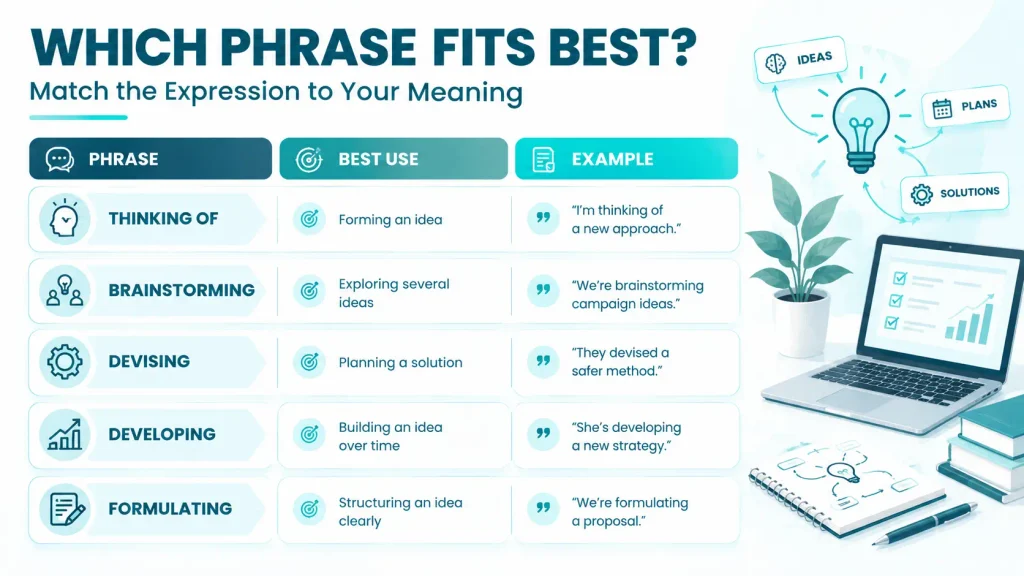
The best replacement depends on what you are describing. Some alternatives emphasize creativity, while others focus on planning, reasoning, or reaching a result.
| Alternative | Main emphasis | Best context |
|---|---|---|
| Thinking of | Forming an idea | Everyday English |
| Devising | Planning a method or solution | Problem-solving |
| Developing | Building an idea over time | Projects and business |
| Brainstorming | Exploring multiple ideas | Group discussions |
| Generating | Producing ideas or options | Reports and research |
| Creating | Making something new | General and creative use |
| Formulating | Structuring an idea | Formal and academic writing |
| Inventing | Producing something original | Innovation |
| Finding | Identifying an answer | Practical problems |
| Thinking up | Imagining an idea | Casual conversations |
| Working out | Solving or figuring out | Plans and problems |
| Mapping out | Organizing steps | Project planning |
| Crafting | Creating with care | Writing and design |
| Conceiving | Forming an original concept | Formal writing |
| Arriving at | Reaching a conclusion | Decisions and discussions |
Examples of “Coming Up With” in Different Contexts
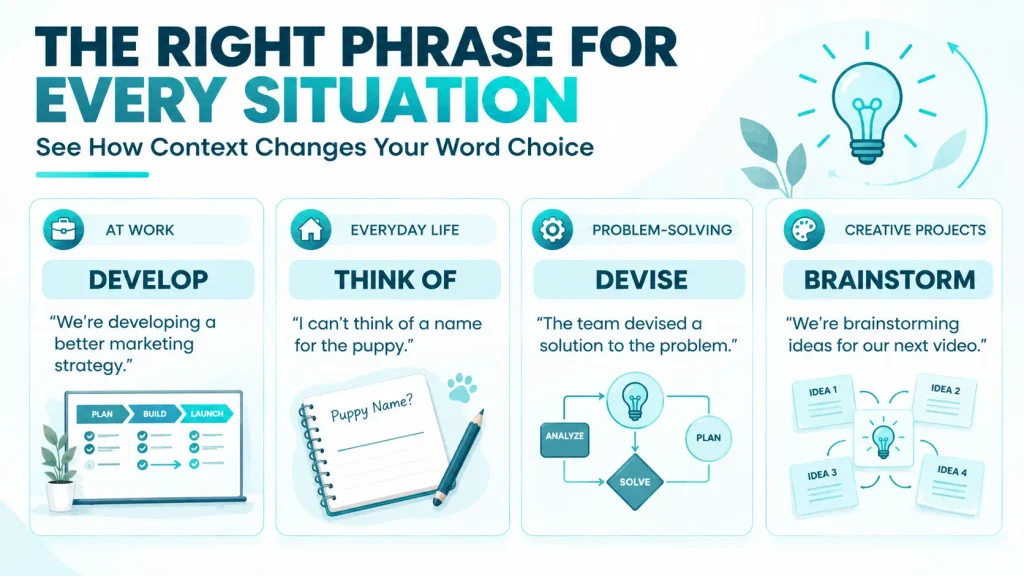
At Work
Original: We need to come up with a better marketing strategy.
Alternative: We need to develop a better marketing strategy.
“Develop” works well because a marketing strategy often involves research, planning, and continued improvement.
In Everyday Conversation
Original: I can’t come up with a name for my new puppy.
Alternative: I can’t think of a name for my new puppy.
“Think of” sounds natural and conversational in this situation.
In Problem-Solving
Original: The team came up with a solution to the technical issue.
Alternative: The team devised a solution to the technical issue.
“Devised” emphasizes the effort involved in creating a method to address the problem.
In Creative Projects
Original: We’re coming up with ideas for our next video.
Alternative: We’re brainstorming ideas for our next video.
“Brainstorming” is appropriate when the group is exploring several possible ideas.
In Academic Writing
Original: The researchers came up with a new explanation for the results.
Alternative: The researchers formulated a new explanation for the results.
“Formulated” sounds more formal and emphasizes the careful development of an explanation.
Common Mistakes to Avoid
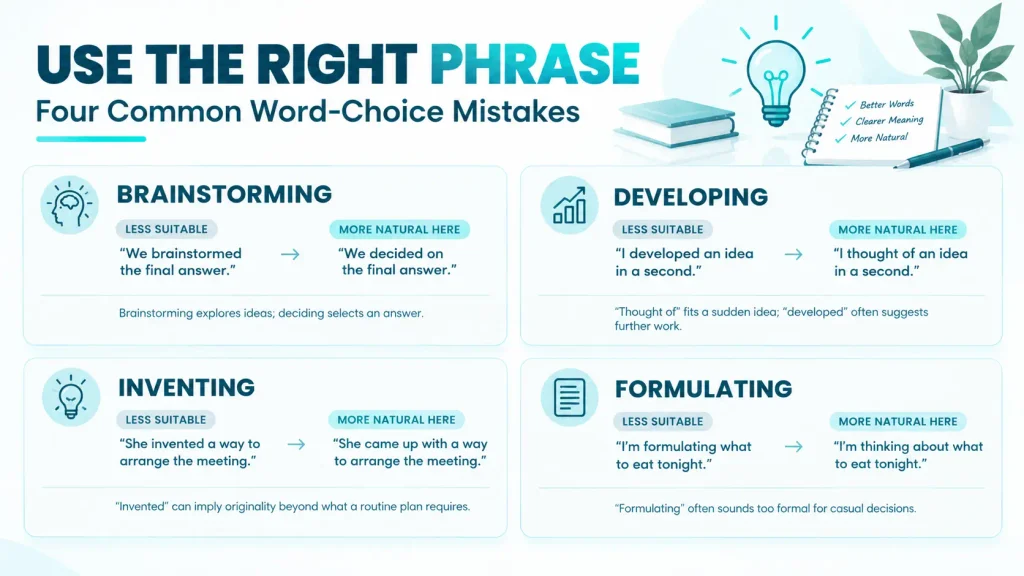
Although these alternatives are related, they are not always interchangeable.
- Using “brainstorming” for a final decision: Brainstorming usually means exploring ideas, not selecting a final answer. Use “deciding on” or “arriving at” when the decision has been made.
- Using “developing” when you mean a sudden idea: If someone has an idea in a moment, “thought of” may be more precise than “developed.”
- Using “inventing” for every solution: “Inventing” often suggests originality. For a routine answer or an existing option, “finding” may be more accurate.
- Using “formulating” in casual conversation: Although correct, it can sound overly formal when talking with friends. “Thinking of” is usually more natural.
- Using “mapping out” for an unplanned idea: This expression suggests organizing the steps of a plan, not simply imagining a possibility.
Remember that “coming up with” is already natural English. You do not need to replace it unless another expression communicates your meaning more clearly.
Frequently Asked Questions
What is the most common alternative to “coming up with”?
“Thinking of” is one of the most common alternatives in everyday English. For example, “I’m trying to think of a solution” sounds natural when someone is looking for an answer.
What is a professional way to say “coming up with”?
“Developing,” “devising,” and “formulating” can work well in professional writing. Choose “developing” for an idea that takes shape over time, “devising” for a carefully planned method, and “formulating” for a structured proposal or strategy.
What is another way to say “coming up with ideas”?
You can say “brainstorming ideas,” “generating ideas,” “thinking of ideas,” or “creating ideas.” “Brainstorming” is especially suitable when exploring several possibilities with a team.
What is another way to say “coming up with a solution”?
Useful alternatives include “finding a solution,” “devising a solution,” “developing a solution,” and “working out a solution.” “Finding” emphasizes identifying an answer, while “devising” emphasizes designing an approach.
Is “coming up with” formal or informal?
“Coming up with” is a neutral, widely used expression that works in both casual conversations and many professional situations. More formal alternatives, such as “formulating” or “devising,” may be better suited to reports or academic writing.
Is “thinking of” the same as “coming up with”?
They often have similar meanings, especially when referring to ideas or suggestions. However, “coming up with” can emphasize producing an idea or solution, while “thinking of” can also mean considering or remembering something.
Can I use “creating” instead of “coming up with”?
Yes, when the meaning involves making something new. For example, “coming up with a business plan” can become “creating a business plan.” However, “creating” may suggest producing the plan itself rather than simply thinking of the idea.
Final Thoughts
The best alternative to “coming up with” depends on the meaning and context. Use “thinking of” for everyday ideas, “brainstorming” for exploring possibilities, “devising” for carefully planned solutions, and “developing” for ideas that grow over time. When writing formally, “formulating” or “conceiving” may be more suitable.
Choose the phrase that communicates your intended meaning naturally. Clear and accurate wording is more useful than replacing a familiar expression simply to make it sound different.

Role: Author & Editorial Specialist
Sophia Williams serves as an Author at Elite’s Collective, bringing strong communication skills and fresh perspectives to the team through high-quality written content.