

The best alternatives to make money include earn money, generate income, earn a living, bring in money, and make a profit. Each phrase has a slightly different meaning. Some work well in professional settings, while others sound more natural in everyday conversation or when discussing a business.
Key Takeaways
- Earn money is the most direct and widely useful alternative.
- Earn a living means making enough money to support yourself.
- Generate income works well in business and financial writing.
- Bring in money is a casual way to describe receiving income.
- Make a profit specifically means earning more than you spend.
- The best expression depends on whether you mean earning wages, running a business, or making a financial gain.
What Does Make Money Mean?
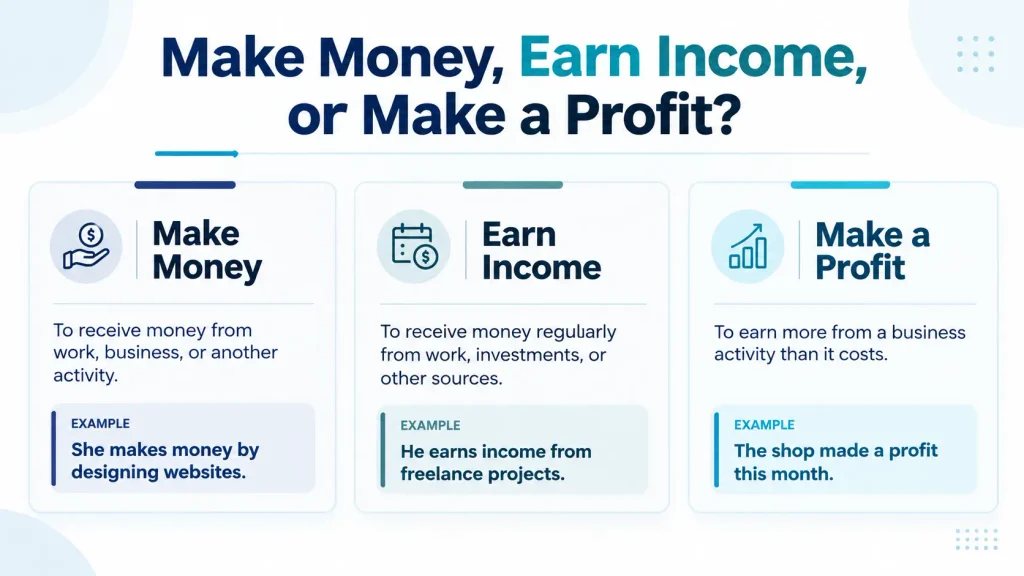
The phrase make money usually means earning or receiving money through work, business, investments, or other activities. It is common in American English and works in both casual conversations and many professional situations.
For example:
- “She makes money by designing websites.”
- “The company makes money by selling software.”
- “He wants to make money from his investments.”
The phrase can describe earning income in general, but it can also refer to a business making a profit. That distinction matters when choosing an alternative.
15 Other Ways to Say Make Money

1. Earn Money
Best for: Everyday conversation, work, and general use.
Earn money is the closest direct alternative to make money. It emphasizes receiving money in exchange for work, services, or effort.
Example: “I earn money by building websites for small businesses.”
Use this phrase when you want a clear, natural expression that fits almost any situation.
2. Earn a Living
Best for: Talking about work or supporting yourself.
Earn a living means making enough money to pay for your needs and support your lifestyle. It focuses on how someone supports themselves rather than on a single payment.
Example: “She earns a living as a freelance graphic designer.”
This is a good choice when discussing someone’s job, career, or main source of income.
3. Generate Income
Best for: Business, finance, and professional writing.
Generate income describes producing money through a business, service, asset, or investment. It sounds more formal than make money.
Example: “The new website generates income through product sales.”
Use it when discussing revenue-producing activities. Remember that generating income does not necessarily mean making a profit.
4. Bring In Money
Best for: Casual conversations and everyday business discussions.
Bring in money means receiving money from work, sales, or another source. It is conversational and often emphasizes the amount coming in.
Example: “Her online store brings in money even when she is not working.”
This phrase is useful when talking about a side hustle, small business, or additional income source.
5. Make a Profit
Best for: Business, sales, and financial results.
Make a profit means earning more from an activity than it costs to operate or complete it. Unlike make money, it clearly focuses on the financial gain remaining after expenses.
Example: “The company made a profit after reducing its operating costs.”
Use this phrase when you specifically mean a positive financial result, not simply receiving money.
6. Earn an Income
Best for: Professional conversations and financial planning.
Earn an income means receiving money, usually through employment, self-employment, or another income-producing activity.
Example: “He earns an income by teaching English online.”
It is a useful alternative when discussing employment, financial stability, or a person’s source of income.
7. Make a Living
Best for: Everyday conversations about jobs and careers.
Make a living means earning the money needed to support yourself. It is similar to earn a living and is common in spoken American English.
Example: “They make a living by repairing computers.”
Use it to describe someone’s occupation or the work they do to pay their bills.
8. Bring Home a Paycheck
Best for: Casual conversations about employment.
This expression refers to earning wages or a salary from a job. It often emphasizes having regular employment income.
Example: “She works full-time to bring home a steady paycheck.”
It is less suitable for describing business revenue or investment returns because it usually suggests money earned through employment.
9. Build Wealth
Best for: Long-term financial goals and investing.
Build wealth means increasing the value of your assets over time. It can involve saving, investing, owning a business, or growing other valuable assets.
Example: “He invests a portion of his salary each month to build wealth.”
This is not an exact synonym for make money. It focuses on long-term financial growth rather than simply earning income.
10. Earn Revenue
Best for: Business reports and financial discussions.
Earn revenue is sometimes used to describe money a business receives from its activities. In formal accounting and business writing, generate revenue or bring in revenue is often more precise.
Example: “The company generates revenue by offering monthly software subscriptions.”
Revenue is the money received from sales or services before expenses are deducted. It should not be confused with profit.
11. Turn a Profit
Best for: Business performance and sales.
Turn a profit means becoming profitable or ending up with more money than was spent.
Example: “The small business turned a profit during its second year.”
This expression is close to make a profit and is particularly natural when discussing a business’s financial performance.
12. Supplement Your Income
Best for: Side jobs, freelance work, and additional earnings.
Supplement your income means earning extra money in addition to your main source of income.
Example: “She tutors students online to supplement her income.”
Choose this phrase when the goal is to add to an existing salary or income source rather than replace it.
13. Earn Extra Cash
Best for: Casual conversations and side hustles.
Earn extra cash means making additional money, often through temporary work, small jobs, or selling unwanted items.
Example: “He delivers groceries on weekends to earn extra cash.”
This expression is informal and works well when discussing short-term or additional earnings.
14. Monetize
Best for: Digital content, websites, apps, and online businesses.
Monetize means turning an asset, activity, audience, or service into a source of income.
Example: “The creator monetizes her blog through advertising and affiliate links.”
It is especially useful in online business contexts. However, monetizing something means creating a way to earn money from it; it does not guarantee that the activity will be profitable.
15. Cash In
Best for: Informal conversations about opportunities or financial gains.
Cash in can mean gaining money or taking advantage of an opportunity for financial benefit. In some contexts, it specifically means exchanging something for money or claiming a financial reward.
Example: “The entrepreneur cashed in on the growing demand for home fitness equipment.”
This expression can suggest that someone benefited from a trend or opportunity. It is more informal than generate income and may sometimes imply opportunism.
How to Choose the Right Alternative
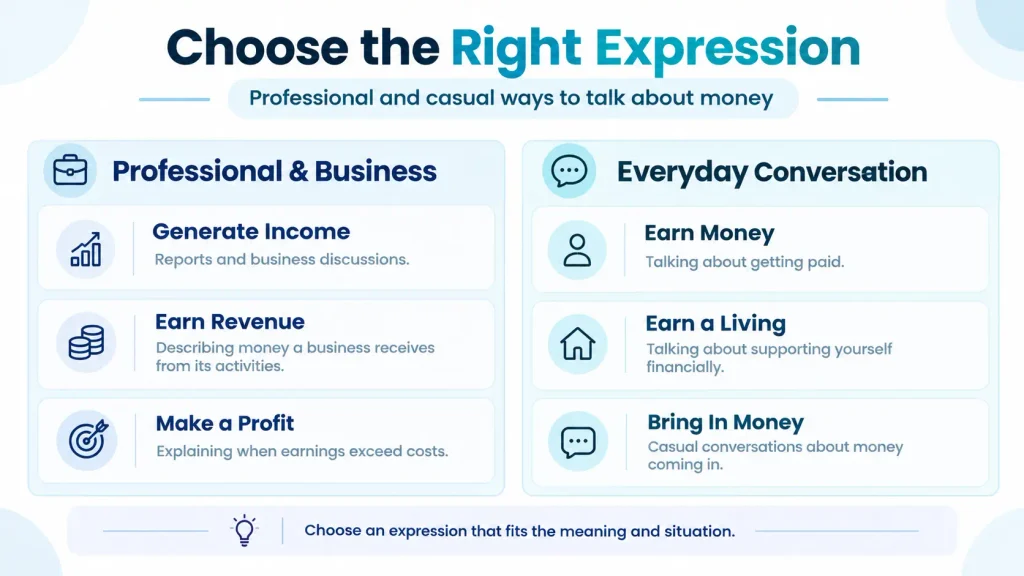
The most suitable phrase depends on what you want to communicate.
| Alternative | Main meaning | Best context |
|---|---|---|
| Earn money | Receive money through work or effort | General use |
| Earn a living | Support yourself financially | Jobs and careers |
| Generate income | Produce income | Business and finance |
| Bring in money | Receive money from an activity | Casual conversations |
| Make a profit | Earn more than expenses | Business results |
| Make a living | Support yourself through work | Everyday English |
| Build wealth | Increase assets over time | Long-term finances |
| Supplement your income | Add extra earnings | Side jobs |
| Earn extra cash | Make additional money | Casual situations |
| Monetize | Turn something into a source of income | Digital business |
Examples of Make Money in Different Situations
At Work
Instead of saying, “I make money as a software developer,” you could say:
- “I earn a living as a software developer.”
- “I earn an income by developing software.”
- “My job provides a steady paycheck.”
The first two describe your source of income, while the third emphasizes regular employment earnings.
In Business
Instead of saying, “Our company makes money from online sales,” consider:
- “Our company generates revenue through online sales.”
- “Our company brings in money through its online store.”
- “Our company makes a profit from online sales.”
Choose generates revenue when discussing sales income and makes a profit when referring to earnings after expenses.
In Freelancing and Side Hustles
Instead of saying, “I want to make money online,” you could say:
- “I want to earn money through freelance work.”
- “I’m looking for ways to supplement my income.”
- “I want to monetize my website.”
- “I’m hoping to earn extra cash on weekends.”
Each option gives the reader a clearer idea of how you intend to earn money.
In Investing
Instead of saying, “I want to make money from stocks,” you could say:
- “I want to earn returns from my investments.”
- “I’m investing to build wealth over time.”
- “I hope to make a profit from my investments.”
These expressions are related but not identical. Investment returns may be positive or negative, and building wealth generally refers to a longer-term goal.
Common Mistakes to Avoid
Choosing an alternative without checking its meaning can make a sentence less accurate.
- Using “make a profit” for all income: A person can receive a salary without making a profit. Profit usually refers to money left after costs.
- Confusing revenue with profit: Revenue is money earned from sales or services before expenses; profit is what remains after relevant costs are deducted.
- Using “build wealth” for a single payment: This expression usually describes increasing financial assets over time.
- Using “bring home a paycheck” for every business: It normally suggests wages or salary from employment.
- Using “monetize” when you simply mean “earn”: Monetize specifically refers to creating a way for something to generate income.
Frequently Asked Questions
What is the most common alternative to make money?
Earn money is the closest and most widely useful alternative. It works in everyday conversation, professional communication, and discussions about work or income.
What is a professional way to say make money?
Generate income is a useful professional alternative. For a business, generate revenue may be more appropriate when discussing sales, while make a profit describes earnings after expenses.
What is a casual way to say make money?
You can say bring in money, earn some cash, or earn extra cash. These expressions sound natural in informal conversations.
What is another way to say make money online?
Depending on the activity, you could say earn money online, generate income online, or monetize a website. For freelance services, earn money through online work is also clear and natural.
What is another way to say make money fast?
You could say earn money quickly or bring in cash quickly. Both communicate speed, but neither guarantees that money will be earned within a particular period.
Are make money and make a profit the same?
No. Make money can refer to receiving income or earning money in general. Make a profit specifically means that the money earned exceeds the relevant costs.
Can I use earn a living instead of make money?
Yes, when you mean earning enough to support yourself. For example, “She makes money as a photographer” and “She earns a living as a photographer” are both natural, although the second emphasizes photography as her means of support.
Conclusion
The best alternative to make money depends on your meaning and audience. Use earn money for a direct replacement, earn a living when discussing work that supports you, generate income in professional contexts, and make a profit when you mean financial gain after expenses. Choosing the phrase that matches your situation makes your English clearer and more precise.

Role: Author & Editorial Specialist
Sophia Williams serves as an Author at Elite’s Collective, bringing strong communication skills and fresh perspectives to the team through high-quality written content.