
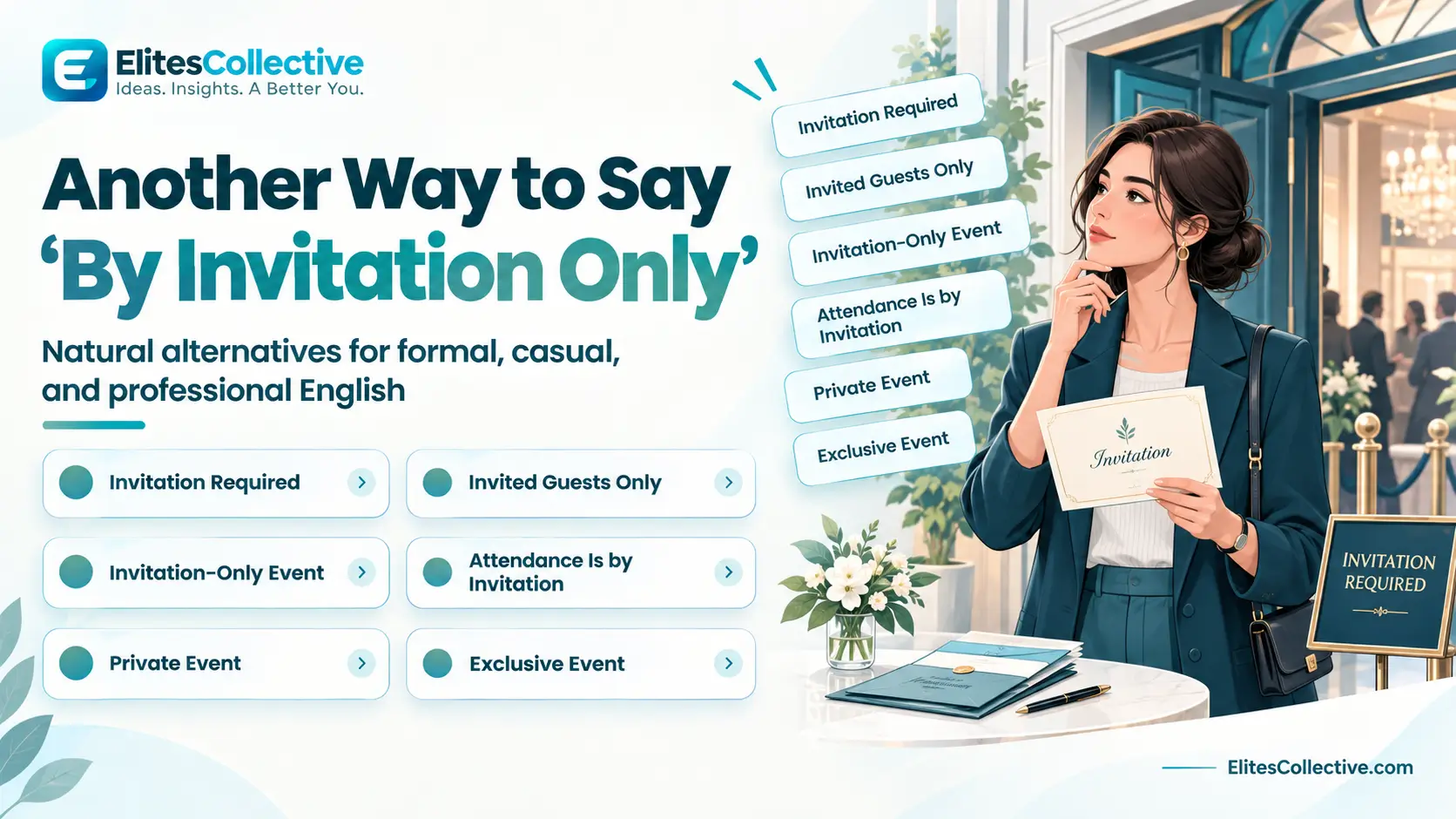
Looking for another way to say “by invitation only”? Depending on the situation, you can say “invitation required,” “invite-only,” “invited guests only,” “by invitation,” or “open to invited guests.” The best choice depends on whether you are describing an event, access policy, membership setting, or a formal announcement.
Key Takeaways
- “Invitation required” is clear, direct, and suitable for formal notices.
- “Invite-only” is concise and common for events, social gatherings, and online promotions.
- “Invited guests only” makes it clear that uninvited people cannot attend.
- “By invitation” is a shorter, polishLooking for a natural alternative to “by invitation only”? Depending on the situation, you can say “invitation required,” “invite-only,” “invited guests only,” “by invitation,” or “open to invited guests.” The right choice depends on whether you are describing an event, access policy, membership setting, or formal announcement.
- Key Takeaways
- “Invitation required” is clear, direct, and suitable for formal notices.
- “Invite-only” is concise and common for events, social gatherings, and online promotions.
- “Invited guests only” clearly shows that attendance is limited to people who have been invited.
- “By invitation” is a shorter, polished option for formal settings.
- “Private event” can sometimes replace the original expression, but the meanings are not always identical.
- Choose your wording based on the audience, setting, and level of formality.
- What Does “By Invitation Only” Mean?ed alternative that works well in formal settings.
- “Private event” can sometimes replace “by invitation only,” but it does not always mean exactly the same thing.
- Choose the phrase based on the audience, setting, and level of formality.
What Does “By Invitation Only” Mean?
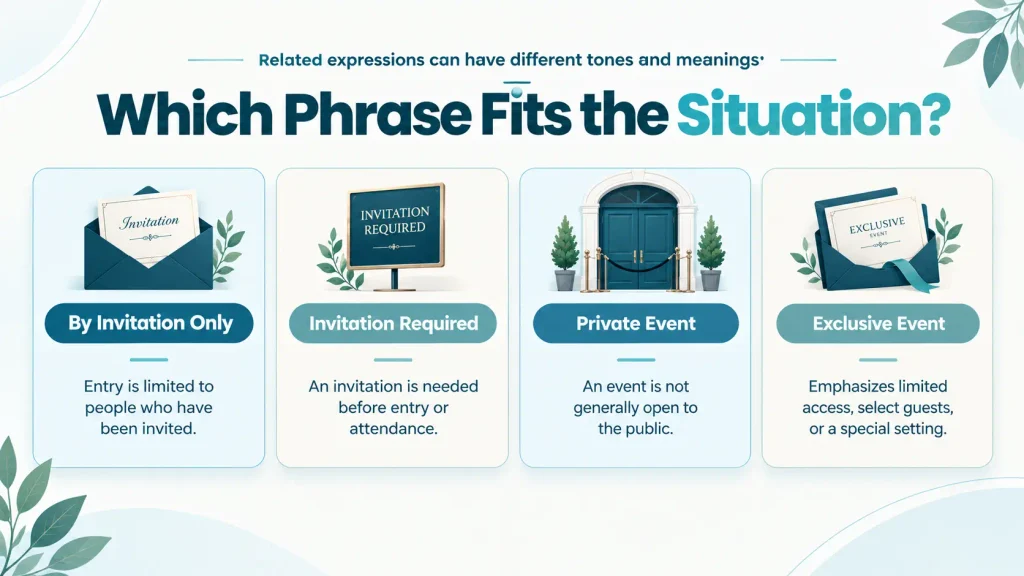
The expression “by invitation only” means that access or attendance is limited to people who have received an invitation. A person generally cannot attend simply by showing up or asking to enter.
This wording is commonly used for:
- Private events
- Business gatherings
- Weddings and celebrations
- Exclusive previews
- Networking events
- Private parties
- Membership events
- Product launches
- Fundraisers
- Online communities or meetings
For example:
The product launch is by invitation only.
This tells readers that they need an invitation to attend.
The expression has a formal and slightly exclusive tone. If you want something shorter, friendlier, or more direct, one of the alternatives below may fit better.
For more examples of natural English expressions, you can also explore our guide to another way to say “real world”.
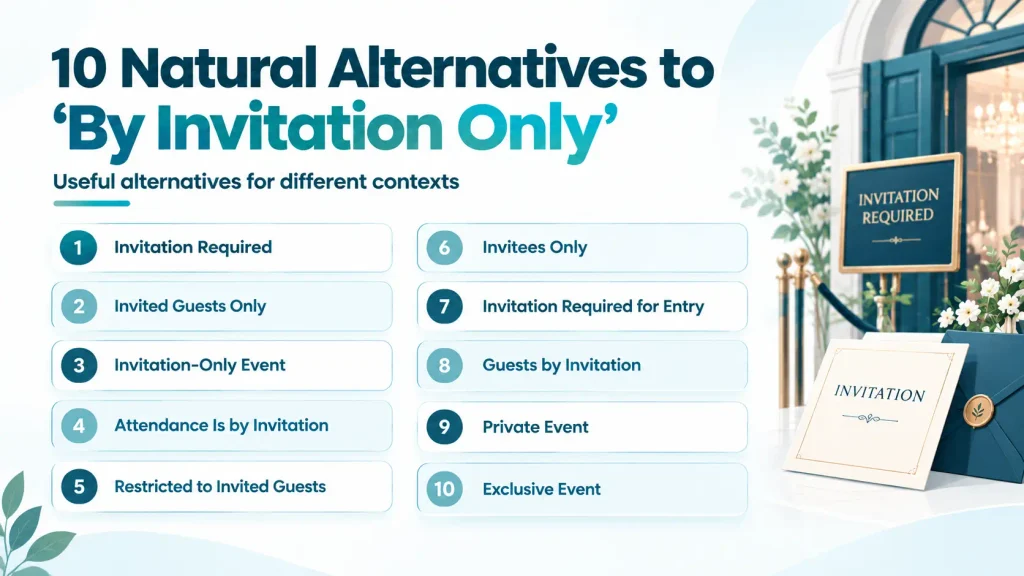
10 Natural Alternatives to “By Invitation Only”
1. Invitation Required
“Invitation required” is one of the clearest alternatives. It directly tells people that they must have an invitation to gain access.
Best for: Formal notices, event pages, business events, and access instructions.
Example:
An invitation is required to attend the reception.
This wording works especially well when clarity matters more than creating an exclusive or sophisticated tone.
2. Invite-Only
“Invite-only” is a concise and widely used expression. It is especially common in event descriptions, promotional materials, social media, and casual business communication.
Best for: Events, parties, launches, networking gatherings, and online announcements.
Example:
We’re hosting an invite-only networking event next Thursday.
It sounds less formal than the longer expression while keeping essentially the same core meaning.
3. By Invitation
“By invitation” is a shorter version that can sound polished and formal, particularly in event descriptions.
Best for: Formal events, galleries, business functions, and announcements.
Example:
Attendance is by invitation.
This wording may sound slightly less explicit about exclusivity. If you want to make it clear that an invitation is mandatory, “invitation required” is more direct.
4. Invited Guests Only
“Invited guests only” makes the attendance restriction very clear. It tells readers that only people who have been invited may attend.
Best for: Private parties, receptions, weddings, dinners, and physical venues.
Example:
This reception is for invited guests only.
This phrase is particularly useful when the message needs to be understood immediately. It puts the focus on who is welcome rather than on the invitation itself.
5. Invitation-Only Event
If you are specifically describing an event, “invitation-only event” is a natural and straightforward choice.
Best for: Event listings, announcements, promotional copy, and business communication.
Example:
The company will host an invitation-only event for selected clients.
This wording keeps the idea of limited attendance while clearly identifying the occasion.
6. Open to Invited Guests
“Open to invited guests” has a slightly warmer and more welcoming tone than a strict access notice.
Best for: Receptions, celebrations, community events, and announcements.
Example:
The evening reception is open to invited guests.
Rather than focusing on who cannot attend, this wording emphasizes who is welcome.
7. Guests Must Be Invited
“Guests must be invited” is a direct way to explain the attendance requirement.
Best for: Event rules, venue notices, private gatherings, and informal announcements.
Example:
Guests must be invited in advance to attend the dinner.
This option is useful when you want to explain the rule in a complete sentence rather than use a short label.
8. Attendance by Invitation
“Attendance by invitation” is a formal expression that emphasizes the requirement for attending.
Best for: Formal events, conferences, receptions, institutional announcements, and professional settings.
Example:
Attendance is by invitation and limited to registered participants.
It has a more official tone than “invite-only,” so it can work well in professional written materials.
9. Private Event
“Private event” can sometimes be used in a similar context, but it is not an exact synonym.
A private event generally means that the gathering is not open to the general public. It does not necessarily mean that every attendee must have received an individual invitation.
Best for: Event listings, venue descriptions, parties, and general announcements.
Example:
The venue will be closed tonight for a private event.
Use this phrase when the main point is that the event is not public. If an invitation is specifically required, a more precise expression is “invitation-only event.”
10. Exclusive Event
“Exclusive event” can communicate a similar sense of limited access, but it adds a stronger sense of selectivity.
Best for: Marketing, luxury events, brand launches, VIP gatherings, and promotional copy.
Example:
Guests were invited to an exclusive event celebrating the new collection.
This is not an exact replacement. An exclusive gathering may be invitation-only, but the phrase itself does not necessarily establish that an invitation is required.
Quick Comparison: Which Alternative Should You Use?
| Alternative | Tone | Best Context | Exact Meaning? |
| Invitation required | Formal, direct | Notices and access rules | Yes |
| Invite-only | Casual to neutral | Events and promotions | Yes |
| By invitation | Formal, polished | Formal events | Usually |
| Invited guests only | Direct, clear | Parties and receptions | Yes |
| Invitation-only event | Neutral, formal | Event descriptions | Yes |
| Open to invited guests | Warm, neutral | Receptions and gatherings | Mostly |
| Guests must be invited | Direct | Rules and announcements | Yes |
| Attendance by invitation | Formal | Professional events | Yes |
| Private event | Neutral | Non-public events | Not always |
| Exclusive event | Promotional, selective | Luxury and marketing | Not always |
How to Choose the Right Alternative
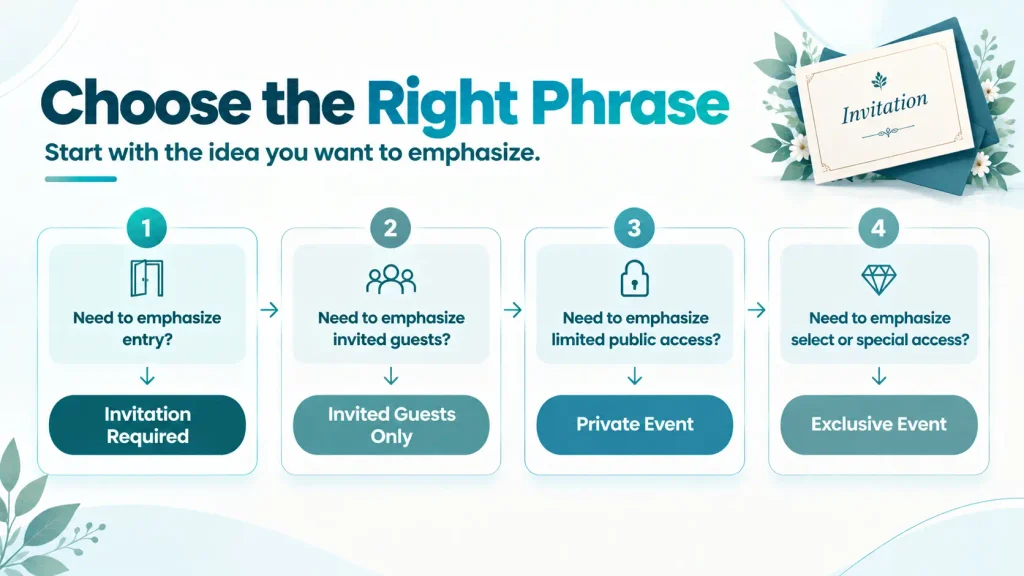
The best wording depends on what you want the sentence to communicate.
For a Formal Announcement
Use “invitation required” or “attendance by invitation.”
Invitation required for entry.
Attendance by invitation.
These options sound clear and professional without being overly casual.
For a Casual Event
Use “invite-only” or “invited guests only.”
It’s an invite-only party.
This dinner is for invited guests only.
These phrases work naturally for social gatherings and informal announcements.
For a Professional Event
Use “invitation-only event” or “invitation required.”
We’re holding an invitation-only event for industry partners.
An invitation is required to attend the presentation.
Both options communicate the access requirement clearly.
For Promotional or Luxury Writing
“Exclusive event” may be appropriate when you want to emphasize the selective nature of a gathering.
Join us for an exclusive event celebrating our newest collection.
Remember that “exclusive” describes the character of the event. It does not necessarily establish that an invitation is mandatory.
“By Invitation Only” vs. “Invite-Only”
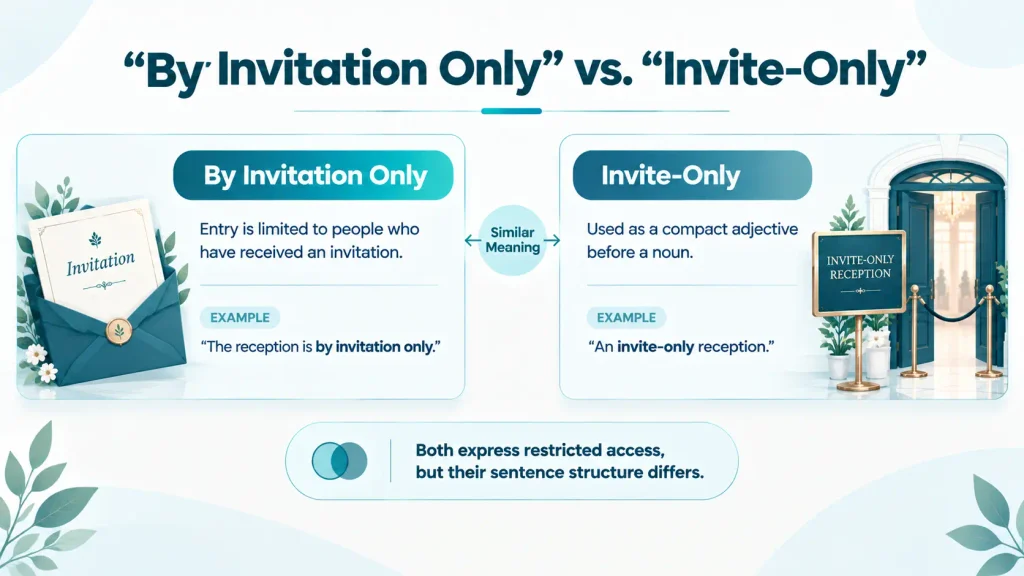
These two expressions are very close in meaning, but their style differs.
“By invitation only” sounds more formal and polished:
The reception is by invitation only.
“Invite-only” is shorter and more conversational:
The reception is invite-only.
For a formal invitation, business announcement, or upscale gathering, the longer wording may fit the tone better. For a website, social media post, or quick event listing, “invite-only” is often more concise.
“By Invitation Only” vs. “Private Event”
These phrases should not always be treated as interchangeable.
A private event is generally not open to the public. However, attendees could potentially be admitted through different arrangements, such as membership, registration, or a guest list.
By invitation only specifically communicates that an invitation is required.
Compare:
The restaurant is closed for a private event.
This tells customers that the gathering is not public.
The restaurant is hosting a dinner by invitation only.
This specifically tells readers that an invitation is required to attend.
If the invitation requirement is important, use wording such as “invitation required” or “invitation-only event.”
Common Mistakes to Avoid
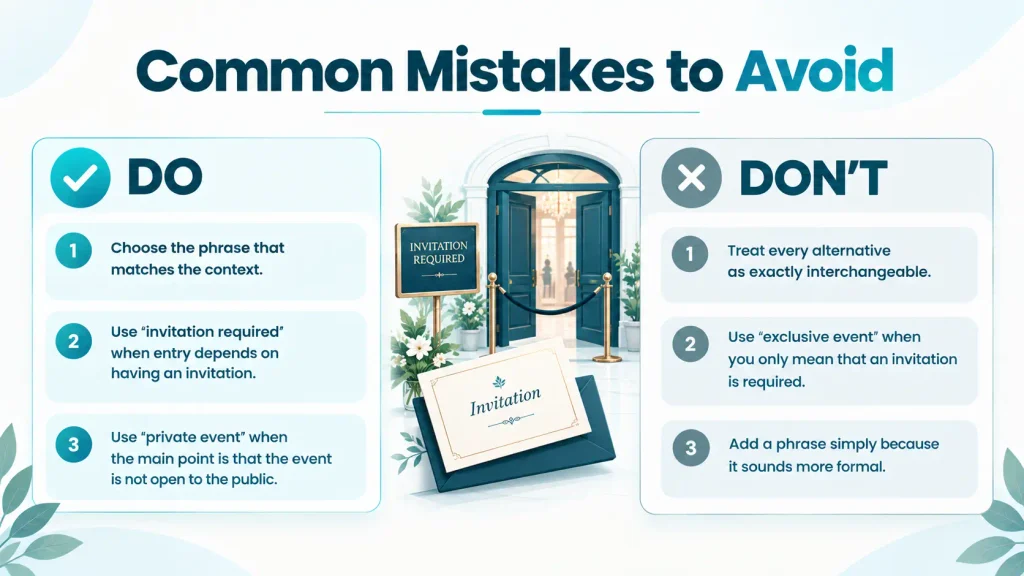
Using “Exclusive” When You Mean “Invitation Required”
“Exclusive” suggests limited or selective access, but it does not always mean that an invitation is mandatory.
Less precise:
The meeting is exclusive.
More precise:
The meeting is invite-only.
Using “Private” as an Exact Synonym
A private event and an invitation-only event can overlap, but they are not identical.
Use “private” when the key point is that the event is not public. Use “invite-only” when the key point is that an invitation is required.
Making Formal Writing Too Casual
“Invite-only” is perfectly natural, but it may not suit every formal document.
For a corporate announcement, “invitation required” may sound more appropriate:
Invitation required for attendance.
Creating Unnecessary Repetition
You usually do not need to write:
The event is by invitation only, and only invited guests may attend.
The second part repeats the same idea.
A simpler version works:
The event is by invitation only.
Frequently Asked Questions
What is another way to say “by invitation only”?
Common alternatives include “invitation required,” “invite-only,” “by invitation,” “invited guests only,” and “invitation-only event.” The best option depends on the tone and context.
Is “invite-only” correct English?
Yes. “Invite-only” is a natural English expression used to describe events or opportunities that are limited to people who have been invited.
Is “private event” the same as “by invitation only”?
Not always. A private event is generally not open to the public, while the original expression specifically indicates that an invitation is required.
What is the formal way to say “by invitation only”?
“Invitation required” and “attendance by invitation” are formal options. The original expression itself is also formal and widely understood.
What is a casual way to say “by invitation only”?
“Invite-only” is a natural casual or conversational option.
How do you say “by invitation only” on an event invitation?
You can simply write “By Invitation Only” or “Invitation Required.” For a warmer tone, you could use “Open to Invited Guests.”
Does “exclusive event” mean invitation-only?
Not necessarily. An exclusive event may have limited access, but the phrase does not automatically mean that an invitation is required.
Which phrase is best for a professional event?
“Invitation required” or “invitation-only event” clearly communicates the access requirement. Choose the one that fits the surrounding sentence and level of formality.
Conclusion
“By invitation only” is already a clear and natural expression, but several alternatives can work depending on the situation. “Invitation required” is useful for formal access instructions, while “invite-only” is concise and conversational. “Invited guests only” is direct, and “invitation-only event” works well when describing a specific gathering.
Be careful with phrases such as “private event” and “exclusive event.” They can communicate a similar idea, but neither always means that an invitation is required. Choosing precise wording helps readers understand who can attend and what the access requirements are.

Role: Author & Editorial Specialist
Sophia Williams serves as an Author at Elite’s Collective, bringing strong communication skills and fresh perspectives to the team through high-quality written content.