
If you need another way to say “reminds me of,” you have several natural choices. For example, you can say “makes me think of,” “brings to mind,” “takes me back to,” or “brings back memories of.” The best phrase depends on the situation, tone, and type of memory or connection you want to express.
Key Takeaways
- “Makes me think of” is a simple choice for everyday conversations.
- “Brings to mind” works well in both speech and writing.
- “Takes me back to” is useful for memories and past experiences.
- “Brings back memories of” clearly focuses on the past.
- “Is reminiscent of” works well when you want to show similarity.
- “Evokes” can describe a memory, feeling, image, or idea.
What Does “Reminds Me Of” Mean?
The phrase “reminds me of” means that something makes you think about another person, place, thing, experience, or time.
For example:
“This song reminds me of my childhood.”
The song makes the speaker think about childhood. The connection could come from a memory, sound, smell, appearance, or feeling.
However, not every alternative has exactly the same meaning. Some phrases focus on memory, while others focus on similarity or association.
That difference matters when you want your English to sound natural.
10 Natural Ways to Say “Reminds Me Of”
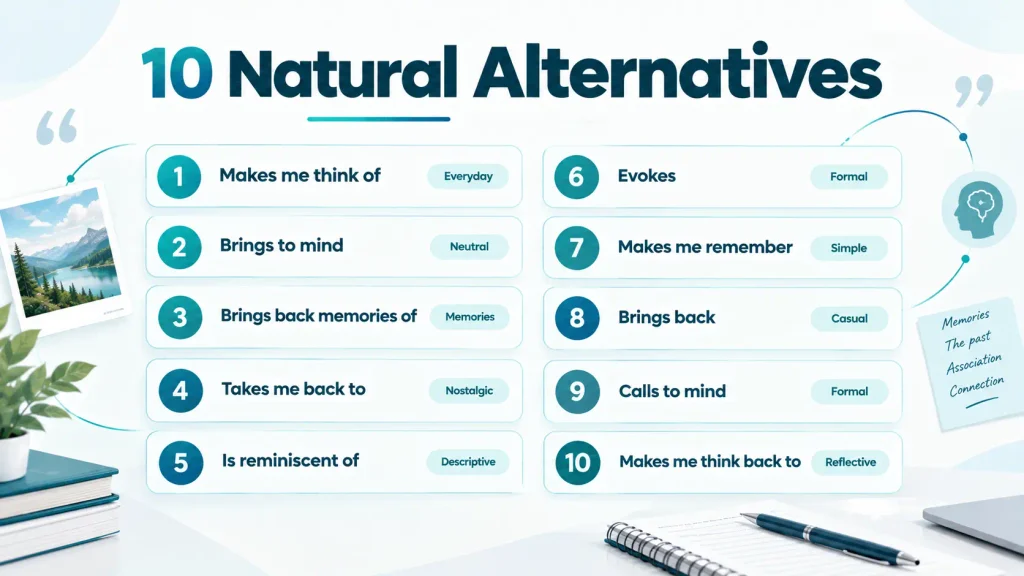
1. Makes Me Think Of
“Makes me think of” is one of the easiest alternatives to use. It sounds natural in everyday American English.
Use it when something causes you to think about a person, place, idea, or experience.
Example:
“This song makes me think of my best friend.”
You can also use it for places and experiences:
“This restaurant makes me think of the café near my old apartment.”
Best for: Casual and everyday English.
2. Brings to Mind
“Brings to mind” means that something causes you to think about another person, thing, or idea.
It sounds a little more polished than “makes me think of.” Therefore, it can work well in both conversation and writing.
Example:
“The smell of fresh bread brings to mind my grandmother’s kitchen.”
You can also use this phrase for ideas:
“The story brings to mind an important lesson about friendship.”
Best for: Neutral and formal English.
3. Brings Back Memories of
When something makes you remember the past, “brings back memories of” is a strong choice.
This phrase clearly focuses on memories. As a result, it works especially well when you want to express nostalgia.
Example:
“Looking at these pictures brings back memories of our family trips.”
Another example is:
“That old song brings back memories of high school.”
Best for: Personal, emotional, and nostalgic situations.
4. Takes Me Back to
“Takes me back to” is another natural way to talk about the past.
It suggests that something makes you feel connected to an earlier time or experience. Because of this, the phrase often has a warm or nostalgic tone.
Example:
“Hearing that song takes me back to my college days.”
You can also use it for places:
“Walking through this neighborhood takes me back to my childhood.”
Best for: Casual, personal, and nostalgic conversations.
5. Is Reminiscent Of
“Is reminiscent of” is more formal than “reminds me of.” It usually describes a similarity in style, appearance, feeling, or character.
For example:
“The building is reminiscent of a traditional European home.”
Here, the speaker is not necessarily describing a personal memory. Instead, the building has features that are similar to traditional European homes.
Therefore, this phrase is useful when you want to focus on resemblance rather than personal memory.
Best for: Formal, descriptive, and creative writing.
6. Evokes
“Evokes” means that something brings a feeling, memory, image, or idea into your mind.
It is shorter and more formal than “reminds me of.” For that reason, it often appears in creative or descriptive writing.
Example:
“The smell of pine evokes memories of winter vacations.”
You can also use it with feelings:
“The painting evokes a feeling of peace.”
However, “evokes” can sound too formal in casual conversation. In those situations, “reminds me of” may sound more natural.
Best for: Creative, descriptive, and formal writing.
7. Makes Me Remember
“Makes me remember” is a direct and simple alternative. It works best when you are talking about a specific memory.
Example:
“This old photo makes me remember our first family vacation.”
Similarly, you can say:
“That smell makes me remember my grandmother’s house.”
Although the phrase is grammatically correct, “reminds me of” will often sound more natural in everyday English.
Best for: Simple and direct conversations.
8. Brings Back
“Brings back” is a short and conversational phrase. It usually refers to memories, emotions, or experiences from the past.
For example:
“That song brings back so many memories.”
You can make the meaning more specific:
“This photo brings back memories of my first apartment.”
The phrase is especially natural when the speaker feels something strongly because of a past experience.
Best for: Casual and emotional conversations.
9. Calls to Mind
“Calls to mind” has a meaning similar to “brings to mind.” It means that something makes you think about another person, idea, place, or event.
However, it sounds more formal. So, it is more common in writing than in casual speech.
Example:
“The painting calls to mind the beauty of the countryside.”
Another example is:
“Her story calls to mind the challenges faced by many families.”
Best for: Formal and descriptive writing.
10. Makes Me Think Back To
“Makes me think back to” focuses on remembering a specific time or experience from the past.
It is useful when you want to show that something causes you to reflect on an earlier part of your life.
Example:
“Seeing my old school makes me think back to my childhood.”
You could also say:
“That photograph makes me think back to our first trip together.”
Best for: Personal and reflective conversations.
Quick Comparison of These Alternatives
| Alternative | Main Idea | Tone | Best Context |
| Makes me think of | Creates an association | Casual | Everyday speech |
| Brings to mind | Causes a thought or memory | Neutral | Speech and writing |
| Brings back memories of | Recalls the past | Emotional | Personal situations |
| Takes me back to | Connects you with an earlier time | Warm | Nostalgic situations |
| Is reminiscent of | Shows similarity | Formal | Descriptive writing |
| Evokes | Creates a memory or feeling | Formal | Creative writing |
| Makes me remember | Causes a specific memory | Simple | Everyday speech |
| Brings back | Recalls memories or feelings | Casual | Conversations |
| Calls to mind | Creates a mental association | Formal | Writing |
| Makes me think back to | Encourages reflection on the past | Neutral | Personal reflection |
Which Alternative Should You Use?
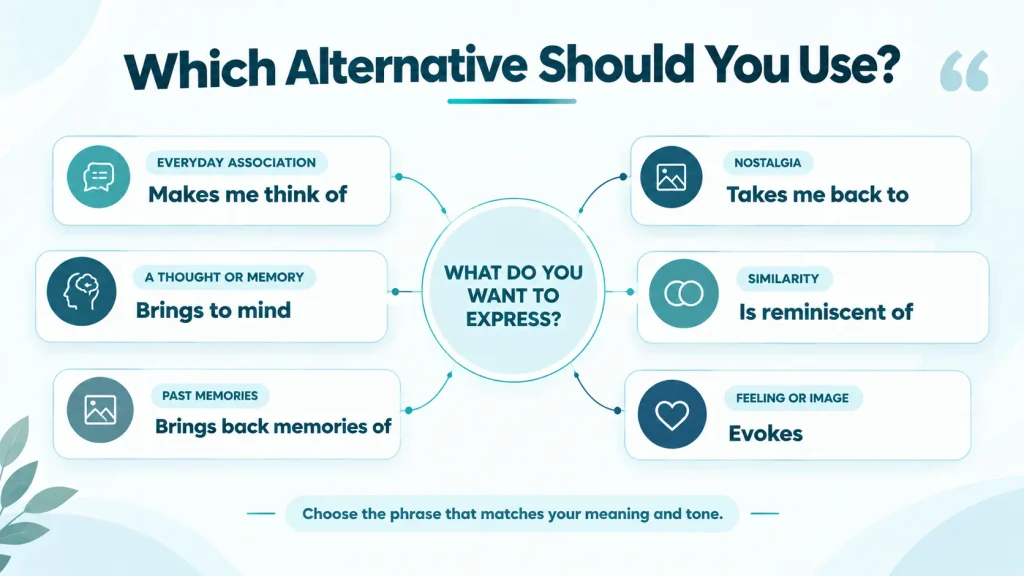
The right phrase depends on what you want to say. First, think about the type of connection you are describing.
For Everyday Conversations
If you are simply talking about something that makes you think of another person or thing, use:
- Makes me think of
- Brings to mind
- Reminds me of
For example:
“This coffee shop makes me think of New York.”
This sentence sounds natural and relaxed. You do not need a more formal expression.
For Memories
When you want to talk about something from the past, try:
- Brings back memories of
- Takes me back to
- Makes me think back to
- Brings back
For example:
“That old movie takes me back to my teenage years.”
In this case, the phrase clearly connects the movie with a past experience.
For Formal Writing
If you are writing an article, essay, review, or description, consider:
- Brings to mind
- Calls to mind
- Is reminiscent of
- Evokes
For example:
“The design is reminiscent of classic American architecture.”
This sounds more polished than:
“The design reminds me of classic American architecture.”
Both sentences are correct. However, the first one places more focus on the design itself.
“Reminds Me Of” vs. “Makes Me Think Of”
These two phrases are very close in meaning.
“Reminds me of” is the more direct expression:
“This song reminds me of my sister.”
On the other hand, “makes me think of” sounds slightly more conversational:
“This song makes me think of my sister.”
Both are natural. Therefore, you can usually choose either one in casual English.
“Reminds Me Of” vs. “Brings Back Memories Of”
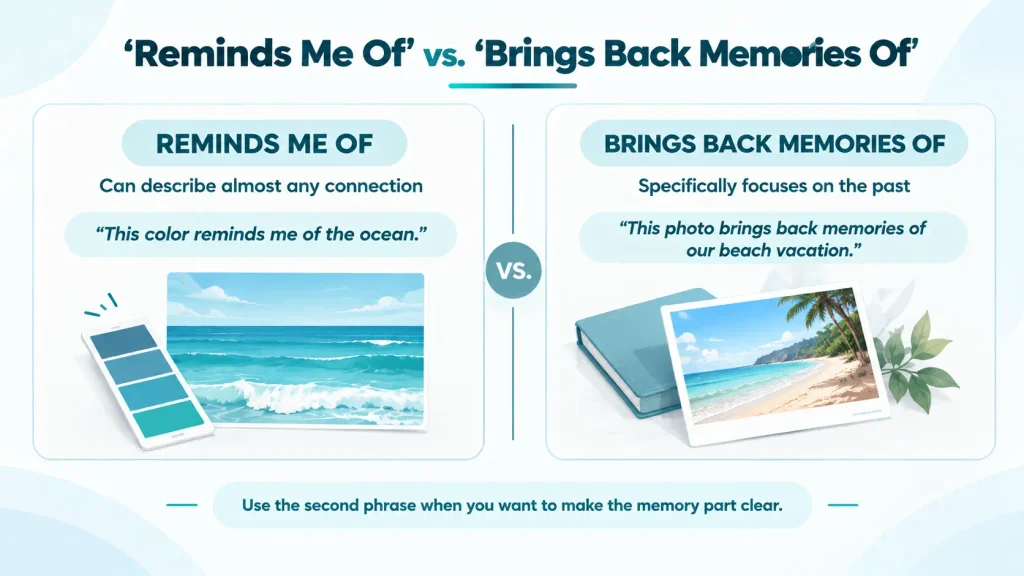
There is a small but important difference.
“Reminds me of” can describe almost any connection:
“This color reminds me of the ocean.”
In contrast, “brings back memories of” specifically focuses on the past:
“This photo brings back memories of our beach vacation.”
So, use the second phrase when you want to make the memory part clear.
“Reminds Me Of” vs. “Takes Me Back To”
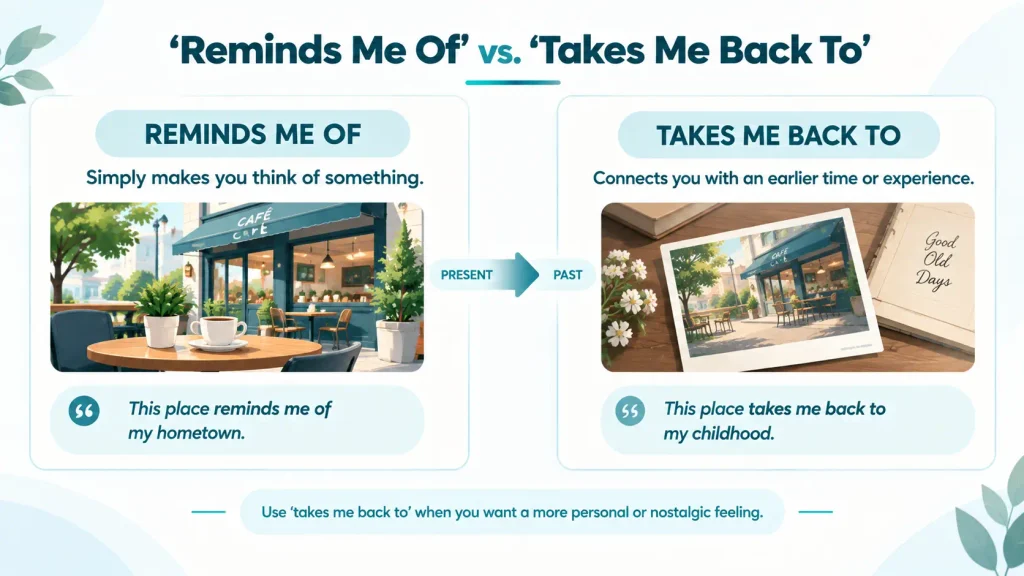
These expressions can both describe memories. Still, they create slightly different feelings.
“Reminds me of” simply makes you think of something:
“This place reminds me of my hometown.”
Meanwhile, “takes me back to” often creates a stronger feeling of nostalgia:
“This place takes me back to my childhood.”
As a result, “takes me back to” is a good choice when you want your sentence to feel more personal or emotional.
“Reminds Me Of” vs. “Is Reminiscent Of”
These phrases are not always interchangeable.
“Reminds me of” often describes a personal connection:
“This house reminds me of my childhood home.”
However, “is reminiscent of” usually points to similarities:
“This house is reminiscent of a traditional farmhouse.”
The second sentence does not say that the speaker personally remembers a farmhouse. Instead, it describes the house’s style.
“Reminds Me Of” vs. “Evokes”
“Evokes” can describe more than a simple memory.
For example:
“The photograph reminds me of my childhood.”
This sentence tells us what the photograph makes the speaker remember.
By comparison:
“The photograph evokes feelings of nostalgia.”
Here, the focus is on the emotion.
Therefore, “evokes” is useful when you want to describe a feeling, image, memory, or idea.
Common Mistakes to Avoid
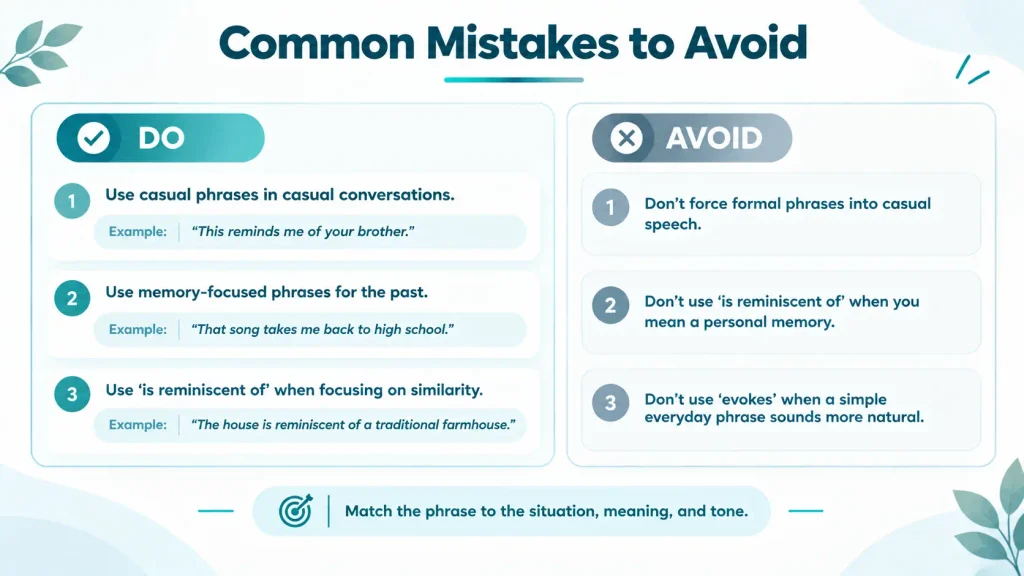
1. Using a Formal Phrase in a Casual Situation
Some alternatives sound more formal than others.
For example, “calls to mind” is correct, but it may sound unusual in a very casual conversation.
Instead of:
“Your new haircut calls to mind your brother.”
A natural speaker might say:
“Your new haircut reminds me of your brother.”
Choose the expression that matches the setting.
2. Using “Is Reminiscent Of” for a Personal Memory
“Is reminiscent of” usually focuses on similarity.
For example:
“The room is reminiscent of a classic hotel.”
If you mean that the room makes you personally remember a hotel, say:
“The room reminds me of that hotel.”
This small difference makes the sentence more precise.
3. Using “Takes Me Back” Without a Clear Past Connection
“Takes me back to” usually works best with a time, place, or experience.
For example:
“That song takes me back to high school.”
The phrase has a clear connection to the past. Without that connection, another alternative may work better.
4. Using “Evokes” in Every Sentence
“Evokes” is useful, but it can sound formal.
For example, saying:
“This pizza evokes my hometown.”
sounds unusual.
A more natural choice would be:
“This pizza reminds me of my hometown.”
Use “evokes” when you want to highlight a feeling, image, memory, or idea.
Examples in Different Situations
Here are some quick examples to help you choose the right phrase.
Talking about a person:
“This song makes me think of my sister.”
Talking about childhood:
“That smell takes me back to my childhood.”
Talking about a past vacation:
“These pictures bring back memories of our trip.”
Describing a similar style:
“The design is reminiscent of an old European café.”
Describing an emotion:
“The music evokes a sense of calm.”
Writing formally:
“The image brings to mind a simpler time.”
Each sentence communicates a similar basic idea. However, the emphasis changes depending on the phrase you choose.
Frequently Asked Questions
What is a casual way to say “reminds me of”?
“Makes me think of” is one of the most natural casual alternatives. “Brings back” also works well when you are talking about memories.
What is a formal way to say “reminds me of”?
You can use “brings to mind,” “calls to mind,” “is reminiscent of,” or “evokes.” Choose the phrase based on the meaning you want to express.
What is another way to say “this reminds me of you”?
You can say:
“This makes me think of you.”
You could also say:
“This brings you to mind.”
The first option sounds more conversational, while the second has a more polished tone.
What is another way to say “it reminds me of my childhood”?
Good options include “it takes me back to my childhood,” “it brings back memories of my childhood,” and “it makes me think back to my childhood.”
Is “reminds me of” grammatically correct?
Yes. “Reminds me of” is a standard English expression. The structure commonly uses remind + person + of + something.
For example:
“This place reminds me of home.”
Is “reminiscent of” the same as “reminds me of”?
Not always. “Reminiscent of” usually describes similarity in style, appearance, feeling, or character. “Reminds me of” can describe a personal memory or association.
Which phrase is best for nostalgia?
“Takes me back to” and “brings back memories of” are strong choices for nostalgic situations. Both clearly connect something in the present with an experience from the past.
Can I use these alternatives in professional writing?
Yes. However, the best choice depends on the sentence. “Brings to mind” and “is reminiscent of” can work well in formal writing, while “makes me think of” is usually more conversational.
Final Thoughts
There is no single replacement for “reminds me of” that works in every situation. Instead, choose your phrase based on the connection you want to show.
For everyday English, “makes me think of” is a safe and natural choice. If you are talking about memories, “brings back memories of” or “takes me back to” may fit better. Meanwhile, “is reminiscent of” works well for similarity, and “evokes” is useful when you want to describe a feeling, image, or memory.
The key is simple: choose the phrase that matches your meaning and tone.

Role: Author & Editorial Specialist
Sophia Williams serves as an Author at Elite’s Collective, bringing strong communication skills and fresh perspectives to the team through high-quality written content.