

If you need another way to say “way of thinking,” the best choice depends on what you mean. Common alternatives include mindset, perspective, outlook, mentality, point of view, frame of mind, attitude, approach, philosophy, and thought process. These expressions are related, but they are not always interchangeable.
Key Takeaways
- Mindset is one of the closest and most natural alternatives to “way of thinking.”
- Perspective focuses on how someone views or interprets a situation.
- Outlook describes a person’s general view of life, the future, or a particular situation.
- Mentality can describe a characteristic pattern of thought, but it may sound more critical in some contexts.
- Point of view is useful when discussing someone’s opinion or position.
- Thought process focuses more on how someone reaches a conclusion.
- Approach works well when someone’s thinking is connected to how they handle a problem or task.
What Does “Way of Thinking” Mean?
“Way of thinking” generally refers to how a person thinks about, understands, interprets, or approaches something.
For example:
Her way of thinking has changed since she started working in a new environment.
Depending on the context, you could replace “way of thinking” with mindset, perspective, outlook, mentality, or another related expression.
The important difference is that some alternatives describe a person’s overall mental attitude, while others focus on a particular opinion, interpretation, or reasoning process.
Best Alternatives to “Way of Thinking”
1. Mindset
Mindset is often the closest natural alternative to “way of thinking.” It refers to a person’s established way of thinking, especially their attitudes and beliefs about a situation.
Example:
Moving to a new city gave him a completely different mindset.
Best for: Everyday English, personal development, education, work, and general writing.
Usage tip: “Mindset” often suggests a pattern of thinking that influences how someone behaves or responds.
2. Perspective
Perspective refers to the particular way someone views or interprets something.
Example:
Talking to people from different backgrounds can change your perspective.
Best for: Opinions, experiences, disagreements, discussions, and formal or neutral writing.
Usage tip: Use “perspective” when you want to emphasize how someone sees a situation rather than their overall mental habits.
3. Outlook
Outlook describes someone’s general attitude or view toward life, the future, or a particular situation.
Example:
Despite the setback, she maintained a positive outlook.
Best for: Attitudes toward the future, life, challenges, and general circumstances.
Usage tip: “Outlook” often works naturally with adjectives such as positive, negative, optimistic, or pessimistic.
4. Mentality
Mentality refers to a particular way of thinking or a characteristic set of attitudes and beliefs.
Example:
The team needs to develop a problem-solving mentality.
Best for: Describing a group’s or individual’s characteristic thinking patterns.
Usage tip: “Mentality” can sometimes carry a critical or negative tone depending on the sentence.
For example:
That defeatist mentality is holding the team back.
Here, “mentality” describes a recurring attitude rather than simply a neutral perspective.
5. Point of View
Point of view refers to someone’s particular position, opinion, or way of seeing a situation.
Example:
From my point of view, the decision was reasonable.
Best for: Opinions, discussions, arguments, personal perspectives, and writing.
Usage tip: “Point of view” is particularly useful when two people have different opinions about the same subject.
6. Frame of Mind
Frame of mind describes someone’s mental or emotional state at a particular time.
Example:
I wasn’t in the right frame of mind to make an important decision.
Best for: Temporary mental or emotional states.
Usage tip: This isn’t always a direct replacement for “way of thinking.” It is better when you are describing someone’s state of mind at a particular moment.
7. Attitude
Attitude refers to the way someone thinks or feels about a person, situation, activity, or subject.
Example:
Her positive attitude helped the team stay motivated.
Best for: Behavior, feelings, reactions, work, school, and interpersonal situations.
Usage tip: “Attitude” emphasizes someone’s feelings or behavior toward something more than their reasoning process.
8. Thought Process
Thought process describes the way someone thinks through a problem, idea, or decision.
Example:
I’d like to understand your thought process before we make a final decision.
Best for: Problem-solving, decision-making, explanations, psychology, education, and professional discussions.
Usage tip: This is more specific than “way of thinking.” It focuses on how someone arrives at an idea or conclusion.
9. Approach
Approach can describe the way someone thinks about or deals with a particular problem, task, or situation.
Example:
We need a different approach to solving this problem.
Best for: Work, education, problem-solving, planning, and practical situations.
Usage tip: “Approach” is especially useful when a person’s thinking leads directly to a method of handling something.
10. Philosophy
Philosophy can describe a set of beliefs or principles that guide how someone thinks and acts.
Example:
Her philosophy is to focus on progress rather than perfection.
Best for: Personal beliefs, life principles, leadership, business, education, and broader ideas.
Usage tip: “Philosophy” is usually broader and more deliberate than “way of thinking.” It suggests underlying principles rather than simply a person’s current perspective.
Quick Comparison
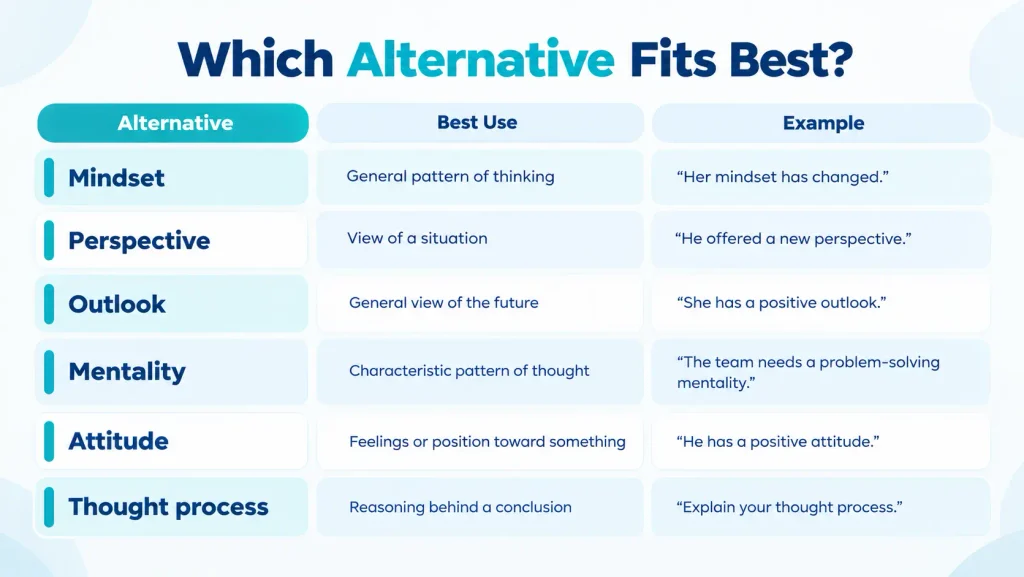
| Alternative | Main Meaning | Tone | Best Context |
|---|---|---|---|
| Mindset | Established pattern of thinking | Neutral | Personal, professional, educational |
| Perspective | How someone views something | Neutral | Opinions and situations |
| Outlook | General view or attitude | Neutral | Life and the future |
| Mentality | Characteristic pattern of thought | Neutral to critical | Groups, attitudes, behavior |
| Point of view | Personal position or opinion | Neutral | Discussions and opinions |
| Frame of mind | Current mental or emotional state | Neutral | Temporary situations |
| Attitude | Feelings or position toward something | Neutral | Behavior and reactions |
| Thought process | How someone reasons | Neutral | Decisions and problem-solving |
| Approach | Way of dealing with something | Neutral | Tasks and problems |
| Philosophy | Guiding beliefs or principles | Formal | Life, leadership, business |
Which Alternative Should You Use?
The right replacement depends on the sentence.
For a general way of thinking
Use mindset.
His mindset has changed considerably over the past few years.
For someone’s view of a situation
Use perspective.
The experience gave her a new perspective on success.
For someone’s general attitude toward life
Use outlook.
His optimistic outlook helped him deal with the uncertainty.
For someone’s reasoning
Use thought process.
Can you explain your thought process?
For someone’s opinion
Use point of view.
I understand your point of view, even though I disagree.
For solving a problem
Use approach.
We need to consider a different approach.
For guiding beliefs
Use philosophy.
The company’s philosophy emphasizes long-term growth.
“Mindset” vs. “Perspective”
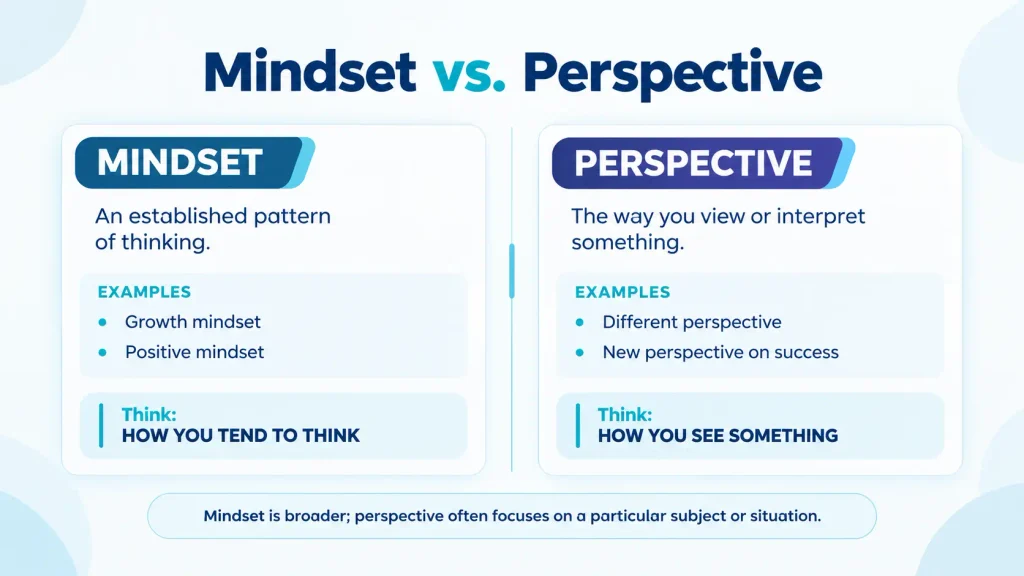
These two are especially easy to confuse.
A mindset is generally a person’s established pattern of thinking. A perspective is the way that person views a particular subject or situation.
Compare:
She has a growth mindset.
This describes a broader pattern of thinking.
She has a different perspective on failure.
This describes how she views a specific idea.
In simple terms, mindset is how you tend to think, while perspective is how you see something.
“Way of Thinking” vs. “Thought Process”
These phrases are related but have different uses.
A way of thinking can refer to a general pattern of thought:
His way of thinking is very analytical.
A thought process usually refers to the reasoning behind a particular decision or conclusion:
Explain your thought process when you chose that solution.
So, use way of thinking or mindset for broader patterns and thought process when discussing reasoning.
“Outlook” vs. “Attitude”
“Outlook” and “attitude” can overlap, but they emphasize different things.
An outlook often describes how someone views life, the future, or their circumstances:
She has a positive outlook on the future.
An attitude more often describes how someone feels or behaves toward a particular person, task, or situation:
He has a positive attitude toward his coworkers.
The distinction is subtle, but choosing the more specific word can make your writing clearer.
Common Mistakes When Replacing “Way of Thinking”
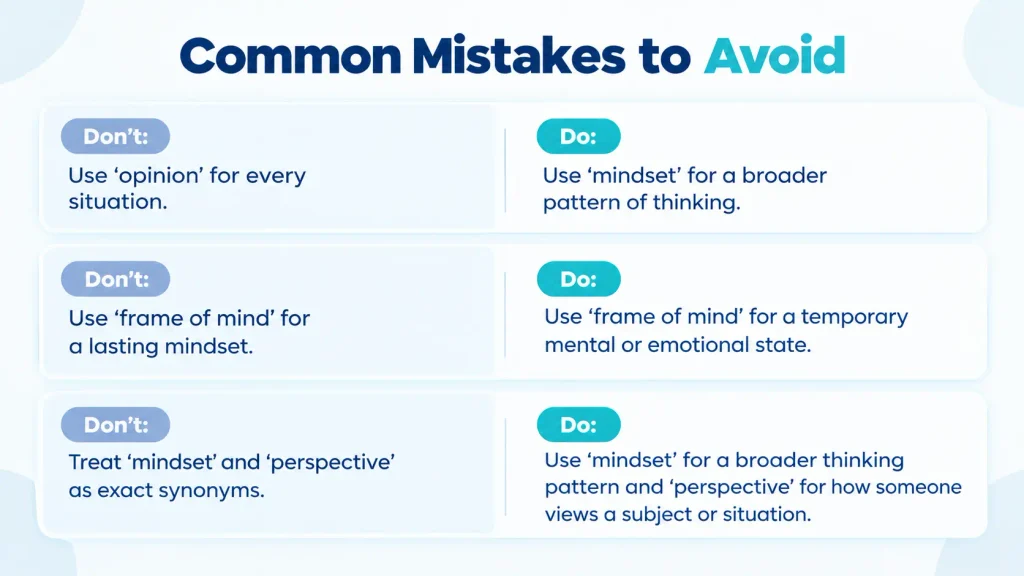
Using “opinion” for every situation
An opinion is a belief or judgment about something. It does not always describe someone’s broader way of thinking.
Instead of:
His opinion has changed completely over the years.
If you mean his broader pattern of thinking, you might say:
His mindset has changed completely over the years.
Using “frame of mind” for a permanent mindset
“Frame of mind” often describes a temporary mental or emotional condition.
She wasn’t in the right frame of mind to talk.
For a lasting pattern of thought, mindset is usually more appropriate.
Treating “perspective” and “mindset” as exact synonyms
They overlap, but they are not identical.
His perspective on education changed.
focuses on his view of education.
His mindset changed.
suggests a broader change in his pattern of thinking.
Using “mentality” when a neutral word is needed
“Mindset” or “perspective” may sound more natural when you simply want to describe someone’s thinking without implying criticism.
For example:
She has a practical mindset.
is generally neutral.
“Practical mentality” is possible, but it can sound less natural depending on the sentence.
Formal Alternatives to “Way of Thinking”
If you’re writing an academic or professional piece, consider:
- Perspective
- Approach
- Thought process
- Philosophy
- Point of view
- Reasoning
- Conceptual framework
The best choice depends on what you are describing. For example, reasoning focuses on logic, while philosophy refers to broader principles or beliefs.
Casual Alternatives to “Way of Thinking”
In everyday conversation, these can sound natural:
- Mindset
- Perspective
- Point of view
- Outlook
- Attitude
- The way someone sees things
For example:
I really like the way you see things.
This is a natural conversational alternative when you want to compliment someone’s perspective.
Frequently Asked Questions
What is the closest synonym for “way of thinking”?
Mindset is often the closest general alternative. However, perspective, outlook, mentality, and thought process may be more accurate depending on the intended meaning.
What is a professional way to say “way of thinking”?
In professional writing, mindset, perspective, approach, thought process, or philosophy can work well. Choose the word based on whether you mean a general pattern of thought, a viewpoint, a method, reasoning, or guiding principles.
Is “mindset” the same as “way of thinking”?
They are very similar, but “mindset” often suggests an established pattern of thinking, beliefs, or attitudes. “Way of thinking” is broader and can describe many different aspects of how someone thinks.
What is another way to say “different way of thinking”?
You could say different perspective, different mindset, different point of view, alternative approach, or new way of looking at things. The best choice depends on whether you mean a different opinion, attitude, or method.
What is another word for someone’s way of thinking?
Common choices include mindset, perspective, outlook, mentality, attitude, point of view, and thought process.
What is a positive way to describe someone’s way of thinking?
Depending on the meaning, you could use open-mindedness, positive mindset, thoughtful perspective, analytical approach, creative thinking, or growth mindset.
What is another way to say “I like your way of thinking”?
Natural alternatives include:
- “I like your perspective.”
- “I like how you think.”
- “I like your approach.”
- “I like the way you see things.”
- “I appreciate your point of view.”
“I like how you think” is especially natural in casual conversation.
Final Takeaway
There is no single replacement for “way of thinking” that works in every sentence. Mindset is the most versatile choice for a general pattern of thought, while perspective works well for someone’s view of a situation. Outlook focuses on a general attitude toward life or the future, thought process describes reasoning, and approach is useful when thinking is connected to solving a problem.
Choosing the word that matches the exact meaning will make your writing sound more natural and precise than simply replacing the phrase with a random synonym.

Role: Author & Editorial Specialist
Sophia Williams serves as an Author at Elite’s Collective, bringing strong communication skills and fresh perspectives to the team through high-quality written content.