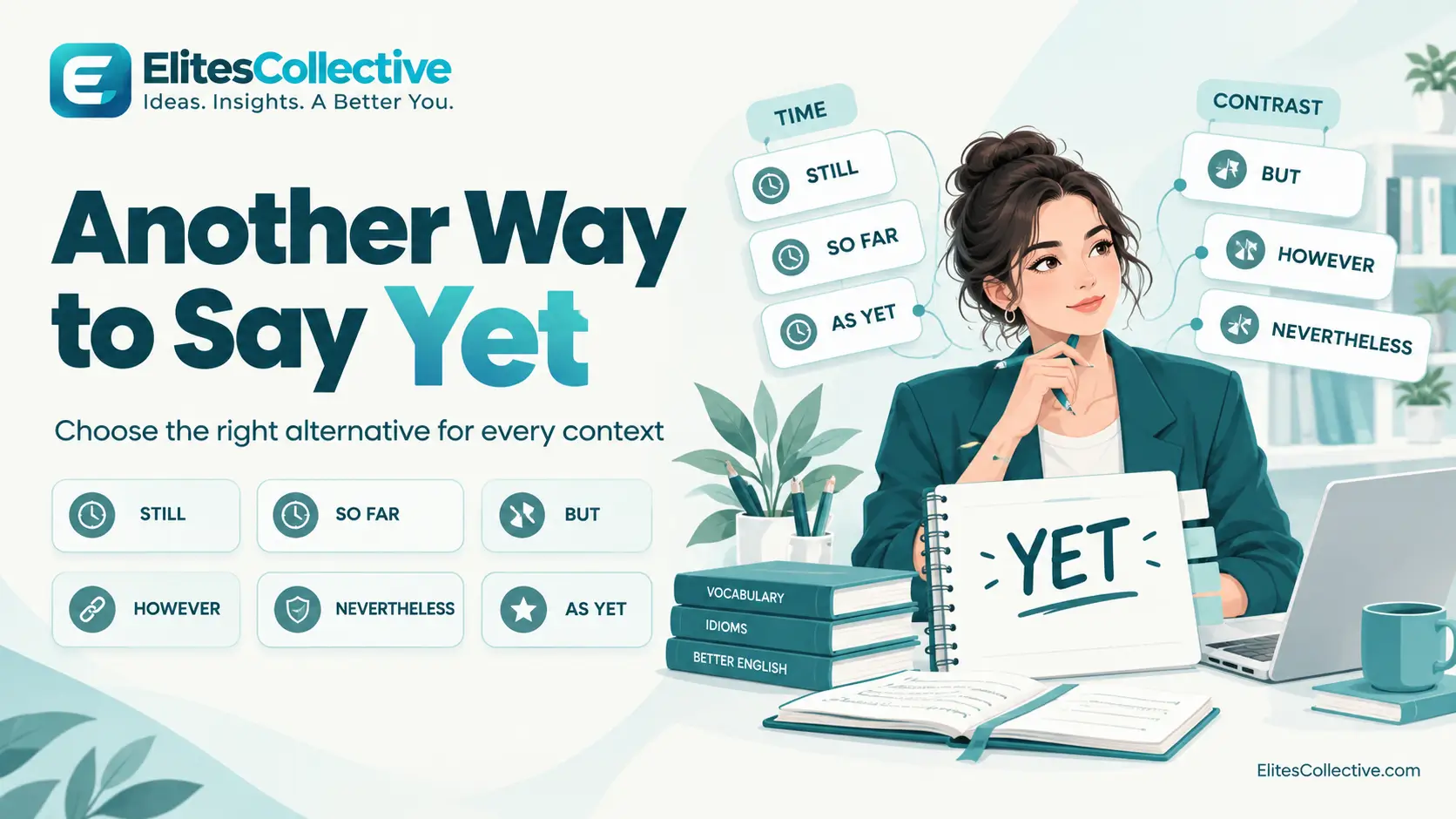
If you’re looking for another way to say “yet,” the best replacement depends on how “yet” is being used. For time, natural alternatives include so far, until now, up to now, as yet, and still. For contrast, you can often use but, however, nevertheless, nonetheless, or even so. These expressions are not interchangeable in every sentence, so context matters.
Key Takeaways
- So far works well when talking about progress or something that has not happened up to the present.
- Still emphasizes that a situation continues or has not changed.
- Until now and up to now focus on the period leading to the present.
- As yet is a more formal expression, usually used in negative statements.
- But is the most common everyday alternative when “yet” introduces a contrast.
- However, nevertheless, and nonetheless are useful for more formal contrast.
- The word “yet” has several meanings, so there is no single replacement that works in every sentence.
What Does “Yet” Mean?
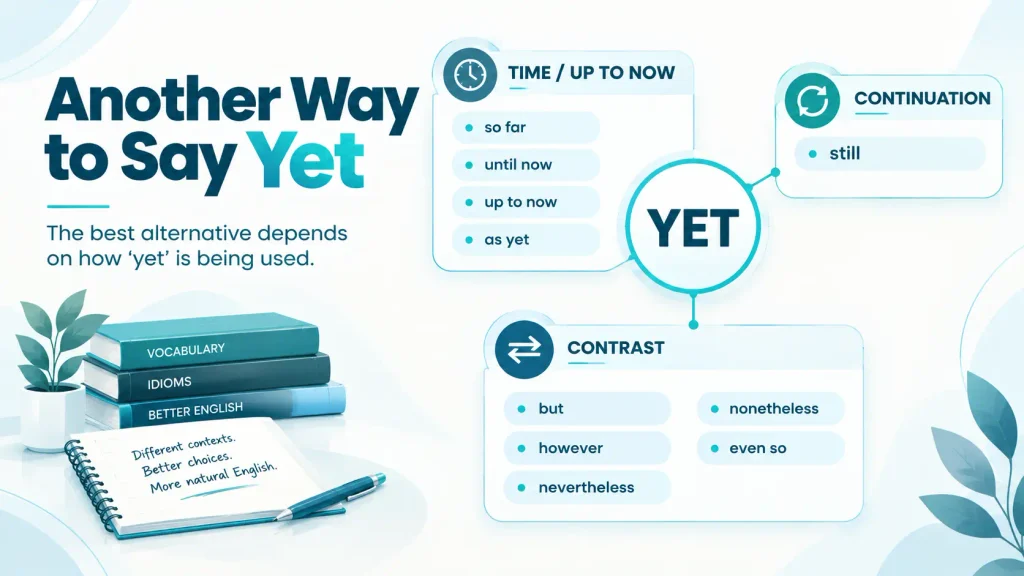
“Yet” has several common uses in American English. It can refer to something that has not happened up to a particular time, as in:
I haven’t finished the report yet.
It can also introduce a contrast, similar to “but” or “nevertheless”:
The task was difficult, yet she completed it on time.
“Yet” can also add emphasis to words such as “another” and “again,” as in “yet another problem” or “yet again.”
Because the meaning changes with the sentence, the right alternative depends on which use you have in mind.
10 Alternatives to “Yet”
1. So Far
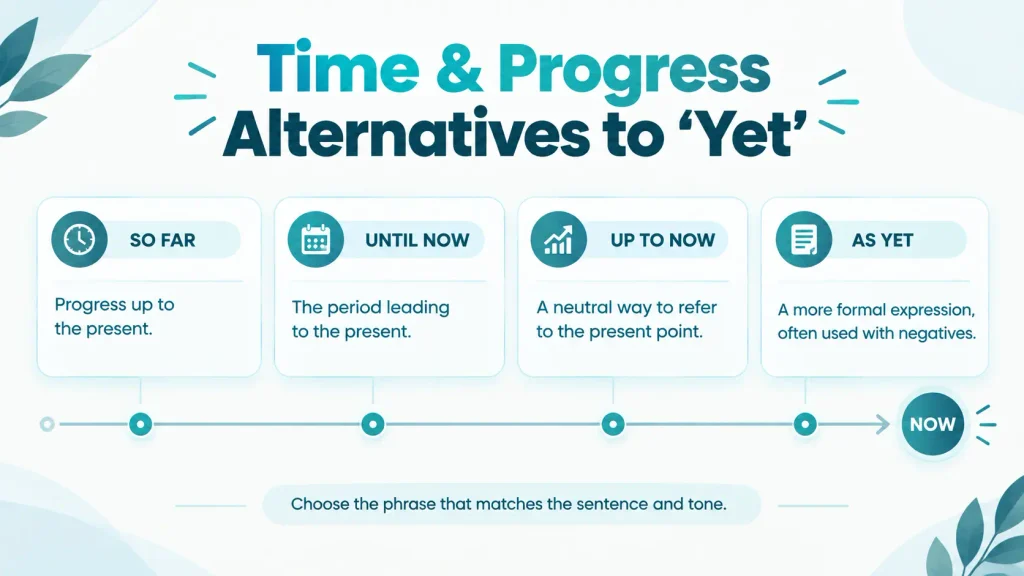
Best for: Talking about progress or something that has not happened up to the present.
“So far” is one of the most natural alternatives when “yet” refers to what has or has not happened until now.
Example:
- I haven’t received a response yet.
- I haven’t received a response so far.
The second sentence can work when you are describing the results or progress up to the present. However, “yet” is often more natural in a simple negative sentence.
Tip: “So far” commonly focuses on the progress or results achieved up to this point.
2. Still
Best for: Emphasizing that a situation continues.
“Still” can replace “yet” in some negative sentences, but it changes the emphasis. It often suggests that the speaker is surprised, concerned, or emphasizing that something remains unchanged.
Example:
She hasn’t finished the project yet.
can become:
She still hasn’t finished the project.
The second version places more emphasis on the fact that the project remains unfinished.
“Still” and “yet” therefore aren’t exact synonyms in every context. English-learning references distinguish their uses, particularly when expressing continuation versus an expected event that has not happened.
3. Until Now
Best for: Formal or neutral writing that focuses on the period before the present.
“Until now” emphasizes that something was true or had not happened before the current point.
Example:
Until now, we haven’t had any major problems.
It can work well in reports, explanations, and professional writing.
Tip: “Until now” often sounds more deliberate than the conversational “yet.”
4. Up to Now
Best for: Neutral explanations and discussions of progress.
“Up to now” has a similar meaning to “until now.”
Example:
Up to now, we haven’t received any complaints.
It emphasizes the period from an earlier point through the present.
In some sentences, “so far” sounds more concise:
So far, everything is going smoothly.
5. As Yet
Best for: Formal writing, especially negative statements.
“As yet” means essentially “up to this point,” but it has a more formal tone.
Example:
No decision has been made as yet.
This is appropriate in formal reports, official statements, and some academic or professional contexts.
Cambridge notes that “as yet” is used in negative contexts to describe something that has not happened up to now, with the expectation that the situation may change.
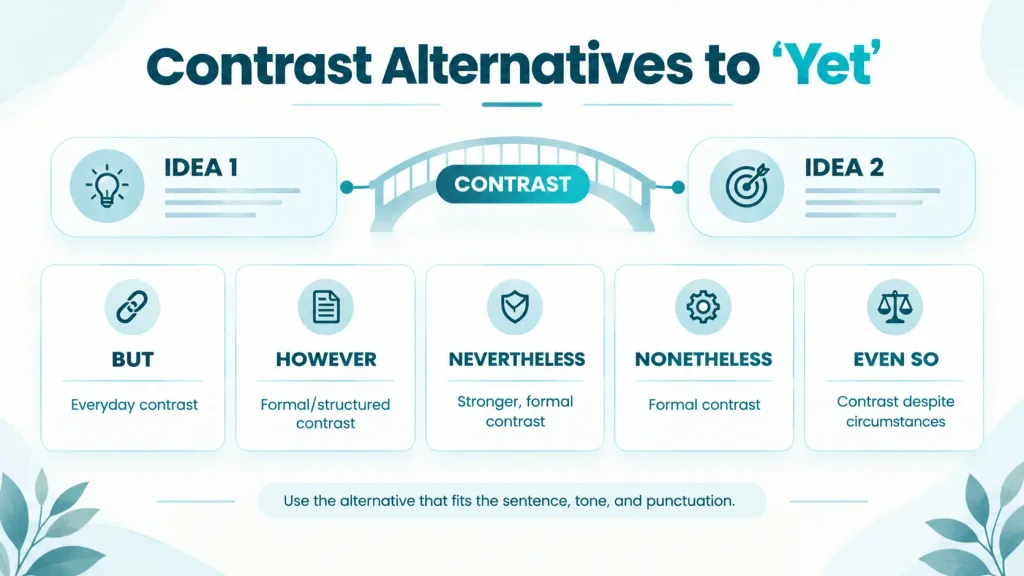
6. But
Best for: Everyday contrast.
When “yet” means something like “but” or “despite that,” but is usually the simplest replacement.
Example:
The apartment is small, yet it feels comfortable.
You could say:
The apartment is small, but it feels comfortable.
“But” is more common in everyday conversation, while “yet” can make the contrast feel more deliberate or striking.
7. However
Best for: Formal or structured contrast.
“However” can replace “yet” when the purpose is to contrast two ideas.
Example:
The product is expensive. However, many customers consider it worthwhile.
Notice that the sentence structure changes. “Yet” can directly connect contrasting clauses:
The product is expensive, yet many customers consider it worthwhile.
“However” is often used as a transitional adverb rather than simply replacing “yet” word-for-word.
8. Nevertheless
Best for: Stronger or more formal contrast.
“Nevertheless” means that something remains true despite what was just mentioned.
Example:
The weather was unpleasant. Nevertheless, the event continued as planned.
It can sometimes replace “yet” when the contrast is important:
The weather was unpleasant, yet the event continued as planned.
“Nevertheless” generally sounds more formal and emphatic than everyday “but.”
Oxford identifies “nevertheless” as a synonym for the conjunction “yet” when it means “despite what has just been said.”
9. Nonetheless
Best for: Formal or polished contrast.
“Nonetheless” has a meaning very close to “nevertheless.”
Example:
The instructions were complicated. Nonetheless, we were able to complete the task.
It can be useful in professional, academic, and formal writing.
Like “nevertheless,” it should not be treated as a universal substitute for “yet.” It works when “yet” is being used to introduce a contrasting idea.
10. Even So
Best for: Emphasizing that the second point remains true despite the first.
“Even so” is a useful conversational and written expression of contrast.
Example:
The repair will be expensive. Even so, it may be worth doing.
This is close in meaning to:
The repair will be expensive, yet it may be worth doing.
“Even so” highlights the idea that the second statement remains true despite the situation described first.
Quick Comparison: Another Way to Say “Yet”
| Alternative | Main Use | Tone | Example |
|---|---|---|---|
| So far | Progress up to now | Neutral | So far, we haven’t found an answer. |
| Still | Continued situation | Neutral | She still hasn’t replied. |
| Until now | Time leading to the present | Neutral/Formal | Until now, no decision had been made. |
| Up to now | Situation up to the present | Neutral | Up to now, everything has worked well. |
| As yet | Something not done by now | Formal | No decision has been announced as yet. |
| But | Basic contrast | Casual/Neutral | It is difficult, but possible. |
| However | Contrast between ideas | Formal/Neutral | However, the results were positive. |
| Nevertheless | Strong contrast | Formal | Nevertheless, they continued. |
| Nonetheless | Strong contrast | Formal | Nonetheless, the plan succeeded. |
| Even so | Contrast despite circumstances | Neutral | Even so, I would try again. |
How to Choose the Right Alternative
The easiest way to choose an alternative is to identify what “yet” means in your sentence.
When “yet” means “up to now”
Use expressions such as:
- so far
- until now
- up to now
- as yet
For example:
We haven’t received the documents yet.
Possible alternatives include:
We haven’t received the documents so far.
or:
As yet, we haven’t received the documents.
The tone and sentence structure change slightly, so “yet” may still be the most natural choice.
When “yet” means “still”
Consider still when you want to emphasize that something continues or remains unfinished.
He hasn’t arrived yet.
He still hasn’t arrived.
The second sentence can sound more emphatic because it highlights the continuing delay.
When “yet” means “but”
Use but for simple, natural contrast:
The restaurant is expensive, yet the food is excellent.
The restaurant is expensive, but the food is excellent.
For more formal writing, consider however, nevertheless, or nonetheless, depending on the sentence structure.
“Yet” vs. “Still”
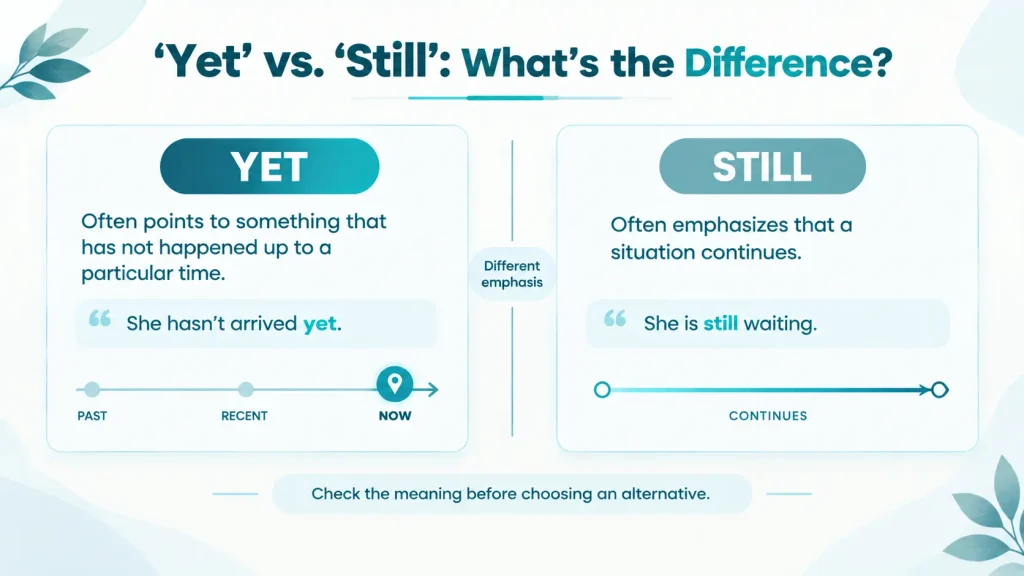
These two words are sometimes confused because they can both appear in negative sentences.
Compare:
I haven’t finished the book yet.
This usually means the book is unfinished at this point, with an expectation that it may be finished later.
Now compare:
I still haven’t finished the book.
This emphasizes that the unfinished situation continues, potentially with a sense of surprise or frustration.
Both are correct, but the emphasis is different.
“Yet” vs. “However”
“Yet” and “however” can both introduce contrast, but they are not always grammatically interchangeable.
The plan was risky, yet we approved it.
A natural alternative is:
The plan was risky. However, we approved it.
The punctuation and sentence structure change because “however” commonly functions as a transitional adverb.
For a straightforward conversational contrast, but is often simpler:
The plan was risky, but we approved it.
“Yet” vs. “Nevertheless”
These expressions are especially close when “yet” means “despite that.”
She was exhausted, yet she kept working.
She was exhausted. Nevertheless, she kept working.
“Nevertheless” makes the contrast sound more formal and somewhat more emphatic. Oxford lists “nevertheless” as a synonym for this conjunction use of “yet.”
Common Mistakes When Replacing “Yet”
Treating every alternative as an exact synonym
“So far,” “still,” “however,” and “but” have overlapping uses, but they do not all mean exactly the same thing.
Choose the replacement based on the meaning of the original sentence.
Using “however” exactly like “yet”
This can create punctuation problems.
Less natural:
I was tired, however I continued working.
Better:
I was tired; however, I continued working.
Or simply:
I was tired, yet I continued working.
Using formal alternatives in casual conversation
Words such as “nevertheless” and “as yet” are grammatically correct, but they can sound unnecessarily formal in ordinary conversation.
For everyday speech, but, still, or so far will often sound more natural.
Forgetting that “yet” has more than one meaning
Compare:
Have you finished yet?
with:
The task was difficult, yet she finished it.
The first “yet” refers to time. The second introduces contrast. A replacement that works for one sentence may not work for the other.
Frequently Asked Questions
What is another word for “yet”?
The best alternative depends on the meaning. Still, so far, until now, up to now, and as yet can work when “yet” refers to time. But, however, nevertheless, nonetheless, and even so can work when “yet” expresses contrast.
What is a formal way to say “yet”?
For the time-related meaning, as yet or until now can work in formal writing. For contrast, nevertheless and nonetheless are common formal alternatives.
Can I use “still” instead of “yet”?
Sometimes. “Still” emphasizes that a situation continues, while “yet” often indicates that something has not happened up to a particular point. Compare “I haven’t finished yet” with “I still haven’t finished.” The second emphasizes continuation.
Can “but” replace “yet”?
Yes, when “yet” is being used to introduce a contrast.
The instructions were long, yet they were easy to follow.
can become:
The instructions were long, but they were easy to follow.
“But” is generally more common in everyday English.
Is “nevertheless” the same as “yet”?
They can have a very similar meaning when “yet” introduces a contrast. However, “nevertheless” is generally more formal, and the sentence structure may need to change.
What is another way to say “not yet”?
Depending on the sentence, you could use still not, not so far, or a longer expression such as has not happened up to now. In ordinary American English, however, “not yet” is often the clearest and most natural choice.
What is another way to say “yet to”?
The construction “yet to” can often be rewritten using “still needs to,” “has not yet,” or “has not been”, depending on the sentence.
For example:
The company is yet to announce the results.
can become:
The company has not yet announced the results.
This second version is often clearer for general readers.
Final Thoughts
There isn’t one perfect replacement for “yet.” The word can express an unfinished or expected event, continuation, contrast, or emphasis, so the best alternative depends on its role in the sentence. For time-related uses, try so far, still, until now, up to now, or as yet. For contrast, consider but, however, nevertheless, nonetheless, or even so.
When in doubt, keep “yet” itself. It is a common, natural word in American English, and changing it simply to avoid repetition can sometimes make a sentence less natural rather than better.

Role: Author & Editorial Specialist
Sophia Williams serves as an Author at Elite’s Collective, bringing strong communication skills and fresh perspectives to the team through high-quality written content.