

The best alternatives to caused include led to, resulted in, brought about, triggered, created, produced, and prompted. The right choice depends on what happened and how directly one event produced another. Some alternatives work well in professional writing, while others are better for describing sudden reactions, changes, or problems.
Key Takeaways
- Led to works well when describing the result of an action or event.
- Resulted in is a clear, formal alternative for reports and academic writing.
- Triggered suggests that something started a sudden reaction or event.
- Brought about emphasizes creating a change or new situation.
- Prompted is useful when an event causes someone to act or respond.
- Contributed to means helping produce a result, not necessarily causing it alone.
What Does Caused Mean?
The word caused means that someone or something made an event, action, condition, or result happen. It is the past tense of cause and often describes a relationship between an action and its outcome.
For example:
- The heavy rain caused flooding in the neighborhood.
- Her thoughtful message caused him to smile.
- The software update caused several technical problems.
In each sentence, something produces an effect. However, the best replacement depends on the situation. Triggered may describe a sudden reaction, while brought about often emphasizes a broader change.
15 Other Ways to Say Caused
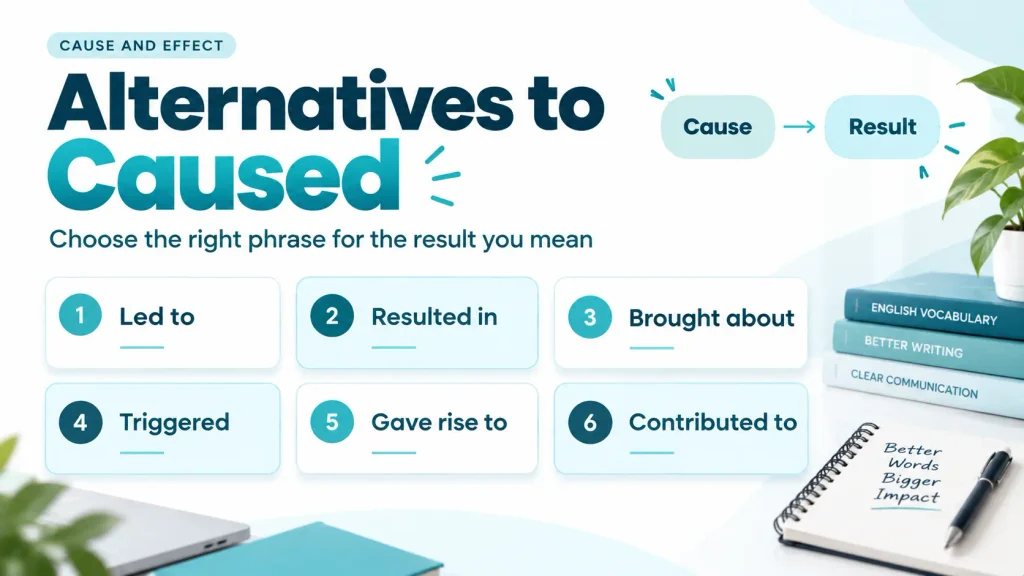
Here are 15 useful alternatives, along with their meanings and examples.
1. Led To
Meaning: Produced a particular result or outcome.
Best for: Everyday writing, professional communication, and explanations of cause and effect.
Led to is one of the most versatile alternatives to caused. It works especially well when explaining how one action, decision, or event resulted in another.
Example: Poor communication led to several delays in the project.
You can also use this phrase when describing positive outcomes.
Example: Her consistent effort led to significant improvements in her performance.
2. Resulted In
Meaning: Produced a specific outcome or consequence.
Best for: Academic papers, business reports, and formal writing.
Resulted in sounds professional and focuses on the outcome rather than the action that produced it.
Example: The unexpected power outage resulted in a temporary shutdown of the factory.
Use resulted in when you want to explain an outcome clearly without adding emotional emphasis.
3. Brought About
Meaning: Made a change, development, or situation happen.
Best for: Formal writing, historical explanations, and discussions of major changes.
This phrase often describes a meaningful change rather than a small or immediate effect.
Example: The new policy brought about major improvements in workplace safety.
Unlike triggered, which often suggests an immediate reaction, brought about can describe a gradual or lasting transformation.
4. Triggered
Meaning: Started or set off a reaction, event, or process.
Best for: Technical writing, health-related discussions, emotional responses, and sudden events.
Triggered suggests that something activated or initiated a response. It is especially useful when the result follows a particular event or stimulus.
Example: The sudden drop in temperature triggered the alarm system.
It can also describe emotional reactions.
Example: The comment triggered an uncomfortable conversation.
Remember that triggered does not always mean that something created the entire situation. It may simply have started the process.
5. Produced
Meaning: Generated or brought forth a particular result, effect, or outcome.
Best for: Business, science, research, and general explanations.
Produced is a useful alternative when the cause generates something observable, measurable, or identifiable.
Example: The new marketing strategy produced better results than the previous campaign.
It also works when describing physical effects.
Example: The chemical reaction produced a small amount of heat.
6. Created
Meaning: Made something exist or established a new condition.
Best for: Everyday English, business communication, and descriptions of opportunities or problems.
Created emphasizes the existence of something new, whether it is a problem, opportunity, situation, or effect.
Example: The sudden increase in orders created a challenge for the delivery team.
Another example:
The partnership created new opportunities for both companies.
Use created when the emphasis is on what came into existence rather than the process that produced it.
7. Prompted
Meaning: Led someone to take an action or respond in a particular way.
Best for: Professional writing, news reports, and descriptions of decisions.
Prompted is especially useful when a situation encourages or causes a response.
Example: Customer feedback prompted the company to redesign its website.
The phrase can describe a strong reason for action without necessarily suggesting that the response was unavoidable.
8. Sparked
Meaning: Started a reaction, discussion, interest, or conflict.
Best for: News writing, conversational English, and descriptions of sudden developments.
Sparked often suggests that something started quickly or generated interest, debate, or emotion.
Example: The announcement sparked a lively discussion among employees.
It is also common when describing disagreements.
Example: The controversial decision sparked an argument between the two groups.
Compared with resulted in, sparked puts more emphasis on the beginning of a reaction.
9. Generated
Meaning: Produced or created a result, response, or resource.
Best for: Business, marketing, technology, and data-related writing.
Generated is useful when discussing measurable results, such as revenue, traffic, interest, or ideas.
Example: The advertising campaign generated thousands of website visits.
Another example:
The workshop generated several practical solutions to the problem.
Choose this alternative when the outcome involves something being produced or developed.
10. Gave Rise To
Meaning: Led to the development or occurrence of something.
Best for: Formal, academic, and analytical writing.
This expression is similar to led to, but it often sounds more formal and emphasizes the emergence of a new situation, issue, or development.
Example: The rapid growth of the city gave rise to new housing challenges.
It can also describe ideas or concerns.
Example: The findings gave rise to several questions about the original research.
11. Induced
Meaning: Brought about a particular condition, effect, or response.
Best for: Scientific, medical, technical, and formal contexts.
Induced is more specialized than caused. It is often used when discussing effects produced by a specific action, treatment, substance, or process.
Example: The medication induced a temporary change in blood pressure.
Use this word when it fits the terminology of the subject. In ordinary conversation, caused or led to will often sound more natural.
12. Was Responsible For
Meaning: Was the source of an outcome or played the main causal role.
Best for: Workplace writing, investigations, and discussions of accountability.
This expression can identify the person, action, or factor linked to a result. Depending on the context, it may also imply responsibility or blame.
Example: A faulty sensor was responsible for the repeated system alerts.
Be careful when assigning responsibility. If the evidence only shows that something played a part, contributed to may be more accurate.
13. Contributed To
Meaning: Helped produce or influence a particular result.
Best for: Research, reports, explanations involving multiple factors, and professional communication.
Contributed to is not an exact synonym for caused. It suggests that something was one factor among several, rather than necessarily being the sole cause.
Example: Poor planning contributed to the project’s delay.
This distinction matters when several conditions combine to produce an outcome.
14. Brought On
Meaning: Caused a condition, experience, or problem to begin.
Best for: Conversational English and descriptions of symptoms, difficulties, or sudden changes.
Brought on is a natural phrase for describing the onset of an unpleasant condition or experience.
Example: Working late several nights in a row brought on a severe headache.
It is generally more conversational than induced and often appears in expressions such as brought on by stress.
15. Set Off
Meaning: Started an event, reaction, alarm, or chain of events.
Best for: Everyday conversation, incidents, alarms, and sudden reactions.
Set off is an informal and natural alternative when something initiates an event or response.
Example: The smoke from the kitchen set off the fire alarm.
It can also describe a chain reaction.
Example: One misunderstanding set off a series of arguments.
Unlike brought about, which can describe broad changes, set off often emphasizes the starting point of an event.
Comparison Table: Alternatives to Caused
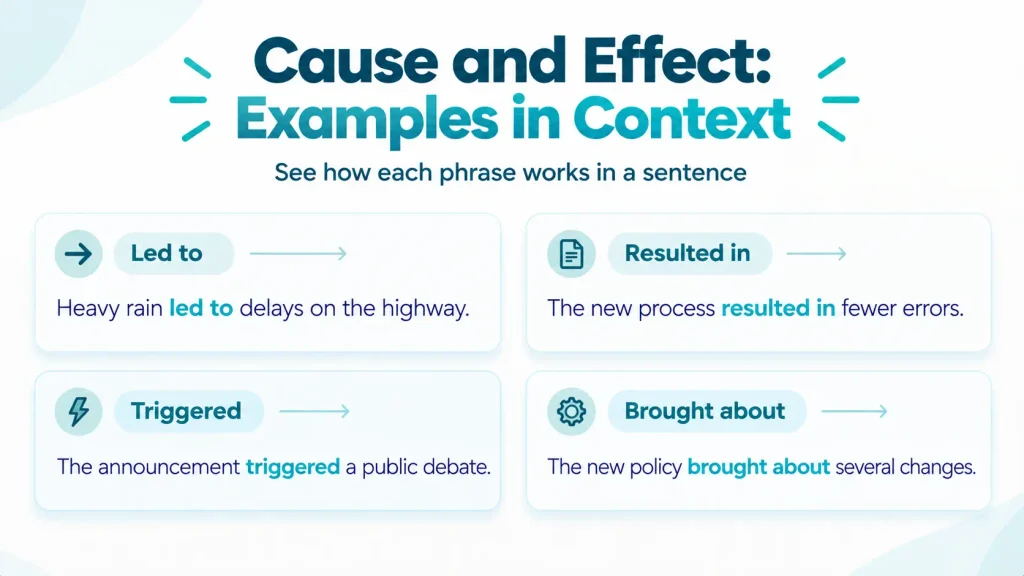
The following table makes it easier to choose an alternative that matches your intended meaning.
| Alternative | Main Meaning | Tone | Best Context |
|---|---|---|---|
| Led to | Produced a result | Neutral | General writing |
| Resulted in | Produced an outcome | Formal | Reports and research |
| Brought about | Created a change | Formal | Major developments |
| Triggered | Started a reaction | Neutral | Sudden events |
| Produced | Generated an effect | Neutral | Business and science |
| Created | Made something exist | Neutral | Problems and opportunities |
| Prompted | Led to a response | Neutral to formal | Decisions and actions |
| Sparked | Started a reaction or discussion | Conversational | News and disagreements |
| Generated | Produced a result or resource | Professional | Marketing and data |
| Gave rise to | Led to a development | Formal | Academic writing |
| Induced | Brought about an effect | Technical | Scientific contexts |
| Was responsible for | Identified a causal source | Neutral to formal | Investigations |
| Contributed to | Helped produce a result | Neutral to formal | Multiple contributing factors |
| Brought on | Caused a condition to begin | Conversational | Symptoms and difficulties |
| Set off | Started an event or reaction | Informal | Alarms and incidents |
How to Choose the Right Alternative

The most appropriate replacement depends on the relationship between the action and its result.
For Professional and Academic Writing
Choose resulted in, led to, brought about, or gave rise to when explaining outcomes, changes, or developments.
For example:
- Original: The lack of planning caused delays.
- Professional: The lack of planning resulted in delays.
- Analytical: The lack of planning contributed to the delays.
The final example is more cautious because it does not claim that poor planning was the only factor.
For Sudden Events and Reactions
Use triggered, sparked, or set off when an action starts a reaction or event.
For example:
- Original: The loud noise caused the alarm to activate.
- Alternative: The loud noise triggered the alarm.
The second sentence is concise and natural because triggered directly describes activating the alarm.
For Positive Outcomes
Use produced, generated, created, or led to when discussing improvements, opportunities, or achievements.
For example:
- Original: The training program caused better results.
- Alternative: The training program produced better results.
The alternative sounds more natural because produced clearly connects the program with its outcome.
For Problems and Unpleasant Conditions
Use brought on, triggered, or led to, depending on the situation.
For example:
- The stressful week brought on a headache.
- The comment triggered an argument.
- The equipment failure led to a delay.
Each phrase describes a different kind of relationship, so the context should guide your choice.
Common Mistakes When Replacing Caused
Even when two expressions are related, they may not communicate exactly the same meaning.
Treating Contributed To as an Exact Synonym
Contributed to suggests partial influence, while caused can suggest a direct or sufficient cause.
Incorrectly strong claim: The new schedule caused the entire problem.
More cautious wording: The new schedule contributed to the problem.
Use the second version when other factors also played a role.
Using Triggered for Every Type of Change
Triggered often suggests that something initiated a reaction or process. It may sound unnatural when describing a slow, long-term development.
Less natural: The new policy triggered years of gradual improvement.
More natural: The new policy brought about years of gradual improvement.
Choosing Overly Technical Language
Words such as induced can sound unnecessarily formal in everyday conversation.
Formal: The medication induced a temporary response.
Everyday: The medication caused a temporary response.
Choose the expression that fits your audience and the subject.
Confusing Caused With Was Responsible For
These expressions can overlap, but was responsible for may suggest accountability or blame.
For example, saying that a worker was responsible for an accident can imply personal responsibility. Saying that a faulty component caused the accident focuses on the mechanical cause.
Choose wording that reflects the evidence rather than assigning blame without support.
Frequently Asked Questions
What Is the Best Synonym for Caused?
Led to is one of the most versatile alternatives because it works in everyday, professional, and academic writing. However, resulted in may be better for formal reports, while triggered is more suitable for reactions or sudden events.
What Is a More Professional Word for Caused?
Resulted in, led to, and brought about are useful professional alternatives. For example, instead of writing, “The error caused delays,” you could write, “The error resulted in delays.”
What Is Another Way to Say Caused by?
Depending on the sentence, you can use resulting from, due to, stemming from, or triggered by.
Examples:
- The delay resulted from a technical issue.
- The cancellation was due to severe weather.
- The problem stemmed from a communication failure.
- The reaction was triggered by an unexpected change.
These expressions have different grammatical structures, so they may require you to rewrite the sentence.
What Is a Formal Alternative to Caused?
Resulted in and gave rise to are formal alternatives. For example, “The policy caused new concerns” could become “The policy gave rise to new concerns.”
What Is Another Word for Caused in a Positive Context?
Produced, generated, created, and led to can describe positive outcomes.
For example, “The initiative caused significant improvements” can be rewritten as “The initiative produced significant improvements.”
Can I Use Triggered Instead of Caused?
Yes, when the intended meaning is that something initiated a reaction, event, or process. For example, “The smoke triggered the alarm” is natural. However, triggered may be less appropriate when describing gradual changes or outcomes that develop over time.
Is Contributed to the Same as Caused?
Not exactly. Caused can identify the source of an outcome, whereas contributed to means that something helped produce or influence it. The latter is more appropriate when several factors played a role.
Conclusion
The best way to replace caused is to choose a phrase that accurately describes the relationship between an event and its outcome. Use led to for general cause-and-effect relationships, resulted in for formal explanations, triggered for reactions, and brought about for changes. When several factors influence an outcome, contributed to may be the more accurate choice.
Choosing the right alternative makes your writing clearer, more natural, and more precise without changing the meaning of your original sentence.

Role: Lead Author & Content Specialist
James Mitchell is an experienced Lead Author at Elite’s Collective. He specializes in creating high-impact editorial content and driving core written projects designed to inform and engage readers.