
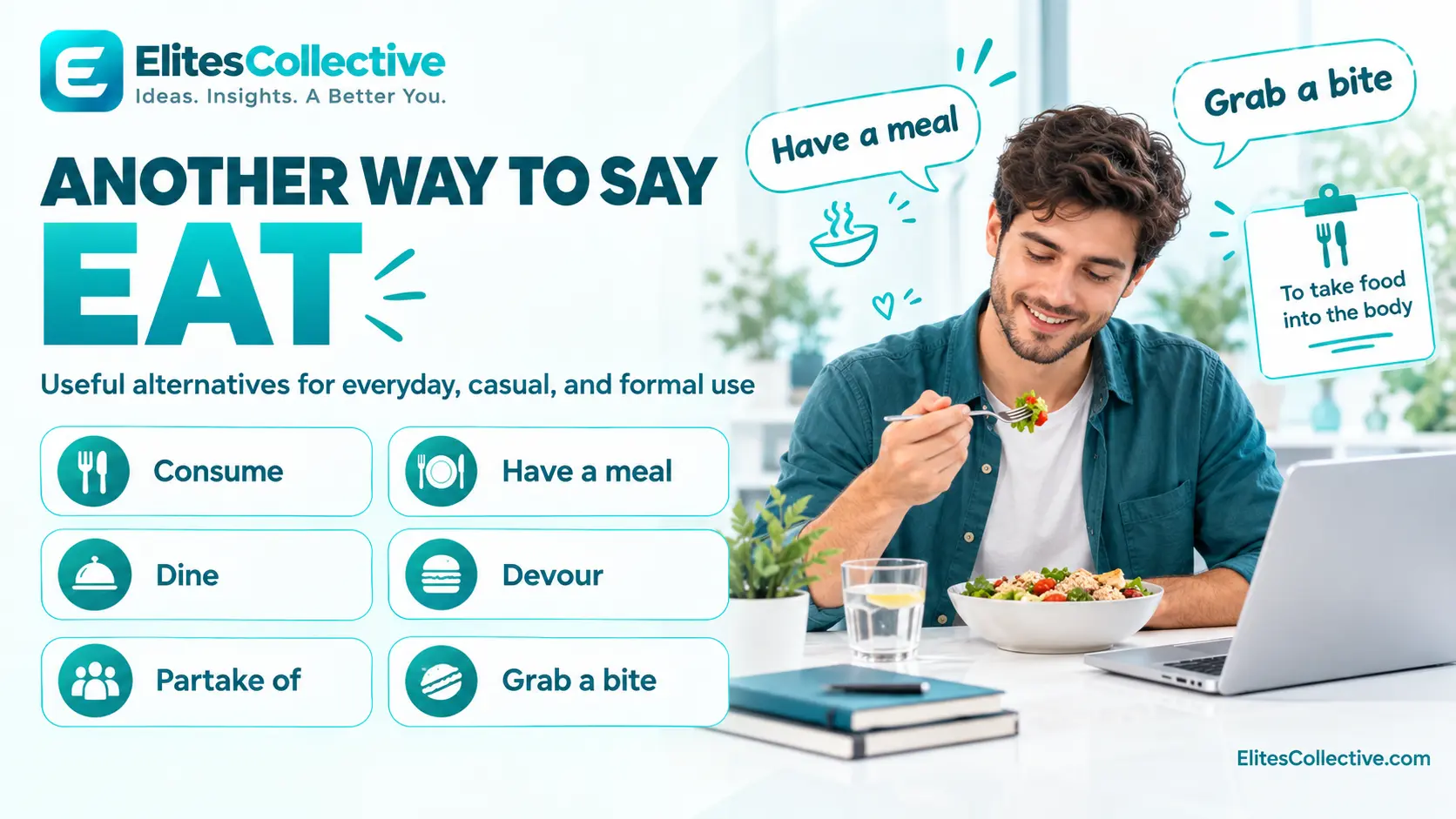
Looking for another way to say eat in everyday conversations, professional writing, or creative content? Words such as “consume,” “dine,” “devour,” and “feast” can help you express the same basic action in different ways. However, each alternative has its own meaning and tone.
In this guide, you’ll discover 50+ alternatives to the word “eat,” including casual expressions, formal terms, descriptive verbs, and phrases for different situations. Moreover, you’ll find practical examples to help you choose the right word for your sentence.
What Is Another Way to Say Eat?
Another way to say eat is a synonym or alternative expression that describes consuming food. Some alternatives sound formal, while others suggest enjoyment, speed, or a particular dining experience.
For example, “consume” works well in scientific or formal writing. In contrast, “devour” suggests eating something eagerly, while “dine” often refers to eating a meal in a more formal or social setting.
Here are some common alternatives:
| Alternative | Meaning or Usage |
|---|---|
| Consume | Eat or take in food |
| Dine | Eat a meal, often in a formal setting |
| Devour | Eat eagerly or quickly |
| Feast | Eat a large or special meal |
| Munch | Eat something with repeated chewing |
| Snack | Eat a small amount of food between meals |
| Nibble | Take small bites |
| Gobble | Eat quickly and eagerly |
| Chow down | Eat a meal, informally |
| Partake | Take part in eating or drinking |
| Savor | Enjoy the taste of food slowly |
| Pick at | Eat small amounts without much appetite |
| Dig in | Begin eating enthusiastically |
| Feed | Give food to someone or an animal |
| Taste | Try a small amount to check its flavor |
Common Synonyms for Eat
If you want a simple replacement for “eat,” start with these commonly used words. Each option fits a different context, so consider the meaning before choosing one.
1. Consume
“Consume” is a formal alternative that describes taking food into the body. It appears frequently in health, nutrition, and scientific writing.
Example: Adults should consume a variety of nutritious foods.
2. Dine
“Dine” means to eat a meal. It often appears in restaurant descriptions, invitations, and formal writing.
Example: We plan to dine at a new Italian restaurant tonight.
3. Devour
“Devour” means to eat something eagerly or very quickly. It can also describe reading or enjoying something with great enthusiasm.
Example: The children devoured the homemade cookies.
4. Munch
“Munch” describes eating something with repeated chewing. It usually sounds casual and works well for snacks.
Example: She likes to munch on popcorn while watching movies.
5. Nibble
“Nibble” means to take small bites of food. People often use it when someone eats slowly or only eats a little.
Example: He nibbled on a piece of toast before leaving.
6. Feast
“Feast” means to eat a large, enjoyable, or special meal. It can also refer to a celebratory meal shared with others.
Example: The family gathered to feast on traditional dishes.
7. Gobble
“Gobble” describes eating quickly and eagerly, often with little attention to taking small bites.
Example: The hungry puppy gobbled up its food.
8. Savor
“Savor” means to enjoy the taste or experience of something slowly.
Example: She took her time to savor every bite of the chocolate cake.
Casual Ways to Say Eat
In everyday conversations, informal expressions can make your language sound more natural. These phrases are common among friends and family.
| Casual Expression | Example |
|---|---|
| Chow down | Let’s chow down before the food gets cold. |
| Dig in | The pizza is ready, so dig in! |
| Grab a bite | Let’s grab a bite after work. |
| Tuck in | Everyone sat down and tucked in. |
| Have a bite | Would you like to have a bite of my sandwich? |
| Grab some food | I’ll grab some food before the movie. |
| Get something to eat | Let’s get something to eat. |
| Fill up | We should eat now and fill up before the trip. |
| Have a snack | I’ll have a snack before dinner. |
| Eat up | Eat up before we leave. |
These expressions are useful in casual speech. However, phrases such as “chow down” may sound too informal for academic writing or a formal business document.
Formal Ways to Say Eat
If you’re writing an academic paper, a professional article, or a formal description, a more precise word may work better.
Consume
Use “consume” when discussing food intake, nutrition, or eating habits.
Example: The study examined how much sugar participants consumed each day.
Dine
Use “dine” when describing a meal or dining experience.
Example: Guests will dine in the hotel’s main restaurant.
Partake
“Partake” means to take part in something. When used with food, it often sounds formal or traditional.
Example: All guests were invited to partake in the evening meal.
Ingest
“Ingest” is a technical term for taking food, liquid, or another substance into the body.
Example: The instructions explain how much liquid to ingest with the medication.
Use this term carefully because it sounds clinical rather than conversational.
Have a Meal
This phrase is a clear, neutral option for formal and everyday writing.
Example: Participants were asked to have a meal before the scheduled activity.
Another Way to Say Eat Food
Sometimes, you need an alternative that specifically refers to eating food rather than drinking or taking in another substance.
Here are useful options:
- Consume food: The athletes consumed food after training.
- Have a meal: We had a meal together after the event.
- Eat a meal: She ate a meal before starting work.
- Partake of food: The guests partook of the food provided.
- Feed yourself: Make sure you have time to feed yourself during a busy day.
- Enjoy a meal: We enjoyed a meal with our friends.
- Sit down to eat: The family sat down to eat at seven.
- Break bread: The group gathered to break bread together.
- Have something to eat: I’ll have something to eat after class.
- Take nourishment: The phrase can describe receiving food for sustenance, although it sounds formal or literary.
Choose a phrase that fits your sentence naturally. For most everyday situations, “have a meal” or “have something to eat” is clear and easy to understand.
Another Way to Say Eat a Lot
When someone eats a large amount of food, you may want a more descriptive expression. However, these words can carry different tones, so choose them carefully.
| Expression | Meaning | Example |
|---|---|---|
| Feast | Eat a large or special meal | We feasted on homemade dishes. |
| Devour | Eat eagerly | He devoured the entire sandwich. |
| Gobble up | Eat quickly | They gobbled up the fresh bread. |
| Load up on | Eat or take a large amount of something | She loaded up on vegetables at lunch. |
| Eat heartily | Eat a substantial meal with appetite | Everyone ate heartily after the hike. |
| Dig into | Begin eating eagerly | The guests dug into the buffet. |
| Put away | Eat a considerable amount, informally | He put away two large servings. |
| Polish off | Finish all the food | She polished off the last slice of pizza. |
Important distinction: “Devour,” “gobble up,” and “polish off” are not exact substitutes in every sentence. “Polish off” emphasizes finishing food, while “devour” emphasizes eager eating.
Another Way to Say Eat Slowly
If you want to describe someone who eats slowly or carefully, these alternatives can help you create a more vivid sentence.
- Nibble: She nibbled on a biscuit.
- Munch slowly: He munched slowly on his apple.
- Savor: They savored each bite of the meal.
- Pick at: She picked at her lunch while talking.
- Take small bites: He took small bites of the sandwich.
- Graze: The guests grazed on small dishes throughout the afternoon.
- Taste: She tasted the soup before adding more salt.
These words have different meanings. For instance, “savor” suggests enjoyment, while “pick at” can suggest a lack of appetite or interest in the food.
Another Way to Say Eat a Snack
When you eat something small between meals, you can use “snack” or one of several related expressions.
Common Alternatives
- Have a snack
- Grab a bite
- Munch on something
- Nibble on a snack
- Have a little something
- Eat between meals
- Grab a quick bite
- Have a light snack
Examples:
- I’ll grab a quick bite before the meeting.
- She likes to snack on fruit in the afternoon.
- We had a light snack while waiting for dinner.
In everyday English, “grab a bite” often means having a quick meal or snack. The exact meaning depends on the context.
Creative Ways to Say Eat in Writing
Writers often use descriptive verbs to make a scene more vivid. Instead of repeating “eat,” choose a verb that shows how a character approaches the food.
For example:
- Gobbled: The hungry traveler gobbled down the sandwich.
- Munched: She munched on crackers while reading.
- Savored: He savored the rich flavor of the soup.
- Devoured: The children devoured the warm pancakes.
- Nibbled: She nibbled on a strawberry.
- Feasted: The guests feasted on a table full of traditional dishes.
- Tucked in: Everyone tucked in as soon as dinner was served.
- Polished off: He polished off the final piece of cake.
How to Choose the Right Descriptive Verb
First, decide what you want readers to picture. If the character eats quickly, “gobbled” may fit. If the character enjoys every bite, “savored” is more precise. Meanwhile, “nibbled” works when the character takes small bites.
As a result, the right verb can make your writing clearer without adding unnecessary adjectives.
Examples of Eat in Different Sentences
The following examples show how you can replace “eat” with a suitable alternative.
| Original Sentence | Alternative Sentence |
|---|---|
| I want to eat dinner. | I want to have dinner. |
| The children ate their snacks quickly. | The children devoured their snacks. |
| We will eat at the restaurant. | We will dine at the restaurant. |
| She ate a little chocolate. | She nibbled on some chocolate. |
| He ate the sandwich very quickly. | He gobbled up the sandwich. |
| They ate a large meal together. | They feasted together. |
| I want to eat something before leaving. | I want to grab a bite before leaving. |
| She ate the cake slowly and enjoyed it. | She savored the cake. |
| The guests started eating. | The guests dug in. |
| He finished all the remaining food. | He polished off the leftovers. |
Notice how each alternative changes the tone or adds a detail. Therefore, choose the word that communicates your intended meaning rather than simply replacing every occurrence of “eat.”
Common Mistakes When Choosing a Synonym for Eat
Although many words can replace “eat,” not every alternative works in every context.
Using Formal Words in Casual Conversations
“Consume” and “ingest” can sound unnatural in an ordinary conversation. For example, “I’m going to consume lunch” sounds less natural than “I’m going to eat lunch.”
Confusing Eating With Tasting
“Taste” usually means trying a small amount to experience its flavor. It doesn’t always mean eating a complete meal.
Using Devour for Every Meal
“Devour” suggests eager or rapid eating. If someone simply eats a normal dinner, “have dinner” or “eat dinner” may be more accurate.
Forgetting the Tone
Words such as “gobble” can sound playful, while “dine” sounds more formal. Match the word to your audience and writing style.
Repeating the Same Verb Too Often
If your writing contains “eat” several times in a short paragraph, consider using a more precise alternative where appropriate. However, don’t force unusual synonyms into sentences where the original word works best.
Frequently Asked Questions
What Is Another Word for Eat?
Common synonyms include consume, dine, devour, munch, nibble, feast, gobble, and partake. The best choice depends on whether you want a formal, casual, or descriptive expression.
What Is a Fancy Word for Eat?
“Dine” is a common polished alternative. “Partake” can sound formal or traditional, while “consume” is useful in scientific and nutrition-related writing.
What Is a Casual Way to Say Eat?
You can say “grab a bite,” “chow down,” “dig in,” “tuck in,” or “get something to eat.” These expressions work well in informal conversations.
What Is Another Way to Say Eat a Lot?
“Feast,” “devour,” “gobble up,” and “eat heartily” can describe eating a large amount or eating eagerly. Their meanings differ, so select the phrase that matches the situation.
What Is Another Word for Eat Slowly?
“Nibble” means taking small bites, while “savor” means enjoying the flavor slowly. “Pick at” can describe eating small amounts without much appetite.
Is Consume a Synonym for Eat?
Yes. “Consume” can mean to eat or drink something. However, it sounds more formal than “eat” in many everyday situations.
How Can I Avoid Repeating the Word Eat?
Use alternatives such as “dine,” “munch,” “snack,” or “savor” when they accurately describe the action. You can also restructure a sentence to avoid repetition.
Conclusion
Finding another way to say eat can make your writing more natural, precise, and engaging. Words such as “consume,” “dine,” “devour,” “munch,” and “savor” each communicate a slightly different meaning.
Ultimately, choose your synonym based on the context. Use simple language in everyday conversations, formal alternatives in professional writing, and descriptive verbs when you want to create a vivid scene. The right word will help readers understand not only that someone is eating, but also how and why the action takes place.

Role: Author & Contributing Writer
Olivia Bennett is a dedicated Author at Elite’s Collective, focused on delivering clear, well-researched, and engaging articles tailored to the audience.