
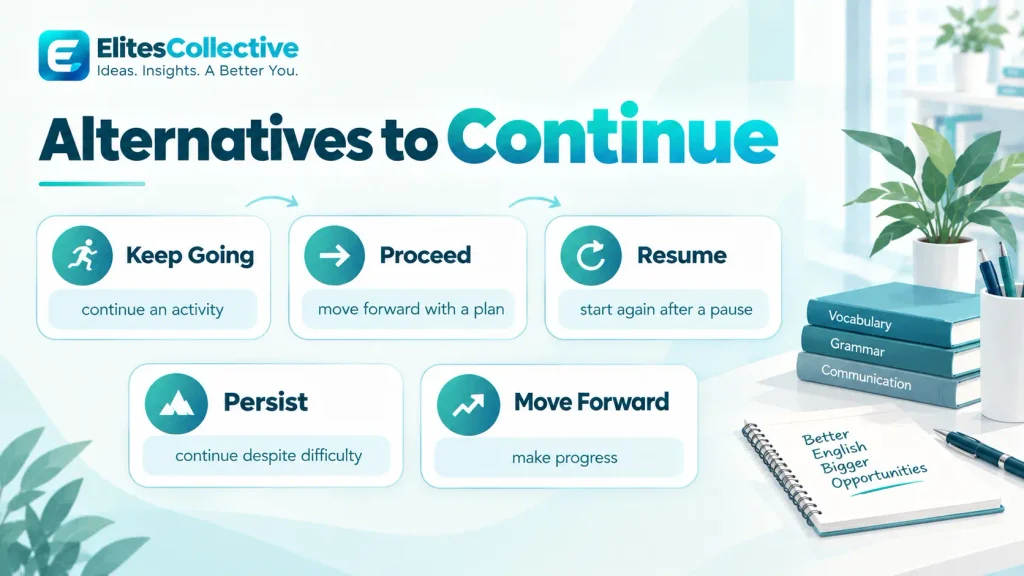
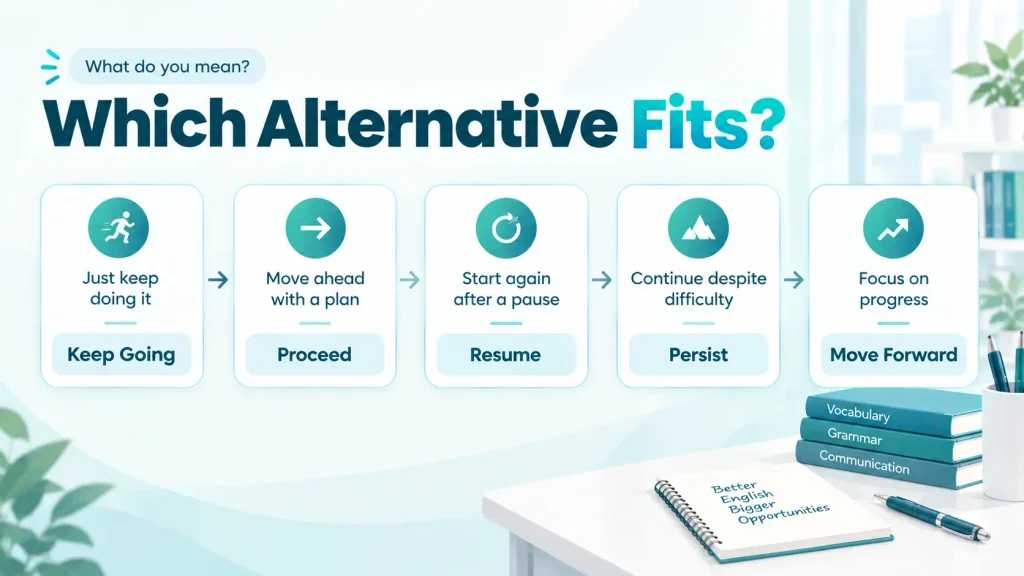
If you need another way to say continue, the best choice depends on the meaning and situation. Keep going sounds natural in everyday conversation, proceed works well in formal and professional situations, and resume is more precise when something starts again after a pause.
Other expressions add a more specific meaning. Persist and persevere suggest continuing despite difficulty, while move forward focuses on progress or reaching the next stage.
In this guide, you’ll learn 15 natural alternatives, along with examples and simple tips for choosing the right expression.
Quick tip: Don’t replace “continue” automatically. First decide whether you mean keeping something going, starting again, making progress, or continuing despite difficulty.
Key Takeaways
- Keep going is a natural choice for everyday conversation and encouragement.
- Proceed is useful for formal, professional, academic, and instructional situations.
- Resume means starting something again after it has stopped.
- Carry on and go on are common conversational expressions.
- Persist and persevere emphasize continuing despite difficulty.
- Press on suggests determination in the face of obstacles.
- Move forward emphasizes progress or advancing to the next stage.
- Maintain focuses on keeping something at the same level, condition, or standard.
What Does “Continue” Mean?
The verb continue generally means to keep doing something, remain in progress, or move forward without stopping.
For example:
We will continue the meeting after lunch.
It can also describe something that remains in existence or happens over a period of time:
The rain continued throughout the afternoon.
Because the word has several uses, the best replacement depends on what you want to communicate.
You might mean:
- keep doing something
- keep an activity in progress
- start something again after a pause
- move to the next stage
- maintain a particular level
- continue despite difficulty
Understanding this distinction makes your English sound more precise and natural.
Related reading: If you are building your English vocabulary, consider linking this section to another relevant ElitesCollective vocabulary guide.
15 Natural Alternatives to “Continue”
1. Keep Going
Keep going is one of the most natural choices in everyday American English. It can describe continuing an activity, moving forward, or making progress.
Best for: Casual conversation, encouragement, activities, and ongoing efforts.
Example:
You’re doing well, so keep going until you finish the project.
Usage tip: This expression often sounds warmer and more encouraging than the neutral verb “continue.”
2. Carry On
Carry on means to keep doing something that is already underway. It is common in conversation and can also be used when giving instructions.
Best for: Conversations, ongoing activities, and instructions.
Example:
Please carry on with your presentation while I take some notes.
Usage tip: Use carry on with + noun when naming a specific activity:
Let’s carry on with the discussion.
“Carry on” can have a somewhat more British feel in some contexts, so keep going may sound more natural in everyday American English.
3. Go On
Go on is a flexible conversational expression. It can mean continuing to talk, continuing an activity, or allowing someone to continue.
Best for: Everyday speech and conversations.
Example:
Please go on. I’d like to hear the rest of your story.
Usage tip: The phrase can have other meanings depending on context, so the surrounding sentence determines whether it means “continue.”
4. Proceed
Proceed means to move forward with an action, process, plan, or next step. It is more formal than keep going.
Best for: Professional writing, instructions, academic contexts, and formal communication.
Example:
Once the documents are approved, we can proceed with the next stage.
Usage tip: Proceed with is common before an activity:
We can proceed with the project.
Proceed to can introduce a next step or destination:
We will now proceed to the next section.
5. Resume
Resume means to start something again after it has stopped or been interrupted.
Best for: Meetings, classes, conversations, events, work, and activities that were paused.
Example:
The meeting will resume at 2 p.m.
Usage tip: Use this word when there was a break or interruption.
For example:
The class stopped for lunch and resumed at 1 p.m.
Do not normally use resume when something has continued without interruption.
6. Keep Up
Keep up can mean maintaining the same level, speed, quality, or progress.
Best for: Work, exercise, learning, performance, and encouragement.
Example:
Keep up the good work, and you’ll finish the assignment on time.
Usage tip: This expression is not always a direct replacement for “continue.” It adds the idea of maintaining a particular standard or pace.
7. Persist
Persist means to keep doing something despite difficulty, resistance, or problems.
Best for: Difficult tasks, long-term efforts, challenges, and determined actions.
Example:
If you persist with your training, you should see steady improvement.
Usage tip: Compared with “continue,” persist suggests that stopping may be tempting or difficult.
8. Persevere
Persevere means to continue making an effort despite obstacles, failure, or difficulty.
Best for: Academic writing, motivational contexts, difficult goals, and long-term challenges.
Example:
She persevered despite several setbacks and eventually completed the program.
Usage tip: This word emphasizes determination and endurance.
It would sound unusual to use it for an ordinary action such as:
She persevered with eating dinner.
For a normal activity, continued eating dinner would be more natural.
9. Press On
Press on means to continue moving or working despite obstacles, delays, or difficulties.
Best for: Motivational, determined, and somewhat literary contexts.
Example:
Despite the delay, the team decided to press on with the project.
Usage tip: This expression communicates more determination than simply saying that someone continued.
10. Move Forward
Move forward focuses on progress or advancement rather than simply keeping the same activity going.
Best for: Projects, plans, decisions, relationships, and professional communication.
Example:
We have addressed the main concerns and can now move forward with the plan.
Usage tip: Choose this expression when progress is an important part of the meaning.
For example:
The team moved forward with the next phase.
This is slightly different from:
The team continued working.
The first emphasizes advancement; the second simply says the work did not stop.
11. Keep at It
Keep at it means to continue working on something, especially when it requires practice or becomes difficult.
Best for: Casual encouragement, learning, practice, and skill-building.
Example:
Your writing is improving, so keep at it.
Usage tip: This is informal and encouraging. It works especially well when someone is struggling but should not give up.
12. Stay With It
Stay with it means to keep focusing on or working on something rather than abandoning it.
Best for: Learning, difficult tasks, projects, and encouragement.
Example:
The course gets easier after the first few weeks, so stay with it.
Usage tip: Like keep at it, this expression often suggests persistence rather than simple continuation.
13. Keep Moving
Keep moving literally means to continue moving, but it can also describe continued progress.
Best for: Travel, physical movement, projects, and motivational language.
Example:
We still have several miles to go, so let’s keep moving.
Usage tip: In a figurative context, it usually emphasizes progress.
For example:
We solved the problem and need to keep moving.
Here, the meaning is closer to “continue making progress.”
14. Maintain
Maintain means to keep something at the same level, condition, or state.
Best for: Professional, technical, academic, and formal contexts.
Example:
The company must maintain its current level of customer service.
Usage tip: Maintain is not a universal replacement. It works best when the meaning involves preserving an existing condition or standard.
For example:
The company maintained its high standards.
This is more precise than simply saying:
The company continued its high standards.
15. Keep Going With
Keep going with is a natural conversational construction used when someone wants to continue a particular task, plan, or activity.
Best for: Casual and neutral conversation.
Example:
Let’s keep going with the original plan and see how it works.
Usage tip: In formal writing, continue with or proceed with may sound more appropriate.
Quick Comparison: Which Expression Should You Use?
| Alternative | Main Meaning | Tone | Best Context |
|---|---|---|---|
| Keep going | Continue without stopping | Casual | Everyday conversation |
| Carry on | Continue an existing activity | Neutral/Casual | Conversation, activities |
| Go on | Continue talking or doing something | Casual | Everyday speech |
| Proceed | Move forward with a plan or process | Formal | Work, instructions |
| Resume | Start again after a pause | Neutral/Formal | Meetings, activities |
| Keep up | Maintain progress or performance | Casual | Work, learning, exercise |
| Persist | Continue despite difficulty | Neutral/Formal | Challenges, long-term efforts |
| Persevere | Continue despite serious difficulty | Formal | Goals, academic writing |
| Press on | Continue despite obstacles | Motivational | Projects, journeys |
| Move forward | Make progress toward the next stage | Neutral | Plans, projects |
| Keep at it | Continue working despite difficulty | Casual | Encouragement |
| Stay with it | Continue rather than give up | Casual | Learning, difficult tasks |
| Keep moving | Continue moving or progressing | Casual | Travel, progress |
| Maintain | Keep at the same level or condition | Formal | Professional/technical |
| Keep going with | Continue a particular activity | Casual/Neutral | Plans and tasks |
Alternatives for Different Situations
The most natural expression depends on what you are trying to say.
Everyday Conversation
For casual conversations, these options usually sound natural:
- Keep going
- Go on
- Carry on
- Keep at it
Example:
“Should I keep explaining?”
“Yes, go on.”
In everyday American English, keep going and go on are often more conversational than the formal-sounding proceed.
Professional or Formal Writing
For workplace, academic, or formal situations, consider:
- Proceed
- Continue
- Resume
- Move forward
- Maintain
Example:
Once the client approves the design, we can proceed with development.
Usage tip: Do not assume a more formal word is automatically better. Choose the expression that accurately matches the situation.
When Something Was Interrupted
When an activity stopped and will start again, use:
- Resume
- Continue
- Pick up again
Example:
We paused the discussion for lunch and will resume at 1 p.m.
Resume is particularly useful because it clearly communicates the sequence:
activity → pause → activity starts again
When Someone Is Facing Difficulty
When the meaning includes determination or difficulty, use:
- Persist
- Persevere
- Press on
- Keep at it
- Stay with it
Example:
The course is challenging, but keep at it and you’ll become more comfortable with the material.
These expressions communicate more than simply saying that something is continuing.
When You Mean “Make Progress”
When the emphasis is on advancement, consider:
- Move forward
- Proceed
- Advance
- Keep moving
- Press on
Example:
The team resolved the main issue and is ready to move forward.
Here, move forward emphasizes progress toward the next stage rather than simply maintaining the current activity.
Continue vs. Proceed vs. Resume
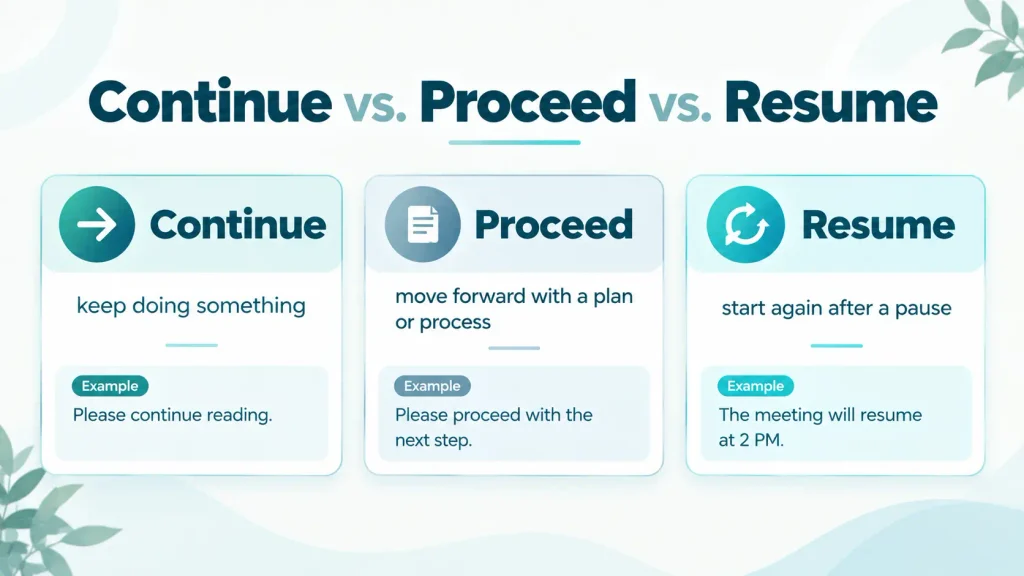
These three words are easy to confuse, but they communicate slightly different ideas.
Continue
Continue is the broadest and most neutral option. It simply means that an action or situation keeps going.
We will continue the discussion tomorrow.
Proceed
Proceed emphasizes moving forward with a plan, process, or next step.
We can proceed with the application after receiving the documents.
Resume
Resume specifically indicates that something stopped and is now starting again.
The class will resume after the break.
A simple way to remember the distinction is:
- Continue = keep doing it
- Proceed = move forward with it
- Resume = start it again after a pause
Internal-link opportunity: This section is a good place to link to another relevant ElitesCollective article about formal English alternatives or professional vocabulary.
Common Mistakes When Replacing “Continue”
Choosing a synonym based only on the dictionary meaning can sometimes make a sentence sound unnatural. Here are some common problems to avoid.
1. Using “Resume” for Something That Never Stopped
Consider:
The company resumed its daily operations throughout the week.
If the operations never stopped, resumed suggests the wrong sequence.
A clearer version is:
The company continued its daily operations throughout the week.
Use resume when there was an actual pause or interruption.
2. Using “Proceed” in Casual Situations
Proceed is grammatically correct in many situations, but it can sound unnecessarily formal in ordinary conversation.
Instead of:
Please proceed with eating your dinner.
A natural conversational version is:
Go ahead and finish your dinner.
The issue is not grammar. It is tone and context.
3. Treating “Persist” as a Perfect Synonym
Persist adds the idea of difficulty or resistance.
Compare:
She continued working on the assignment.
This simply says that she kept working.
Now compare:
She persisted with the assignment despite several setbacks.
The second sentence suggests that continuing required determination.
4. Using “Move On” When You Mean the Same Activity Continues
Move on often means leaving one subject, stage, place, or situation behind and going to something else.
For example:
Let’s move on to the next question.
This does not mean simply continuing the same activity. It means progressing to a different question or stage.
If you mean that the same activity should continue, keep going, carry on, or continue may be more appropriate.
How to Choose the Right Expression
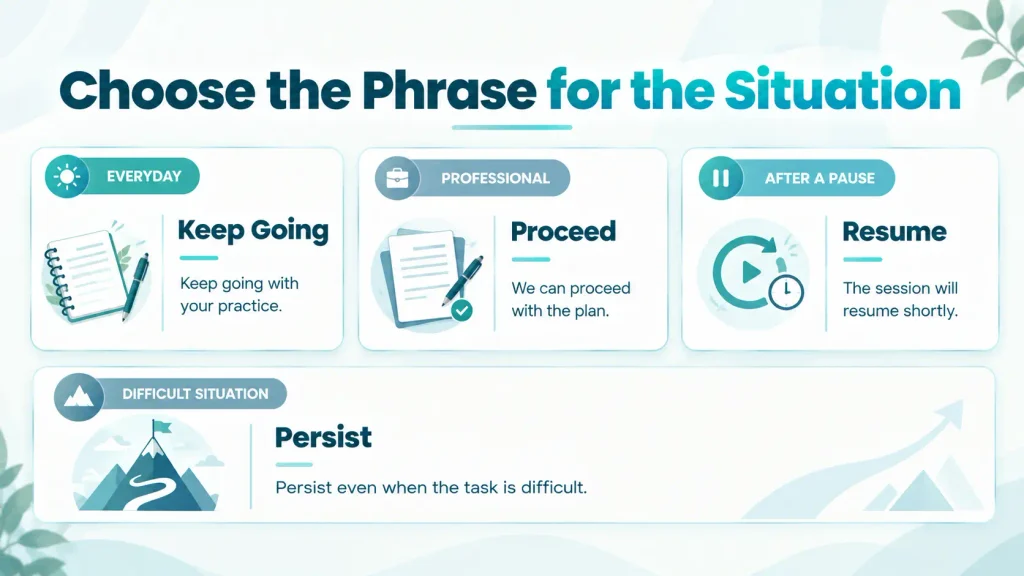
Before replacing the word, ask yourself what you actually want the sentence to communicate.
Do you simply mean “keep doing it”?
Use:
- Continue
- Keep going
- Carry on
Did the activity stop and then start again?
Use:
- Resume
- Pick up again
Are you moving to the next stage of a process?
Use:
- Proceed
- Move forward
- Advance
Are you continuing despite difficulty?
Use:
- Persist
- Persevere
- Press on
- Keep at it
Are you encouraging someone?
Use:
- Keep going
- Keep at it
- Stay with it
Are you maintaining the same level or condition?
Use:
- Maintain
- Keep up
This distinction helps you choose a phrase that communicates the exact meaning rather than simply replacing one word with another.
Frequently Asked Questions
What is the most common alternative to “continue”?
Keep going is a very common conversational alternative. Carry on and go on are also natural depending on the sentence and context.
What is a formal way to say “continue”?
Proceed is a useful formal option when you mean moving forward with a plan, process, or activity. However, continue itself is completely appropriate in formal writing.
What word means to continue after a pause?
Resume is usually the most precise choice when something has stopped and then starts again.
Is “carry on” the same as “continue”?
They can have the same basic meaning when referring to an ongoing activity. However, carry on is generally more conversational and may have a slightly different regional feel.
What is a synonym for continuing despite difficulties?
Persist, persevere, and press on can all express this idea. Persist and persevere emphasize determination, while press on emphasizes moving forward despite obstacles.
Can “move forward” replace “continue”?
Sometimes. Move forward usually emphasizes progress or advancement, whereas continue simply means that something keeps happening.
Is “keep going” formal or informal?
Keep going is generally conversational and informal to neutral. It is especially natural when encouraging someone or talking about an ongoing activity.
What is the difference between “continue” and “keep going”?
Both can mean that something does not stop. Continue is more neutral and versatile, while keep going is more conversational and often has an encouraging tone.
Conclusion
There are many natural ways to say continue, but the best alternative depends on the exact meaning you want. Use keep going for everyday conversation, proceed for formal processes, resume after a pause, and persist or persevere when difficulty is part of the meaning. Choosing the phrase that matches the context will make your English clearer and more natural.

Role: English Language & Communication Writer
Daniel Carter is an English language writer specializing in workplace communication, professional vocabulary, resumes, emails, and career-focused English.