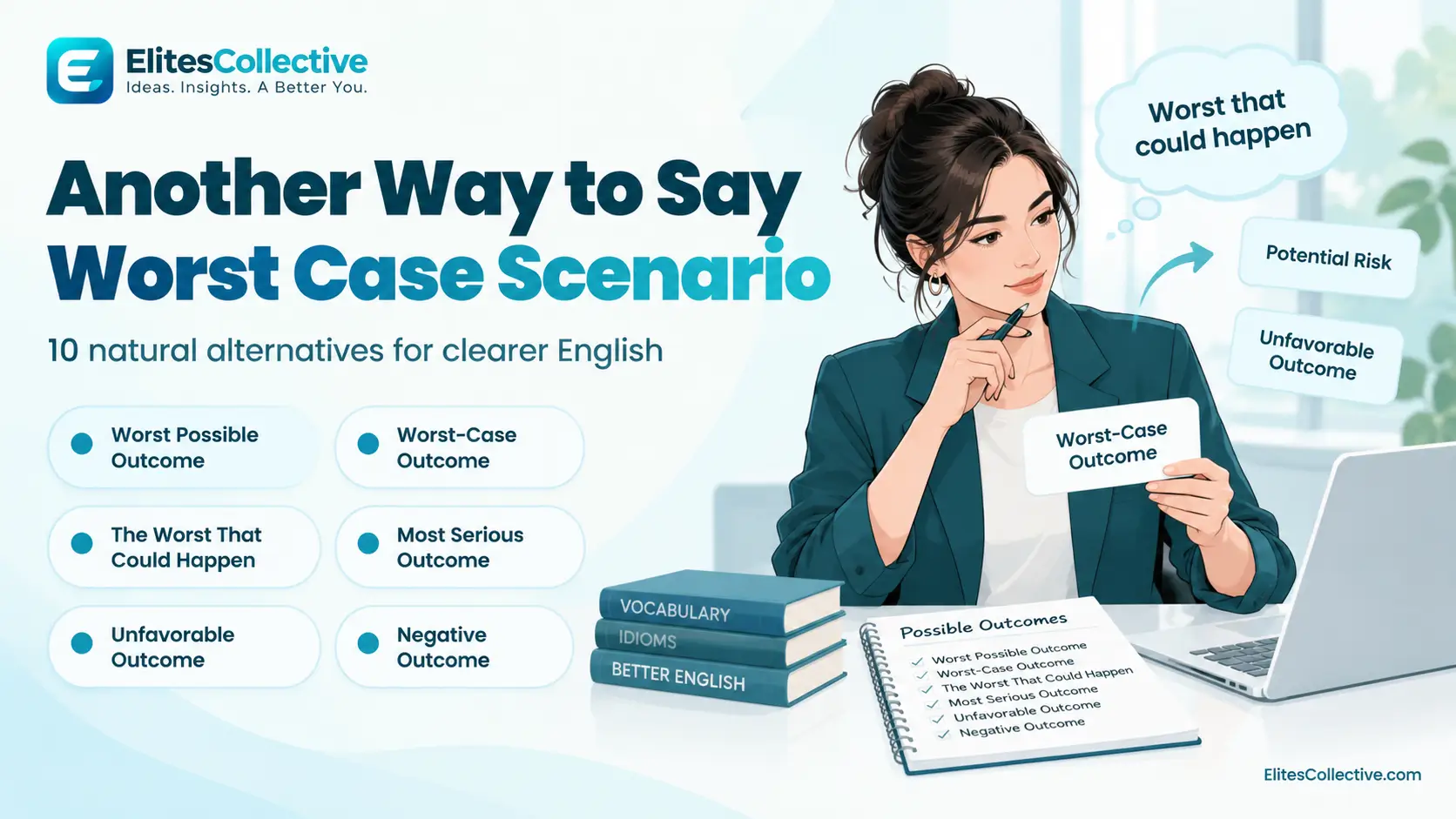
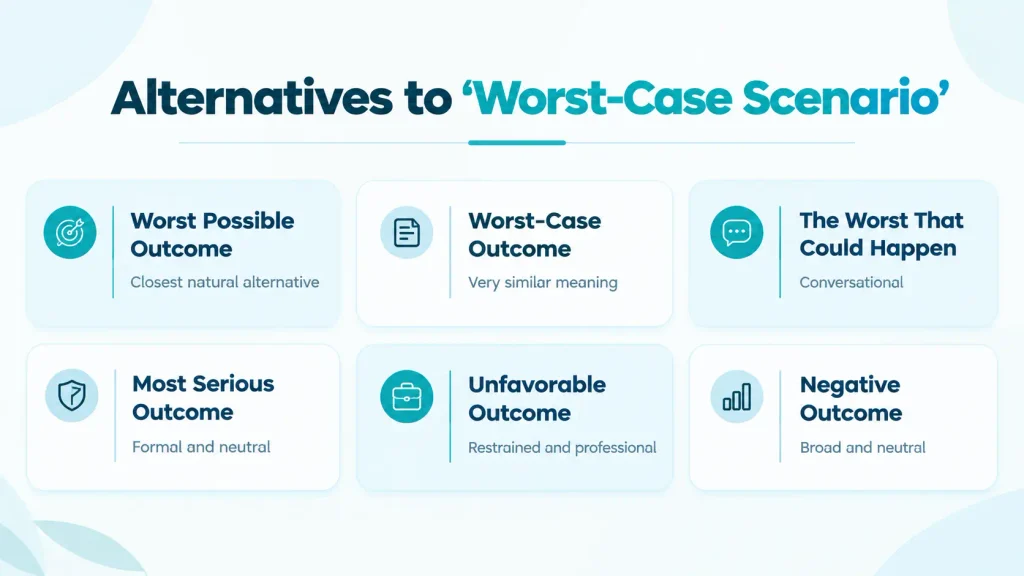
If you need another way to say “worst case scenario,” some natural alternatives include worst possible outcome, worst-case outcome, most serious outcome, worst that could happen, downside, negative outcome, and unfavorable outcome. The best choice depends on whether you want a casual, professional, formal, or more direct tone.
Key Takeaways
- “Worst possible outcome” is one of the closest natural alternatives to “worst-case scenario.”
- “Worst that could happen” works well in everyday conversation.
- “Most serious outcome” is useful when discussing risks in professional or formal settings.
- “Unfavorable outcome” sounds more neutral and less dramatic.
- “Downside” is useful when discussing disadvantages, but it is not always an exact synonym.
- Some alternatives describe an outcome, while “scenario” describes a possible situation or set of events.
What Does “Worst Case Scenario” Mean?
“Worst-case scenario” refers to the most negative or difficult situation that could reasonably happen.
For example:
The worst-case scenario is that we miss the deadline and have to postpone the launch.
The phrase is commonly used when discussing risks, problems, uncertainty, planning, or possible consequences. It can be serious or casual depending on the situation.
You can also use it in everyday conversation:
What’s the worst-case scenario if we leave a little late?
Because the expression is already common and natural, you don’t always need to replace it. However, another phrase may work better if you want to sound more formal, less dramatic, or more specific.
Another Way to Say “Worst Case Scenario”
Here are natural alternatives, with the differences that matter most.
1. Worst Possible Outcome
“Worst possible outcome” is one of the closest alternatives to “worst-case scenario.”
It focuses on the negative result rather than the entire situation.
Example:
The worst possible outcome would be losing the client.
Best for: Professional, formal, and neutral writing.
2. Worst-Case Outcome
“Worst-case outcome” is very similar to “worst-case scenario,” but it emphasizes the final result.
Example:
We need to consider the worst-case outcome before making a decision.
Best for: Business, planning, risk discussions, and formal writing.
3. The Worst That Could Happen
This is a natural conversational alternative. It sounds less formal and works particularly well in speech.
Example:
What’s the worst that could happen if we try it?
Best for: Everyday conversation and informal writing.
4. Most Serious Outcome
“Most serious outcome” is useful when you want to discuss a potentially harmful result without sounding overly dramatic.
Example:
The most serious outcome would be a complete loss of the investment.
Best for: Professional, academic, medical, technical, or risk-related discussions.
5. Most Negative Outcome
This phrase focuses directly on the negative result.
Example:
We should consider the most negative outcome before moving forward.
Best for: Formal and analytical writing.
It can sound more neutral and objective than “worst-case scenario.”
6. Unfavorable Outcome
“Unfavorable outcome” is a more restrained way to describe a negative result.
Example:
Even in the event of an unfavorable outcome, we have several options available.
Best for: Professional, formal, and business writing.
Unlike “worst-case scenario,” it does not necessarily mean the absolute worst thing that could happen. It simply indicates a result that is not desirable.
7. Negative Outcome
“Negative outcome” is straightforward and widely applicable.
Example:
We should prepare for the possibility of a negative outcome.
Best for: Professional, academic, technical, and general contexts.
It is broader than “worst-case scenario,” so use it when you mean an undesirable result rather than the most extreme possible result.
8. Worst-Case Result
“Worst-case result” is another direct alternative when you want to emphasize what happens at the end of a situation.
Example:
In the worst-case result, the project could take several additional months.
Best for: General and professional contexts.
However, “worst-case outcome” is generally more natural than “worst-case result” in many formal contexts.
9. Worst-Case Possibility
“Worst-case possibility” emphasizes the most negative possibility under consideration.
Example:
We have to plan for the worst-case possibility.
Best for: Planning, risk management, and everyday discussion.
10. The Most Difficult Situation
This phrase can work when you are referring to a challenging circumstance rather than a specific result.
Example:
We should have a plan for the most difficult situation we might face.
Best for: Formal, professional, and explanatory writing.
It is not an exact synonym in every sentence because it describes a difficult situation rather than necessarily the final outcome.
More Natural Alternatives by Context
The best replacement depends on what you are trying to communicate.
| Alternative | Meaning/Use | Tone | Best Context |
|---|---|---|---|
| Worst possible outcome | The most negative result | Neutral | Professional, formal |
| Worst-case outcome | The most negative expected result | Neutral | Business, planning |
| The worst that could happen | The most negative possibility | Casual | Conversation |
| Most serious outcome | The most severe result | Formal | Professional, technical |
| Most negative outcome | The most negative result | Formal | Analytical writing |
| Unfavorable outcome | An undesirable result | Formal/neutral | Business, professional |
| Negative outcome | A result that is not desirable | Neutral | General, academic |
| Worst-case result | The most negative result | Neutral | General |
| Worst-case possibility | The most negative possibility | Neutral | Planning |
| Most difficult situation | The hardest situation that may arise | Formal/neutral | Professional |
“Worst Case Scenario” vs. “Worst Possible Outcome”
These expressions are close, but there is a small difference.
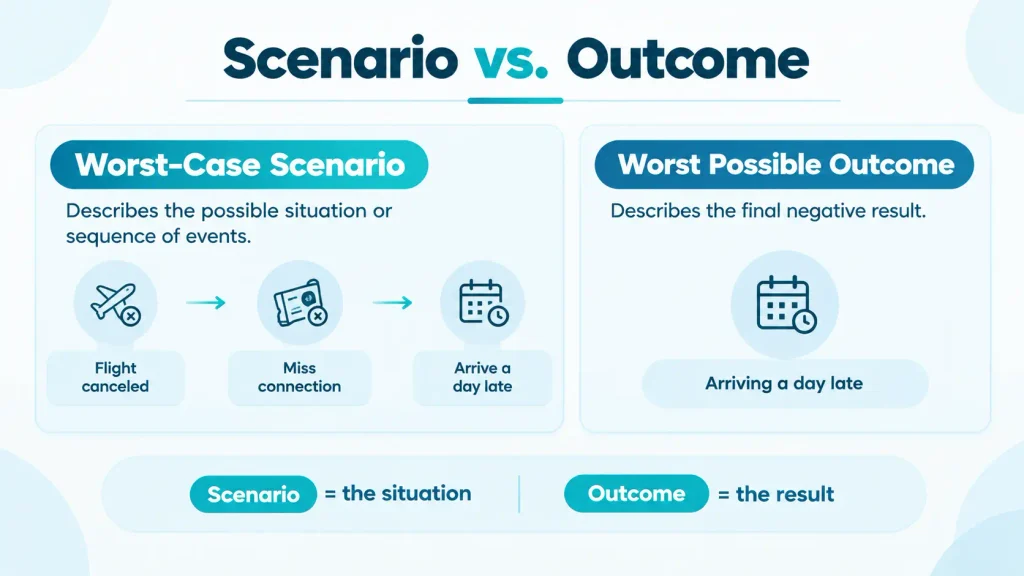
A scenario describes a possible situation or sequence of events. An outcome describes the result of those events.
For example:
The worst-case scenario is that the flight is canceled, we miss the connection, and we arrive a day late.
Here, the phrase describes a whole chain of events.
By contrast:
The worst possible outcome is arriving a day late.
Here, the focus is on the final result.
This distinction matters when you are writing professionally or trying to be precise.
Formal Alternatives to “Worst Case Scenario”
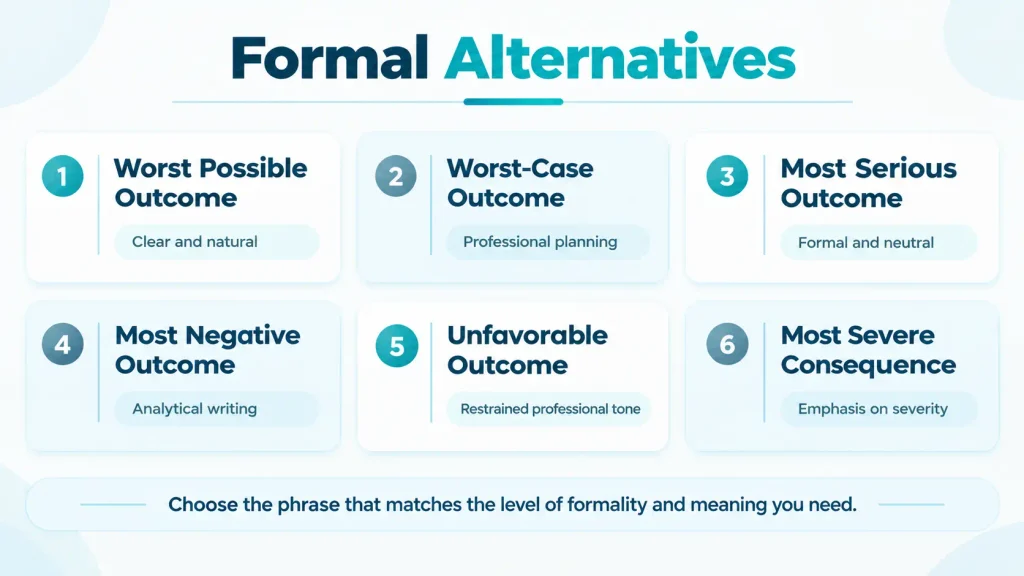
If you’re writing a report, business document, academic paper, or professional email, you may want a more neutral expression.
Consider:
- Worst possible outcome
- Worst-case outcome
- Most serious outcome
- Most negative outcome
- Unfavorable outcome
- Potential adverse outcome
- Most challenging scenario
- Most severe consequence
For example, instead of:
We need to prepare for the worst-case scenario.
You could write:
We need to prepare for the most serious potential outcome.
Or:
The team should prepare for the possibility of an unfavorable outcome.
The best choice depends on how severe the situation actually is. Avoid using a very formal expression when a simple phrase would be clearer.
Casual Alternatives to “Worst Case Scenario”
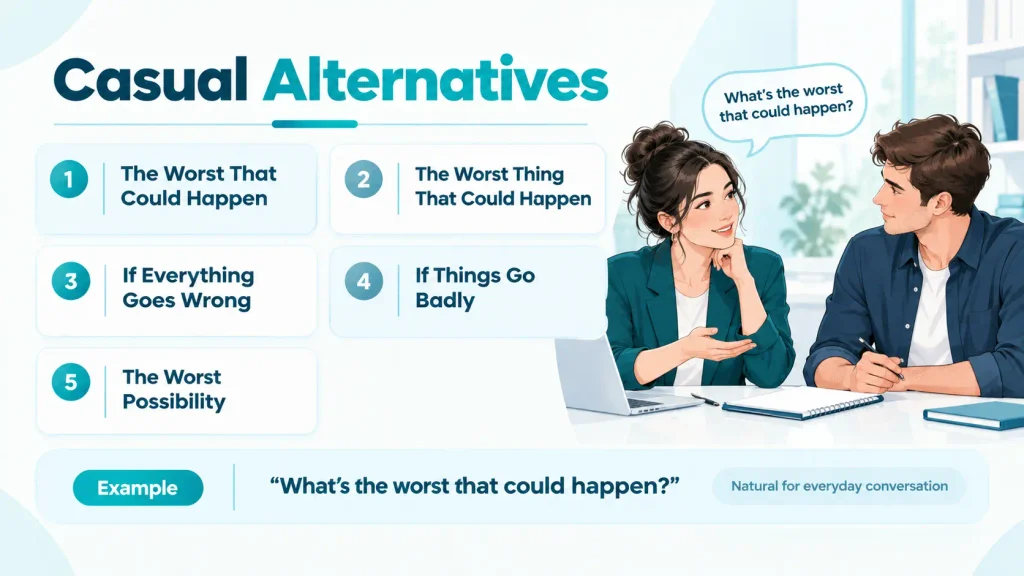
In everyday conversation, you can use simpler expressions:
- The worst that could happen
- The worst thing that could happen
- If everything goes wrong
- If things go badly
- The worst possibility
- If the situation takes a bad turn
For example:
What’s the worst-case scenario if we don’t finish today?
could become:
What’s the worst that could happen if we don’t finish today?
The second version sounds more conversational and natural in speech.
Alternatives for Risk and Planning
When discussing risks, you may want language that sounds objective rather than alarming.
Useful choices include:
- Worst-case outcome
- Most serious outcome
- Potential negative outcome
- Adverse outcome
- Unfavorable outcome
- Most severe consequence
- Highest-risk situation
For example:
The team identified the worst-case scenario during the planning meeting.
could be rewritten as:
The team identified the most serious potential outcome during the planning meeting.
This wording can be useful when writing reports or discussing risk without making the situation sound more dramatic than necessary.
Alternatives for “Worst Case Scenario” in a Sentence
Here are several examples showing how the wording changes naturally depending on context.
Casual
What’s the worst that could happen if we ask?
Professional
We should consider the worst possible outcome before proceeding.
Formal
The analysis should account for the most serious potential outcome.
Business
Our contingency plan addresses the worst-case outcome.
Risk Management
The team evaluated the most severe potential consequences.
General
We need to prepare for the possibility that things could go wrong.
Planning
Let’s make a backup plan in case everything goes wrong.
Common Mistakes When Replacing “Worst Case Scenario”
Treating “downside” as an exact synonym
“Downside” usually means a disadvantage or negative aspect of something. It does not necessarily mean the absolute worst thing that could happen.
For example:
One downside of moving is the longer commute.
This does not mean the longer commute is the worst possible outcome.
Using “negative outcome” when you mean the absolute worst outcome
A negative outcome can be any undesirable result.
If you mean the most extreme negative result, “worst possible outcome” or “worst-case outcome” is more precise.
Using overly formal language in casual conversation
A phrase such as “most severe potential consequence” may sound unnatural in a simple conversation.
Instead, say:
What’s the worst that could happen?
Confusing a scenario with an outcome
A scenario can describe a complete possible situation, while an outcome usually refers to what results from that situation.
Choosing the right term can make your writing more precise.
Frequently Asked Questions
What is another word for “worst case scenario”?
Common alternatives include worst possible outcome, worst-case outcome, worst that could happen, most serious outcome, most negative outcome, and unfavorable outcome.
What is a formal way to say “worst case scenario”?
For formal writing, “worst possible outcome,” “most serious outcome,” “most negative outcome,” or “most severe consequence” can work depending on the context.
What is a casual way to say “worst case scenario”?
“The worst that could happen” is one of the most natural casual alternatives.
For example:
What’s the worst that could happen?
Is “worst possible outcome” the same as “worst-case scenario”?
They are very similar, but not always identical. A worst-case scenario can describe an entire possible situation or chain of events, while a worst possible outcome focuses more specifically on the final result.
Is “negative outcome” the same as “worst-case scenario”?
Not exactly. A negative outcome is simply an undesirable result. A worst-case scenario refers to the most negative or difficult situation being considered.
Can I use “downside” instead of “worst-case scenario”?
Sometimes, but they are not exact synonyms. “Downside” normally refers to a disadvantage, while “worst-case scenario” refers to the most negative possible situation.
What is the best alternative to “worst case scenario” in professional writing?
“Worst possible outcome” and “worst-case outcome” are useful choices when you want to remain clear and professional. If the situation is more technical or analytical, “most serious outcome” may also fit.
Should “worst case scenario” have hyphens?
When it appears before a noun as a compound modifier, write “worst-case scenario.”
Example:
We need a worst-case scenario plan.
When used differently in a sentence, punctuation can depend on the grammatical construction. In standard American English, “worst-case scenario” is the common written form.
Final Thoughts
“Worst-case scenario” is already a natural and widely understood phrase, so you don’t always need to replace it. When you do want a different expression, choose one based on the meaning and tone you need.
For a close replacement, use “worst possible outcome” or “worst-case outcome.” For casual conversation, “the worst that could happen” sounds natural. In more formal or analytical writing, “most serious outcome,” “most negative outcome,” or “unfavorable outcome” may fit better.
The key is to choose a phrase that preserves the specific idea you mean rather than treating every negative expression as a perfect synonym.

Role: Author & Editorial Specialist
Sophia Williams serves as an Author at Elite’s Collective, bringing strong communication skills and fresh perspectives to the team through high-quality written content.