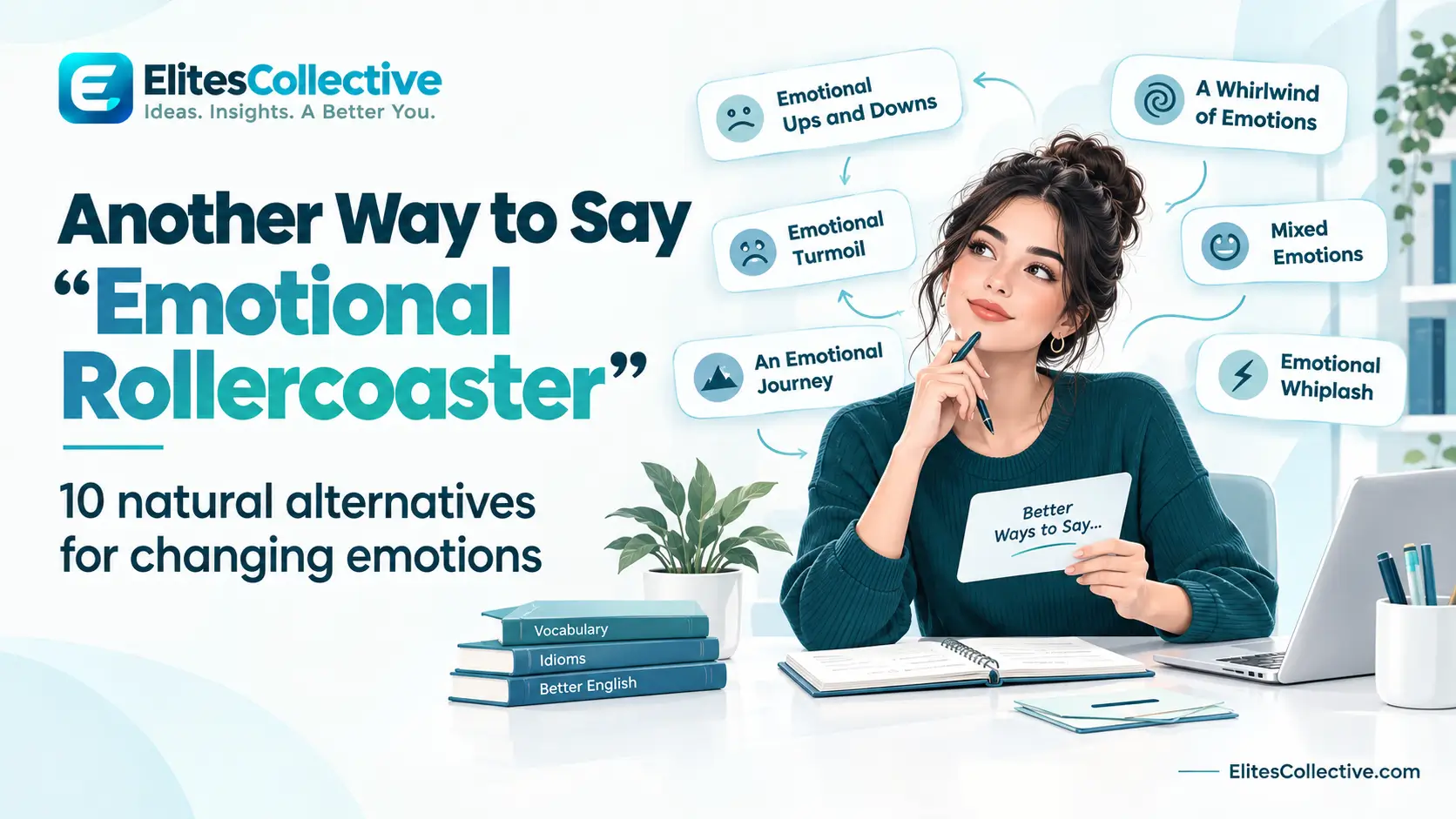
If you want another way to say “emotional rollercoaster,” you can use phrases such as emotional ups and downs, emotional turmoil, a whirlwind of emotions, an emotional journey, or a lot of mixed emotions. The best choice depends on whether you want to describe changing feelings, emotional stress, or a confusing mix of emotions.
Key Takeaways
- Emotional ups and downs is the closest everyday alternative.
- A whirlwind of emotions works well for intense, rapidly changing feelings.
- Emotional turmoil emphasizes distress or inner conflict.
- Mixed emotions is useful when several conflicting feelings exist at once.
- An emotional journey sounds more reflective and less negative.
- Some alternatives change the meaning slightly, so context matters.
What Does “Emotional Rollercoaster” Mean?
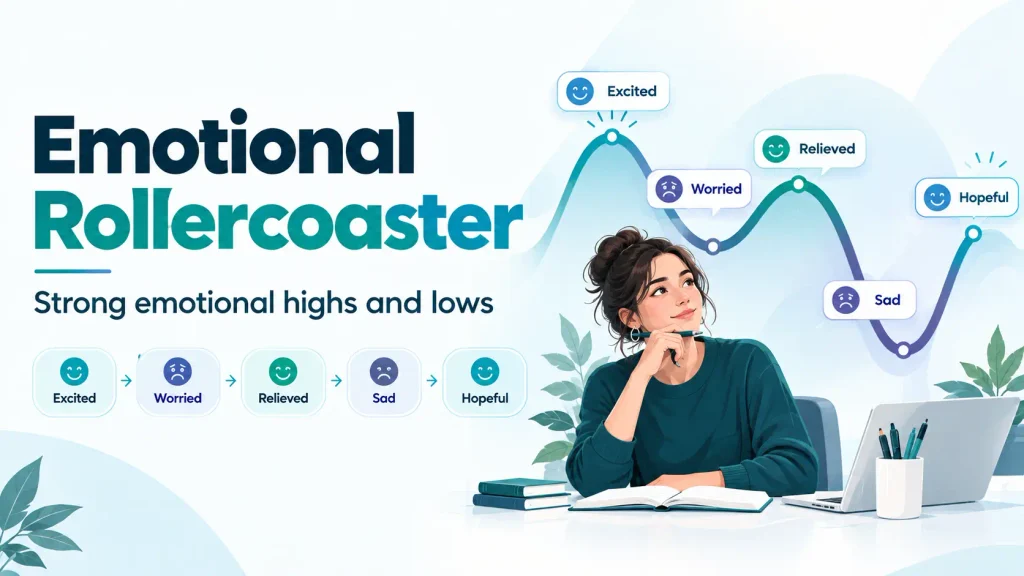
“Emotional rollercoaster” is an informal metaphor for a situation in which your feelings change dramatically or unpredictably. You might feel excited one moment, worried the next, and relieved shortly afterward.
The phrase is common in conversations about relationships, major life events, difficult decisions, stressful experiences, and unexpected news.
For example:
“The past few weeks have been an emotional rollercoaster.”
This suggests that the person has experienced several strong emotional changes during that period.
10 Natural Ways to Say “Emotional Rollercoaster”
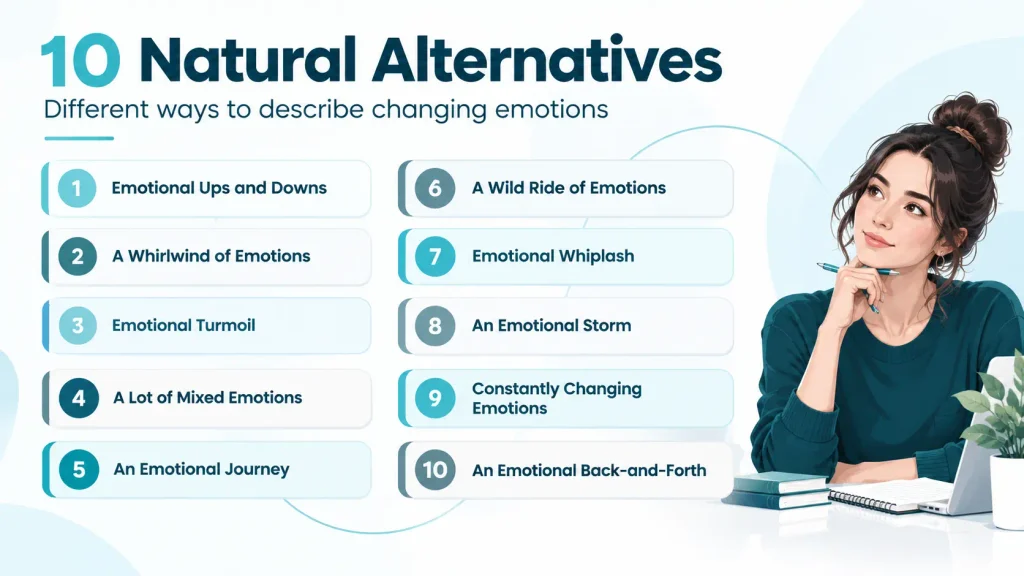
1. Emotional Ups and Downs
Meaning: Frequent changes between positive and negative emotions.
Best for: Everyday conversation and general writing.
Example:
“The last few months have been full of emotional ups and downs.”
This is one of the closest natural alternatives because it keeps the main idea of changing emotions without sounding overly dramatic.
2. A Whirlwind of Emotions
Meaning: A period when many strong feelings happen quickly or all at once.
Best for: Emotional, personal, or expressive writing.
Example:
“Moving to a new city was a whirlwind of emotions.”
Unlike “emotional ups and downs,” this phrase can describe many emotions without suggesting that they necessarily alternate between good and bad.
3. Emotional Turmoil
Meaning: A state of intense emotional distress, confusion, or inner conflict.
Best for: Serious or difficult situations.
Example:
“She experienced a lot of emotional turmoil after the breakup.”
This is stronger and more negative than “emotional rollercoaster,” so it should not be used when the experience was mostly exciting or positive.
4. A Lot of Mixed Emotions
Meaning: Experiencing several feelings that may conflict with each other.
Best for: Everyday and conversational English.
Example:
“I had a lot of mixed emotions when I accepted the new job.”
This works particularly well when you feel happy and nervous, excited and sad, or hopeful and uncertain at the same time.
5. An Emotional Journey
Meaning: A period involving meaningful emotional experiences or changes.
Best for: Reflective, personal, or thoughtful writing.
Example:
“Recovering from the setback was an emotional journey.”
This expression is usually less negative than “emotional rollercoaster.” It focuses more on the overall experience and personal growth.
6. A Ride of Emotions
Meaning: A series of changing or intense emotional experiences.
Best for: Casual and expressive writing.
Example:
“The entire experience was a wild ride of emotions.”
The phrase “a wild ride of emotions” sounds especially natural in casual American English. It keeps the energetic feeling of “emotional rollercoaster.”
7. Emotional Whiplash
Meaning: A sudden and sometimes confusing change in emotions caused by rapidly changing circumstances.
Best for: Informal and expressive situations.
Example:
“Going from hearing good news to getting bad news an hour later gave me emotional whiplash.”
This is a vivid expression, but it is not a direct synonym in every situation. It works best when the emotional change is particularly sudden.
8. An Emotional Storm
Meaning: A period of intense and difficult feelings.
Best for: Creative, descriptive, or emotional writing.
Example:
“He was caught in an emotional storm after the unexpected announcement.”
This phrase is more figurative and dramatic than “emotional ups and downs.”
9. Constantly Changing Emotions
Meaning: Feelings that keep shifting from one state to another.
Best for: Clear, direct writing.
Example:
“I’ve been dealing with constantly changing emotions lately.”
This is less idiomatic but very clear. It can be useful when you want the meaning to be immediately understandable.
10. An Emotional Back-and-Forth
Meaning: Repeated changes between different feelings, reactions, or emotional positions.
Best for: Relationships, decisions, and uncertain situations.
Example:
“Their relationship has involved a lot of emotional back-and-forth.”
This can describe changing feelings between people as well as internal uncertainty.
Which Alternative Should You Choose?
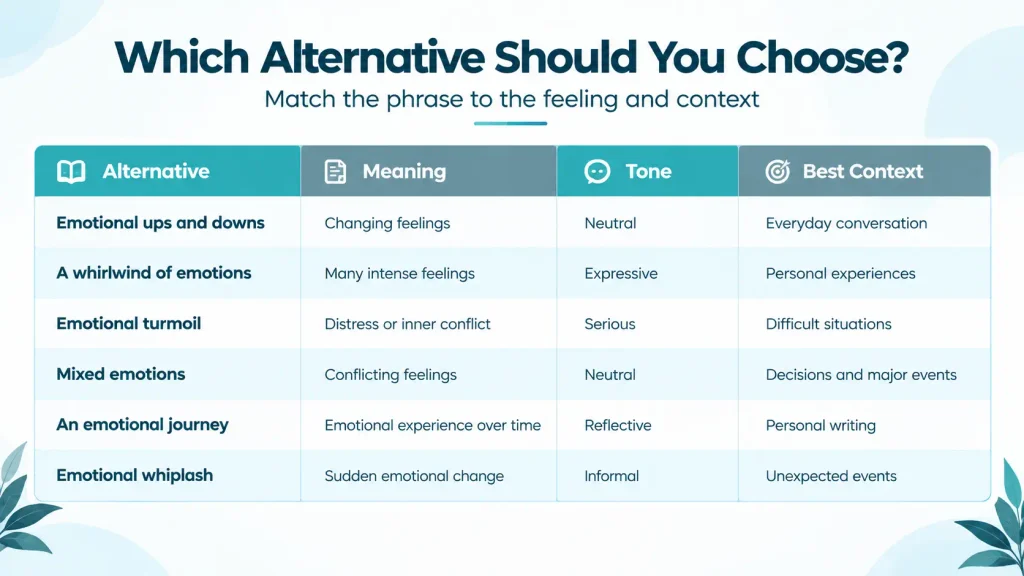
The right phrase depends on what you are trying to emphasize.
| Alternative | Main Meaning | Tone | Best Context |
| Emotional ups and downs | Changing feelings | Neutral | Everyday conversation |
| A whirlwind of emotions | Many intense feelings | Expressive | Personal experiences |
| Emotional turmoil | Distress or inner conflict | Serious | Difficult situations |
| Mixed emotions | Conflicting feelings | Neutral | Decisions and major events |
| An emotional journey | Emotional experience over time | Reflective | Personal writing |
| A wild ride of emotions | Intense emotional changes | Casual | Conversations |
| Emotional whiplash | Sudden emotional change | Informal | Unexpected events |
| An emotional storm | Intense emotional distress | Dramatic | Creative writing |
| Constantly changing emotions | Frequent emotional changes | Direct | General writing |
| Emotional back-and-forth | Repeated emotional shifts | Conversational | Relationships or uncertainty |
“Emotional Rollercoaster” vs. “Emotional Ups and Downs”
These expressions are very similar, but they create slightly different impressions.
“Emotional rollercoaster” is more vivid and dramatic. It suggests strong highs and lows.
“Emotional ups and downs” is simpler and more neutral. It works in everyday conversation without sounding overly dramatic.
Compare:
“The pregnancy journey was an emotional rollercoaster.”
“The pregnancy journey had its emotional ups and downs.”
Both sentences work, but the first feels more intense and expressive.
“Emotional Rollercoaster” vs. “Mixed Emotions”
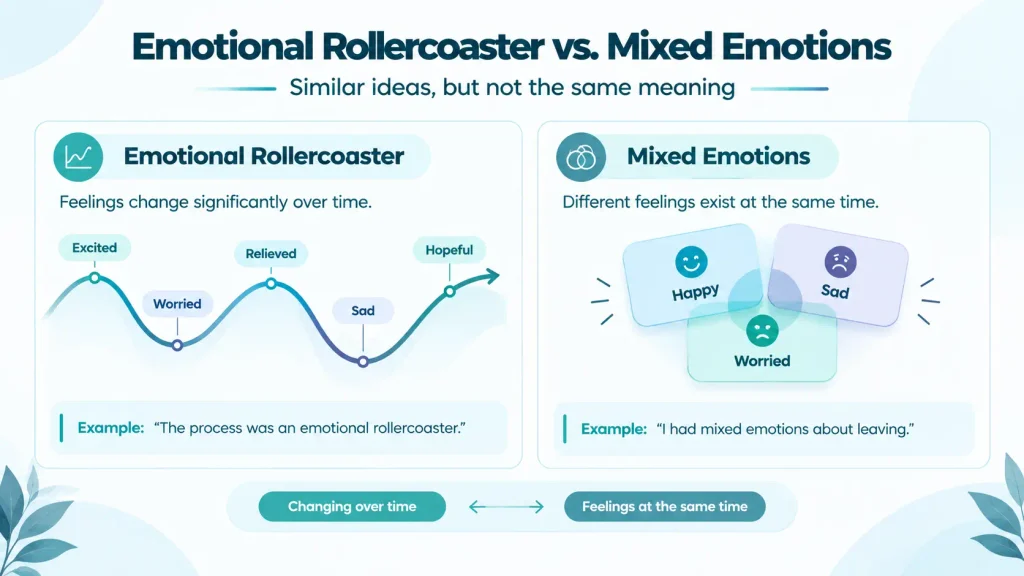
These phrases are not exact synonyms.
Mixed emotions means experiencing multiple feelings at the same time, especially feelings that conflict.
Emotional rollercoaster usually suggests that feelings change over time.
For example:
“I had mixed emotions about leaving my hometown.”
This means the person may feel excited about the future but sad about leaving.
By contrast:
“The process was an emotional rollercoaster.”
This suggests the person’s emotions changed significantly throughout the experience.
Common Mistakes to Avoid
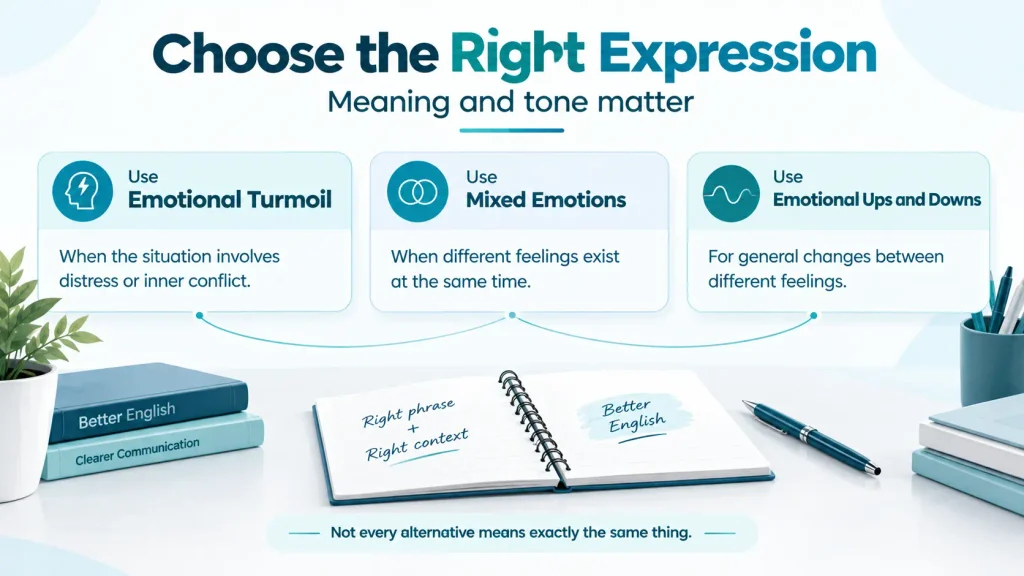
Using “emotional turmoil” for a positive experience
“Emotional turmoil” usually suggests distress, conflict, or suffering.
If someone had both exciting and difficult moments, emotional ups and downs or a whirlwind of emotions may be more accurate.
Treating “mixed emotions” as an exact replacement
“Mixed emotions” describes conflicting feelings, not necessarily emotional changes over time.
Using dramatic expressions in formal writing
Phrases such as “emotional rollercoaster,” “emotional whiplash,” and “wild ride of emotions” are generally more conversational.
For formal writing, a clearer phrase such as significant emotional changes may be more appropriate.
Choosing a phrase based only on intensity
Not every emotional experience is negative. If the experience includes happiness, excitement, sadness, and uncertainty, avoid alternatives that imply distress unless that is actually what you mean.
How to Use These Alternatives in a Sentence
Here are a few natural examples:
- “Starting college brought a lot of emotional ups and downs.”
- “The announcement created a whirlwind of emotions.”
- “He went through emotional turmoil after losing his job.”
- “I have mixed emotions about moving away.”
- “The recovery process has been an emotional journey.”
- “The whole week was a wild ride of emotions.”
- “The sudden change gave everyone emotional whiplash.”
- “She felt caught in an emotional storm.”
- “I’ve been experiencing constantly changing emotions.”
- “Their relationship has had a lot of emotional back-and-forth.”
Frequently Asked Questions
What is the closest synonym for “emotional rollercoaster”?
Emotional ups and downs is one of the closest natural alternatives. It describes repeated changes between different emotional states without adding a strong positive or negative judgment.
What is a more formal way to say “emotional rollercoaster”?
For formal writing, you could use significant emotional changes, emotional fluctuations, or a period of emotional uncertainty, depending on the meaning.
What is a casual way to say “emotional rollercoaster”?
A wild ride of emotions is a natural casual alternative. Emotional ups and downs also works well in everyday conversation.
Is “emotional turmoil” the same as “emotional rollercoaster”?
Not exactly. “Emotional turmoil” emphasizes distress, confusion, or inner conflict. “Emotional rollercoaster” can describe both positive and negative emotional changes.
Can I use “mixed emotions” instead of “emotional rollercoaster”?
Sometimes. Use “mixed emotions” when different feelings exist at the same time. Use “emotional rollercoaster” when feelings change significantly over a period of time.
What is a positive way to say “emotional rollercoaster”?
An emotional journey is a more positive or reflective option. A whirlwind of emotions can also work when the experience includes many strong but not necessarily negative feelings.
Is “emotional whiplash” formal?
No. “Emotional whiplash” is informal and vivid. It works best when describing a sudden shift from one emotional state to another.
Final Thoughts
“Emotional rollercoaster” is a flexible phrase, but the best alternative depends on the exact emotional experience. Choose emotional ups and downs for a neutral everyday expression, a whirlwind of emotions for many intense feelings, emotional turmoil for distress, and an emotional journey for a more reflective tone. For sudden changes, emotional whiplash can be especially effective.

Role: Author & Contributing Writer
Olivia Bennett is a dedicated Author at Elite’s Collective, focused on delivering clear, well-researched, and engaging articles tailored to the audience.