

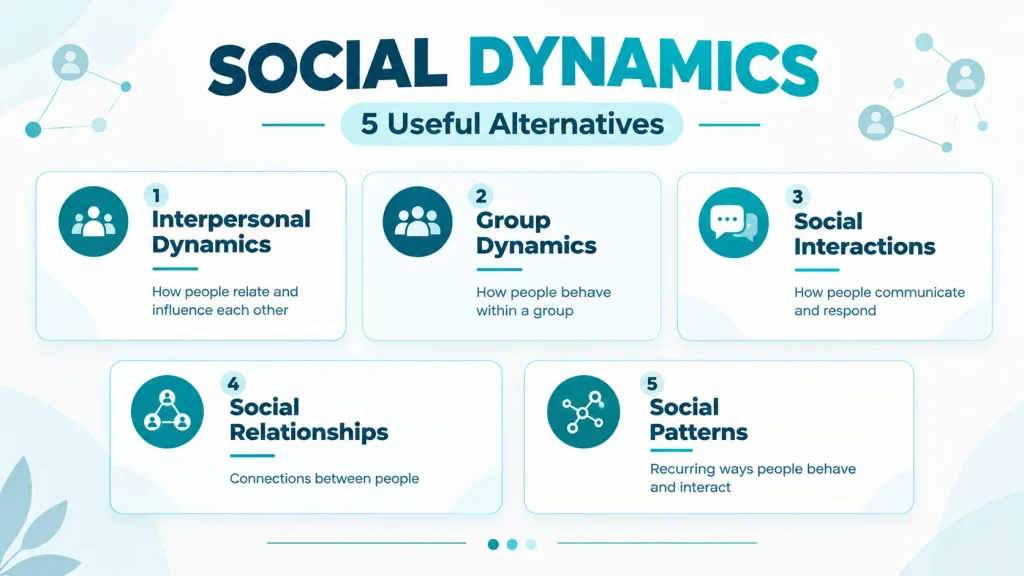
If you need another way to say social dynamics, the best choice depends on what you mean. Natural alternatives include interpersonal dynamics, group dynamics, social interactions, social relationships, social patterns, group behavior, and interpersonal relationships. Some are close synonyms, while others work better when you want to describe a specific part of how people interact.
Key Takeaways
- Interpersonal dynamics is one of the closest alternatives to social dynamics.
- Group dynamics works best when you’re discussing people within a group or team.
- Social interactions focuses on how people communicate and behave with one another.
- Social relationships emphasizes connections between people.
- Social patterns highlights repeated behaviors or trends.
- More descriptive phrases can make your writing clearer when the original term feels too broad.
What Does “Social Dynamics” Mean?
Social dynamics refers to the ways people interact, communicate, influence one another, and respond to changes within a social setting.
The phrase can describe relationships between two people, behavior within a group, or larger patterns in a community or society.
For example:
The manager wanted to understand the social dynamics within the team.
Here, social dynamics refers to how team members communicate, form relationships, influence one another, and respond to different personalities.
Because the phrase covers several ideas at once, there isn’t always one perfect synonym. The best replacement depends on the specific part of social behavior you want to emphasize.
10 Alternatives to “Social Dynamics”
1. Interpersonal Dynamics
Interpersonal dynamics is one of the closest alternatives to social dynamics. It focuses on how people relate to, communicate with, and influence each other.
Best for: Professional, academic, and general writing
Understanding interpersonal dynamics can help managers resolve conflicts within a team.
Use this phrase when your focus is on relationships or interactions between individuals.
2. Group Dynamics
Group dynamics describes how people behave and interact as members of a group. It can include communication, leadership, cooperation, conflict, and social roles.
Best for: Teams, workplaces, classrooms, clubs, and organizations
The new manager spent time observing the group dynamics before making changes.
This is more specific than social dynamics because it usually refers to people functioning together as a group.
3. Social Interactions
Social interactions refers to the ways people communicate and behave toward one another.
Best for: Everyday, academic, and educational writing
Regular social interactions can help people build stronger relationships.
This alternative is useful when you are talking about actual conversations, encounters, or exchanges rather than broader social patterns.
4. Social Relationships
Social relationships emphasizes the connections people have with one another.
Best for: Personal, academic, and social topics
Strong social relationships can contribute to a supportive community.
Choose this phrase when the relationships themselves matter more than the behavior surrounding them.
5. Interpersonal Relationships
Interpersonal relationships refers to relationships between people. It can include friendships, professional relationships, family connections, and other personal bonds.
Best for: Psychology, education, workplace communication, and formal writing
Good communication is essential for healthy interpersonal relationships.
This phrase is slightly different from social dynamics. It focuses more on relationships than on the changing patterns of interaction.
6. Social Patterns
Social patterns describes repeated or noticeable ways that people behave and interact within a group or society.
Best for: Research, sociology, education, and analytical writing
The study examined social patterns among young adults in urban communities.
This is a good choice when you’re discussing trends rather than individual interactions.
7. Group Behavior
Group behavior focuses on how people act when they are part of a group.
Best for: Psychology, education, workplace discussions, and research
The experiment explored how group behavior changes when new members join.
Unlike social dynamics, this phrase puts more emphasis on observable behavior within a group.
8. Social Relationships and Interactions
If social dynamics feels too broad, social relationships and interactions can make the meaning more explicit.
Best for: Educational and explanatory writing
The course explores social relationships and interactions in multicultural communities.
This isn’t a direct synonym, but it can be a clearer replacement when you want readers to understand exactly what you’re discussing.
9. How People Interact
For general readers, how people interact is often clearer and more natural than the more abstract term social dynamics.
Best for: Conversational, educational, and reader-friendly writing
The book examines how people interact in different social settings.
This is especially useful when you’re trying to avoid technical or academic language.
10. Patterns of Social Interaction
Patterns of social interaction refers to recurring ways people communicate, respond, cooperate, or behave toward one another.
Best for: Academic, research, and analytical writing
Researchers studied patterns of social interaction among students in the classroom.
This phrase works well when the focus is on repeated behaviors rather than one particular interaction.
Which Alternative Should You Use?
The right replacement depends on the meaning you want to emphasize.
| Alternative | Main Focus | Tone | Best Context |
| Interpersonal dynamics | How people influence and relate to each other | Neutral/Formal | Workplace, academic |
| Group dynamics | Behavior within a group | Neutral | Teams, organizations |
| Social interactions | Communication and exchanges | Neutral | Everyday, academic |
| Social relationships | Connections between people | Neutral | Social, personal |
| Interpersonal relationships | Relationships between individuals | Formal | Academic, professional |
| Social patterns | Recurring social behaviors | Formal | Research, analysis |
| Group behavior | How groups behave | Neutral/Formal | Psychology, education |
| Social relationships and interactions | Relationships and exchanges | Neutral | Educational |
| How people interact | General human interaction | Casual/Neutral | General audiences |
| Patterns of social interaction | Repeated interaction patterns | Formal | Research, academic |
How to Choose the Right Phrase
For workplace writing
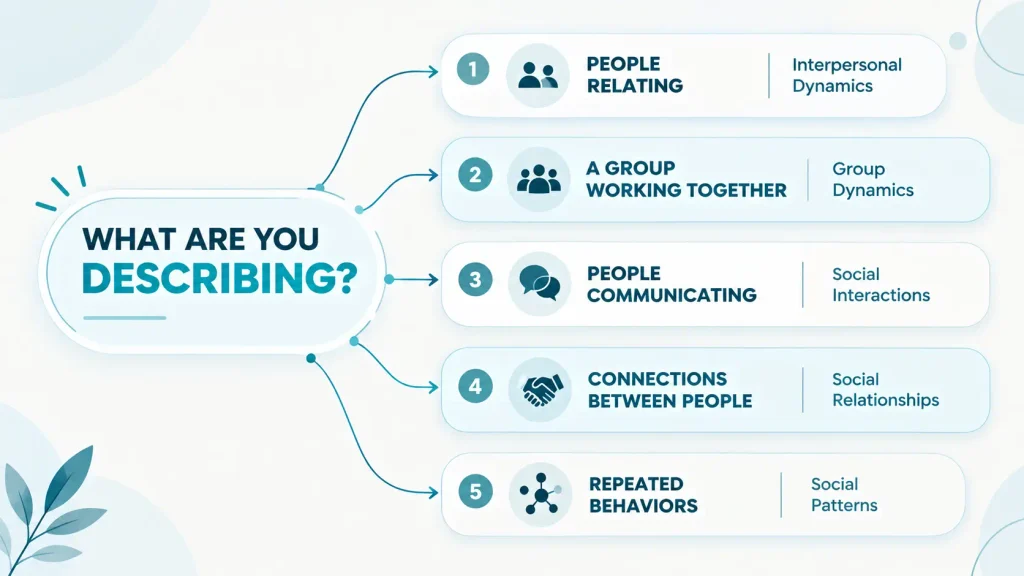
Use interpersonal dynamics or group dynamics when discussing how coworkers communicate, collaborate, or handle conflict.
The training program focuses on interpersonal dynamics in the workplace.
If you’re specifically talking about a team, group dynamics is usually more precise.
For academic writing
Social patterns, patterns of social interaction, and interpersonal relationships can work well in formal or research-based writing.
The researchers analyzed patterns of social interaction among college students.
These options make the subject more specific than the broad phrase social dynamics.
For everyday English
If you’re writing for a general audience, social interactions or how people interact may sound more natural.
The article explains how people interact in unfamiliar social situations.
You don’t always need a technical-sounding replacement when a simple phrase communicates the idea more clearly.
When discussing groups
Choose group dynamics when the setting involves a team, class, organization, club, or other defined group.
The coach noticed a change in the team’s group dynamics after the new players joined.
Calling this simply social relationships would miss part of the meaning because the focus is on how the group functions as a whole.
Social Dynamics vs. Group Dynamics
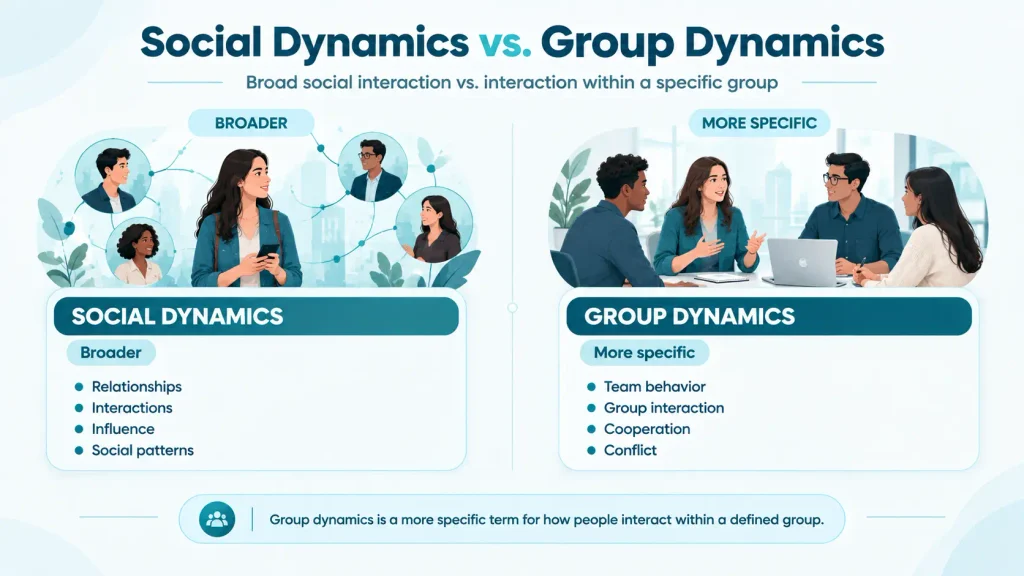
These expressions are related, but they aren’t interchangeable in every situation.
Social dynamics is broader. It can refer to interactions and relationships among people in many different settings.
Group dynamics is narrower. It usually describes how people behave and relate to one another within a particular group.
For example:
- The researcher studied the social dynamics of the community.
- The manager studied the group dynamics of the department.
The first can cover broader social relationships and patterns. The second focuses specifically on how members of a group function together.
Common Mistakes to Avoid
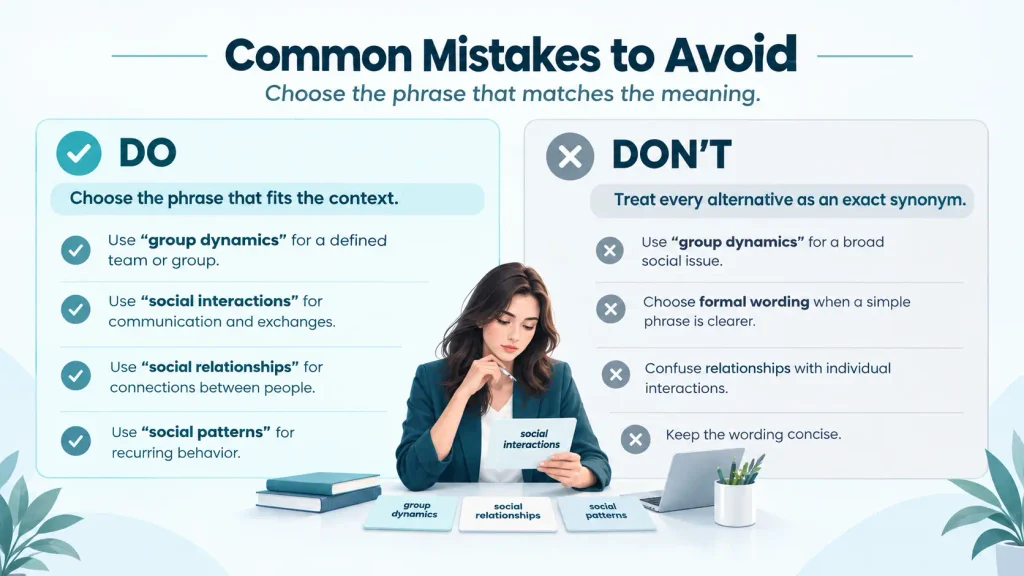
Treating every alternative as an exact synonym
Not every phrase above has exactly the same meaning. Group behavior, for example, focuses on behavior within groups, while social relationships focuses on connections between people.
Choose based on your intended meaning rather than simply replacing one phrase with another.
Using “group dynamics” for a broader social issue
If you’re discussing society as a whole, group dynamics may be too narrow.
The article examines social dynamics in modern communities.
Here, social dynamics can cover a wider range of relationships and behaviors.
Using formal language when simple language works
Interpersonal dynamics may be appropriate in a report, but how people interact can be easier for a general audience to understand.
Good writing isn’t about choosing the most sophisticated phrase. It’s about choosing the clearest one.
Confusing relationships with interactions
A relationship describes a connection between people. An interaction is an exchange or encounter between them.
Someone can have a professional relationship with a coworker without interacting with them every day.
Frequently Asked Questions
What is the closest synonym for “social dynamics”?
Interpersonal dynamics is one of the closest alternatives. It describes how people relate to, communicate with, and influence one another.
Is “group dynamics” the same as “social dynamics”?
Not exactly. Group dynamics focuses on interactions and behavior within a particular group, while social dynamics has a broader meaning.
What is a simple way to say “social dynamics”?
For a general audience, how people interact is a simple and natural alternative. Social interactions is another clear option.
What is a professional way to say “social dynamics”?
Interpersonal dynamics is a strong professional alternative, especially when discussing communication, relationships, teamwork, or workplace behavior.
What is another way to say “social dynamics in a group”?
Group dynamics is usually the most direct choice.
Can I use “social patterns” instead of “social dynamics”?
Sometimes. Social patterns works when you’re describing recurring behaviors or trends. It may not fully capture the idea of influence, relationships, or changing interactions.
Is “social interaction” or “social interactions” better?
Both are correct. Social interaction is often used for the general concept, while social interactions works when referring to multiple exchanges or types of interaction.
Final Thoughts
There isn’t one replacement for social dynamics that works in every sentence. Interpersonal dynamics is a close general alternative, group dynamics is better for teams and organizations, and social interactions works well when the focus is on communication and exchanges.
For broader analysis, social patterns or patterns of social interaction may be more precise. And when clarity matters most, simply saying how people interact can be the most natural choice.

Role: Author & Contributing Writer
Olivia Bennett is a dedicated Author at Elite’s Collective, focused on delivering clear, well-researched, and engaging articles tailored to the audience.