

If you’re looking for another way to say “point out,” the best choice depends on what you mean. Natural alternatives include “highlight,” “mention,” “note,” “indicate,” “identify,” “flag,” and “draw attention to.” Some work better in professional writing, while others fit everyday conversation.
Key Takeaways
- “Point out” can mean to mention something, draw attention to it, identify it, or indicate where something is.
- “Highlight” works well when emphasizing something important.
- “Mention” and “note” are useful when simply bringing information into a conversation or discussion.
- “Indicate” is more formal and often describes showing or signaling something.
- “Flag” is especially useful for problems, risks, or issues that need attention.
- No single synonym works in every sentence, so context matters.
What Does “Point Out” Mean?
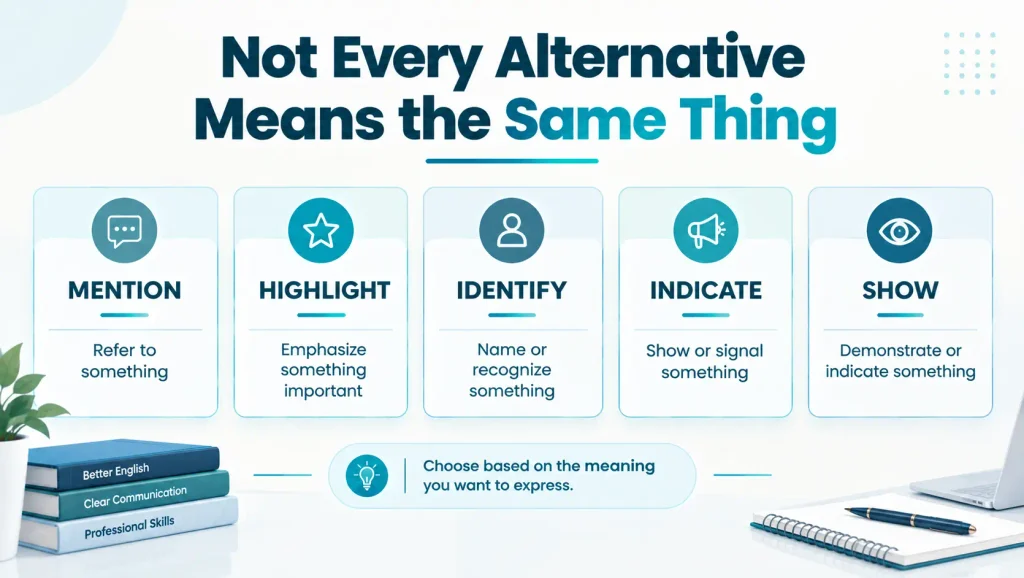
“Point out” is a phrasal verb with several related meanings. Most commonly, it means to draw someone’s attention to something, mention an important fact, or identify something clearly.
For example:
“She pointed out a mistake in the report.”
Here, “pointed out” means that she drew attention to the mistake.
It can also mean physically indicating something:
“He pointed out the building across the street.”
In this sentence, he showed someone which building he meant.
Because “point out” has more than one use, the best replacement depends on the context.
15 Other Ways to Say “Point Out”
1. Highlight
“Highlight” means to emphasize something because it is important, useful, or worth noticing.
Best for: Professional writing, presentations, reports, and important information.
Example:
“The report highlights several areas that need improvement.”
“Highlight” is often one of the closest alternatives when you want to emphasize an important point.
2. Mention
“Mention” means to refer to something briefly in speech or writing.
Best for: Everyday conversation, emails, discussions, and general writing.
Example:
“Sarah mentioned that the deadline had been moved.”
Unlike “point out,” “mention” does not necessarily suggest that the information is especially important or corrective.
3. Note
“Note” means to observe or call attention to a particular fact or detail.
Best for: Professional, academic, and formal writing.
Example:
“Please note that the office will be closed on Friday.”
“Note” is concise and often sounds more polished than “point out” in formal writing.
4. Indicate
“Indicate” means to show, signal, or suggest something.
Best for: Formal writing, reports, instructions, research, and factual statements.
Example:
“The results indicate that customer satisfaction has improved.”
Use “indicate” when something provides a sign or evidence of something rather than simply being mentioned.
5. Identify
“Identify” means to recognize, name, or specify something or someone.
Best for: Problems, causes, people, objects, and specific information.
Example:
“The audit identified several errors in the accounting records.”
“Identify” is particularly useful when “point out” means recognizing or naming a specific issue.
6. Flag
“Flag” means to draw attention to something that may require consideration or action.
Best for: Workplace communication, technical discussions, problems, risks, and potential issues.
Example:
“I wanted to flag a potential issue with the new schedule.”
“Flag” is common in professional American English, especially when bringing a problem or concern to someone’s attention.
7. Draw Attention to
“Draw attention to” means to make someone notice something.
Best for: Formal and professional communication.
Example:
“The manager drew attention to the importance of meeting the deadline.”
This is a very close alternative to “point out” when the main idea is making something noticeable.
8. Bring to Someone’s Attention
This phrase means to make someone aware of something.
Best for: Professional emails, formal communication, complaints, and workplace situations.
Example:
“I’d like to bring this issue to your attention.”
It sounds more formal and deliberate than “point out.”
9. Emphasize
“Emphasize” means to give special importance to something.
Best for: Speeches, presentations, academic writing, professional communication, and persuasive contexts.
Example:
“The professor emphasized the importance of checking the data carefully.”
Use “emphasize” when the speaker wants people to understand that something is especially important.
10. Call Attention to
“Call attention to” means to deliberately make people notice something.
Best for: Formal writing, announcements, discussions, and public communication.
Example:
“The article calls attention to the challenges faced by small businesses.”
This phrase is close to “draw attention to,” but it can sound more deliberate or formal.
11. Bring Up
“Bring up” means to introduce a subject into a conversation or discussion.
Best for: Casual and conversational English.
Example:
“I’m glad you brought up the budget issue.”
“Bring up” is not an exact synonym for every use of “point out.” It works when the meaning is closer to introducing or mentioning a topic.
12. Specify
“Specify” means to state something clearly and exactly.
Best for: Instructions, requirements, contracts, technical writing, and professional communication.
Example:
“The instructions specify which documents applicants need to provide.”
Use “specify” when “point out” means clearly identifying particular details or requirements.
13. Observe
“Observe” can mean to make a comment about something that has been noticed.
Best for: Formal, academic, analytical, and professional writing.
Example:
“The researcher observed that the two groups responded differently.”
“Observe” can sound more analytical than “point out,” so it is most natural when the speaker is making an observation rather than simply drawing attention to a fact.
14. Mention Specifically
“Mention specifically” means to refer to a particular person, fact, issue, or detail rather than discussing something generally.
Best for: Clarifying information and professional or academic writing.
Example:
“The instructions specifically mention that applications must be submitted online.”
This works when you want to stress that a particular detail has been explicitly included.
15. Show
“Show” can replace “point out” when the meaning is to indicate or demonstrate something.
Best for: Physical directions, demonstrations, evidence, and simple explanations.
Example:
“Can you show me where the nearest entrance is?”
In this context, “show” is more natural than a formal alternative such as “indicate.”
Quick Comparison: Which Alternative Should You Use?
| Alternative | Main Use | Tone | Best Context |
| Highlight | Emphasize importance | Neutral/Professional | Reports, presentations |
| Mention | Refer to something | Neutral | Conversation, emails |
| Note | Call attention to a fact | Formal | Professional or academic writing |
| Indicate | Show or signal | Formal | Reports, data, instructions |
| Identify | Name or recognize | Neutral/Professional | Problems, causes, details |
| Flag | Draw attention to an issue | Professional | Workplace communication |
| Draw attention to | Make something noticeable | Formal | Professional writing |
| Bring to someone’s attention | Make someone aware | Formal | Emails, workplace communication |
| Emphasize | Stress importance | Neutral/Formal | Presentations, writing |
| Call attention to | Deliberately highlight | Formal | Articles, announcements |
| Bring up | Introduce a topic | Casual | Conversations |
| Specify | State exactly | Formal | Instructions, requirements |
| Observe | Make an analytical comment | Formal | Academic or professional writing |
| Mention specifically | Refer to a particular detail | Neutral/Formal | Clarification |
| Show | Indicate or demonstrate | Neutral | Directions, explanations |
How to Choose the Right Alternative
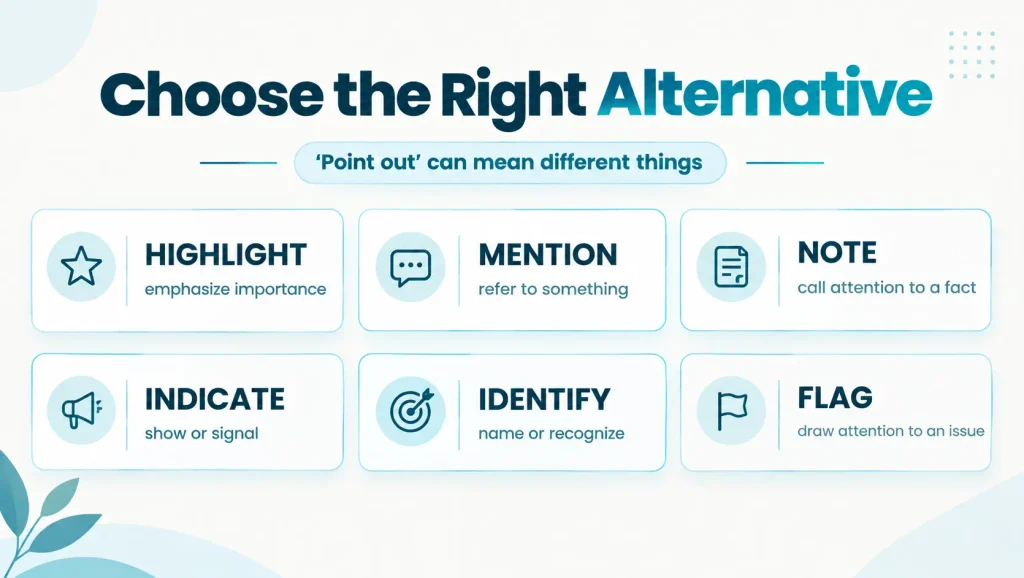
The easiest way to choose a replacement is to ask what “point out” is doing in your sentence.
If you mean “emphasize something”
Use:
- Highlight
- Emphasize
- Call attention to
- Draw attention to
Original:
“The manager pointed out the importance of accurate records.”
Alternative:
“The manager emphasized the importance of accurate records.”
If you mean “mention something”
Use:
- Mention
- Note
- Bring up
Original:
“She pointed out that the meeting had been rescheduled.”
Alternative:
“She mentioned that the meeting had been rescheduled.”
If you mean “identify a problem”
Use:
- Identify
- Flag
- Highlight
- Bring to someone’s attention
Original:
“The technician pointed out a problem with the system.”
Alternative:
“The technician flagged a problem with the system.”
If you mean “show where something is”
Use:
- Show
- Indicate
Original:
“He pointed out the correct entrance.”
Alternative:
“He showed us the correct entrance.”
If you mean “state something clearly”
Use:
- Specify
- Note
- Indicate
Original:
“The policy points out which documents are required.”
Alternative:
“The policy specifies which documents are required.”
“Point Out” in Professional Writing
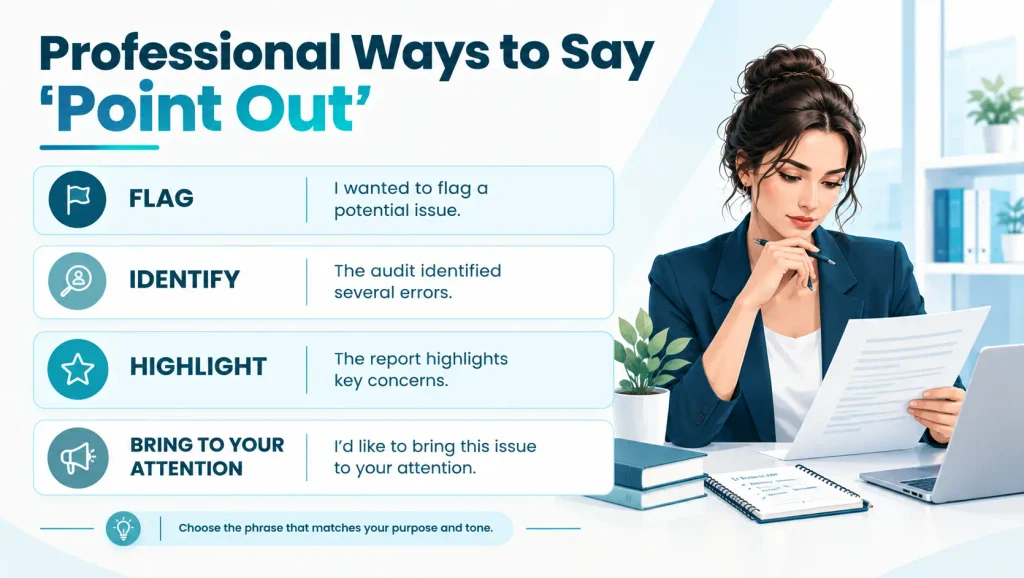
“Point out” is perfectly acceptable in professional English, but another expression may sometimes sound more precise.
For example:
Less precise:
“The report points out some problems.”
More specific:
“The report identifies several problems.”
Or:
Less specific:
“I wanted to point out a potential issue.”
Professional:
“I wanted to flag a potential issue.”
Or:
Formal:
“I’d like to bring this issue to your attention.”
The best choice depends on what you are trying to communicate, not simply on how formal you want the sentence to sound.
Common Mistakes to Avoid
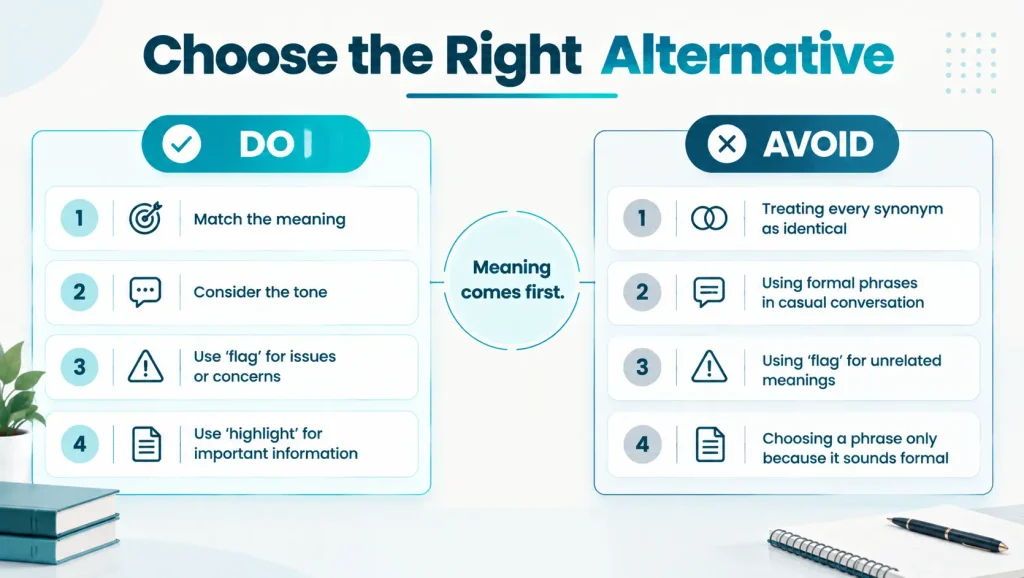
Treating every synonym as interchangeable
“Mention,” “highlight,” “identify,” and “indicate” overlap with “point out,” but they do not always mean exactly the same thing.
For example, “mention” usually means referring to something, while “highlight” suggests giving it special attention.
Using overly formal language in casual conversation
A sentence like:
“I would like to bring this matter to your attention.”
may be appropriate in a formal email, but it can sound stiff in a casual conversation.
In everyday speech, you might simply say:
“I wanted to point something out.”
Using “flag” for everything
“Flag” is especially natural for issues, risks, concerns, or items that need attention. It is not always the best replacement for “point out.”
For example:
“She flagged a potential error.”
sounds natural.
But:
“She flagged where the restaurant was.”
is not a natural replacement for “pointed out where the restaurant was.”
Forgetting the difference between “indicate” and “identify”
“Indicate” often means to show or signal something, while “identify” means to recognize, name, or establish what something is.
Compare:
“The results indicate a possible problem.”
with:
“The technician identified the problem.”
The first suggests evidence or a sign; the second says the problem was recognized.
Frequently Asked Questions
What is the most common synonym for “point out”?
“Highlight,” “mention,” “note,” and “indicate” are common alternatives, but the best choice depends on the sentence. “Highlight” works especially well when you want to emphasize something important.
What is a professional way to say “point out”?
“Highlight,” “note,” “identify,” “flag,” and “bring to your attention” can work well in professional communication. Choose based on whether you’re emphasizing information, identifying a problem, or formally notifying someone.
Is “highlight” the same as “point out”?
Not always. “Highlight” usually emphasizes something as important or noteworthy. “Point out” has a broader meaning and can also mean simply mentioning, identifying, or indicating something.
What is a casual way to say “point out”?
“Mention” and “bring up” can work in casual conversation, depending on the meaning. “Show” is also natural when you’re indicating the location of something.
Can I use “indicate” instead of “point out”?
Yes, in some contexts. “Indicate” is particularly appropriate when something shows, signals, or suggests information. It may sound more formal than “point out.”
What is another way to say “point out a problem”?
Natural choices include “identify a problem,” “flag a problem,” “highlight a problem,” and “bring a problem to someone’s attention.” “Flag” is especially common in workplace communication.
What is another way to say “point out a mistake”?
You can say “identify a mistake,” “highlight a mistake,” “note a mistake,” or “call attention to a mistake.” The best choice depends on whether you want the wording to sound neutral, formal, or direct.
Final Thoughts
“Point out” is a flexible expression, so the best alternative depends on your exact meaning. Use “highlight” or “emphasize” when stressing importance, “mention” or “bring up” when referring to a topic, “identify” when naming a problem, “flag” when drawing attention to a concern, and “indicate” or “show” when signaling or demonstrating something.
Choosing the right alternative is less about finding a perfect synonym and more about matching the phrase to the meaning, tone, and situation

Role: Author & Editorial Specialist
Sophia Williams serves as an Author at Elite’s Collective, bringing strong communication skills and fresh perspectives to the team through high-quality written content.