
If you want another way to say “very interested,” try “fascinated,” “eager to learn more,” “deeply interested,” or “enthusiastic about.” The best alternative depends on what you mean. Some phrases express curiosity, while others show excitement, strong attention, or a desire to take action.
Key Takeaways
- “Fascinated” expresses strong curiosity or interest in a subject.
- “Enthusiastic about” emphasizes excitement and positive energy.
- “Eager to learn more” shows curiosity and a desire for more information.
- “Deeply interested in” works well in formal and professional writing.
- “Intrigued by” suggests that something has caught your attention.
- “Passionate about” expresses a strong, lasting interest in something important to you.
What Does “Very Interested” Mean?
“Very interested” means having a strong desire to know more about something, learn about it, take part in it, or give it your attention.
The phrase can describe curiosity, excitement, or personal involvement.
For example:
- I’m very interested in learning Spanish.
- She’s very interested in the new job opportunity.
- He was very interested in the scientific discovery.
Depending on the situation, you might want a phrase that sounds more enthusiastic, professional, curious, or personal.
20 Other Ways to Say Very Interested
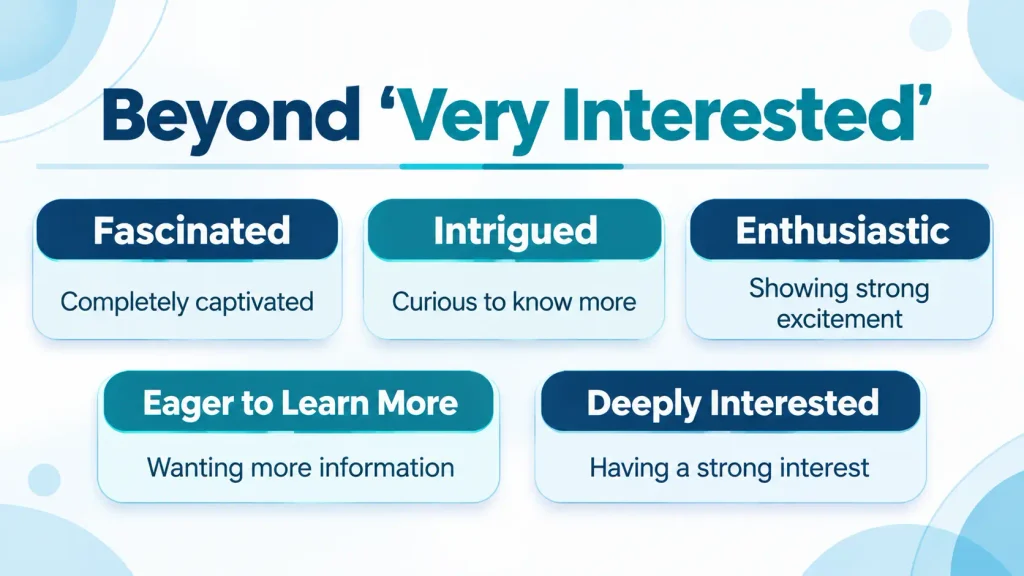
Here are 20 natural alternatives that work in different situations.
1. Fascinated
“Fascinated” means extremely interested in something because it is unusual, exciting, or captivating.
Best for: Strong curiosity, learning, and discovery.
Example: I’m fascinated by how the human brain works.
2. Intrigued
“Intrigued” means interested because something is mysterious, unusual, or makes you want to know more.
Best for: Curiosity and situations involving something unexpected.
Example: The unusual business idea intrigued me.
3. Deeply Interested
“Deeply interested” expresses a strong and serious interest in a subject.
Best for: Formal writing, academic discussions, and professional communication.
Example: I am deeply interested in environmental research.
4. Eager to Learn More
This phrase shows that you are interested and actively want additional information.
Best for: Interviews, professional conversations, and educational settings.
Example: I’m eager to learn more about your company’s approach to customer service.
5. Enthusiastic About
“Enthusiastic about” means feeling excited and positive about something.
Best for: Work, hobbies, projects, and opportunities.
Example: She’s enthusiastic about joining the marketing team.
6. Passionate About
“Passionate about” describes a strong, often lasting interest that matters to you personally.
Best for: Personal interests, career goals, and meaningful causes.
Example: He is passionate about helping young students succeed.
7. Keen on
“Keen on” is a natural way to express strong interest or enthusiasm, especially in British English. It is also understood and used in American English.
Best for: Casual conversations and expressing preferences.
Example: I’m keen on exploring new photography techniques.
8. Captivated By
“Captivated by” means so interested that something holds your attention.
Best for: Stories, performances, experiences, and compelling ideas.
Example: The audience was captivated by her presentation.
9. Absorbed In
“Absorbed in” describes being deeply involved in something that holds your attention.
Best for: Reading, studying, working, or concentrating.
Example: She was completely absorbed in her research.
10. Engrossed In
“Engrossed in” means giving something your full attention because it is highly interesting.
Best for: Activities, books, work, and detailed tasks.
Example: He was engrossed in the documentary.
11. Curious About
“Curious about” means wanting to understand or discover something.
Best for: Everyday conversations and learning.
Example: I’m curious about how this new technology works.
12. Excited About
“Excited about” expresses enthusiasm and positive feelings about something.
Best for: New opportunities, events, plans, and experiences.
Example: I’m excited about the upcoming conference.
13. Highly Interested In
“Highly interested in” is a direct and professional alternative that emphasizes the strength of your interest.
Best for: Business communication, applications, and formal discussions.
Example: We are highly interested in exploring a potential partnership.
14. Intrinsically Motivated By
This phrase describes an interest driven by personal enjoyment or internal motivation rather than external rewards.
Best for: Academic, professional, and motivational contexts.
Example: She is intrinsically motivated by the opportunity to solve complex problems.
15. Eager to Explore
“Eager to explore” shows that you are excited to investigate or experience something further.
Best for: New ideas, opportunities, and unfamiliar subjects.
Example: I’m eager to explore the possibilities of artificial intelligence.
16. Drawn To
“Drawn to” means naturally attracted to or interested in something.
Best for: Personal preferences, creative interests, and emotional connections.
Example: I’ve always been drawn to stories about human resilience.
17. Invested In
“Invested in” suggests that you care deeply about something and have committed time, energy, or effort to it.
Best for: Projects, relationships, and professional goals.
Example: Our team is deeply invested in the success of this project.
18. Attentive To
“Attentive to” means paying close attention to something.
Best for: Listening, communication, and professional situations.
Example: The manager was attentive to the customer’s concerns.
19. Highly Engaged With
“Highly engaged with” means actively involved and interested in a subject, activity, or discussion.
Best for: Work, education, and group activities.
Example: Students are highly engaged with the interactive lessons.
20. Enthralled By
“Enthralled by” means completely fascinated or captivated by something.
Best for: Stories, performances, and extraordinary experiences.
Example: The children were enthralled by the magician’s performance.
Best Alternatives for Different Situations
Not every alternative to “very interested” works in every context. The following comparison can help you choose the right expression.
| Alternative | Meaning or Use | Tone |
|---|---|---|
| Fascinated by | Strong curiosity | Expressive |
| Intrigued by | Curious and interested | Neutral |
| Eager to learn more | Wants more information | Professional |
| Deeply interested in | Serious interest | Formal |
| Enthusiastic about | Excited and positive | Friendly |
| Passionate about | Strong personal interest | Emotional |
| Captivated by | Attention completely held | Expressive |
| Curious about | Wants to understand | Casual |
| Highly interested in | Strong professional interest | Formal |
| Engrossed in | Fully focused | Neutral |
Professional Ways to Say Very Interested
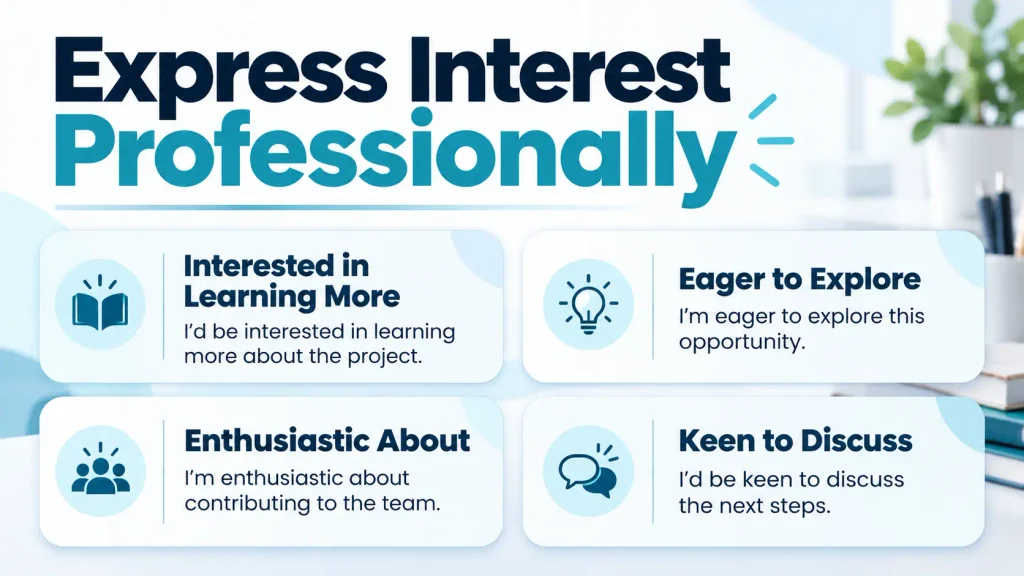
When writing a professional email, cover letter, or job application, choose language that sounds confident and natural.
Here are some useful examples:
- I am eager to learn more about the opportunity.
- I am highly interested in this position.
- I would welcome the opportunity to discuss this further.
- I am enthusiastic about the possibility of joining your team.
- I am deeply interested in contributing to this project.
For example, instead of writing:
“I’m very interested in your company.”
You could write:
“I’m enthusiastic about the opportunity to contribute to your team and learn more about your company’s goals.”
The second version communicates interest while showing a willingness to participate.
Casual Ways to Say Very Interested
In everyday conversations, shorter and more expressive phrases often sound more natural.
| Phrase | Example |
|---|---|
| Really into | I’m really into photography lately. |
| Hooked on | I’m hooked on this new TV show. |
| All about | She’s all about learning new languages. |
| Can’t get enough of | I can’t get enough of these history podcasts. |
| Super curious about | I’m super curious about what happens next. |
These expressions are more casual. For example, “hooked on” can suggest that something is so enjoyable that you keep returning to it.
Common Mistakes When Using Alternatives
Using “Passionate About” for Every Situation
“Passionate about” expresses a strong personal connection. It may sound exaggerated when you simply want to learn more about something.
Instead of:
“I’m passionate about your new spreadsheet.”
Try:
“I’m interested in learning more about your new spreadsheet.”
Confusing “Intrigued” With “Excited”
“Intrigued” focuses on curiosity. “Excited” focuses on positive feelings and anticipation.
For example:
- I’m intrigued by the proposal. (I want to understand it.)
- I’m excited about the proposal. (I feel positive about it.)
Using “Absorbed” to Describe a Future Opportunity
“Absorbed in” usually describes something you are already deeply involved in.
Less natural: “I’m absorbed in joining the company.”
More natural: “I’m eager to join the company.”
Using Casual Expressions in Formal Writing
Phrases such as “really into” and “hooked on” are natural in conversations but may sound too informal in a job application.
Use “deeply interested in” or “enthusiastic about” instead.
FAQs
What is the best synonym for very interested?
“Fascinated” is a strong choice when you mean extremely curious about something. “Enthusiastic about” is better when you want to express excitement, while “deeply interested in” works well in formal writing.
How do you say very interested professionally?
You can say “highly interested in,” “eager to learn more,” “enthusiastic about,” or “deeply interested in.” These expressions work well in emails, interviews, and professional discussions.
What is a stronger word than interested?
“Fascinated,” “captivated,” and “enthralled” can express a stronger level of interest. “Passionate” is also strong, but it suggests a deeper personal connection.
What is another way to say very interested in someone?
Depending on the context, you could say “attracted to,” “drawn to,” or “fascinated by.” If you mean romantic interest, “attracted to” is usually the clearest choice.
What is a casual way to say very interested?
“Really into,” “super curious about,” and “hooked on” are natural casual expressions.
For example: “I’m really into learning about space.”
Is “keen on” American English?
“Keen on” is understood in American English, but it is more common in British English. In the United States, “really interested in” or “enthusiastic about” may sound more familiar in everyday speech.
What is the difference between interested and intrigued?
“Interested” means you want to know more about something. “Intrigued” suggests that something has caught your attention because it is unusual, mysterious, or especially thought-provoking.
Conclusion
The best alternative to “very interested” depends on the meaning you want to express.
Use “fascinated” for strong curiosity, “enthusiastic about” for excitement, “deeply interested in” for serious interest, and “eager to learn more” when you want to show curiosity and initiative.
Choosing the right expression helps you communicate your interest more clearly and naturally in both everyday conversations and professional writing.

Role: Lead Author & Content Specialist
James Mitchell is an experienced Lead Author at Elite’s Collective. He specializes in creating high-impact editorial content and driving core written projects designed to inform and engage readers.