A negative impact is a harmful or unwanted effect on a person, situation, organization, or environment. Other ways to say “negative impact” include adverse effect, harmful effect, detrimental effect, damaging influence, and unwanted consequence. The best alternative depends on how serious the effect is and whether you’re writing formally, speaking casually, or discussing a specific problem.
Key Takeaways
- Adverse effect is a strong choice for formal and professional writing.
- Harmful effect is a clear, everyday alternative.
- Detrimental effect works well in academic and business contexts.
- Damaging influence emphasizes the power of something to cause harm.
- Unwanted consequence focuses on an undesirable result.
- The right phrase depends on the type and severity of the effect.
What Does Negative Impact Mean?
A negative impact is an effect that causes harm, creates problems, or makes a situation worse.
The phrase can describe many kinds of harm, including financial losses, emotional stress, environmental damage, poor performance, or changes that affect people’s lives.
For example:
- The new policy had a negative impact on employee morale.
- Air pollution has a negative impact on public health.
- The delay created a negative impact on the company’s profits.
Although “negative impact” is widely understood, using a more precise expression can make your writing clearer and more natural.
15 Other Ways to Say Negative Impact
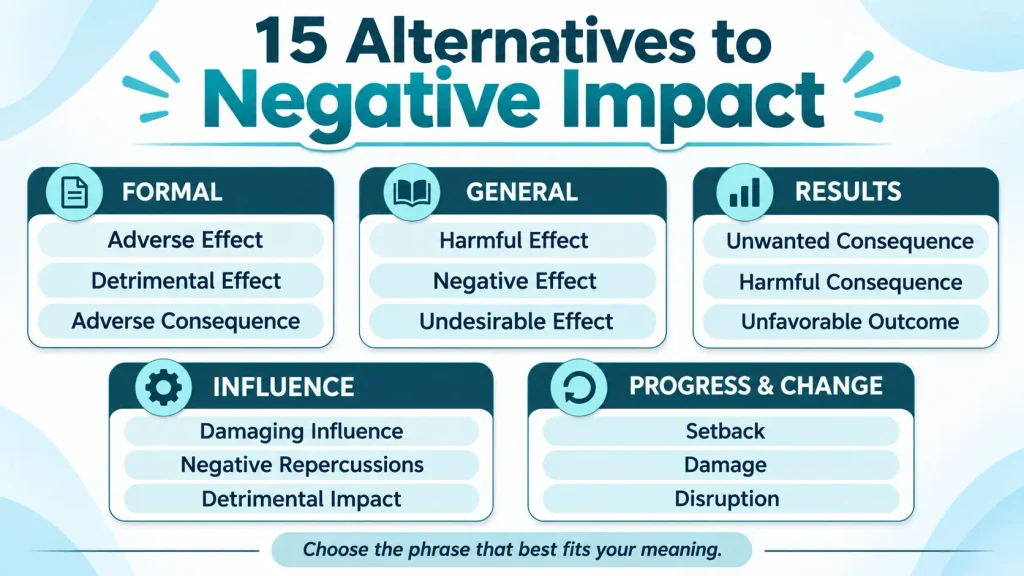
These alternatives can help you express the same general idea without repeating the phrase “negative impact.”
1. Adverse Effect
An adverse effect is an unwanted or harmful result. It is one of the most natural alternatives in formal, academic, and professional writing.
Best for: Research, reports, business communication, and formal discussions.
Example: The new regulations had an adverse effect on small businesses.
2. Harmful Effect
A harmful effect is a result that causes damage or makes something worse. It is a direct, easy-to-understand alternative.
Best for: Everyday English, educational writing, and general explanations.
Example: Too much screen time can have a harmful effect on sleep quality.
3. Detrimental Effect
A detrimental effect is a result that causes harm or reduces the quality, value, or success of something.
It sounds slightly more formal than “harmful effect.”
Best for: Academic papers, professional reports, and formal essays.
Example: Poor communication can have a detrimental effect on team performance.
4. Damaging Influence
A damaging influence describes something that negatively affects the behavior, development, or condition of a person or situation.
Best for: Discussions about relationships, behavior, decisions, and social issues.
Example: Negative peer pressure can have a damaging influence on young people.
5. Unwanted Consequence
An unwanted consequence is an undesirable result of an action, decision, or event.
It emphasizes the result rather than the harm itself.
Best for: Business decisions, planning, and problem-solving.
Example: The company introduced the new system without considering its unwanted consequences.
6. Harmful Consequence
A harmful consequence is a result that causes damage, difficulty, or suffering.
Best for: Formal and informal writing.
Example: Ignoring customer complaints can have harmful consequences for a business.
7. Negative Effect
A negative effect is a general expression for an undesirable result. It is very close in meaning to “negative impact.”
Best for: Everyday conversation, essays, and professional writing.
Example: The construction project had a negative effect on local traffic.
8. Undesirable Effect
An undesirable effect is a result that is not wanted or preferred.
It can be useful when the outcome is inconvenient or disappointing but not necessarily severe.
Best for: Neutral and formal discussions.
Example: The change in schedule produced an undesirable effect on employee productivity.
9. Detrimental Impact
A detrimental impact is a harmful influence or effect that makes a situation worse.
It is similar to “negative impact,” but it uses a more formal adjective.
Best for: Academic writing, business reports, and formal presentations.
Example: Rising costs can have a detrimental impact on the company’s growth.
10. Setback
A setback is a problem or difficulty that delays progress or makes success harder to achieve.
Unlike “negative impact,” it usually focuses on a delay or obstacle.
Best for: Career, business, education, and personal progress.
Example: The unexpected expenses were a major setback for the project.
11. Damage
Damage refers to physical, emotional, financial, or other harm caused to something.
It is more direct and can sound stronger than “negative impact.”
Best for: Situations involving clear harm or loss.
Example: The storm caused significant damage to the local economy.
12. Disruption
A disruption is an interruption that prevents something from continuing normally.
It does not always mean permanent harm, so it is useful when the effect is temporary.
Best for: Workplaces, services, technology, and daily activities.
Example: The power outage caused a major disruption to business operations.
13. Adverse Consequence
An adverse consequence is an unfavorable or harmful result of an action or decision.
It is particularly useful when explaining the outcomes of a choice.
Best for: Formal reports, policy discussions, and academic writing.
Example: Failing to plan ahead may lead to adverse consequences.
14. Negative Repercussions
Negative repercussions are harmful or unwanted results that follow an action or event.
The phrase often suggests that the consequences may appear later.
Best for: Professional writing, public discussions, and decision-making.
Example: The company faced negative repercussions after the announcement.
15. Unfavorable Outcome
An unfavorable outcome is a result that is not beneficial or does not meet expectations.
It is often more neutral than “harmful effect.”
Best for: Business, education, negotiations, and general discussions.
Example: The lack of preparation led to an unfavorable outcome.
Best Alternatives for Different Contexts
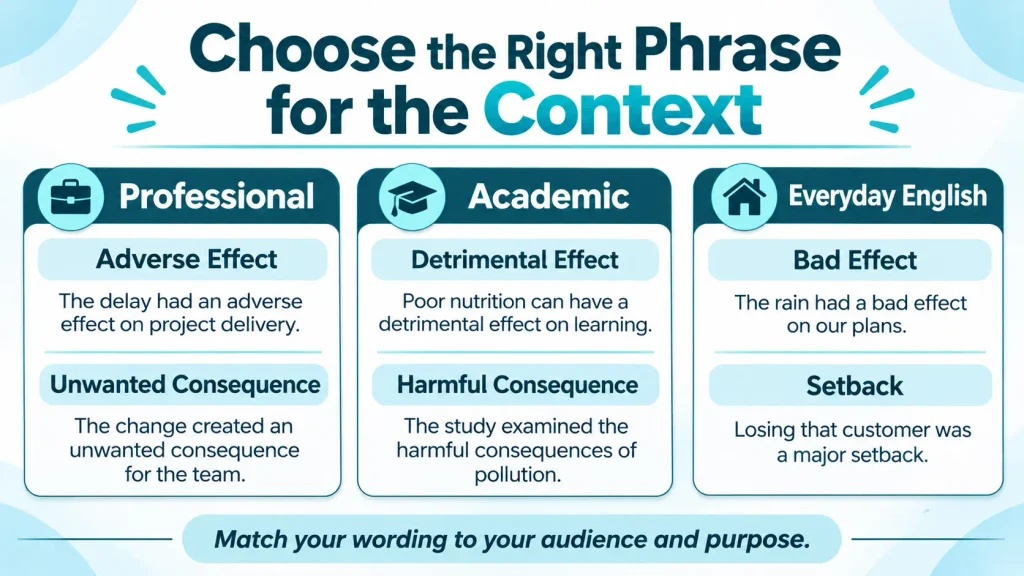
Not every alternative fits every situation. The following expressions are especially useful when choosing words for a specific audience or purpose.
Negative Impact in Professional Writing
For workplace communication, business reports, and professional emails, these phrases sound natural:
- Adverse effect
- Detrimental effect
- Negative repercussions
- Unwanted consequence
Example:
Original: The delay had a negative impact on the project.
Professional alternative: The delay had an adverse effect on project delivery.
Negative Impact in Academic Writing
Academic writing often benefits from precise and formal expressions.
| Alternative | Example |
|---|---|
| Adverse effect | The policy had an adverse effect on employment. |
| Detrimental effect | Poor nutrition can have a detrimental effect on learning. |
| Harmful consequence | The study examined the harmful consequences of pollution. |
| Negative influence | Social factors may have a negative influence on behavior. |
Use the phrase that accurately describes the relationship you’re discussing. An influence may shape behavior, while an effect or consequence describes a result.
Negative Impact in Everyday English
For casual conversations, simple expressions are often more natural.
- Bad effect
- Harmful effect
- Negative effect
- Setback
- Problem
Examples:
“The rain had a bad effect on our plans.”
“Losing that customer was a major setback.”
“The change caused a lot of problems.”
Negative Impact vs. Negative Effect vs. Adverse Effect
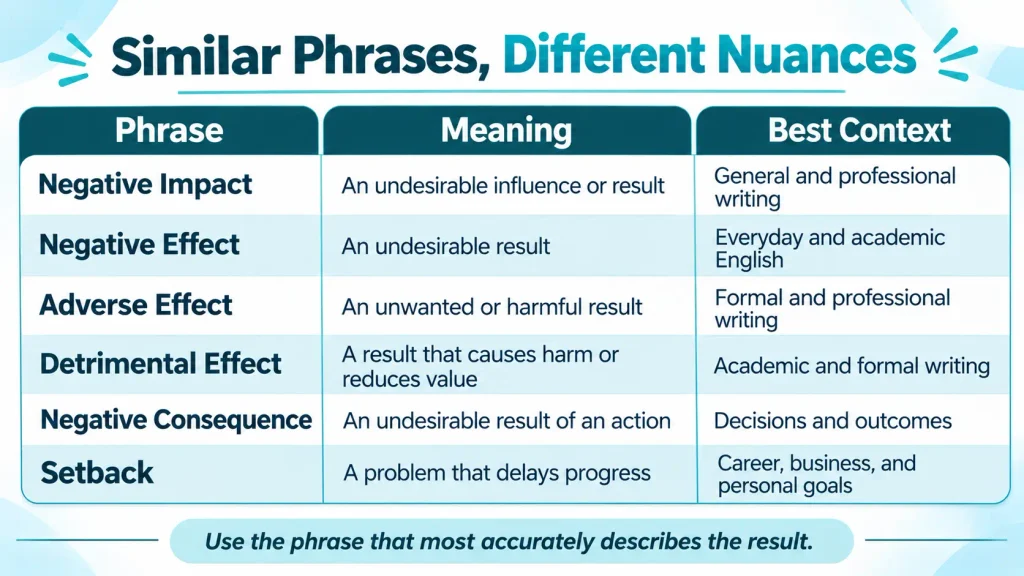
These expressions are closely related, but they are not always interchangeable.
| Phrase | Meaning | Best Context |
|---|---|---|
| Negative impact | An undesirable influence or result | General and professional writing |
| Negative effect | An undesirable result | Everyday and academic English |
| Adverse effect | An unwanted or harmful result | Formal and professional writing |
| Detrimental effect | A result that causes harm or reduces value | Academic and formal writing |
| Negative consequence | An undesirable result of an action | Decisions and outcomes |
| Setback | A problem that delays progress | Career, business, and personal goals |
For most general situations, “negative effect” is a simple alternative. For formal writing, “adverse effect” is often a better choice.
How to Choose the Right Alternative
When replacing “negative impact,” consider three things.
1. How Serious Is the Harm?
Use “harmful effect” when the result causes harm.
Use “damaging influence” when something has a strong negative effect on behavior, relationships, or development.
Use “setback” when the result delays progress rather than causing lasting damage.
2. What Is the Writing Style?
For academic writing, “adverse effect” and “detrimental effect” are useful.
For everyday conversation, “bad effect” and “negative effect” sound natural.
For business reports, “adverse consequence” and “unfavorable outcome” may be appropriate.
3. What Exactly Are You Describing?
Consider these examples:
- Financial losses: The decision had an adverse effect on revenue.
- Emotional well-being: The situation had a harmful effect on her confidence.
- Project delays: The unexpected problem was a major setback.
- Business operations: The outage caused significant disruption.
- Long-term results: The policy had negative repercussions.
The more specific your wording, the easier it is for readers to understand your meaning.
Common Mistakes When Using Negative Impact Alternatives
Using “Setback” for Every Harmful Effect
A setback usually refers to a delay or obstacle.
Incorrect: Pollution had a setback on public health.
Correct: Pollution had a harmful effect on public health.
Treating “Unwanted Consequence” as Always Severe
An unwanted consequence can be minor or serious.
For example, an unwanted consequence of changing a meeting time might simply be inconvenience.
Using “Adverse Effect” in Casual Conversations
“Adverse effect” is grammatically correct in everyday speech, but it can sound formal.
In a casual conversation, “bad effect” or “negative effect” may sound more natural.
Repeating “Negative Impact” Too Often
Repeated use can make writing sound monotonous.
Instead of writing:
“The policy had a negative impact on workers. The negative impact affected productivity and morale.”
Try:
“The policy had an adverse effect on workers, reducing productivity and lowering morale.”
Frequently Asked Questions
What is the best synonym for negative impact?
“Adverse effect” is one of the best alternatives for formal and professional writing. “Harmful effect” is a clear and natural option for everyday English.
What is a formal way to say negative impact?
You can use “adverse effect,” “detrimental effect,” “adverse consequence,” or “negative repercussions.” The best choice depends on the sentence.
What is another way to say negative impact in an essay?
“Adverse effect,” “detrimental effect,” and “harmful consequence” are useful alternatives in essays. Choose the phrase that best describes the result.
What is a simple word for negative impact?
“Effect,” “harm,” and “damage” can work, depending on the sentence. “Bad effect” is also a simple alternative.
Is negative impact the same as negative effect?
They are very similar. “Negative impact” can emphasize an influence on a person or situation, while “negative effect” often focuses on the result. In many everyday sentences, they can be used interchangeably.
Is adverse effect stronger than negative impact?
Not always. “Adverse effect” is more formal and often suggests harm, but the seriousness depends on the context. A minor adverse effect can still be less serious than a major negative impact.
Can I use detrimental impact instead of negative impact?
Yes. “Detrimental impact” is a natural alternative in formal writing. For example, “The decision had a detrimental impact on employee morale” is grammatically correct.
Conclusion
The best alternative to “negative impact” depends on what you want to express.
Use “adverse effect” for formal writing, “harmful effect” for clear everyday language, “detrimental effect” for academic discussions, and “setback” when a problem delays progress.
Choosing a phrase that matches the meaning and tone of your sentence will make your writing clearer, more natural, and more precise.

Role: Lead Author & Content Specialist
James Mitchell is an experienced Lead Author at Elite’s Collective. He specializes in creating high-impact editorial content and driving core written projects designed to inform and engage readers.