
A good alternative to “less fortunate” depends on what you mean. “Financially disadvantaged,” “facing hardship,” “in need,” and “people with fewer resources” are useful options when discussing poverty or difficult circumstances. For a more respectful and specific expression, choose words that describe the situation without defining a person by their struggles.
Key Takeaways
- Use financially disadvantaged when discussing economic difficulties.
- Choose facing hardship to describe someone going through a difficult time.
- Say in need when referring to people who need help or support.
- Use people with fewer resources when you want neutral, person-centered wording.
- Choose underprivileged when discussing limited access to opportunities, but be aware that it can sound broad or labeling.
- Avoid assuming that every less fortunate person is poor. The phrase can refer to many kinds of disadvantage.
15 Alternatives to “Less Fortunate”
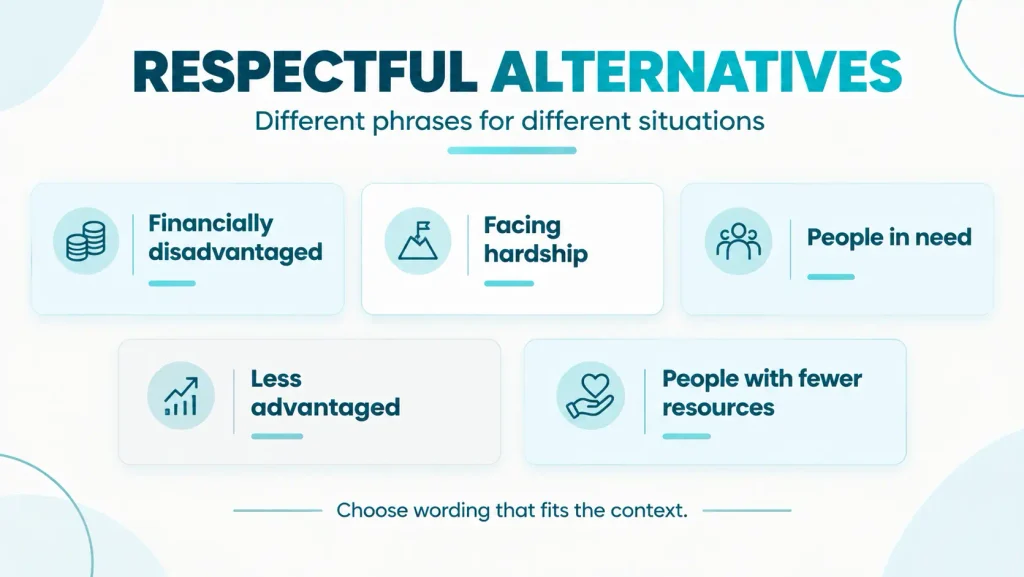
The phrase “less fortunate” describes people who face disadvantages or have fewer opportunities, resources, or advantages than others. It is often used when discussing poverty, charitable work, education, and social inequality.
Here are 15 alternatives, along with their meanings and examples.
1. Financially Disadvantaged
This phrase describes people who have limited financial resources or face economic barriers. It is a strong choice for formal writing, educational discussions, and social programs.
Example: The organization provides scholarships to financially disadvantaged students.
Best for: Education, social services, reports, and formal communication.
2. Facing Hardship
Use this expression for people experiencing difficult circumstances, such as job loss, family problems, illness, or financial stress.
Example: The community raised funds for families facing hardship during the winter.
Best for: Personal stories, fundraising, community support, and compassionate writing.
Unlike “less fortunate,” this phrase emphasizes a person’s current circumstances rather than their overall position in society.
3. In Need
“In need” refers to people who require assistance, resources, or basic necessities. It is simple, natural, and common in charitable contexts.
Example: Volunteers delivered food and clothing to families in need.
Best for: Charity campaigns, community projects, and everyday conversation.
Use it when the need for support is relevant. It does not necessarily mean someone is poor.
4. Economically Disadvantaged
This is a formal expression for people who experience financial barriers that may limit their access to education, housing, healthcare, or other opportunities.
Example: The program helps economically disadvantaged families access affordable childcare.
Best for: Research, public policy, education, and professional writing.
It is more specific than “less fortunate” because it focuses on economic circumstances.
5. Underprivileged
“Underprivileged” describes people who have fewer social, economic, educational, or other opportunities than others.
Example: The nonprofit offers after-school tutoring to children from underprivileged communities.
Best for: Discussions about unequal opportunities and access to resources.
Usage tip: The word is widely understood, but it can sound like a label. When possible, specify the actual barrier, such as limited access to education or low household income.
6. People With Fewer Resources
This expression focuses on access to money, services, equipment, education, or other resources rather than suggesting that people themselves are less valuable.
Example: The library offers free computer classes for people with fewer resources.
Best for: Inclusive writing, education, community services, and general communication.
It is especially useful when the type of disadvantage needs further explanation.
7. Low-Income Individuals
This phrase refers specifically to people whose income is limited relative to a relevant standard or threshold.
Example: The city expanded its housing assistance program for low-income individuals.
Best for: Housing, financial assistance, social programs, and public policy.
Use “low-income” only when income is the issue. It is not a general substitute for every meaning of “less fortunate.”
8. Disadvantaged Individuals
This broad expression describes people who face barriers that limit their opportunities or access to resources.
Example: The mentorship program connects disadvantaged individuals with career development opportunities.
Best for: Professional reports, education, social policy, and community programs.
Because the term is broad, explain the type of disadvantage whenever possible.
9. People Experiencing Poverty
This phrase directly describes people who are living in poverty. It can be useful when accuracy and clarity matter.
Example: The organization works with people experiencing poverty to improve access to affordable housing.
Best for: Social issues, journalism, nonprofit communications, and research.
It focuses on a person’s circumstances rather than making poverty their defining identity.
10. Those Who Need Support
This warm, straightforward expression describes people who would benefit from assistance.
Example: The fundraiser will provide meals and essential supplies to those who need support.
Best for: Fundraising, personal messages, volunteer work, and community announcements.
Use this phrase when the goal is to emphasize support rather than compare people’s circumstances.
11. Less Advantaged
“Less advantaged” describes people who have fewer benefits, opportunities, or resources than others.
Example: The scholarship helps students from less advantaged backgrounds attend college.
Best for: Education, social inequality, and discussions about opportunity.
It is close in meaning to “less fortunate,” but it often emphasizes differences in access and opportunity.
12. Vulnerable Individuals
This phrase refers to people who may face a greater risk of harm because of their circumstances or limited access to protection and support.
Example: The emergency plan includes additional services for vulnerable individuals.
Best for: Public health, emergency services, social care, and safety planning.
Usage tip: Vulnerability is not the same as poverty. Use this term when a person’s risk of harm is relevant.
13. People Facing Financial Difficulties
This expression describes people who are struggling with money, bills, debt, or the cost of everyday needs.
Example: The community center offers free budgeting workshops for people facing financial difficulties.
Best for: Financial guidance, personal communication, and community assistance.
It is a practical alternative when you want to explain the problem clearly without using a broad label.
14. Underserved Communities
“Underserved communities” refers to groups or areas that do not receive adequate access to essential services, resources, or opportunities.
Example: The mobile clinic provides healthcare services to underserved communities.
Best for: Healthcare, education, public services, and community development.
This phrase is not a direct synonym for “less fortunate.” It is more appropriate when the issue involves a lack of services or institutional support.
15. People Experiencing Difficult Circumstances
This expression describes people dealing with challenging situations without assuming the exact cause.
Example: The support group welcomes people experiencing difficult circumstances and offers practical guidance.
Best for: Personal writing, compassionate communication, and general discussions.
It is a flexible option when someone’s challenges may involve finances, family life, health, employment, or other situations.
Which Alternative to “Less Fortunate” Should You Use?
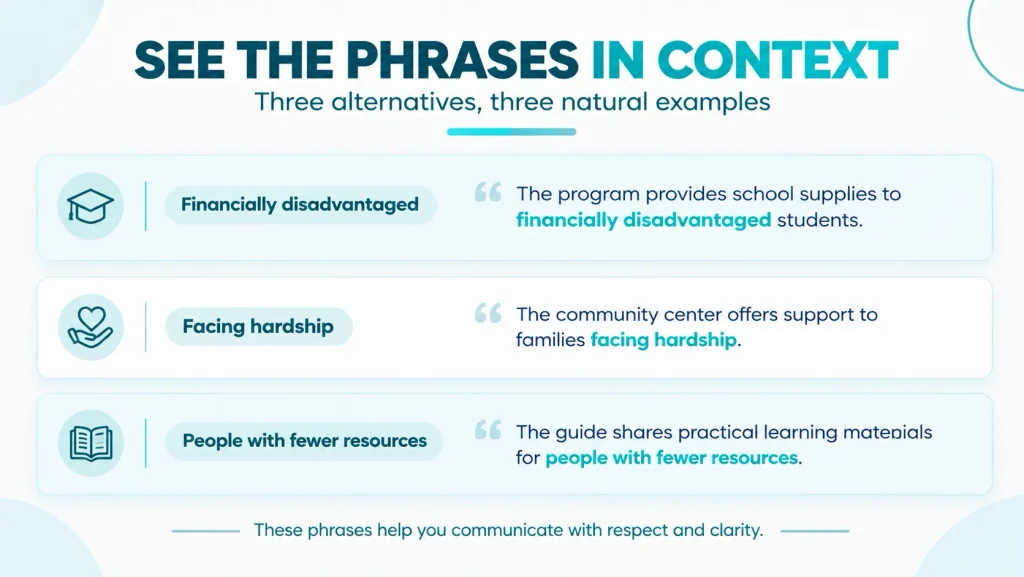
The best phrase depends on the context and the meaning you want to convey.
| Alternative | Main Meaning | Best Context |
|---|---|---|
| Financially disadvantaged | Limited financial resources | Formal and educational writing |
| Facing hardship | Experiencing difficult circumstances | Personal stories and community support |
| In need | Requiring help or resources | Charity and fundraising |
| Economically disadvantaged | Facing economic barriers | Research and public policy |
| Underprivileged | Having fewer opportunities or advantages | Education and social issues |
| People with fewer resources | Limited access to resources | Inclusive, neutral writing |
| Low-income individuals | Having limited income | Housing and financial assistance |
| Disadvantaged individuals | Facing barriers or disadvantages | Professional and social contexts |
| People experiencing poverty | Living in poverty | Journalism and social issues |
| Those who need support | Requiring assistance | Friendly and compassionate communication |
| Less advantaged | Having fewer opportunities or benefits | Education and social inequality |
| Vulnerable individuals | Facing an increased risk of harm | Healthcare and social care |
| People facing financial difficulties | Experiencing money problems | Everyday and professional communication |
| Underserved communities | Lacking adequate services or resources | Healthcare and community development |
| People experiencing difficult circumstances | Dealing with challenging situations | General and sensitive communication |
How to Use “Less Fortunate” in Different Situations
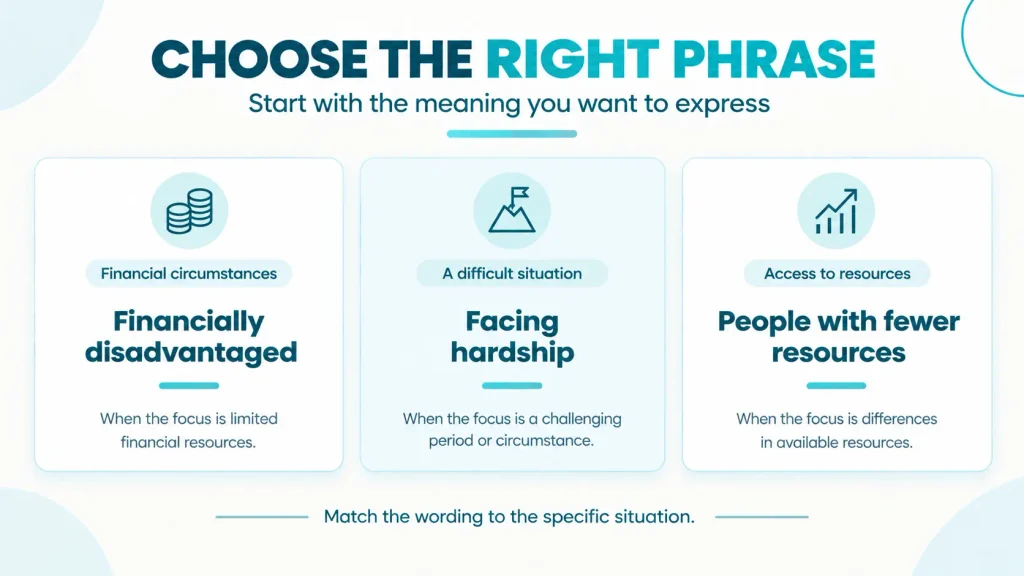
Choosing an appropriate alternative becomes easier when you consider your audience and purpose.
In Professional or Academic Writing
Use precise expressions such as “economically disadvantaged,” “low-income individuals,” or “people experiencing poverty.”
Example:
Instead of: “Our program helps less fortunate families.”
Write: “Our program provides financial assistance to low-income families.”
The revised sentence explains who the program serves and what kind of help it provides.
In Charity and Fundraising
Expressions such as “families in need,” “people facing hardship,” and “those who need support” can communicate compassion without sounding judgmental.
Example:
“Our volunteers provide meals and essential supplies to families facing hardship.”
This wording keeps the focus on the support being offered.
In Everyday Conversation
Use simple phrases such as “going through a tough time,” “struggling financially,” or “having fewer opportunities,” depending on the situation.
Example:
“She’s going through a tough time, so we’re helping her with groceries.”
This sounds natural and describes the circumstances without making assumptions about her life.
In Educational Discussions
“Students from low-income families,” “students with limited access to educational resources,” or “students from disadvantaged backgrounds” may be more useful than “less fortunate students.”
Example:
“The school offers free tutoring to students with limited access to educational resources.”
This wording identifies the barrier that the program is designed to address.
Is “Less Fortunate” a Respectful Phrase?
Yes, “less fortunate” is generally understood as a polite expression for people who face financial difficulties or other disadvantages. However, it can be vague because it does not explain what a person lacks or what challenges they face.
For example, “less fortunate people” might refer to people experiencing poverty, individuals affected by a natural disaster, or families who lack access to healthcare.
When the situation is known, a more specific phrase is often clearer. “Families affected by job loss” tells readers more than “less fortunate families.”
It is also helpful to describe people as individuals rather than defining them only by their circumstances. Phrases such as “people experiencing poverty” and “families facing financial hardship” can make the intended meaning more precise.
Common Mistakes to Avoid
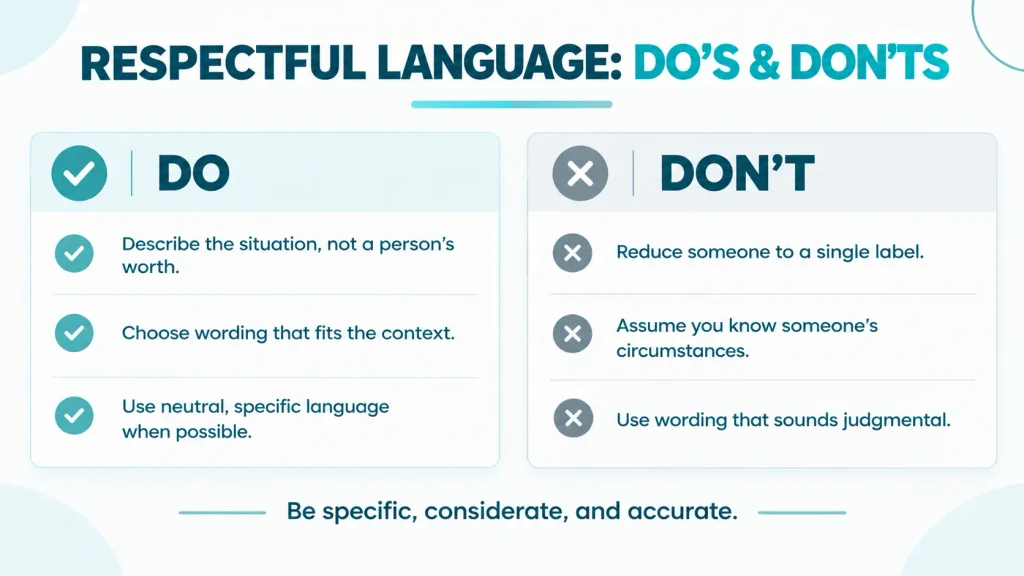
Using “Poor” When You Mean “Less Fortunate”
“Poor” usually refers to a lack of money or resources, while “less fortunate” can describe a wider range of disadvantages.
If you are discussing limited educational opportunities rather than income, “students with fewer educational opportunities” may be more accurate.
Using “Underserved” as a Direct Synonym
“Underserved” describes inadequate access to services or resources. It does not automatically mean that someone is poor or personally disadvantaged in every area of life.
For example, a rural community may be underserved because it lacks nearby healthcare facilities.
Assuming Everyone Needs Financial Help
Some people face social, educational, or health-related barriers without experiencing poverty. Choose an expression that matches the actual circumstances.
Making People Sound Defined by Their Difficulties
Avoid wording that reduces people to a label when a more specific, respectful description is available. Focus on their circumstances, needs, or barriers rather than implying that their lives have less value.
Frequently Asked Questions
What is the best synonym for “less fortunate”?
“Financially disadvantaged” is a useful alternative when referring to economic hardship. “Facing hardship” works for broader difficulties, while “people with fewer resources” is a neutral option when the exact disadvantage varies.
What is a polite way to say “less fortunate people”?
“People facing hardship,” “people in need,” and “people with fewer resources” are often polite alternatives. The most appropriate choice depends on whether you mean financial problems, limited opportunities, or another type of disadvantage.
What is another way to say “less fortunate” in a formal sentence?
Use “economically disadvantaged,” “financially disadvantaged,” or “people experiencing poverty” when those terms accurately describe the situation.
For example: “The initiative provides educational opportunities for economically disadvantaged students.”
What is another word for “less fortunate” in charity work?
“People in need,” “families facing hardship,” and “those who need support” are common choices. If the charity addresses a specific problem, such as hunger or housing insecurity, naming that problem may be even clearer.
Does “less fortunate” mean poor?
Not always. The phrase often refers to poverty, but it can also describe people with fewer opportunities, limited access to resources, or difficult life circumstances.
Is “underprivileged” the same as “less fortunate”?
The meanings overlap, but they are not identical. “Underprivileged” generally emphasizes a lack of opportunities or advantages, while “less fortunate” is broader and can refer to many kinds of hardship.
What is a more inclusive alternative to “less fortunate”?
“People experiencing poverty,” “people facing financial hardship,” and “people with limited access to resources” can be more precise and person-centered alternatives. Choose the expression that accurately reflects the situation rather than assuming one phrase fits everyone.
Conclusion
The best alternative to “less fortunate” depends on what you want to communicate. Use “financially disadvantaged” for economic barriers, “facing hardship” for difficult circumstances, and “in need” when someone requires assistance. For clear and respectful writing, describe the actual challenge whenever possible.
Choosing specific language helps readers understand people’s circumstances without reducing them to a broad label.
Role: Author & Contributing Writer
Olivia Bennett is a dedicated Author at Elite’s Collective, focused on delivering clear, well-researched, and engaging articles tailored to the audience.