

If you want another way to say “make the most of,” the best alternatives include take full advantage of, get the most out of, make good use of, maximize, capitalize on, and use wisely. The right choice depends on your meaning. Some phrases focus on using resources well, while others emphasize enjoying an experience or acting on an opportunity.
Key Takeaways
- Get the most out of works well for experiences, tools, and learning.
- Take full advantage of emphasizes using an opportunity or benefit.
- Make good use of is a natural choice for time, money, and resources.
- Maximize suits goals, results, efficiency, and performance.
- Savor works when you want to enjoy a moment or experience fully.
- Choose an alternative based on context rather than replacing the original phrase every time.
What Does “Make the Most Of” Mean?
“Make the most of” means to use something as effectively as possible or gain as much value, enjoyment, or benefit from it as you can.
For example:
- Make the most of your weekend means enjoy your free time as much as possible.
- Make the most of your budget means use your money wisely.
- Make the most of an opportunity means take advantage of a chance to achieve something.
The phrase is flexible, so no single synonym works in every situation. Consider whether you are talking about time, money, an opportunity, a difficult situation, or an enjoyable experience.
15 Best Alternatives to “Make the Most Of”
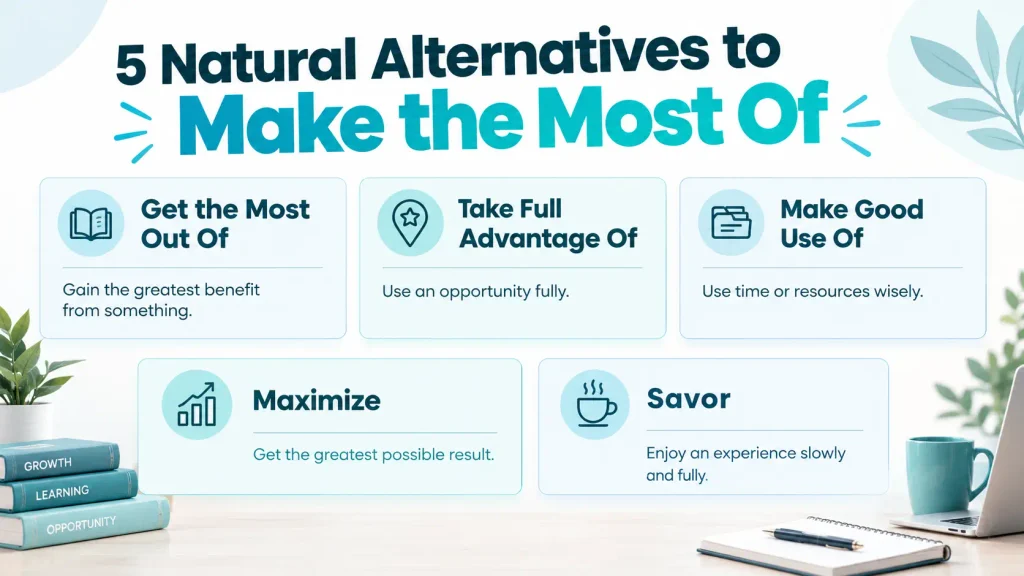
1. Get the Most Out Of
This is one of the closest and most natural alternatives. It means gaining as much value or benefit as possible from something.
Best for: Experiences, courses, tools, and activities.
Example: Get the most out of your online course by practicing what you learn every day.
2. Take Full Advantage Of
Use this phrase when you want to benefit from an available opportunity, resource, or favorable situation.
Best for: Career opportunities, discounts, benefits, and available resources.
Example: She took full advantage of the free training offered by her company.
Usage tip: This phrase can suggest actively using an opportunity that might not last.
3. Make Good Use Of
This alternative emphasizes using something wisely and productively.
Best for: Time, money, skills, and resources.
Example: He made good use of his free afternoon by finishing his assignments.
It is a practical choice for everyday conversation and professional writing.
4. Maximize
“Maximize” means increase something to the greatest possible level. It is more direct and often sounds more technical or professional.
Best for: Results, productivity, efficiency, and performance.
Example: We changed our schedule to maximize the time available for the project.
Use it when the goal is to increase a measurable result, not simply enjoy an experience.
5. Capitalize On
To “capitalize on” something means to use an opportunity or situation to gain an advantage.
Best for: Business, career growth, and favorable circumstances.
Example: The small business capitalized on the growing demand for affordable home products.
This phrase often suggests a strategic decision rather than simple enjoyment.
6. Use Wisely
“Use wisely” means make sensible decisions about how to use something valuable.
Best for: Money, time, energy, and resources.
Example: Use your study time wisely by focusing on the topics you find most difficult.
It is especially useful when the emphasis is on good judgment.
7. Make the Best Of
This phrase means handle a situation as well as possible, especially when circumstances are not ideal.
Best for: Unexpected problems, delays, limited resources, and difficult situations.
Example: Our flight was delayed, so we made the best of the extra time by exploring the airport shops.
Important distinction: “Make the best of” often involves accepting a less-than-ideal situation. “Make the most of” can describe positive situations, too.
8. Use to Your Advantage
This expression means use a resource, quality, or situation in a way that benefits you.
Best for: Personal strengths, useful information, and opportunities.
Example: She used her strong communication skills to her advantage during the interview.
It focuses on gaining a benefit rather than simply using something efficiently.
9. Get the Best Possible Results From
This longer alternative emphasizes the outcome you want to achieve.
Best for: Work projects, training, tools, and business decisions.
Example: We adjusted the marketing campaign to get the best possible results from our budget.
Choose this phrase when the result matters more than the experience itself.
10. Make Every Moment Count
This expression means use your time meaningfully or ensure that an experience feels worthwhile.
Best for: Travel, personal goals, important events, and limited time.
Example: We had only one day in Chicago, so we planned ahead to make every moment count.
It has a motivational tone and is less suitable for technical discussions about resources.
11. Take Advantage Of
This is a shorter, common alternative to “take full advantage of.” It means benefit from an opportunity or situation.
Best for: Special offers, available services, and convenient opportunities.
Example: Take advantage of the library’s free workshops to improve your writing skills.
Usage tip: The phrase can also mean exploit someone or something unfairly. Context makes the intended meaning clear.
12. Leverage
“Leverage” means use an asset, skill, resource, or advantage to achieve a desired result. It is common in business and professional communication.
Best for: Skills, experience, technology, and business resources.
Example: The team leveraged customer feedback to improve the new website.
For casual conversation, “use” or “make good use of” may sound more natural.
13. Benefit From
Use “benefit from” when the main idea is receiving a positive result or advantage.
Best for: Education, advice, support, and useful experiences.
Example: New employees can benefit from the company’s mentoring program.
Unlike “make the most of,” this phrase does not necessarily mean someone has gained the greatest possible benefit.
14. Aprovechar the Opportunity? No — Seize the Opportunity
“Seize the opportunity” means act quickly and confidently when a valuable chance appears.
Best for: Career decisions, personal growth, and time-sensitive opportunities.
Example: When the company offered her a leadership role, she seized the opportunity.
This phrase emphasizes taking action. It is not a direct replacement when you are talking about enjoying a vacation or using a budget carefully.
15. Savor
“Savor” means enjoy an experience, feeling, or moment slowly and fully.
Best for: Special occasions, meals, achievements, and meaningful moments.
Example: She took a quiet walk along the beach to savor the last evening of her vacation.
Choose “savor” when enjoyment is the main point, rather than efficiency or productivity.
Which Alternative Should You Choose?
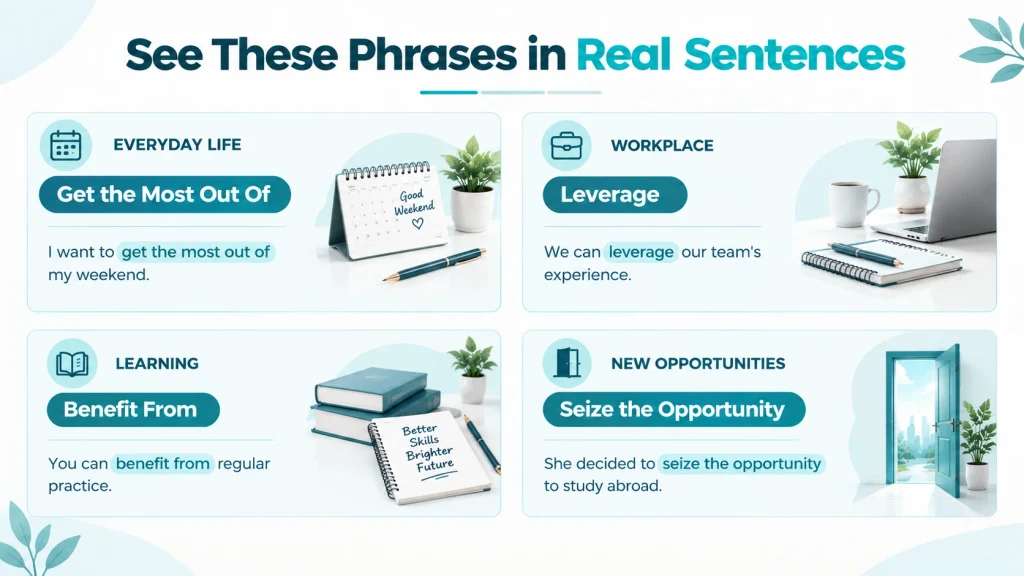
The best replacement depends on what you want to express. Use this table to find a phrase that fits your sentence.
| Alternative | Main meaning | Best context |
|---|---|---|
| Get the most out of | Gain maximum value | Experiences and learning |
| Take full advantage of | Use an opportunity fully | Opportunities and benefits |
| Make good use of | Use effectively | Time and resources |
| Maximize | Increase to the highest level | Results and performance |
| Capitalize on | Gain an advantage | Business and career |
| Use wisely | Make sensible choices | Money and time |
| Make the best of | Handle a situation positively | Difficult circumstances |
| Use to your advantage | Turn something into a benefit | Skills and strengths |
| Make every moment count | Use time meaningfully | Travel and life experiences |
| Savor | Enjoy fully | Special moments |
Alternatives for Different Situations
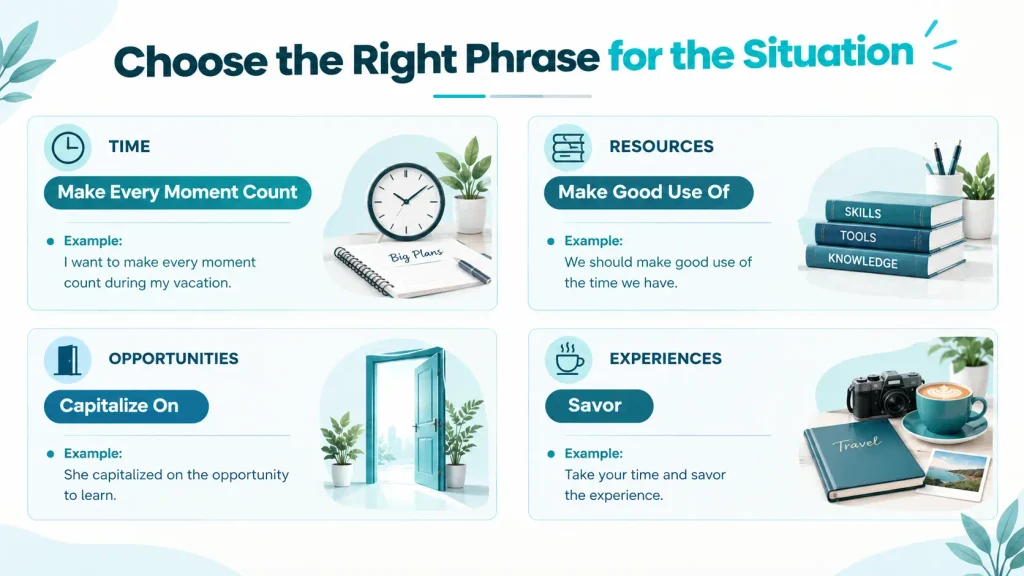
Another Way to Say “Make the Most of Your Time”
Consider these options:
- Use your time wisely: Focus on making sensible choices.
- Make every minute count: Emphasize productivity or meaningful use of time.
- Be productive: Focus on completing useful tasks.
- Use your time effectively: Emphasize achieving a goal with the time available.
Example: Instead of saying, “Make the most of your study time,” you could say, “Use your study time effectively.”
Another Way to Say “Make the Most of an Opportunity”
These phrases work well when a valuable chance is available:
- Take full advantage of the opportunity.
- Seize the opportunity.
- Capitalize on the opportunity.
- Make the most of the chance.
Example: “She seized the opportunity to study abroad when she received the scholarship.”
Another Way to Say “Make the Most of a Situation”
The best phrase depends on whether the situation is positive or difficult.
- Make the best of it: Accept the circumstances and try to have a positive experience.
- Use the situation to your advantage: Find a way to benefit from what is happening.
- Find the positives: Focus on the good parts of a situation.
- Turn it into an opportunity: Use a challenge as a chance to learn or improve.
Example: “Although the project was delayed, we used the extra time to improve the design.”
Another Way to Say “Make the Most of Your Resources”
For money, equipment, staff, or other resources, try:
- Make good use of your resources.
- Use your resources efficiently.
- Maximize available resources.
- Get the greatest value from your resources.
Example: “The team reorganized its workflow to use its resources more efficiently.”
Common Mistakes to Avoid
- Using “maximize” for every situation: It works well for results and efficiency, but “savor” is more natural for enjoying a special moment.
- Confusing “make the best of” with “make the most of”: The first often refers to dealing positively with an unwanted situation. The second has a broader meaning.
- Using “capitalize on” in casual conversation unnecessarily: It may sound businesslike when “take advantage of” would be simpler.
- Treating “benefit from” as an exact synonym: You can benefit from something without using it to its fullest potential.
- Forgetting the word “of”: The standard expression is “make the most of something,” as in “make the most of your vacation.”
Frequently Asked Questions
1. What is the closest synonym for “make the most of”?
“Get the most out of” is often the closest alternative. Both expressions describe gaining as much value or benefit as possible from something.
2. What is a professional way to say “make the most of”?
“Maximize,” “make effective use of,” and “capitalize on” are useful professional alternatives. Choose based on whether you mean improving results, using resources efficiently, or benefiting from an opportunity.
3. What is another way to say “make the most of your time”?
You can say “use your time wisely,” “use your time effectively,” or “make every moment count.” The first two emphasize sensible or productive time use, while the last has a more motivational tone.
4. Is “take advantage of” the same as “make the most of”?
They overlap, but their meanings are not identical. “Take advantage of” usually emphasizes using an opportunity or benefit. “Make the most of” can also mean enjoying an experience or using limited resources well.
5. How can I say “make the most of” in formal writing?
Try “maximize the benefits of,” “make effective use of,” or “optimize,” depending on the sentence. For example, “We aim to maximize the benefits of our training program.”
6. What is another way to say “make the most of a bad situation”?
“Make the best of a bad situation” is the most direct choice. You could also say “find the positives” or “turn the challenge into an opportunity,” depending on the intended meaning.
7. Can I use “leverage” instead of “make the most of”?
Yes, when you mean using a resource, skill, or advantage to achieve a goal. For example, “We leveraged our experience to improve the project.” It is less suitable when you simply mean enjoying a moment.
Conclusion
The best alternative to “make the most of” depends on your message. Use “get the most out of” for experiences, “make good use of” for resources, “maximize” for results, and “savor” for special moments. For difficult circumstances, “make the best of” is often the better choice.
Choosing the phrase that matches your exact meaning will make your English sound clearer and more natural.

Role: Author & Contributing Writer
Olivia Bennett is a dedicated Author at Elite’s Collective, focused on delivering clear, well-researched, and engaging articles tailored to the audience.