

A natural way to say “play a role” is “play a part,” “contribute to,” “influence,” “help shape,” or “be involved in,” depending on the context. For example, “Exercise plays a role in good health” can become “Exercise contributes to good health” or “Exercise influences overall health.”
Key Takeaways
- “Play a part” is the closest everyday alternative to “play a role.”
- “Contribute to” works well when something helps produce a result.
- “Influence” is useful when something affects an outcome without directly causing it.
- “Help shape” suggests that something has an important effect on how something develops.
- “Be involved in” focuses more on participation than influence.
- The best alternative depends on the meaning, tone, and context of your sentence.
What Does “Play a Role” Mean?
“Play a role” means to have an effect, influence, or part in a situation, process, or result. It does not usually mean that something is the only cause of an outcome. Instead, it suggests that it is one factor among several.
For example:
Sleep plays a role in maintaining good health.
This means that sleep is one factor that affects good health.
The phrase is common in everyday English, academic writing, business communication, journalism, and professional writing. However, repeating it too often can make your writing feel predictable. Choosing a more precise alternative can make your sentence clearer.
10 Natural Alternatives to “Play a Role”
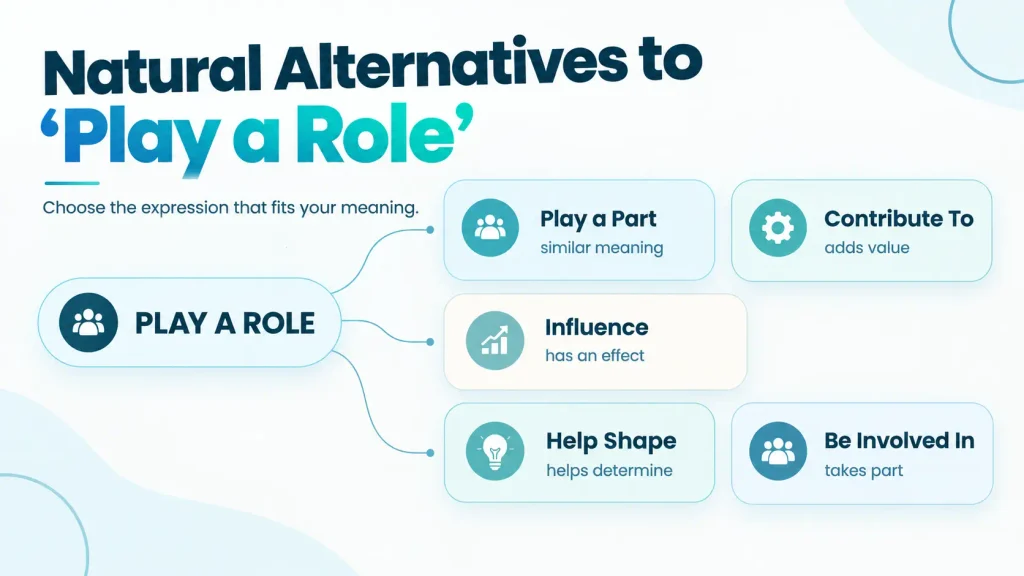
1. Play a Part
“Play a part” is the closest direct alternative to “play a role.” The two expressions are often interchangeable.
Example:
Regular exercise plays a part in maintaining a healthy lifestyle.
Best for: Everyday, professional, and general writing.
Usage tip: Use “play a part” when you want to change the wording without significantly changing the original meaning.
2. Contribute to
“Contribute to” means to help cause or produce a particular result. It is especially useful when several factors combine to create an outcome.
Example:
Poor communication can contribute to workplace conflicts.
Best for: Professional, academic, and explanatory writing.
Usage tip: This phrase can sound more direct than “play a role” because it emphasizes how something helps produce an outcome.
3. Influence
“Influence” means to affect the way something develops, behaves, or turns out.
Example:
Family experiences can influence a person’s career choices.
Best for: Academic, professional, analytical, and general writing.
Usage tip: “Influence” is a good choice when the focus is on an effect rather than participation.
4. Affect
“Affect” is a simple and direct verb meaning to have an effect on something.
Example:
Stress can affect your ability to concentrate.
Best for: Clear, concise, and direct writing.
Usage tip: “Affect” is often a stronger and shorter replacement when “play a role in” feels unnecessarily wordy.
Compare:
- Stress plays a role in concentration.
- Stress affects concentration.
The second sentence is more direct.
5. Help Shape
“Help shape” suggests that something has an important influence on how a person, situation, decision, or outcome develops.
Example:
Early experiences can help shape a child’s personality.
Best for: Personal development, education, culture, business, and social topics.
Usage tip: This phrase works particularly well when something influences development over time.
6. Be a Factor in
“Be a factor in” emphasizes that something is one of several elements affecting an outcome.
Example:
Cost is an important factor in the decision to buy a new car.
Best for: Analytical, professional, and informative writing.
Usage tip: Choose this phrase when you want to make it clear that the subject is only one part of a larger situation.
7. Have an Impact on
“Have an impact on” means to affect something, often in a noticeable or meaningful way.
Example:
Social media has a significant impact on consumer behavior.
Best for: Business, academic, professional, and general writing.
Usage tip: “Impact” can suggest a stronger or more noticeable effect than the neutral phrase “play a role.”
8. Be Involved in
“Be involved in” focuses on participation or connection rather than simply causing an effect.
Example:
Several departments were involved in the development of the new product.
Best for: Workplace, business, projects, events, and activities.
Usage tip: Do not automatically replace “play a role” with “be involved in.” The meaning changes if the original sentence is about influence rather than participation.
9. Help Bring About
“Help bring about” means to help cause a particular change or result.
Example:
The new policy helped bring about major changes in the education system.
Best for: Formal, professional, academic, and historical writing.
Usage tip: This phrase is useful when you want to emphasize that an action or factor helped produce a specific result.
10. Be Instrumental in
“Be instrumental in” means to be very important in making something happen or succeed.
Example:
Her leadership was instrumental in the company’s successful expansion.
Best for: Formal and professional writing.
Usage tip: This is stronger than “play a role.” Use it when the subject had a particularly important influence on the outcome.
“Play a Role” vs. “Play a Part”
“Play a part” is the most direct substitute for “play a role.”
| Expression | Meaning | Tone | Best Context |
|---|---|---|---|
| Play a role | Have an effect or influence | Neutral | General writing |
| Play a part | Have an effect or influence | Neutral | General and conversational |
| Contribute to | Help produce a result | Neutral | Professional and academic |
| Influence | Affect an outcome | Neutral | Analytical and general |
| Help shape | Influence development | Neutral | Development and change |
| Be a factor in | Be one element affecting a result | Neutral/Formal | Analytical writing |
| Have an impact on | Affect something noticeably | Neutral/Formal | Business and academic |
| Be involved in | Participate or take part | Neutral | Workplace and projects |
| Help bring about | Help cause a result | Formal | Professional and academic |
| Be instrumental in | Be very important to an outcome | Formal | Professional writing |
Which Alternative Should You Use?

The best replacement depends on what you actually mean.
When you mean “have an effect”
Use influence or affect.
Exercise plays a role in mental well-being.
Could become:
Exercise influences mental well-being.
Or:
Exercise affects mental well-being.
When you mean “help cause something”
Use contribute to.
Several factors played a role in the company’s growth.
Could become:
Several factors contributed to the company’s growth.
When you mean “participate”
Use be involved in.
She played a role in organizing the event.
Could become:
She was involved in organizing the event.
The second sentence emphasizes her participation rather than simply her influence.
When you mean “strongly influence”
Use be instrumental in.
His leadership played a role in the project’s success.
If his leadership was especially important, you could write:
His leadership was instrumental in the project’s success.
This version gives the contribution more weight.
Common Mistakes When Replacing “Play a Role”
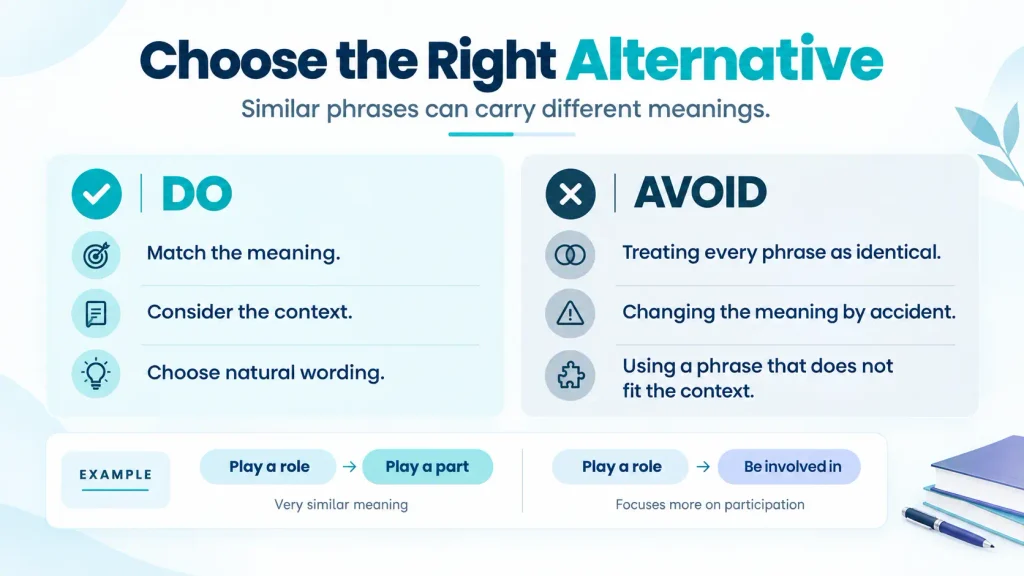
Not every alternative has exactly the same meaning. A few distinctions are important.
Using “participate” when you mean “influence”
Consider:
Technology plays a role in modern education.
You could say:
Technology influences modern education.
But saying:
Technology participates in modern education.
would sound unnatural because technology is not literally participating in an activity.
Using “be instrumental in” for a minor contribution
“Be instrumental in” suggests an important contribution.
If you mean that something had only a small effect, “contribute to” or “play a part” may be more accurate.
Assuming “impact” and “role” always mean the same thing
“Play a role” can describe a relatively general contribution, while “have an impact on” often emphasizes an effect.
Compare:
Several factors played a role in the decision.
with:
The new evidence had a major impact on the decision.
The second sentence gives the effect more emphasis.
Replacing every instance with “play a part”
Although “play a part” is a natural alternative, repeating it throughout an article does not add much variety. In longer writing, choose a phrase that describes the exact relationship between the subject and the result.
Examples in Different Contexts
Workplace
Original:
Communication plays a role in successful teamwork.
Alternative:
Communication contributes to successful teamwork.
Education
Original:
Teachers play a role in helping students develop confidence.
Alternative:
Teachers help shape students’ confidence.
Health
Original:
Sleep plays a role in maintaining good health.
Alternative:
Sleep contributes to overall health.
Business
Original:
Customer feedback played a role in the company’s decision.
Alternative:
Customer feedback influenced the company’s decision.
Personal Development
Original:
Past experiences play a role in how people respond to challenges.
Alternative:
Past experiences can influence how people respond to challenges.
Projects
Original:
Several employees played a role in organizing the event.
Alternative:
Several employees were involved in organizing the event.
Is “Play a Role” Formal or Informal?
“Play a role” is a neutral expression. It is appropriate in everyday conversation as well as professional, academic, and general informative writing.
For example:
Good communication plays a role in building strong relationships.
This sounds natural in both a general article and a professional discussion.
If you want a more precise or formal alternative, consider phrases such as “contribute to,” “influence,” “have an impact on,” or “be instrumental in,” depending on the intended meaning.
Frequently Asked Questions
What is the closest synonym for “play a role”?
“Play a part” is the closest direct alternative. It generally preserves the same meaning and works in many of the same situations.
What is a professional way to say “play a role”?
“Contribute to,” “influence,” “have an impact on,” and “be instrumental in” can work well in professional writing. The best choice depends on how strong or direct the contribution is.
Is “play a part” the same as “play a role”?
Yes, they are usually interchangeable when describing someone’s or something’s contribution or influence. “Play a part” is often slightly more conversational, but both are widely used.
What is another way to say “plays an important role”?
You can say “has a significant impact,” “makes an important contribution,” “is a key factor,” or “is instrumental in,” depending on the sentence.
Can I use “contribute to” instead of “play a role”?
Often, yes. “Contribute to” is especially useful when something helps produce a particular result. It can sound more direct than “play a role.”
What is a stronger alternative to “play a role”?
“Be instrumental in” is a strong alternative because it suggests that something was especially important to the outcome.
What is a simple alternative to “play a role”?
“Play a part” is the simplest direct replacement. “Affect” and “influence” are also concise options when the meaning is about having an effect.
Final Thoughts
“Play a role” is already a natural and useful English expression, so you do not need to replace it every time. If you want variety, choose an alternative based on the exact meaning you want to express.
Use “play a part” for a close replacement, “contribute to” for a helpful contribution, “influence” or “affect” for an effect, “be involved in” for participation, and “be instrumental in” when the contribution was especially important. Choosing the phrase that matches the relationship between an action and its result will make your writing more precise and natural.

Role: Lead Author & Content Specialist
James Mitchell is an experienced Lead Author at Elite’s Collective. He specializes in creating high-impact editorial content and driving core written projects designed to inform and engage readers.