
If you need another way to say “level the playing field,” good choices include “create a fairer environment,” “ensure equal opportunities,” “give everyone a fair chance,” “promote fairness,” and “make the competition more equal.” The best alternative depends on whether you are writing for a professional, academic, formal, or everyday audience.
Key Takeaways
- “Level the playing field” means making a situation fairer for everyone involved.
- “Create a fairer environment” works well in professional and formal writing.
- “Give everyone a fair chance” sounds natural in everyday English.
- “Ensure equal opportunities” is useful for policies, education, and workplaces.
- Some alternatives focus on fairness rather than competition.
- Choose the phrase based on the context and tone of your sentence.
What Does “Level the Playing Field” Mean?

“Level the playing field” is an idiom that means to make a situation more fair by reducing an advantage or disadvantage between people, groups, or organizations.
The phrase often appears when people are competing or working under different conditions.
For example:
The new policy could help level the playing field for small businesses.
Here, the idea is to give smaller businesses a fairer chance to compete with larger companies.
The expression is common in business, education, sports, politics, and everyday conversation. It can also be used more broadly when discussing equal access, opportunities, or resources.
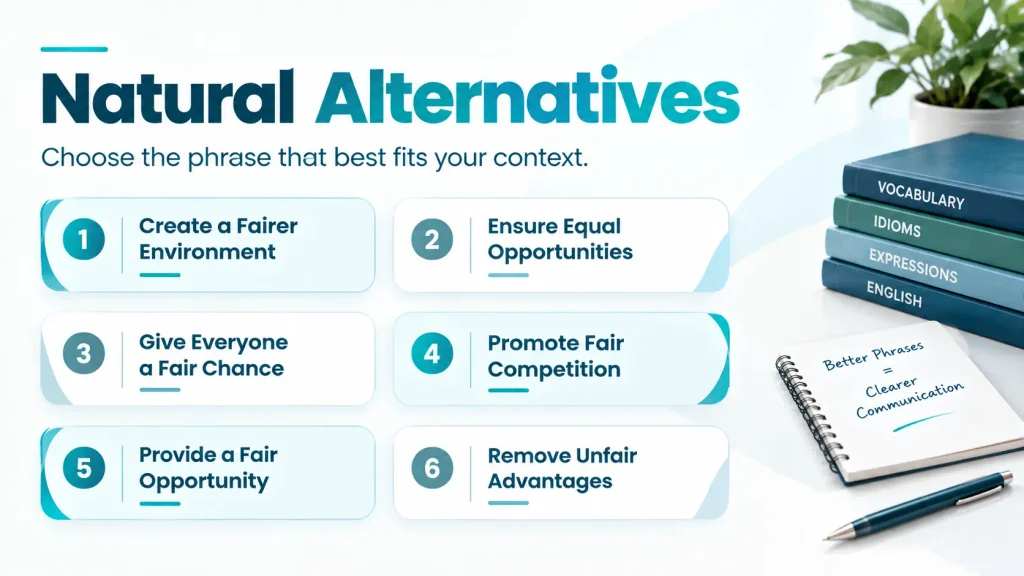
10 Natural Alternatives to “Level the Playing Field”
1. Create a Fairer Environment
This is a flexible alternative that works well when you want to focus on fairness rather than direct competition.
Best for: Professional, formal, and general writing
Example:
The program was designed to create a fairer environment for all students.
This option is especially useful when the situation involves people with different starting conditions.
2. Ensure Equal Opportunities
“Ensure equal opportunities” emphasizes giving people the same opportunities to succeed.
Best for: Workplace, education, policy, and formal writing
Example:
The company is taking steps to ensure equal opportunities for all employees.
This phrase is a good choice when the main issue is access rather than competition.
3. Give Everyone a Fair Chance
This is one of the most natural conversational alternatives.
Best for: Everyday English, speeches, and general writing
Example:
The new rules give everyone a fair chance to compete.
It has a friendly and straightforward tone, so it works well when you want your writing to sound less formal.
4. Promote Fair Competition
Use this phrase when the original expression specifically refers to competitors.
Best for: Business, sports, economics, and professional writing
Example:
The regulations are intended to promote fair competition among companies.
Unlike “create a fairer environment,” this phrase clearly keeps the idea of competition.
5. Make the Competition More Equal
This is a direct and easy-to-understand alternative.
Best for: General and conversational writing
Example:
The changes could make the competition more equal for smaller companies.
It is less idiomatic than “level the playing field,” but its meaning is very clear.
6. Provide a Fair Opportunity
“Provide a fair opportunity” focuses on access to a reasonable chance of success.
Best for: Professional, academic, and formal writing
Example:
The scholarship program provides a fair opportunity for students from different backgrounds.
This works particularly well when discussing education, employment, funding, or access.
7. Reduce the Advantage Gap
This phrase highlights the difference between groups that have different levels of advantage.
Best for: Analytical and professional contexts
Example:
The initiative aims to reduce the advantage gap between large and small businesses.
Use this option when the focus is on reducing an existing imbalance.
8. Promote a More Equal Playing Environment
This alternative keeps the basic idea of the original idiom while making the wording more explicit.
Best for: Formal and explanatory writing
Example:
The policy was introduced to promote a more equal playing environment for all participants.
It can work when discussing competition, although “create a fairer environment” is usually more natural in everyday American English.
9. Remove Unfair Advantages
This phrase is useful when one group has a specific advantage that others do not have.
Best for: Business, policy, competition, and formal discussions
Example:
The rule change is intended to remove unfair advantages in the hiring process.
This wording is more direct than “level the playing field” because it identifies the source of the imbalance.
10. Make the Situation Fairer for Everyone
This is a plain-English paraphrase that works in many contexts.
Best for: General, conversational, and explanatory writing
Example:
The new system could make the situation fairer for everyone.
It does not preserve the competitive image of the original idiom, but it clearly communicates the central idea.
Which Alternative Should You Use?
The right choice depends on what you want to emphasize.
| Alternative | Main Focus | Tone | Best Context |
| Create a fairer environment | Overall fairness | Neutral | General and professional |
| Ensure equal opportunities | Equal access | Formal | Work, education, policy |
| Give everyone a fair chance | Opportunity | Conversational | Everyday English |
| Promote fair competition | Competition | Professional | Business and sports |
| Make the competition more equal | Equal competition | Neutral | General |
| Provide a fair opportunity | Access and opportunity | Formal | Academic and professional |
| Reduce the advantage gap | Existing imbalance | Analytical | Business and policy |
| Promote a more equal playing environment | Fair competition | Formal | Competitive settings |
| Remove unfair advantages | Specific disadvantages | Direct | Policy and business |
| Make the situation fairer for everyone | General fairness | Neutral | Everyday and explanatory writing |
“Level the Playing Field” vs. “Give Everyone a Fair Chance”
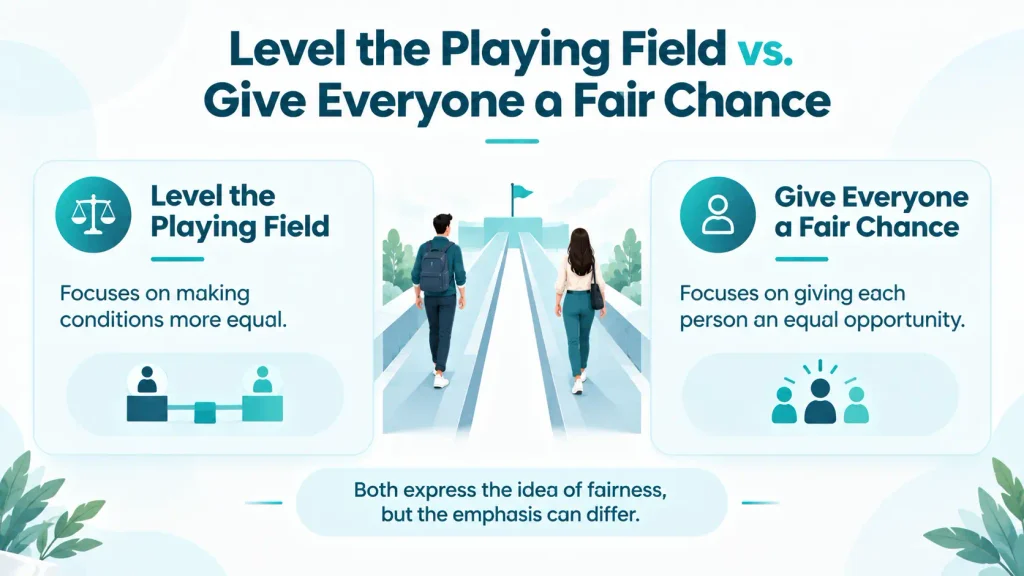
These expressions are close, but they are not always interchangeable.
“Level the playing field” usually suggests changing the conditions so that people or groups have a more equal starting point.
“Give everyone a fair chance” focuses more on the opportunity to succeed.
For example:
The scholarship helps level the playing field for students from low-income families.
This suggests that the scholarship addresses an existing difference in resources.
The scholarship gives everyone a fair chance to attend college.
This focuses on the opportunity created by the scholarship.
When to Use a More Formal Alternative

The idiom “level the playing field” is perfectly normal in American English, but you may want a more formal expression in professional or academic writing.
Consider:
- “Ensure equal opportunities”
- “Provide a fair opportunity”
- “Create a fairer environment”
- “Promote fair competition”
- “Remove unfair advantages”
For example, instead of:
The policy aims to level the playing field for smaller companies.
A formal version could be:
The policy aims to promote fair competition for smaller companies.
Or:
The policy aims to reduce existing disadvantages for smaller companies.
The best choice depends on exactly what the policy is designed to change.
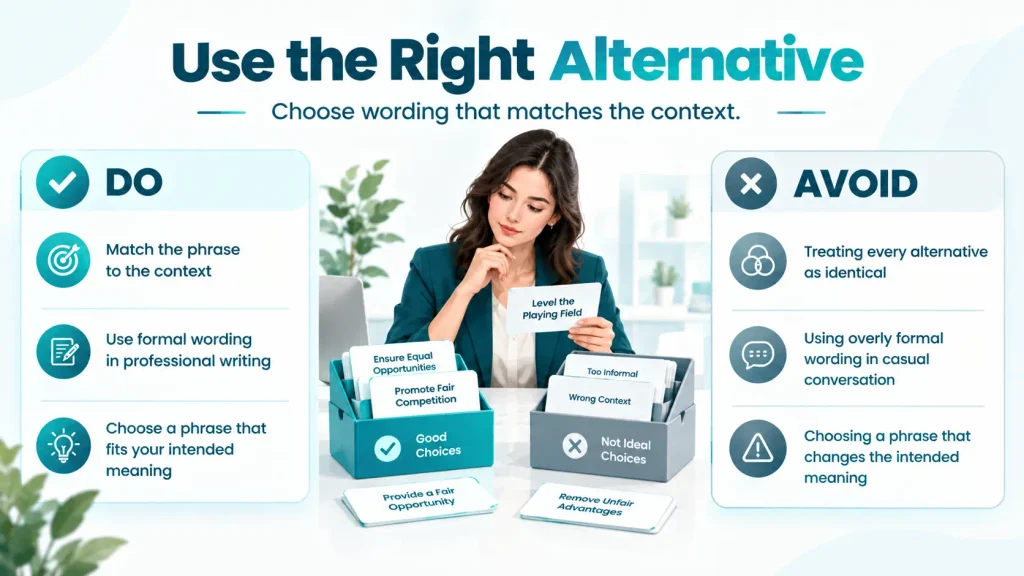
Common Mistakes to Avoid
Using “equal” when you mean “fair”
Fairness and equality are related, but they are not always identical.
“Equal opportunities” means people have the same opportunities. “Fair” can be broader and may involve addressing disadvantages that prevent people from competing on similar terms.
Using “remove unfair advantages” in every situation
This phrase suggests that a particular unfair advantage exists and needs to be removed. It may sound too strong if you simply want to describe a general effort to improve fairness.
Replacing the idiom with overly formal language
“Level the playing field” is already standard American English. You do not need to replace it just because it is an idiom.
If the sentence is for a casual conversation, “give everyone a fair chance” may sound more natural than “ensure equal opportunities.”
Forgetting the competitive meaning
Some alternatives, such as “make the situation fairer for everyone,” are broader than the original phrase.
If competition is central to your sentence, “promote fair competition” may preserve the original meaning more accurately.
Frequently Asked Questions
What is another way to say “level the playing field”?
You can say “create a fairer environment,” “ensure equal opportunities,” “give everyone a fair chance,” “promote fair competition,” or “remove unfair advantages,” depending on the context.
Is “level the playing field” formal or informal?
It is a common English idiom that can be used in both professional and everyday contexts. In highly formal or academic writing, a direct phrase such as “ensure equal opportunities” may sometimes be more appropriate.
What is a professional way to say “level the playing field”?
“Ensure equal opportunities,” “promote fair competition,” and “create a fairer environment” are useful professional alternatives.
What is a simple way to say “level the playing field”?
“Give everyone a fair chance” is a simple and natural alternative.
Does “level the playing field” mean equality?
It generally means making conditions fairer so that people or groups have a more equal opportunity to compete or succeed. It does not necessarily mean making every person or group identical in resources or outcomes.
Can I use “level the playing field” in a business context?
Yes. The expression is commonly used when discussing competition between companies, access to markets, hiring, pricing, regulations, and business opportunities.
What is the opposite of “level the playing field”?
Depending on the context, the opposite could be “create an unfair advantage,” “widen the gap,” “increase inequality,” or “give one side an advantage.”
Conclusion
“Level the playing field” is a natural American English idiom for making conditions fairer between people or groups. If you want a direct alternative, “create a fairer environment” is flexible. For professional writing, “ensure equal opportunities” or “promote fair competition” may work better. For everyday conversation, “give everyone a fair chance” is simple and natural.

Role: Author & Editorial Specialist
Sophia Williams serves as an Author at Elite’s Collective, bringing strong communication skills and fresh perspectives to the team through high-quality written content.