

If you’re looking for another way to say trial and error, the best choice depends on what you want to emphasize. Natural alternatives include experimentation, testing, iterative problem-solving, learning by doing, testing and refining, and an empirical approach. Some expressions, such as hit-or-miss, describe a similar process but suggest less planning or consistency.
Key Takeaways
- Experimentation is a strong choice for scientific, technical, and professional writing.
- Testing works well when different methods, products, or solutions are being evaluated.
- Testing and refining emphasizes repeated improvement rather than simple mistakes.
- Learning by doing focuses on gaining knowledge through practical experience.
- Hit-or-miss is more casual and suggests an uncertain or inconsistent approach.
- Not every phrase associated with trial and error is a true synonym, so context matters.
What Does “Trial and Error” Mean?
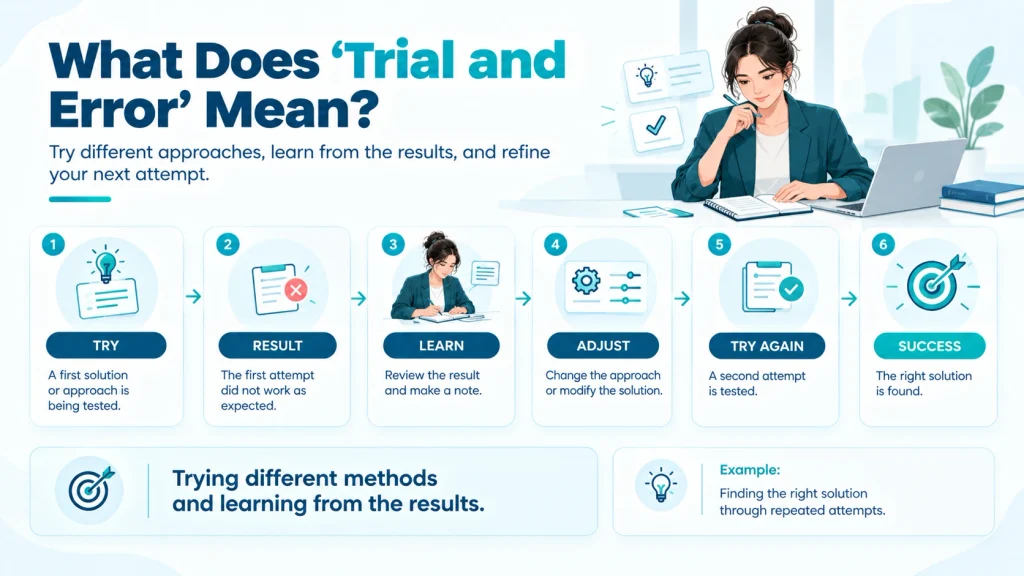
Trial and error is a way of solving a problem or reaching a goal by trying different methods, learning from mistakes, and continuing until you find an approach that works. Cambridge defines it as trying different methods and learning from the mistakes you make, while Collins describes it as making repeated trials or tests and improving methods based on errors.
For example:
We found the right formula through trial and error.
The phrase is neutral and common in American English. It can describe everything from learning a new skill to solving a technical problem.
12 Other Ways to Say “Trial and Error”
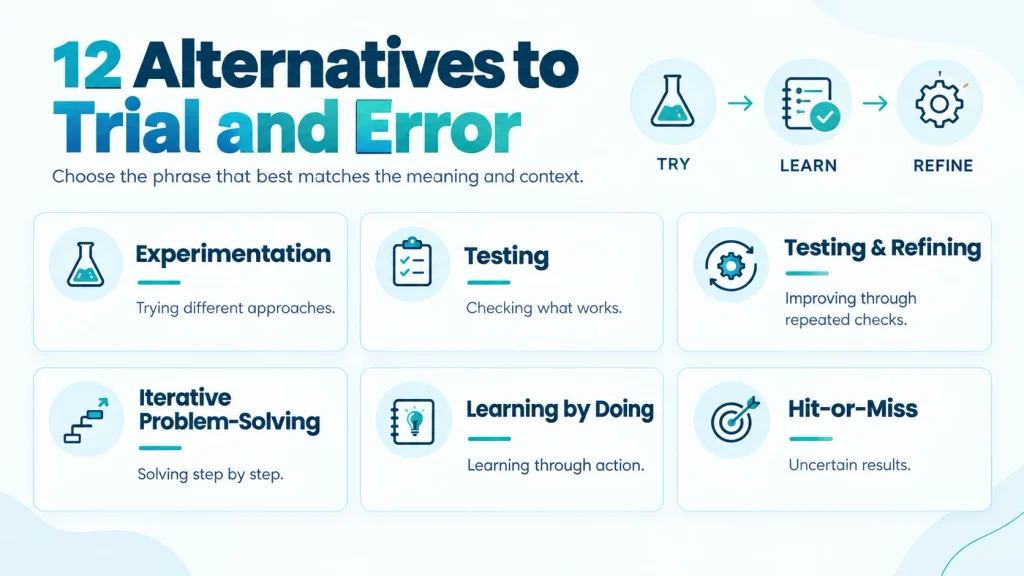
1. Experimentation
Experimentation is one of the closest alternatives when you mean trying different methods to discover what works.
Best for: Scientific, technical, academic, and professional contexts.
Example:
The team used experimentation to determine which design performed best.
Usage tip: “Experimentation” can sound more deliberate and systematic than “trial and error.”
2. Testing
Testing works when you are evaluating different options, methods, products, or solutions to determine which one works.
Best for: Technology, business, engineering, education, and everyday situations.
Example:
We found the most effective layout through extensive testing.
Usage tip: “Testing” does not always imply that mistakes are involved, so it is broader than “trial and error.”
3. Testing and Refining
Testing and refining emphasizes trying something, identifying what needs improvement, and making changes.
Best for: Professional, technical, creative, and project-based writing.
Example:
The designer improved the prototype through repeated testing and refining.
Usage tip: This phrase is useful when the process involves gradual improvement rather than simply trying random options.
4. Iterative Problem-Solving
Iterative problem-solving describes solving a problem through repeated attempts, evaluation, and adjustment.
Best for: Business, technology, engineering, software development, and academic writing.
Example:
The team used iterative problem-solving to improve the software’s performance.
Usage tip: This is more formal and structured than “trial and error.” Use it when the process is intentional and repeated.
5. Learning by Doing
Learning by doing focuses on gaining knowledge or skill through practical experience rather than relying only on theory.
Best for: Education, skills, hobbies, training, and personal development.
Example:
I learned basic woodworking by doing it rather than simply reading about it.
Usage tip: This is related to trial and error, but the emphasis is on learning through action rather than finding a solution through repeated attempts.
6. An Empirical Approach
An empirical approach refers to using observation, experience, testing, or evidence to determine what works.
Best for: Academic, scientific, research, and professional writing.
Example:
The researchers used an empirical approach to evaluate the two methods.
Usage tip: This is more formal than “trial and error” and does not necessarily involve mistakes or failed attempts.
7. Repeated Testing
Repeated testing is a straightforward alternative when a method is tried multiple times to evaluate or improve the result.
Best for: Technical, scientific, workplace, and instructional contexts.
Example:
The product was improved through repeated testing under different conditions.
Usage tip: Use this when repetition is the main idea you want to highlight.
8. Test and Adjust
Test and adjust describes trying an approach, examining the result, and changing it when necessary.
Best for: Practical instructions, workplace communication, design, and problem-solving.
Example:
You may need to test and adjust the settings until the system works properly.
Usage tip: This phrase sounds practical and direct. It is especially useful when describing an ongoing process.
9. Experimenting and Refining
Experimenting and refining highlights the process of trying possibilities and gradually improving the result.
Best for: Design, writing, product development, cooking, creative work, and technical projects.
Example:
The chef spent several weeks experimenting and refining the recipe.
Usage tip: This is a good choice when the process involves creativity and gradual improvement.
10. Process of Elimination
Process of elimination means ruling out unsuitable possibilities until the remaining option is identified.
Best for: Problem-solving, troubleshooting, multiple-choice questions, diagnosis, and decision-making.
Example:
Through a process of elimination, we identified the source of the problem.
Usage tip: This is related to trial and error but is not an exact synonym. It emphasizes removing incorrect possibilities rather than repeatedly trying methods.
11. Hit-or-Miss
Hit-or-miss describes an approach that produces uncertain or inconsistent results.
Best for: Casual and conversational English.
Example:
Finding a reliable repair service online can sometimes be hit-or-miss.
Usage tip: This phrase can carry a negative or critical tone because it suggests that success is unpredictable. It is not a good replacement when you want to describe a careful, systematic process.
12. Cut and Try
Cut and try refers to making repeated adjustments or attempts until an acceptable result is achieved.
Best for: Practical or technical contexts where something is repeatedly adjusted.
Example:
The design was developed through a cut-and-try process.
Usage tip: This expression is less common in everyday American English than “trial and error,” so it is usually better to choose a more familiar alternative unless the context specifically calls for it.
Which Alternative Should You Use?
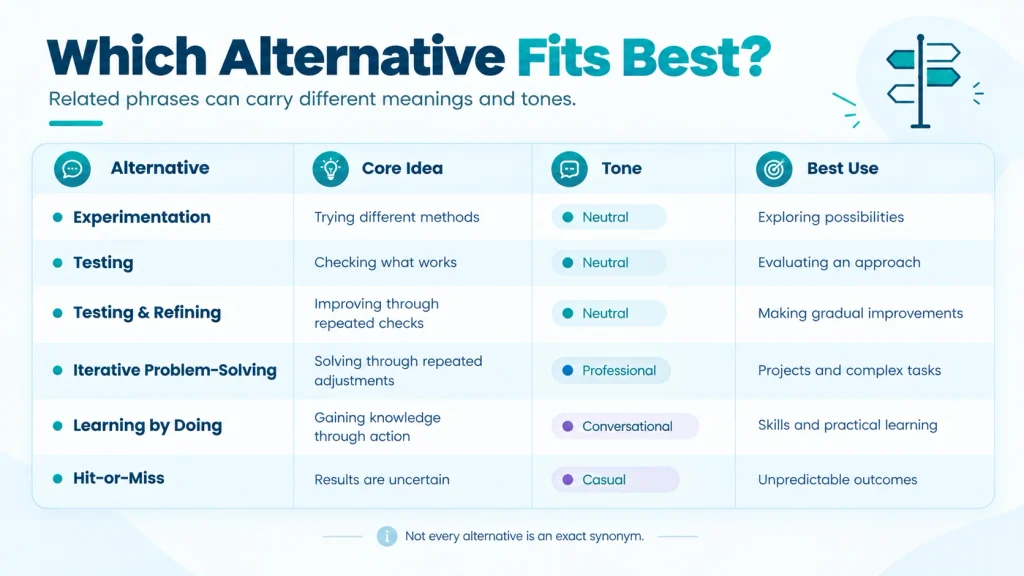
The right replacement depends on the meaning and tone you need.
| Alternative | Main Meaning | Tone | Best Context |
|---|---|---|---|
| Experimentation | Trying methods to discover what works | Neutral/Formal | Science, research, work |
| Testing | Evaluating different options | Neutral | Business, technology, everyday use |
| Testing and refining | Improving through repeated evaluation | Professional | Design, projects |
| Iterative problem-solving | Repeatedly solving and adjusting | Formal | Technology, engineering |
| Learning by doing | Gaining knowledge through practice | Neutral | Education, skills |
| An empirical approach | Relying on observation and evidence | Formal | Academic, scientific |
| Repeated testing | Testing something multiple times | Neutral | Technical, professional |
| Test and adjust | Trying and changing as needed | Direct | Practical instructions |
| Experimenting and refining | Trying and improving | Neutral | Creative, technical |
| Process of elimination | Removing unsuitable options | Neutral/Formal | Troubleshooting |
| Hit-or-miss | Uncertain or inconsistent results | Casual | Conversation |
| Cut and try | Repeated practical adjustments | Technical/less common | Practical work |
“Trial and Error” vs. “Experimentation”
These expressions are closely related, but they are not identical.
Trial and error usually emphasizes trying different approaches and learning from mistakes. Experimentation is broader and can suggest a more deliberate process of testing ideas or methods.
Compare:
- We solved the problem through trial and error.
- We used experimentation to determine which method was most effective.
The first sentence highlights the process of trying and learning from unsuccessful attempts. The second focuses more on systematic investigation.
“Trial and Error” vs. “Testing”
Testing is another broad alternative, but it does not necessarily involve failure.
For example:
The developers conducted testing before releasing the update.
This tells us that the software was evaluated. It does not necessarily mean the developers repeatedly failed and changed their approach.
By contrast:
The developers solved the issue through trial and error.
This suggests that they tried different approaches and learned from unsuccessful attempts.
“Trial and Error” vs. “Hit-or-Miss”
These phrases can describe uncertain methods, but their tone is different.
Trial and error is generally neutral. It describes a normal process of finding a solution through repeated attempts.
Hit-or-miss suggests that the results are unpredictable or inconsistent.
For example:
Learning to play the guitar involved some trial and error.
This simply describes the learning process.
The quality of the repair service was hit-or-miss.
Here, “hit-or-miss” suggests that the service was unreliable.
Professional Ways to Say “Trial and Error”
If you’re writing a report, email, academic paper, or workplace document, some alternatives sound more precise than the casual phrase “trial and error.”
Consider:
- Experimentation
- Iterative testing
- Repeated testing
- Testing and refinement
- Iterative problem-solving
- An empirical approach
- Systematic evaluation
For example:
Casual:
We figured it out through trial and error.
More professional:
We identified the most effective approach through iterative testing and refinement.
The second version is useful when you want to emphasize a structured process rather than mistakes.
Common Mistakes When Replacing “Trial and Error”
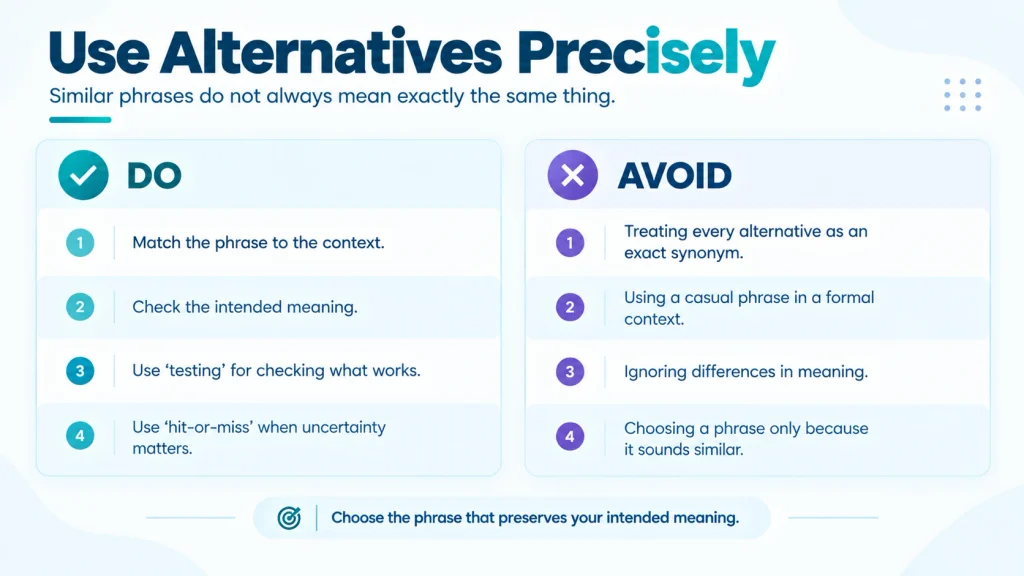
Treating every related phrase as an exact synonym
“Process of elimination” and “learning by doing” are related to trial and error, but they emphasize different parts of the process.
Choose the phrase that matches the specific idea you want to express.
Using “hit-or-miss” in formal writing
“Hit-or-miss” is natural in conversation, but it can sound too casual or negative in a formal report.
Use testing, experimentation, or iterative testing when appropriate.
Using “experimentation” when you mean simple practice
If someone is learning a skill through hands-on practice, learning by doing may communicate the idea more accurately than “experimentation.”
Assuming “testing” always means trial and error
Testing can be planned and systematic. It does not automatically suggest repeated mistakes or failed attempts.
Frequently Asked Questions
What is the closest synonym for “trial and error”?
Experimentation is one of the closest alternatives, especially when you mean trying different methods to discover what works. However, “trial and error” specifically highlights repeated attempts and learning from mistakes, so the two phrases are not identical in every context.
What is a professional way to say “trial and error”?
Depending on the context, you can use experimentation, iterative testing, testing and refinement, repeated testing, or iterative problem-solving. These options can sound more precise in professional and technical writing.
Is “hit-or-miss” the same as “trial and error”?
Not exactly. Both can involve uncertainty, but “hit-or-miss” emphasizes inconsistent or unpredictable results. “Trial and error” focuses on trying different methods and learning from mistakes.
Can I use “experimentation” instead of “trial and error”?
Often, yes. “Experimentation” is especially appropriate when you are deliberately testing different methods or ideas. It can sound more systematic than “trial and error.”
What is another way to say “trial and error method”?
You could say experimental method, iterative approach, iterative problem-solving, testing and refinement, repeated testing, or empirical approach, depending on the context.
What is a simple way to say “trial and error”?
For everyday English, trying different things until something works is a clear and natural explanation.
Is “process of elimination” a synonym for “trial and error”?
It is a related expression, but not a direct synonym. A process of elimination focuses on ruling out possibilities, while trial and error involves trying different methods and learning from the results.
Final Thoughts
The best alternative to trial and error depends on what you want to emphasize. Use experimentation for investigation, testing for evaluation, testing and refining for improvement, and learning by doing for practical experience. For formal writing, iterative problem-solving or iterative testing can provide a more precise description of a structured process.
If you simply mean trying different approaches until you find one that works, trial and error itself remains a clear and natural phrase in American English.

Role: Lead Author & Content Specialist
James Mitchell is an experienced Lead Author at Elite’s Collective. He specializes in creating high-impact editorial content and driving core written projects designed to inform and engage readers.